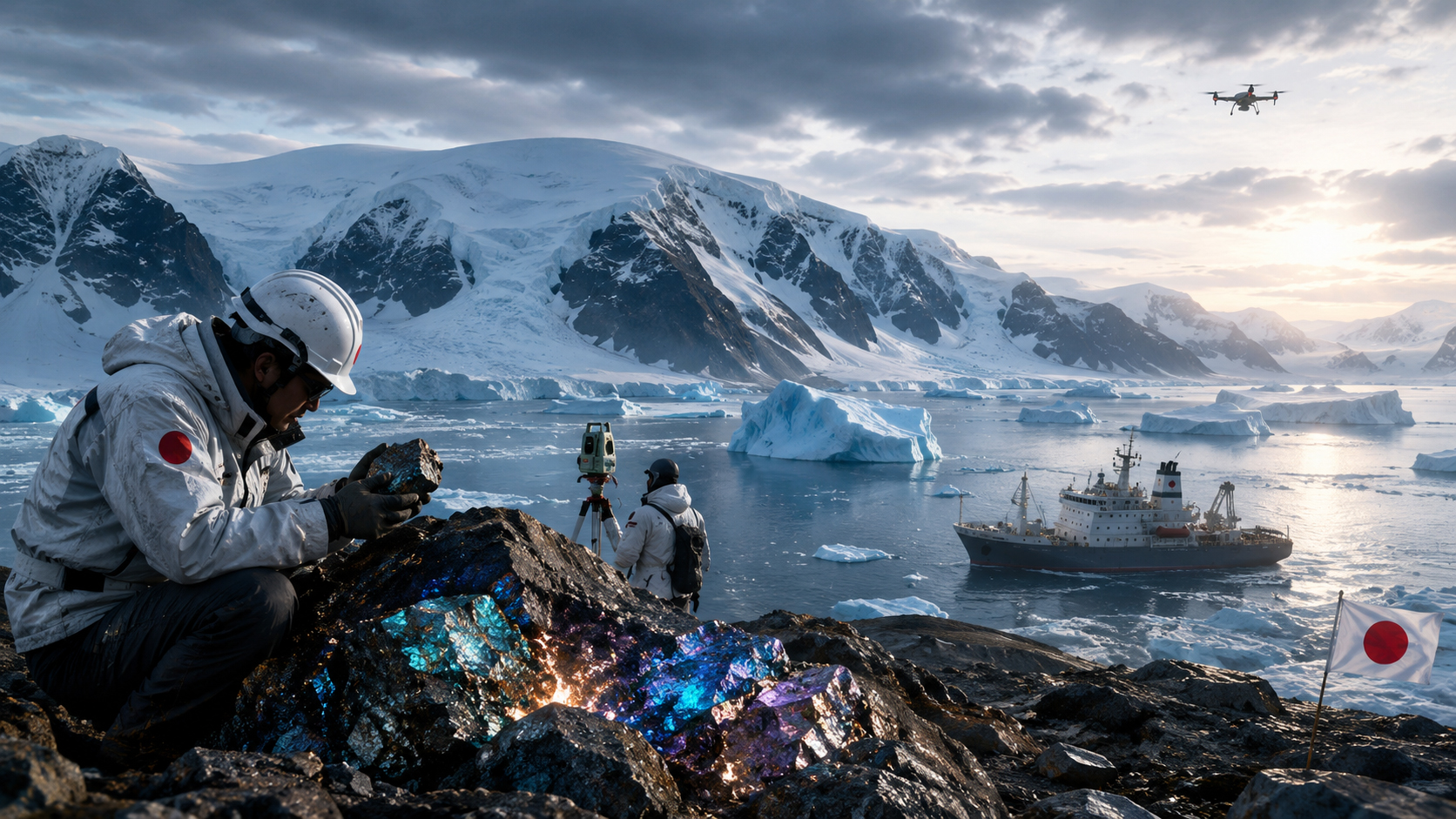
Greenland is far from Tokyo. That is exactly why it matters. For Japan, rare earths are not an abstract line in a commodities table. They are inside electric-vehicle motors, factory robots, wind turbines, semiconductor tools, sensors, guidance systems and the permanent magnets that make modern machines smaller, lighter and stronger. Since the 2010 rare-earth shock, Japan has known that a single weak link in the minerals chain can become a national vulnerability.
In June 2026, Japan was reported to be preparing a delegation to Greenland to evaluate rare-earth extraction potential. The group is expected to include officials from the Ministry of Economy, Trade and Industry, trading houses and JOGMEC, Japan’s metals and energy security agency. The trip is not simply a mining reconnaissance. It is a question: can Japan help build a non-Chinese rare-earth supply chain that actually works from rock to refined material to magnet?
Greenland is not a treasure island. It is a hard island.
To outsiders, Greenland can look like a blank space on the resource map: ice, rock, fjords and untapped minerals. To Greenlanders, it is home, politics, environment and self-government. Minerals may be present, but a mine requires far more than geology. It needs ports, roads, power, workers, local acceptance, waste management, environmental monitoring, financing, long-term buyers and a realistic processing route.
Rare earths are especially complicated. They are not difficult because they are always geologically scarce. They are difficult because useful elements must be separated from complex ores, often in the presence of radioactive materials, wastewater challenges and costly chemical processing. China’s dominance rests not only on mining. It rests on decades of separation, refining, metal-making and magnet production experience.
The memory of 2010
Japan’s rare-earth strategy begins with a memory. In 2010, after a collision near the Senkaku Islands between a Chinese fishing vessel and Japanese Coast Guard ships, rare-earth shipments to Japan were disrupted. The official explanations were contested, but the lesson for industry was clear. One material bottleneck could threaten entire manufacturing systems.
Japan responded with unusual discipline. It diversified supply, supported Australia’s Lynas, invested in substitutes and recycling, built stockpiles and used trade rules. China’s share of Japan’s rare-earth imports fell substantially from the near-total dependence Japan faced at the time. But the problem did not disappear. China retained overwhelming influence in midstream and downstream stages, especially in separation and high-performance magnets.
Why the Arctic now?
Greenland sits at the intersection of minerals, climate, shipping and security. It is an autonomous territory within the Kingdom of Denmark, a vast Arctic island, and a place watched closely by the United States, Europe, China, Russia and Canada. As ice retreats and the Arctic draws more attention, Greenland’s strategic value rises.
Japan is not an Arctic state. But it is a resource-poor industrial power whose factories depend on secure seaborne trade and trusted alliances. Interest in Greenland allows Tokyo to connect resource security with cooperation among the United States, Europe and other partners. The question is whether that interest can be turned into a supply chain that respects Greenland’s own politics and environmental concerns.
Kvanefjeld: the giant deposit with a uranium problem
Kvanefjeld in southern Greenland is often described as one of the world’s most significant rare-earth deposits. Yet it is also a political warning. The deposit is associated with uranium, and local concerns over radioactive waste, drinking water, farming and marine life have shaped the debate. Greenland’s parliament passed legislation in 2021 banning uranium mining and limiting uranium content in mined resources, effectively stalling the project and triggering legal disputes.
For Japan, Kvanefjeld offers a lesson. Resource security cannot be built by ignoring the people who live above the resource. Any Japanese role in Greenland would need to address environmental standards, waste management, local employment, transparency and long-term responsibility. A supply chain created in the name of resilience will not last if it leaves distrust behind.


Tanbreez: the attraction of heavy rare earths
Tanbreez is the other name driving interest. Analysts describe it as a major heavy-rare-earth deposit. Heavy rare earths are especially valuable because they are used in heat-resistant magnets and advanced defense, aerospace and electrification applications. These are the materials most difficult to replace and among the areas where China’s dominance is most strategically important.
In May 2026, Critical Metals announced a 15-year offtake deal covering concentrate from the Tanbreez project. The agreement showed that Greenland’s rare-earth story is moving from geology toward commercial architecture. But an offtake contract is not a mine. Development still requires permits, environmental compliance, closure planning, capital, infrastructure, processing capacity and local legitimacy.
Japan’s strength is patient capital
Japan’s biggest advantage in rare earths is not geology. It is institutional patience. Trading houses, manufacturers, state-backed finance, JOGMEC and research agencies can work together over long periods. They can support projects through price cycles, share risk, develop substitutes, combine stockpiling with investment and connect miners to downstream users.
The Lynas example remains important. After 2010, Japan helped support a non-Chinese rare-earth producer in Australia. It did not produce total independence, but it expanded choice. Greenland would require the same philosophy on a more difficult field: reconnaissance, testing, environmental cooperation, small offtakes, processing partnerships, transport logistics, insurance and long-term purchase commitments.
The hard part is not digging. It is separating.
Rare-earth security is not solved when ore leaves the ground. The strategic bottleneck is the midstream: separation, refining, metal-making, alloy production and magnet manufacturing. If Greenlandic concentrate were mined but then processed through China, the dependency would simply move one step downstream.
That is why Japan’s real challenge is to link Greenland with processing in Europe, North America, Australia or Japan itself. Those facilities are difficult to build under modern environmental rules. They require chemical expertise, waste handling, reliable power, skilled workers, permits and local acceptance. But without them, a “non-Chinese” supply chain remains incomplete.
The United States, Europe and Japan
In 2025, the United States and Japan announced a framework to secure critical minerals and rare earths through mining and processing cooperation. Europe is also seeking resilient supply chains for clean technology and defense. Their interests overlap: the United States wants defense and aerospace security; Europe wants electrification and industrial resilience; Japan wants to protect automotive, robotics, electronics, battery and semiconductor supply chains.
If Japan becomes involved in Greenland, it will likely be as part of this broader allied effort. But there is a danger. Greenland should not be treated merely as a chessboard in a great-power contest. It has its own self-government, communities, environmental priorities and economic ambitions. A durable partnership must speak to Greenlandic development, not only to outsiders’ China-risk anxieties.
- Do Greenland’s deposits contain the heavy rare earths Japan’s industries actually need?
- Can uranium and thorium risks be handled in a way local communities trust?
- Where will concentrate be separated and refined, and who carries environmental responsibility?
- Will long-term contracts and public finance survive a downturn in rare-earth prices?
- How will Greenland benefit through jobs, training, infrastructure and revenue?
The deep-sea alternative
Japan is also looking closer to home, including rare-earth mud near Minamitorishima in the Pacific. Deep-sea extraction from roughly 6,000 meters would be technologically ambitious and strategically transformative if it works at scale. Yet it carries its own uncertainties: environmental impact, equipment reliability, extraction cost and commercial throughput.
Greenland is different. It is land-based, but Arctic. Its challenges are not depth but climate, infrastructure, consent and politics. Japan is therefore pursuing multiple imperfect options: Australia, Southeast Asia, the United States, Europe, recycling, substitutes, stockpiles, deep sea and now Greenland. Supply-chain security is not one big solution. It is many partial solutions layered together.
Greenland is not a shortcut
Japan’s interest in Greenland is strategically logical, but it is not a shortcut. Large deposits do not automatically become secure supply. Between a promising ore body and a Japanese factory lie permitting, environmental trust, financing, transport, processing, price cycles and geopolitics. The timeline is measured in years, often decades.
Still, going matters. Japan learned in 2010 that waiting for a crisis is too late. In 2026, the lesson is broader: supply security must be designed before the next shock. That means not only finding mines, but building the processing, finance, legal and diplomatic architecture around them.
From Arctic rock to Japanese industry
No one yet knows when Greenlandic rare earths might enter Japanese motors, factory robots, semiconductor equipment or defense systems. It may take far longer than headlines suggest. But the direction of travel is clear. Raw materials are no longer only a procurement issue. They are a matter of trust, alliance, environmental governance, industrial capacity and national strategy.
Japan’s Greenland mission is a journey to find resources. More importantly, it is a journey to find a design for reducing dependency. The metals under Greenland’s ice matter. But the harder question is who extracts them, who processes them, who benefits, who bears the environmental burden and who can keep the chain alive when geopolitics turns cold.
Sources and further reading
This Japan.co.jp report was prepared from wire reporting, policy research, public documents and company announcements.
- Reuters: Japan to send delegation to Greenland to evaluate rare earth extraction
- CSIS: Greenland, Rare Earths, and Arctic Security
- Reuters: Critical Metals inks 15-year Greenland rare earth deal with REalloys
- East Asia Forum: Lessons from Japan’s rare earth shock
- CSIS: China’s Rare Earth Campaign Against Japan
- Atlantic Council: Greenland’s critical minerals require patient statecraft
- United States-Japan framework for critical minerals and rare earths
- Wood Mackenzie: Greenland rare earth sector faces multi-year development delays