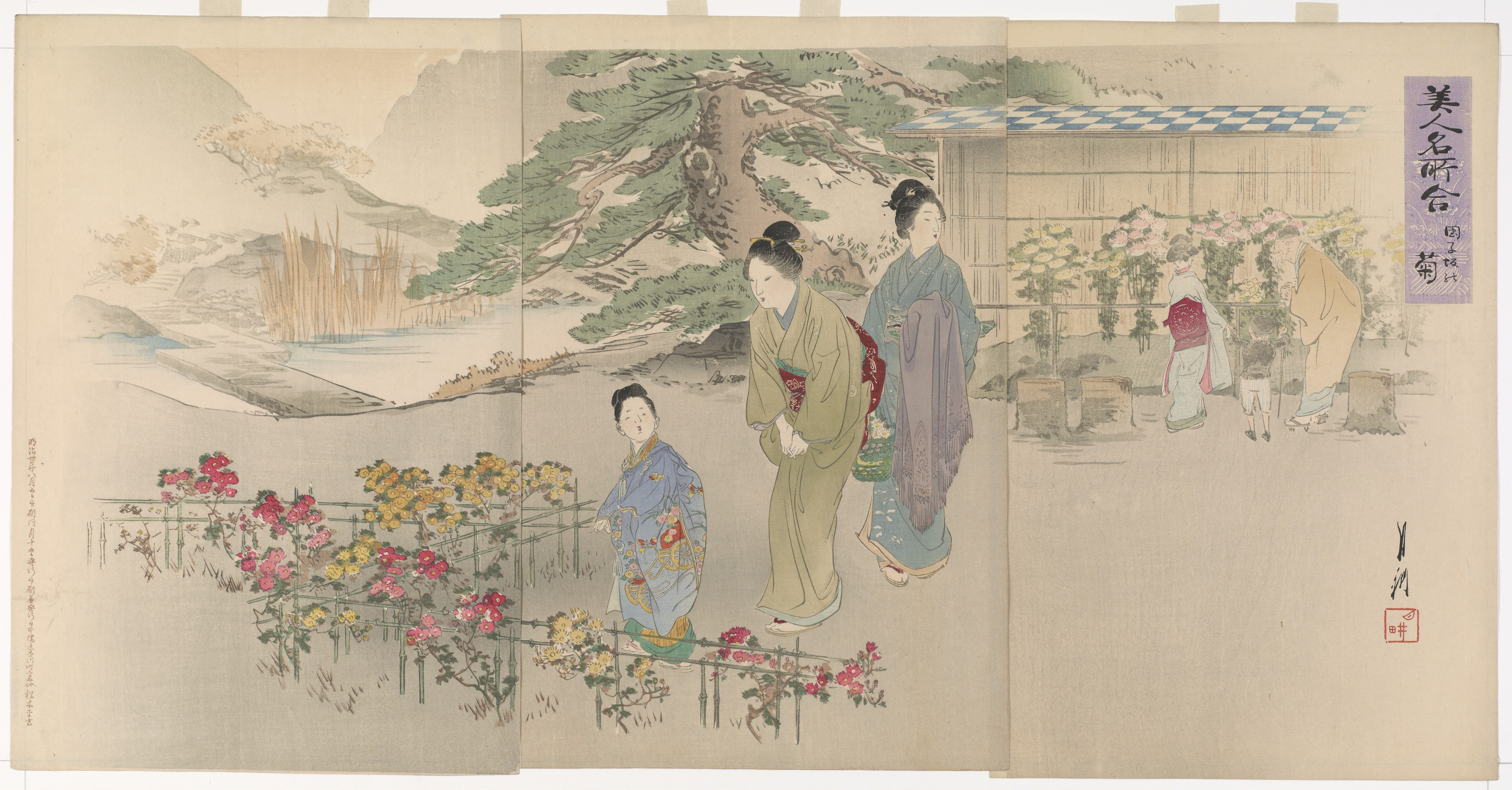
This is more than a picture of flowers. It is a portrait of a city learning how to entertain itself.
A lost autumn attraction, preserved on paper
In late-nineteenth-century Tokyo, the approach to Dango-zaka in today’s Sendagi district became an autumn destination. Crowds came to see chrysanthemums transformed into elaborate displays, including life-sized figures whose clothing was made of living flowers. One image of that world survived in an American museum collection: Ogata Gekkō’s 1897 woodblock triptych, commonly titled *Chrysanthemums at Dango Zaka*.
The print rewards a closer look because it records more than flowers. It offers a glimpse of an emerging mass-leisure economy: visitors, seasonal entertainment, horticultural labor, commercial illustration and the rapidly changing city that connected them.
What exactly is the work?
The Smithsonian National Museum of Asian Art catalogs *Chrysanthemums at Dango Zaka* as a Japanese woodblock print by Ogata Gekkō (1859–1920), accession S2003.8.1763, in the Robert O. Muller Collection. Its image measures 35.9 by 72.4 centimeters and is composed as a triptych. The object is not currently on view, according to its collection record.
The fuller Japanese title is *Bijin meisho awase: Dangozaka no kiku* (美人名所合 団子坂の菊), as documented by the Nakagawa-machi Bato Hiroshige Museum of Art and the Ota Memorial Museum of Art. That series title matters: Gekkō was matching fashionable human figures and celebrated locations, inviting viewers to see seasonal Tokyo through both place and presence.
The flower figures behind the spectacle
Bunkyo City’s local-history museum identifies Dango-zaka as a center of chrysanthemum-figure exhibitions from the end of the Edo period through the Meiji era. Rather than a conventional flower show, its displays included full-size figures depicting theatrical and historical scenes. Sculpted heads, hands and feet were combined with costumes made from chrysanthemum blossoms.
Municipal cultural-history records describe a demanding division of labor: figure makers fashioned the human elements, chrysanthemum specialists assembled the plant-covered structures, and promoters organized the attractions. The flowers had to remain alive throughout an outdoor exhibition. The result was a form of temporary sculpture, gardening and theater combined—spectacular precisely because its medium was perishable.
How an ordinary slope became a destination
Dango-zaka lies in what is now Sendagi, part of Tokyo’s Bunkyo ward. Local authorities say organized ticketed shows gained formal approval in 1876 and peaked during the 1880s and 1890s. The timing of Gekkō’s print, 1897, therefore places it within the attraction’s heyday.
This was urban tourism before mass digital advertising: a seasonal place to visit, talk about and picture. Woodblock images could circulate a recognizable destination beyond the neighborhood itself. But no print is a neutral attendance record. Gekkō composed a persuasive and elegant scene, not a measured plan of the venue; visitor numbers, admission prices on that particular day, and the exact layout cannot be derived from the picture alone.
A painter who crossed old and new Japan
Ogata Gekkō was born in Edo in 1859 and died in 1920. Japan’s National Diet Library describes an artist who largely taught himself, studying predecessors such as Tani Bunchō and Kikuchi Yōsai rather than training within a conventional master’s workshop. Before becoming known for printed illustration, he worked on decorative painting for objects ranging from rickshaws to export ceramics.
His career expanded through newspapers and illustrated books, as well as paintings and color prints. In 1891 he helped establish the Japan Youth Painting Association; later he was associated with the founding of the Japan Art Institute. The Tokushima Modern Art Museum describes an artist engaged with exhibitions and international expositions. Gekkō was thus neither simply the last of an Edo tradition nor fully separate from it. He was a professional adapting Japanese picture-making to new markets and institutions.
The visual intelligence of the triptych
A triptych offers a wide theatrical field without losing the intricacy of printed line. In Gekkō’s *Dango Zaka*, the people looking at the blooms are part of the subject. Their presence gives scale and turns a horticultural display into an event. The attraction is not merely the flower, but the act of collectively visiting it.
Gekkō’s delicate tonal changes suggest brush painting even within the distributed medium of woodblock printing. The composition belongs to a lineage of prints depicting places and people, yet its attention to an ephemeral urban attraction feels decidedly modern. It illustrates how the value of a celebrated location often resides in what people do there, not only what permanently stands there.
Ukiyo-e was also a medium for the present
International audiences often encounter ukiyo-e through landscapes by Hokusai and Hiroshige or images of Edo-period actors. Meiji printmakers, however, also pictured current events, changing fashions, transport, wars, and public entertainment. Their art participated in a fast-moving information economy, even when its conventions remained deliberately stylized.
It would be misleading to call Gekkō’s triptych a photograph or a literal newspaper report. Yet it belonged to a visual world in which pictures helped audiences recognize and desire new experiences. That combination of beauty and circulating information is especially relevant to an online publication seeking to explain Japan through images as well as text.
Why Dango-zaka’s flower shows faded
The local history is unusually clear about the attraction’s ending. In 1909, larger electrically enhanced chrysanthemum-figure productions began at Ryōgoku Kokugikan. Dango-zaka lost ground, and its final chrysanthemum-figure show took place in 1911, according to Bunkyo’s historical museum.
This was not the disappearance of chrysanthemum craft. Its practitioners moved into other regions, and related traditions continued. What changed was the economics and staging of mass entertainment: a neighborhood slope could no longer compete so easily with a large venue and mechanical effects. The 1897 print captures the earlier model at its most recognizable.
The artist abroad: survival and unanswered provenance
The Smithsonian holds the print through the Robert O. Muller Collection, but its online record explicitly says provenance research is underway. That is a meaningful limit. It does not reveal an uninterrupted chain of ownership from the original publisher to the present collection, and it would be speculative to invent one.
A counterpart held by the British Museum is also cataloged as a Meiji-period triptych from the *Bijin meisho awase* series. The existence of prints in major overseas museums underscores the international circulation of Japanese woodblocks, without establishing precisely when or why this particular impression left Japan.
An awkward but important licensing detail
The Smithsonian object record describes its image as CC0 and public domain, stating that it can be copied, modified and distributed without permission. On the same page, an additional “Usage Conditions Apply” notice also appears. Publishers should therefore review the current item-level statement and museum terms rather than treating an automated rights badge as the whole story.
For readers, the object’s identity is unambiguous: artist, title, year, museum and accession number are all available. Crediting those details is good scholarly practice even where copyright attribution is not legally required.
One year, two catalog dates
Both the Smithsonian and British Museum assign the work to 1897, but the detailed dates differ. The Smithsonian specifies August 5, while the British Museum gives October. The accessible records do not establish whether that reflects a printing date, an administrative dating convention, or a cataloging error.
Japan.co.jp therefore uses **1897** as the secure year and does not present a particular day as beyond dispute. An honest art-historical essay must leave room for such small uncertainties. The date of a print is evidence to be evaluated, not a decorative detail to be repeated uncritically.
What remains after the flowers
The living chrysanthemums disappeared every season. The entertainment migrated, changed form, then left Dango-zaka altogether. But Gekkō’s image still lets viewers imagine the shared ritual of going somewhere because a season has briefly made it special.
That is the achievement of *Chrysanthemums at Dango Zaka*. It makes an overlooked chapter in Tokyo’s cultural history accessible through a work of visual pleasure. The triptych is an image of flowers, certainly—but also of spectators, artisans, commercial invention, and the fleeting city that brought them together.