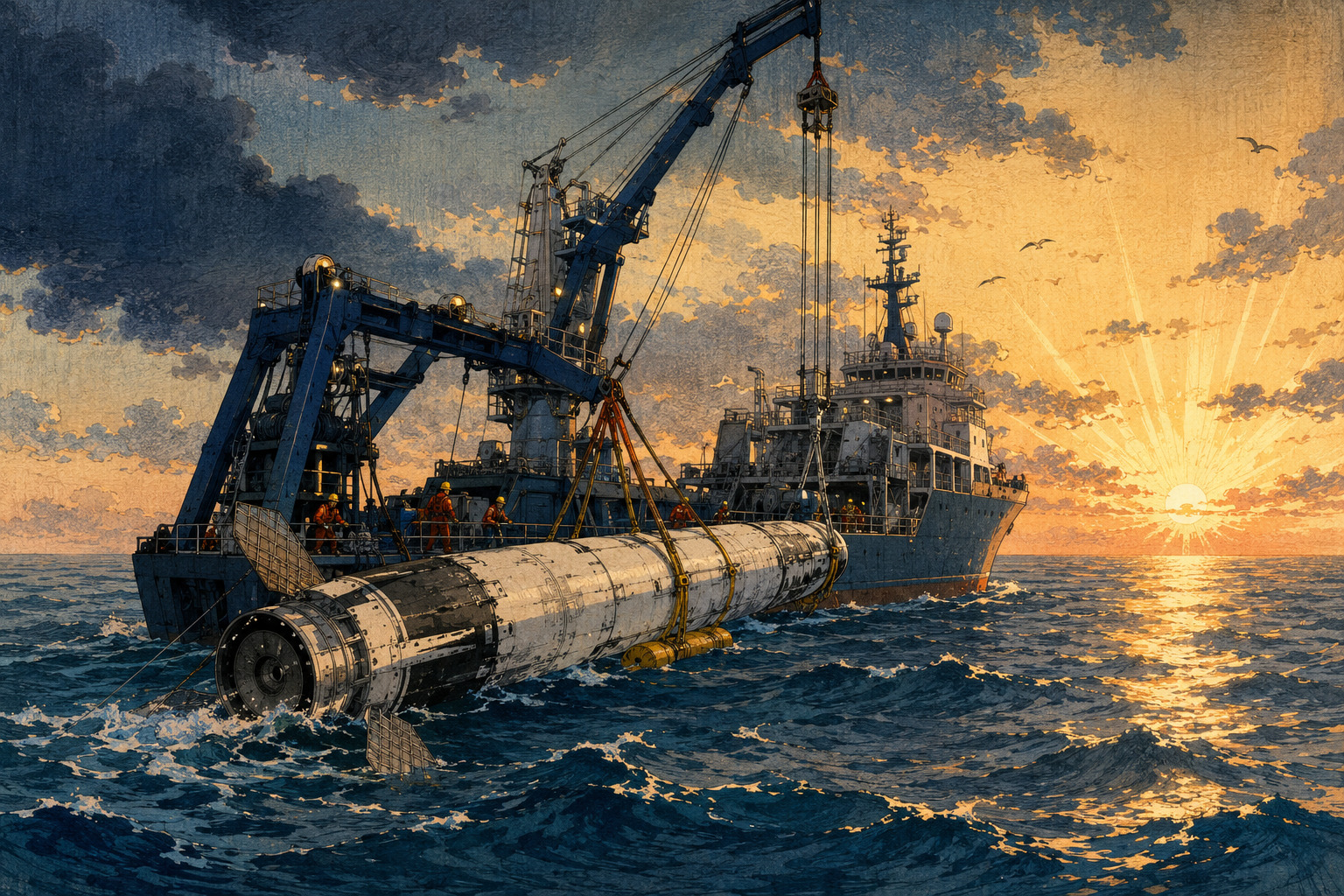
On April 27, the approved object was bigger than a ship
The headline in the three companies’ announcement is a “rocket recovery vessel,” but the system that ABS reviewed in principle is broader. It consists of an unmanned, autonomously operated recovery vessel; another vessel that supports recovery work; and a shore-based control system that monitors and controls both as an integrated operation.
Mitsui O.S.K. Lines, or MOL, says it brought shipping and offshore operating knowledge, safe-navigation expertise and the work of developing the offshore-platform operating concept. Innovative Space Carrier, or ISC, is the space-transport startup developing the ASCA family of reusable launch vehicles. Tsuneishi Solutions Tokyobay—the former Mitsui E&S Shipbuilding—contributed ship and offshore-structure design knowledge. ABS, the classification society, independently reviewed the concept’s safety and technical feasibility.
The most important number here is zero. No vessel name, shipyard order, keel-laying, launch or service date has been announced. This is not news that a recovery ship is complete. It is news that shipping, ship design, reusable rockets and remote operation have been assembled into one safety proposition that a third party considers worthy of further design.
What AiP approves—and what it does not
Approval in Principle is an early assessment used when a concept is novel or existing rules do not neatly cover it. At the conceptual design stage, a classification society examines whether an idea is technically feasible and whether any fundamental safety or regulatory obstacle is evident. The point is to find a dead end before committing full resources to detailed design and construction.
AiP does not replace plan approval, equipment type approval, construction surveys, sea trials, flag registration, a class certificate, a MASS safety certificate, a Japanese launch license or commercial operating permission. It does not demonstrate that a rocket can safely arrive in a stated sea condition, that the communications link will survive, or that the business will make money. MOL’s own wording—that the partners will advance the design and study implementation with technical advice from ABS—marks how much work remains.
Not three vehicles, but three fields of responsibility
| Element | Confirmed role | Questions for detailed design |
|---|---|---|
| Rocket recovery vessel | Conduct offshore recovery while unmanned and autonomously operated | Station-keeping, recovery method, heat, blast and loads, fire protection and safe state after failure |
| Support vessel | Support recovery work | Crew, stand-off distance, towage, firefighting, rescue, inspection and conditions for approach |
| Shore control | Centrally monitor and control both vessels | Authority among master, remote operator and flight control; redundancy, cyber defense and handover |
The announcement does not say whether the support ship is crewed, what equipment it carries, or whether the shore center continuously pilots the vessels, intervenes only on demand or supervises a high level of autonomy. The table’s right-hand column lists engineering and governance questions a safe system would normally have to answer; it does not describe selected specifications.
Even so, the three-part architecture has a clear logic. People can be removed from the center of a hazardous recovery while rescue, towing, firefighting and inspection resources remain nearby on another platform. Shore staff can combine ship position, weather, rocket trajectory, communications and the route home. Each element can be designed to protect life and the sea if another element fails.
The verb hidden inside “recovery” has not been published
Offshore rocket recovery can mean very different operations. A stage may make a powered vertical landing on a deck; descend by parachute to the water and be hoisted aboard; be captured in the air or above the sea; float for later towing; or use a hybrid process. Each verb calls for a different vessel. The April material says “recovery” and “recovery vessel,” but it does not specify landing, catching, lifting or towing as the baseline method.
The 2025 partnership said the parties would study applicability to ISC’s ASCA 1. Because ASCA has been developed as a vertical-takeoff, vertical-landing reusable rocket family, it is tempting to imagine a broad deck for a propulsive landing. An inference must not be turned into a design fact. If the rocket generation, engine, mass, legs or residual propellant changes, the ship’s loads, deck, thermal protection, securing equipment and operating procedure also change.
Nor does recovery end at touchdown or contact. The stage must be kept upright or otherwise secured, residual propellant and pressure made safe, heat and leakage monitored, and the hardware returned before weather deteriorates. Who declares the stage safe to approach—and when—is as consequential as the arrival itself.
Why go downrange to sea instead of back to land?
After accelerating an upper stage, a first stage is already far from the launch point and moving eastward. Returning to the pad requires a reversal and propellant for a boostback burn. Placing an ocean platform downrange can reduce that return requirement and may preserve more launch performance for the satellite.
An offshore site can also move around shipping routes, fishing grounds, territorial boundaries and weather. ISC has emphasized the geographic potential of the Japanese archipelago’s long Pacific exposure. A movable point can be aligned to a mission’s azimuth more flexibly than a fixed landing zone and can be placed away from population.
The price is a moving ground. Wind, waves, swell and current translate a ship, heave it, tilt it and rotate it. Dynamic positioning may hold average position, but it does not erase instantaneous deck motion. If a descending stage and a vessel follow different sensors, clocks or communication delays, even a small relative error near contact can create a large side load.
The deck becomes a small spaceport
A conventional cargo deck carries heavy objects. A recovery deck may have to survive concentrated landing-leg loads, touchdown impact, engine plume, heat, sound and vibration. It must resist plume erosion and keep detached material from rebounding into the vehicle. Drains, cables, antennas, coatings and deck edges have to be arranged for flame and high-speed gas rather than normal cargo handling.
A bad arrival is not an ordinary loading accident. A stage with residual propellant could strike the deck and combine fire, explosion, debris, hull damage, pollution and loss of propulsion. The most immediate safety value of an unmanned recovery vessel is removing people from the hull and deck at that moment. Risk still extends to the support vessel, nearby traffic, aircraft and shore personnel, so absence of crew is only one layer.
A defensible concept needs layered protection: weather and sea-state criteria, a large exclusion area, independent cross-checks of rocket and vessel position, abort rules, redundant ship propulsion and electrical power, heat-resistant and fire-separated spaces, remote firefighting, gas detection, emergency towage and a pollution plan for sinking or breakup. Those safeguards belong in one hazard analysis, not in isolated boxes.
An autonomous ship is a ship with people elsewhere
In May 2026, the International Maritime Organization adopted its first non-mandatory MASS Code, effective July 1. It provides goal-based guidance intended to give remotely operated and autonomous ships a level of safety, security and environmental protection equivalent to conventional shipping. It addresses operating modes, risk assessment, systems and software, connectivity, remote operations centers, fire safety, search and rescue and the human element.
The code preserves the master’s overall responsibility even when the master is not aboard. That creates a pivotal interface. What happens if rocket flight control wants to continue an arrival while the remote master decides the sea state is unsafe? What if shore communications fail but the vessel’s autonomy remains healthy? Who has final authority to abort, divert, scuttle, tow or fight a fire?
Application will depend on the ship’s tonnage, voyage, purpose, flag and the national regime. The public concept does not reveal those facts, so it is too early to claim a particular MASS certification path. The useful contribution of the code is a vocabulary for tracing the human role instead of treating “unmanned” as a blank.
The partnership began as an employee proposal
MOL and ISC signed a cooperation agreement on July 9, 2025 and announced it the following day. The idea grew through MOL Incubation Bridge, the shipping company’s employee new-business program. The partners said they would first develop and study a recovery vessel, then assess the feasibility of an offshore launch vessel.
Their public horizon was commercialization around 2030. The work included design requirements, application to ISC’s ASCA 1 reusable vehicle and verification tests. ISC said it aimed to begin tests during fiscal 2026. The April 2026 AiP is therefore a visible design milestone inside an older business-development sequence—not evidence that the planned ship tests or commercialization have occurred.
The lineage also explains why a launch vessel remains in the background. Launching from sea can move a pad toward a preferred latitude and azimuth and away from land, but adds fueling, range safety, vibration, licensing and weather problems. The partners deliberately put recovery first.
ASCA changed course while the ship concept advanced
ISC’s May 2025 plan for ASCA 1.0 envisioned a vertical-takeoff, vertical-landing test at Spaceport America in New Mexico, using two Ursa Major Hadley engines. The stated objectives included flight above 0.1 kilometer, landing within five meters, model-predictive control and autonomous flight safety.
In December 2025, ISC canceled that U.S. mission, saying the FAA licensing process would not permit the flight by March 2026. It shifted to a domestic path built around a Japanese liquid-methane engine and electric turbopump and said it aimed for a satellite-launch demonstration at Hokkaido Spaceport by March 2028. An April 2026 update described hardware-in-the-loop work, a return-and-landing demonstrator and cooperation with 13 companies in Fukushima’s Hamadori region, with a vehicle flight test planned for fiscal 2026.
That change does not invalidate the recovery-vessel AiP. It does show why interface control matters. Engine, dimensions, mass distribution, landing legs, residual propellant and flight schedule can all change a ship design. “Applicable to ASCA 1” must eventually become a controlled set of numbers and configurations.
Before a full rocket, a methane hopper and a falling leg
ISC reported six combustion tests of its ASCA hopper’s liquid-oxygen and methane engine in March 2025. The longest burn reached 8.3 seconds and maximum thrust was 4.3 kilonewtons. In April, the company also dropped a landing-leg test article about 500 millimeters with representative mass and center of gravity to compare measured loads and motion with analysis.
These are small but important pieces of reusable-flight engineering: start an engine repeatedly, control thrust, absorb an imperfect contact, and make the model agree with the hardware. They are not offshore recovery tests and should not be presented as such. A ship introduces a moving coordinate frame, corrosion, wind-over-deck, sea spray and remote emergency response that a land hopper does not.
Japan began learning vertical reuse in 1999
Japan’s reusable-rocket history predates the current startup cycle. ISAS began flight tests of the Reusable Vehicle Testing, or RVT, program at Noshiro in May 1999. The compact hydrogen-fueled vehicle was designed not merely to rise and land but to let engineers repeat the cycle, inspect hardware, shorten turnaround and learn which components survived reuse.
A second series in 2001 achieved three successive vertical takeoffs and landings. In the third series in 2003, a vehicle roughly 3.5 meters tall and about 500 kilograms dry flew to approximately 10, 30 and 42 meters. Work included a composite cryogenic tank, a durable propulsion system and repeated ground handling.
RVT did not become an orbital commercial launcher or recovery ship. Its legacy is methodological: design the vehicle and its operation together; fly, inspect, service, and fly again. A first stage standing on a deck has little economic value unless it can safely enter that next cycle.
On July 11, RV-X moved sideways and came home
The historical thread reached the week before this special issue. At 6:14:55 a.m. JST on July 11, 2026, JAXA’s RV-X experimental vehicle lifted off at the Noshiro Rocket Testing Center. JAXA’s preliminary report says the flight lasted about 40 seconds, reached roughly 11 meters and translated horizontally about 16 meters before landing—close to a plan of 10 meters vertical and 15 meters horizontal.
RV-X supports technology for a future reusable core stage and the Japan–France–Germany CALLISTO demonstrator. Its Noshiro landing was on land, not on a ship, and RV-X is not the ISC ASCA vehicle. The milestone matters because lateral motion, descent and touchdown demand integrated navigation, guidance and control—the same family of abilities an offshore arrival will need, with deck motion added.
Honda added a private flight milestone
Honda’s separate reusable-rocket program conducted a takeoff-and-landing test at Taiki, Hokkaido, on June 17, 2025. The company reported a maximum altitude of 271.4 meters, a flight of 56.6 seconds and a landing displacement of 37 centimeters from the target. Honda described it as Japan’s first private-company success with a roughly 300-meter-class reusable experimental rocket.
Honda, JAXA and ISC are distinct programs with different hardware, objectives and schedules. Their results cannot be added together as though they certify one national vehicle. They do, however, broaden Japan’s domestic base in methane or hydrogen propulsion, navigation, throttling, structures, landing legs and operations.
Apollo made recovery ships part of human spaceflight
Ocean recovery is older than reusable boosters. American Mercury, Gemini and Apollo capsules used the sea as a broad landing area, with aircraft, ships, swimmers and medical teams turning splashdown into a complete rescue operation. Apollo 11 entered the Pacific on July 24, 1969, about 13 miles from the recovery carrier USS Hornet. Weather had caused planners to move the landing area by roughly 250 miles.
That history established enduring principles: forecast the recovery zone, patrol and clear it, locate the returning object, approach hazardous hardware, protect people, make it safe and lift it aboard. The target floated rather than stood on a moving deck, but recovery was already a network of flight control, weather, aircraft, ship crews and command authority.
The Space Shuttle retrieved hardware after every launch
The Space Shuttle’s solid rocket boosters separated at about 45 kilometers altitude, descended under parachutes into the Atlantic and were recovered by dedicated vessels. Liberty Star and Freedom Star deployed divers and equipment, rendered the boosters towable and returned them for disassembly, inspection and refurbishment.
This was reuse by splashdown and tow, not a precision landing. Saltwater exposure complicated processing, and the ships went to objects already in the sea. Yet the shuttle made marine recovery a routine industrial chain tied to every launch: prepare ships, station crews, retrieve hardware, return to port, disassemble, inspect and feed findings into the next mission.
SpaceX and Blue Origin turned a vessel into the destination
SpaceX changed the geometry. Falcon 9 made the first successful landing of an orbital-class first stage on land on December 21, 2015. On April 8, 2016, a stage landed successfully on the autonomous spaceport drone ship Of Course I Still Love You in the Atlantic. In March 2017, the company achieved the first reflight of an orbital-class booster.
The platform was no longer merely searching after splashdown. It became a mobile landing site positioned downrange to meet a returning stage. After landing, a support and port operation secured and transported the booster. That is the operational category most readers now picture when they see “rocket recovery ship,” although Japan’s selected method remains unpublished.
Blue Origin’s New Glenn joined the large-booster record in November 2025 when its second mission landed the first stage on the Atlantic platform Jacklyn. The company had lost the booster on its first flight and had disclosed schedule movement caused by sea conditions. Offshore landing is no longer a one-company exception, but weather and a steep learning curve have not disappeared.
Three eras of recovery—and Japan’s open question
| Method | What happens at sea | Primary marine task | Examples |
|---|---|---|---|
| Crewed capsule splashdown | Parachute descent to the water | Search, rescue, lifting, medical care and safing | Mercury, Gemini, Apollo |
| Booster splashdown and tow | Parachute descent into seawater | Diving, flotation, towage and port disassembly | Space Shuttle SRBs |
| Powered deck landing | Engine-powered vertical arrival on a mobile platform | Station-keeping, uncrewed hazard zone, securing and return | Falcon 9, New Glenn |
| Japan’s 2026 concept | Method undisclosed | Autonomous recovery vessel + support vessel + shore control | MOL–ISC–Tsuneishi AiP |
The final row must not be automatically assigned to an American method. The published innovation is less a deck shape than the treatment of vessel, support vessel and shore center as one reviewed system. Whatever the physical method, the architecture can keep people away from the hazard center while distributing and then reconnecting marine responsibilities.
The system must pass through two regulatory worlds
Launching satellites and other spacecraft in Japan involves permission under the Space Activities Act and review of the launch facility, vehicle and safety-management system. Flight path, third-party damage, insurance and accident response belong to the space side of the safety case. Offshore recovery cannot be separated from the license and flight-safety system under which the stage returns.
The vessel side includes flag-state law, class, SOLAS, collision regulations, MARPOL, navigation, ports, radio, search and rescue and cyber security. The non-mandatory MASS Code that took effect in July 2026 supplies a new common language for autonomous functions and remote operations, but its exact application changes with tonnage, voyage, use and flag.
Launch and descent areas also bring airspace and sea-lane closure, fisheries coordination, coast-guard work, local government, ports, spectrum and environmental review. ABS AiP is meaningful technical scrutiny. It does not bundle the permissions of those authorities. Regulation and coordination of the operating area may become the critical path even if hull construction is straightforward.
A cyberattack could move both the ship and the target
GNSS jamming, AIS spoofing, communication loss, remote-control takeover and compromised software updates already matter to an autonomous ship. In rocket recovery, the vessel and returning stage must trust a coordinate system and time reference while converging. False position or time can turn two individually healthy high-energy systems into a collision.
The shore center will combine rocket telemetry, vessel position, machinery, weather, cameras, radar and communications, making it a high-value target. Directly joining rocket control and marine operations on one network could let a breach cross domains. Least privilege, segmentation, authenticated and encrypted commands, redundant position and time sources, anomaly cross-checks and safe autonomous or manual fallbacks belong in the concept—not as an afterthought.
Cyber exercises must leave the IT screen. Simulations and sea trials should combine a false landing point, GNSS loss, delayed video, a condition in which only the support-vessel link survives, and a final flight phase when the rocket has limited abort options.
Recovery does not automatically make reuse cheaper
If the cost of a first stage can be spread across multiple flights, reuse can lower the launch price. But landing propellant, legs, thermal protection and guidance consume mass that could otherwise support payload. Recovery and support vessels, port facilities, shore control, crews and remote operators, insurance, maintenance and weather waiting all cost money.
The decisive measures are not recovery success alone. How many reflights does a stage complete? How many days and yen separate flights? Which parts require replacement? How many launches and customers can one marine system serve? A special-purpose ship maintained for one rocket a year carries a heavy fixed cost. Cadence and recovery infrastructure form a chicken-and-egg problem.
Around 2030, both rocket and ship would have to mature on compatible schedules. Modular deck equipment, fittings for more than one stage size, other offshore uses or shared service among launch providers could improve utilization. The three companies have not disclosed a business model, fee, customer list, construction cost or investment gate.
Environmental value is more than “do not throw it into the sea”
Recovering a first stage can prevent the deliberate loss of valuable hardware and material and may avoid impacts from repeated mining, manufacture and transport. Reducing discarded stages and navigation hazards is a clear direction of benefit.
The full account adds landing propellant, fuel for two vessels, port transits, maintenance and replacement parts. Methane combustion produces carbon dioxide; unburned methane has a strong warming effect. Plume, noise and exclusion zones may affect seabirds, marine life and fishing in time and space. A failure plan must cover propellant, composites, batteries and marine fuel.
The fair comparison is a disposable stage built and lost versus a recoverable stage retrieved by ships and actually flown a measured number of times, calculated per kilogram delivered to orbit. A booster retired after a few missions gives a different answer from one used dozens of times. Environmental claims need a life-cycle assessment that includes vessel fuel and realized reuse.
A test ladder should begin before ship construction
The first stage is digital. Couple rocket dispersion, wind, waves, six-degree-of-freedom vessel motion, sensor error and communications delay to define an acceptable sea envelope and abort line. Next come models and component tests for plume, heat, impact, leg slip, securing and fire.
Ship-only trials can then test unmanned navigation, dynamic positioning, lost communications, support-vessel coordination, remote firefighting and emergency towage. A surrogate vehicle—drone, drop article or hopper—can test relative navigation and deck reception before a full stage approaches. The real vehicle should enter in progressively harder steps.
Failure tests are more valuable than a perfectly rehearsed success. They should include engine shutdown, a bad landing leg, deck-edge contact, loss of one thruster, conflicting GNSS sources, a delayed support vessel, sudden swell, or fire at the same time as communications loss. An uncrewed vessel is not expendable; its absence of people creates room to prove the safe limits.
The specification sheet is still mostly blank
| Public | Undisclosed |
|---|---|
| Three-company partnership, ABS AiP, unmanned autonomous operation, support vessel, shore control, study for ASCA 1 and a concept around 2030 | Name and count; length, beam, draft and tonnage; hull form; propulsion and fuel; speed and range; DP class; deck dimensions and load |
| Concept-level confirmation of overall technical feasibility and safety | Recovery method; stage dimensions, mass and propellant; arrival accuracy; sea-state limit; operating area, home port and exclusion zone; support-vessel crew and equipment |
| MOL’s work on operating concept and offshore operation | Autonomy level; shore staff and master location; communications; cyber; fire and blast design; flag; class notation; permits; shipyard, contract, cost and schedule |
Absence of publication is not proof of poor design. Specifications change at the AiP stage, and some security information may never be public. But “basic design approval” can imply too much if it travels without context. A useful next announcement would identify the recovery category, target rocket class, test phase, applicable rule framework and decision gate for construction even if exact values remain confidential.
A scorecard for 2030
On the vessel side, measure station-keeping error, heave and tilt at the deck, operable sea state, communication latency and uptime, autonomy interventions, remaining capability after propulsion or power failure and support-vessel response time. On the rocket side, record arrival error, touchdown speed and attitude, leg loads, residual propellant, safing time and the time required to secure and return the stage.
For the whole system, publish weather-scrub rate, recovery success, transit time from port, cost per attempt, marine and shore labor, maintenance duration and reflights of the same stage. Environmental measures should include vessel fuel, carbon-dioxide equivalent, methane leakage, noise, sea-area occupation, debris and waste against the disposable baseline.
Failure data has public value. Anonymized accounts of aborts, lost position, communication failures, deck damage, securing delay, emergency tow, fire and pollution could help the next Japanese vessel and future rules. Maturity is not the count of AiP certificates; it is the speed with which hazards are found and designed out.
The sea is becoming part of the spaceport
For Japanese rockets, the ocean has traditionally been a fall zone and a protective distance from land. The MOL–ISC–Tsuneishi concept turns it into active space infrastructure. The recovery vessel can move downrange; the support ship can wait outside the hazard center; shore control can join maritime and space decisions.
History prepared the pieces. Apollo rescued people from the sea. Shuttle ships towed boosters home. SpaceX and Blue Origin brought first stages to mobile decks. In Japan, RVT began learning repeated landing in 1999, Honda returned from 271.4 meters, and RV-X moved 16 meters sideways and landed days before this issue. Overseas success plus domestic small-vehicle tests, however, do not equal a Japanese offshore recovery.
The 2026 achievement is modest and consequential. The partners have not built the ship. They have instead defined as one approval object a problem that neither a rocket nor a vessel can solve alone. Ocean meets space on a deck, but success will be decided around it—by the support ship, shore center, regulators, port, weather, maintenance system and a human authority empowered to say stop.
Sources and further reading
- MOL, “Approval in Principle for the Basic Design of an Unmanned Autonomous Offshore Rocket Recovery Vessel” (Japanese, April 27, 2026): partners, ABS review, three-part system and MOL role.
- MOL, “AiP for Basic Design of an Unmanned Autonomous Rocket Recovery Vessel” (April 27, 2026): English terminology and AiP definition.
- Innovative Space Carrier, “AiP Acquired for an Offshore Rocket Recovery Vessel” (Japanese, April 27, 2026): ISC’s account and Japan’s geographic potential.
- MOL, agreement to commercialize offshore rocket launch and recovery (Japanese, July 10, 2025): around 2030, recovery first, ASCA 1 and MOL Incubation Bridge.
- ISC, study of offshore rocket-recovery and launch vessels (Japanese, July 10, 2025): verification vessel, fiscal-2026 tests and the commercial-use concept.
- ISC, cancellation of the U.S. ASCA 1.0 mission (Japanese, December 23, 2025): FAA process, domestic engine path and a Hokkaido demonstration target by March 2028.
- ISC, preparing a full-vehicle flight test in fiscal 2026 (Japanese, April 14, 2026): HILS, demonstrator and 13 Hamadori companies.
- ISC, ASCA hopper liquid-methane engine firing (Japanese, April 16, 2025): six tests, 8.3 seconds and 4.3 kN.
- ISC, landing-leg drop test for a reusable rocket (Japanese, May 14, 2025): roughly 500-millimeter free fall and analytical validation.
- JAXA/ISAS, “Reusable Vehicle Test at Noshiro” (October 2003): 1999 beginning, vehicle, propulsion and repeated operations.
- JAXA/ISAS, “Reusable Vehicle Flight Experiment” (November 7, 2003): 10-, 30- and 42-meter flights, composite tank and durable propulsion.
- JAXA, reducing launch cost through core-rocket reuse (Japanese): RV-X, CALLISTO and the preliminary July 11, 2026 flight report.
- Honda, reusable-rocket takeoff and landing experiment (Japanese): June 17, 2025; 271.4 meters, 37 centimeters and 56.6 seconds.
- NASA, “The Recovery of Apollo 11”: Pacific splashdown, USS Hornet and the weather-driven change of landing area.
- NASA, SCA and SRB Recovery Oral History Project: Liberty Star, Freedom Star and Space Shuttle booster recovery.
- SpaceX mission milestones: 2015 land landing, April 8, 2016 drone-ship landing and 2017 reflight.
- Blue Origin, New Glenn lands a reusable booster (November 13, 2025): first-stage arrival on Jacklyn.
- Blue Origin, New Glenn’s first mission (January 2025): sea-state delay and first-flight booster loss.
- International Maritime Organization, autonomous-shipping FAQ: 2026 MASS Code, scope, remote operations center and master’s responsibility.
- Cabinet Office, applications under Japan’s Space Activities Act: launch permission and related rules.
- MOL, MEGURI2040 Stage 2 (March 30, 2026): separate MOL work on autonomous commercial vessels and shore support.
Editor’s note: This article relies principally on primary sources available through July 17, 2026. It does not describe AiP as construction approval, entry into service, commercial operation or a successful rocket recovery. The recovery method, deck landing, target-stage specifications, vessel dimensions, DP class, sea-state limit, support-vessel crewing, operating area, home port, cost and construction schedule have not been published. Discussion of deck, propulsion, fire, cyber and testing identifies engineering questions arising from the public concept, not adopted specifications. JAXA RV-X, Honda and ISC are separate programs. The hero is an editorial illustration. The exchange-rate display uses this issue’s specified value: 1 US Dollar = 162.39 Japanese Yen.