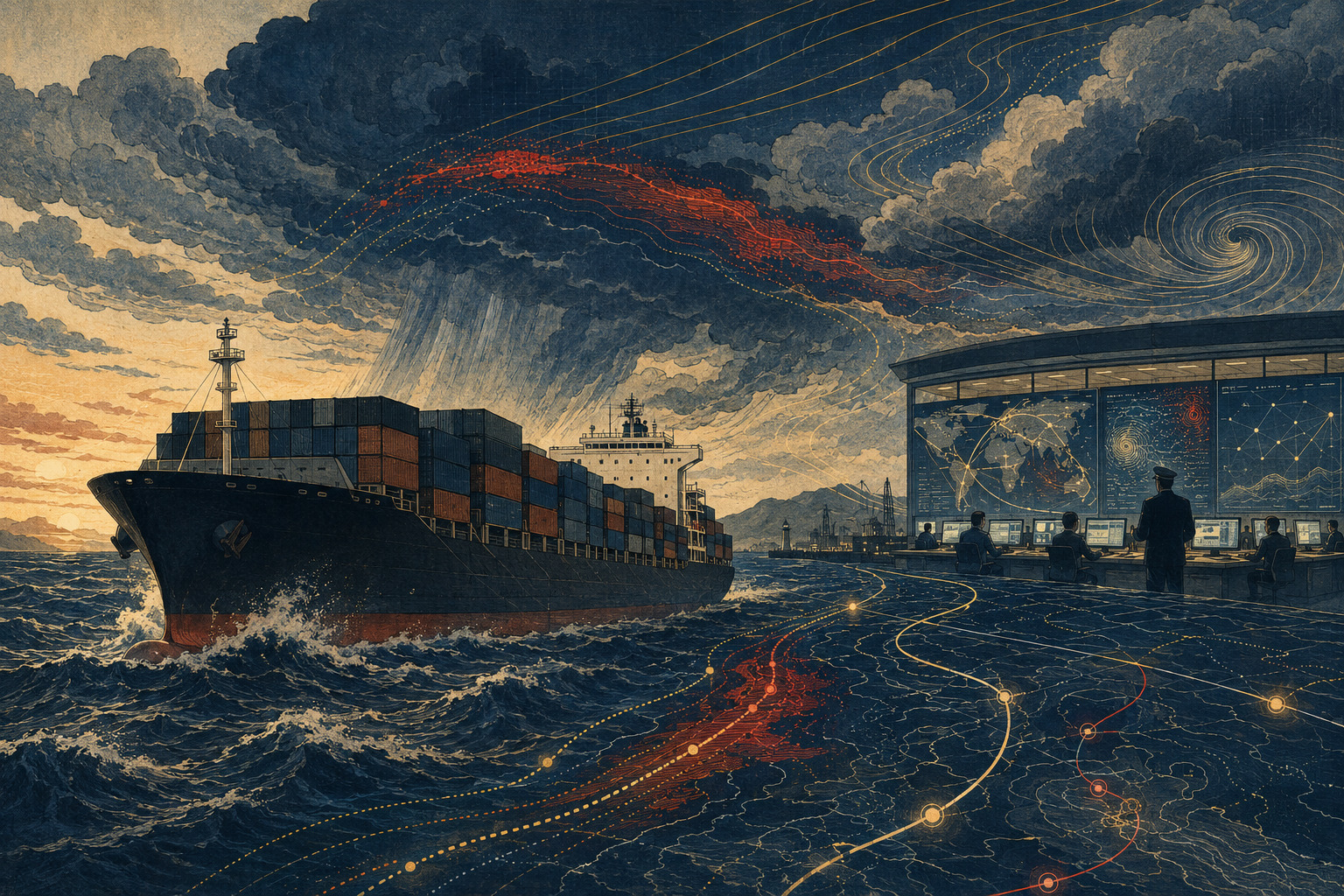
On July 1, the AI went to work ashore
The workplace in MOL and IBM Japan’s joint announcement is not a ship’s bridge. It is the Safety Operation Supporting Center, or SOSC, at MOL’s Tokyo headquarters. The center watches MOL-related vessels around the world 24 hours a day, 365 days a year and gives advice or corrective recommendations to masters and operations managers. The new platform entered service there on July 1, 2026.
Its job is to shorten the path from an ocean of information to a focused question: which ship faces which risk now? Typhoons, waves, ice, position and speed, port conditions, piracy, conflict and navigation warnings arrive at different speeds, in different formats and for different geographic areas. Watchkeepers must relate overlapping hazards and decide what deserves attention first. The companies say the platform brings together weather and ocean data, ship-operating information and geopolitical developments that had been dispersed, then uses generative AI to identify and extract risks from current information and historical operating records.
The three published functions
| Layer | What the announcement confirms | Operational meaning |
|---|---|---|
| Information | Real-time integration and visualization of weather, ocean, operating and geopolitical information | Reduce the time spent moving among screens and documents; align information to the same vessel, place and time |
| AI assistant | Generative AI identifies and extracts current vessel risks from historical operating records and live information | Support movement monitoring, situation assessment and priority-setting |
| Knowledge | Share and analyze accident information, response cases and field knowledge across the organization | Turn individual memory and departmental files into knowledge that can be found for the next decision |
The project combines SOSC’s operating knowledge, AI capabilities from MOL Information Technology India and IBM Japan’s AI and data expertise. The partners used IBM Garage, an approach intended to carry work from user needs and design through development and implementation. That name marks a method, not a disclosed product stack. The release does not identify watsonx, a particular cloud service or a foundation model. It would be wrong to infer a product merely because IBM participated.
What “inside global ship operations” means—and does not
The headline does not mean that software aboard every ship directly controls rudder or engine. The release says SOSC staff can find important events, combining AI analysis with the knowledge of experienced captains. The center supports the judgments of ship masters and operations managers. It does not say that generative AI automatically changes route, speed, evasive action or departure time.
That makes this a different technology stream from MEGURI2040, whose latest MOL announcement in March 2026 concerned certified autonomous commercial vessels. MEGURI combines onboard perception, future-behavior prediction, collision avoidance, route planning, communications and land support. The July platform deals with information and knowledge at a shore decision-support center. Before labeling a maritime system “autonomous,” the useful question is which function moved from which human, and where.
SOLAS preserves the master’s ultimate responsibility for a ship’s safety and security. Shore AI can strengthen that authority by widening the master’s information. It can also blur it. A real human-control policy must specify how following or rejecting an AI recommendation will be treated in appraisal, investigation and liability. Otherwise “human in the loop” can shrink to an approval button.
What generative AI adds to older optimization
Maritime operations used numerical models long before generative AI. Weather and wave forecasts, performance curves, fuel consumption, arrival estimates and collision risk are calculated with physics, statistics and optimization. Wayfinder, the Sofar Ocean platform MOL adopted in 2024, proposes speed and route using high-resolution marine forecasts, vessel-specific fuel models, market constraints and safety constraints. MOL said a trial on 40 ships confirmed an average fuel and greenhouse-gas reduction of about 6 percent per voyage.
Generative AI’s better role is not replacing these calculations. It can read and summarize large volumes of differently structured text, retrieve related cases and explain them in accessible language. Piracy notices, port circulars, internal reports, casualty files, handovers and free-text near misses resist a neat table. If a vessel is approaching a hazardous area, AI may reduce the friction of finding a similar response in the company’s history.
Fluency is not numerical assurance. Route, under-keel clearance, fuel, stability and machinery limits should remain with validated specialist tools. Explaining an optimizer’s result is not the same as calculating a safe route. The announcement does not disclose the internal boundary between conventional analytics, rules and generative output.
The history begins with four serious accidents in 2006
MOL’s present safety story does not begin as a technology success. The company’s own 2006 review records four major casualties: an engine-room fire aboard a containership in April, a severe list aboard a car carrier in July, a crude-oil spill from a tanker in August and the grounding of an iron-ore carrier in October. The individual cases involved MOL Initiative, Cougar Ace, Bright Artemis and Giant Step. Lives were lost in the Giant Step grounding.
In December, MOL announced a “Returning to Basics” package. It included bridge-resource-management training that recreated real accidents, a dedicated training ship and a new round-the-clock room to monitor every operating vessel’s position, movement, weather and forecasts and to send warnings directly to masters. The Safety Operation Supporting Center opened on February 1, 2007.
History should not be reverse-engineered into a product claim. Nobody can show that a 2026 language model would have prevented accidents in 2006; the causes, communications, data and operating conditions differ. The valid continuity is institutional: accident records and response cases are supposed to become memory that can improve a later decision.
The first SOSC watched satellite dots and weather
In 2007, SOSC polled vessel positions through Inmarsat, monitored Weathernews assessments of atmospheric and ocean hazards and distributed severe-weather, tsunami, security and navigation warnings to ships, managers and deployment teams. It also acted as an emergency help desk. Its later motto, “Never leave the captain alone,” describes experienced captains standing a shore watch around the clock.
In 2009, MOL and Weathernews introduced FMS.Globe. Drawing from the FMS.SAFETY system used in SOSC, it displayed every vessel’s position plus pressure, typhoons, currents, sea temperature and clouds on a real-time globe. A 2023 renovation added a broad video wall, a crisis-response room and an open layout physically connected by stairs to operating divisions. Central data matters less if people cannot confer quickly.
Today SOSC monitors typhoons, winter storms, ice and icebergs, tsunamis, piracy, missile tests and rocket launches. In January 2026, an anti-piracy exercise aboard LNG carrier Energy Advance tested emergency communications linking the ship, its manager, SOSC, the Japan Coast Guard, transport ministry and ReCAAP Information Sharing Centre. Safety work leaves the screen and enters a human and institutional network.
MOL and IBM were already reading casualty data in 2017
The partnership did not appear from nowhere in 2026. In December 2017, MOL and then-subsidiary MOL Information Systems began using IBM SPSS Modeler to analyze correlations and causal relationships across operating, crewmember, vessel-inspection and other data. They also planned text mining of unstructured near-miss reports submitted by crew.
That was not large-language-model generative AI. It was an earlier generation of statistical analysis, machine learning and text mining based on word and passage patterns. The underlying question nevertheless anticipated the new system: can a company do more than collect incident reports—can it combine data, design prevention and verify whether the countermeasure works?
Generative AI widens the natural-language doorway. A user may be able to seek “past cases where several alerts overlapped in this region” without mastering a taxonomy or database query. The new costs are sensitivity to phrasing and the possibility of inventing a plausible answer or case that never existed.
FOCUS built the data needed to “see” a ship from shore
MOL organized a Smart Shipping Promotion office in 2016 to apply IoT and AI to safety, efficiency and advanced navigation support. In 2019 it released Fleet Viewer, the first application in FOCUS—Fleet Optimal Control Unified System. Fleet Viewer collected nearly 6,000 sensing items at one-minute intervals, including position, machinery condition, weather and ocean information, for ship and shore to share.
MOL described the distant ship as a local clinic and shoreside management as a hospital. Historically, communications let the two speak but not let shore personnel directly “examine” the ship. FOCUS data supported diagnostics, performance analysis and predictive-maintenance applications such as Fleet Guardian. Lighthouse later gave customers access to schedule, weather, cargo and contract information.
The 2026 assistant rests on this long work of collecting and organizing data. The joint release, however, does not say exactly how FOCUS, SPIRIT, Wayfinder or Lighthouse connect to the new platform. “Integration” should not be inflated into a claim that every system and every field is connected.
Do not confuse a 930-vessel company with disclosed coverage
MOL’s corporate profile lists an operating-fleet scale of 930 vessels, 611 group companies and 11,567 group employees at March 31, 2026. That gives the platform industrial context: information must cross ship types, ages, management companies, flags, routes, languages and communications conditions.
It does not establish deployment to 930 vessels. The announcement says the platform is centered on the SOSC that supports MOL-related ships sailing worldwide. It does not provide the number of ships, departments or users covered on day one, the rollout schedule, languages or source-refresh intervals. Converting company size into deployment size would be a classic numerical exaggeration.
The chain of human and machine decisions
The public chain is simple: integrate weather, ocean, vessel and geopolitical data; use generative AI and historical records to identify risks; support monitoring, assessment and prioritization; combine the output with former captains’ knowledge; then support the master and operations manager.
An implementation normally must align time and position, resolve ship names and IMO numbers, grade sources, remove duplicate reports, handle expiration and determine whether a hazard area intersects a planned route. Those are editorial inferences about what a robust platform requires, not a disclosed MOL-IBM architecture.
A safe interface should make the evidence reversible. A “high risk” result ought to reveal which forecast run, position report, port circular and historical case it used, when each source was updated and what conflicting evidence remains. The original material should be one action away. A generated paragraph must never become a substitute for the source.
What is public—and what is not
| Question | Status at July 1, 2026 |
|---|---|
| Use | Information integration, risk extraction, monitoring, assessment, priority-setting and organizational knowledge |
| Location | Centered on MOL’s shore-based Tokyo SOSC |
| Human role | AI analysis is combined with experienced captains’ knowledge to support masters and managers |
| Developers | MOL, MOL Information Technology India and IBM Japan, using IBM Garage |
| Model / product | Undisclosed: LLM, IBM product, model provider, size or tuning method |
| Architecture | Undisclosed: cloud, retrieval-augmented generation, vector database, connected systems or data residency |
| Scale / performance | Undisclosed: vessels, users, recall, false alarms, misses, latency or uptime |
| Governance | Undisclosed: approval workflow, audit logs, retention, external assessment or incident reporting |
| Economics | Undisclosed: development and operating cost, contract term, IP or model-update conditions |
Undisclosed does not mean defective. Some safety and cyber details should remain protected. Yet if even aggregate performance is unavailable, outsiders cannot test the claim that decisions became better and faster. A safety-related AI project must find a line between withholding an attacker’s blueprint and publishing detection performance, significant failures, governance and improvement.
Five ways generative AI can be wrong
First is what NIST calls “confabulation”: confidently producing false or erroneous content. An invented accident case, obsolete port rule or wrong coordinate written in calm prose may be harder to detect than a crashed program. Second is freshness. Storm tracks, navigation warnings, port closures and security information expire; yesterday’s correct answer can be dangerous today.
Third is conflict. Forecast models and authorities may disagree. If AI compresses uncertainty into a single smooth story, it destroys information. Fourth is omission. False alarms are visible; a critical ship absent from the list is a silent failure. Fifth is automation bias. Under workload, a tidy summary can discourage the operator from opening the source.
“A human checks” is not a complete control. The system needs source links, timestamps, confidence or uncertainty, contrary evidence, model and prompt versions, and records of why an output was accepted or rejected. Critical alerts should be paired with deterministic rules or double-checks. SOSC also needs a degraded mode that preserves conventional monitoring when AI is unavailable.
Geopolitical documents can become an attack surface
The more external documents a generative system reads, the more useful it may become—and the more untrusted input it ingests. NIST defines prompt injection as exploiting the concatenation of untrusted input with a prompt created by a higher-trust party. A malicious instruction hidden in an acquired web document might look to a human like an ordinary notice while attempting to redirect the model.
Combining vessel positions, intended routes, cargo, ports, crew, accidents and inspections also creates a valuable target. The threat model must cover false-data injection, credential theft, model-mediated leakage, lateral movement through excessive permissions and compromised supply-chain updates.
IMO’s revised Guidelines on Maritime Cyber Risk Management call for a strategy and the functional cycle of identifying, protecting, detecting, responding and recovering. AI should sit inside the safety-management and cyber framework, not in a special exception. For decision support, prudent controls include least privilege, network segmentation, read-only connections, approved sources, sanitization of retrieved content and no direct generative-AI write path to ship control.
When “never leave the captain alone” must not become control
SOSC’s motto promised support, not replacement. The master knows immediate visibility, vessel feel, crew, cargo and actual equipment condition. Shore staff see wide-area weather, other ships, ports, geopolitics and cases from across the company. Value comes from joining these asymmetric views.
AI can make shore advice more frequent and standardized. Too many alerts consume bridge attention. If every rejection demands justification, advice becomes an order. The opposite design treats a master’s evidence-based rejection as valuable feedback to the model and the organization.
Training must go beyond prompting. Ship and shore need to practice finding errors, checking source age, recognizing when not to use AI, escalating disagreement, working through a communications or platform outage and respecting confidential-data boundaries. If expert reasoning is encoded into a system, junior staff must still be able to learn the reason—not merely copy the answer.
Does searchable casualty knowledge automatically create safety?
The third feature—using accidents, responses and field knowledge—is the most consequential. A casualty is rarely a single-cause data point. Immediate cause, organization, fatigue, design, weather, communications and commercial pressure may interact. Excessive summarization can return to the unhelpful story of “human error.”
A strong knowledge system preserves applicability, assumptions, contrary evidence, corrective actions, later effectiveness and unresolved questions. Names and medical or employment details require purpose-based deletion or access restriction. Learning must be separated from surveillance and blame. Old cases need a label explaining how equipment and rules have changed.
Calling the 2006 casualties training data is not enough; it risks turning loss into raw material. Humans must continue to explain what changed, which recurrence paths were closed and where weakness remains. Generative AI should not rewrite history. It should make forgetting harder and return the watchkeeper to the primary record at the right moment.
Measure speed and accuracy separately
MOL and IBM promise better quality and response speed. Useful evidence would include time from an event to detection, acknowledgment and vessel contact; agreement on priority; miss and false-alarm rates; completeness of evidence links; stale-source rates; and disagreement between AI and watchkeeper.
One aggregate accuracy figure would mislead. Correctly suppressing 99 trivial alerts does not compensate for missing one vessel entering a severe storm. Performance needs breakdowns by severity, ship type, sea area, language, alert class, time of day and communications quality. It should also measure workload when multiple crises saturate the center.
Archived events can support back-testing, followed by a shadow period in production. Red teams should inject stale notices, fabricated geopolitical documents, unit mistakes, duplicate vessel names, position jumps, missing feeds and prompt attacks. Every model update needs regression testing. “Faster” should mean reaching verified action sooner, not answering sooner.
Twenty years of shore support
| Year | Milestone | Change in operations support |
|---|---|---|
| 2006 | Four major accidents; “Returning to Basics” package | Plan for 24-hour monitoring of every vessel and global weather |
| 2007 | SOSC opens | Inmarsat positions, Weathernews risk, warnings and help desk |
| 2009 | FMS.Globe | Real-time view of fleet positions and world weather |
| 2016 | Smart Shipping Promotion office | Organized IoT, AI and advanced navigation support |
| 2017 | IBM SPSS multidimensional incident analysis | Crossed operation, crew, inspection and free-text data |
| 2019 | FOCUS Fleet Viewer | Nearly 6,000 sensing items shared every minute |
| 2020 | Lighthouse | Schedule, weather, cargo and contract information for customers |
| 2023 | SOSC renovation | Video wall, crisis room and physical link to operating teams |
| 2024 | Wayfinder adopted | Marine forecasts and vessel performance optimize speed and route |
| 2026 | Generative-AI platform live | Extract and prioritize present risk with accident and response knowledge |
The sequence makes generative AI a next layer over observation, communications, data organization, statistics, sensors and visualization—not a sudden revolution. Buying a language model without correct positions, times, forecasts, casualty classification and accountable watchkeeping would not create a safety system.
“Safety” and “DX” inside BLUE ACTION 2035
MOL places the project under Safety and Digital Transformation in BLUE ACTION 2035 Phase 2. It says functions and supported operations will expand with group companies and that the work should contribute to safety across shipping.
Expansion can move horizontally to more ships, ship types, group companies, languages and hazards. It can also move vertically into investigation, training, maintenance, deployment and customer work. The second route changes purpose and authority. Crew data gathered for safety should not quietly become personnel scoring or productivity surveillance.
Industry contribution does not require publishing a proprietary model or raw company data. MOL can share evaluation methods, anonymized failure modes, alert taxonomies, cyber exercises and human-factors findings. Common measures that class societies, flags, IMO and other operators can compare would matter beyond one dashboard.
The scorecard the next announcement should carry
Start with deployment: covered ships and types, SOSC users, languages, connected sources, operating hours and the boundary with old procedures. Then publish severity-weighted detection and miss rates, false alarms, median and tail time to contact a vessel, evidence-link completeness, stale-source incidence and platform downtime.
For the human system, aggregate acceptance, modification and rejection of AI outputs, disagreement between master and SOSC, alert burden, verification time and training results. For safety outcomes, avoid claiming AI caused every improvement; follow hazardous encounters, near misses, delay, fuel, casualty and assistance over time. Define when a significant erroneous output or cyber incident will be reported outside the company.
The model’s brand is less important. What matters is what gets retested after every update, whether every result can return to evidence, who can stop the platform and whether SOSC can still support a vessel during the outage. A safety system reveals its maturity through exceptions and failure—not the fluency of a demonstration.
The next 20 years of never leaving a captain alone
The 2007 SOSC watched satellite position dots and world weather, then called or emailed ships. FMS.Globe placed the fleet on a real-time globe. IBM statistical tools crossed casualty, crew, inspection and free-text reports in 2017. FOCUS shared thousands of sensor points between sea and shore. In 2026, generative AI is attempting to compress risk and experience into something a watchkeeper can read quickly.
This is not the end state in which machines inherit maritime judgment. It is an opportunity to leave a better record of why one ship came first, which source was trusted and when a human disagreed. Done well, it can distribute expert knowledge, teach junior staff and reduce omissions during simultaneous crises. Done badly, polished summaries will hide uncertainty and accelerate a central error to ships around the world.
MOL and IBM have reached the harder stage after the technical launch: proving during ordinary watches that AI remains useful and doubtable at the same time. If the twenty-year promise to “never leave the captain alone” holds, generative AI is not the new captain. It is one more line connecting evidence, experienced people ashore and the master at sea before risk becomes emergency.
Sources and methodology
- MOL and IBM Japan, “Jointly Develop AI Platform to Enhance Decision-Making in Vessel Operations” (July 1, 2026): launch, features, developers, SOSC and BLUE ACTION 2035.
- MOL and IBM Japan joint release, Japanese original (July 1, 2026): controlling text and Japanese terminology.
- IBM Japan Newsroom, MOL platform release (July 1, 2026): IBM-side publication and IBM Garage.
- MOL, “Safety Operation Supporting Center—History and Role”: 2006 accidents, 2007 foundation, motto, monitored hazards and operating practice.
- MOL, “MOL Opens Safety Operation Supporting Center” (February 7, 2007): establishment, Inmarsat, Weathernews, warnings and 24-hour response.
- MOL, “Major News in 2006” (December 26, 2006): company summary of four major casualties.
- MOL, “Returning to Basics” safety package (December 22, 2006): training and plan for round-the-clock monitoring.
- MOL and Weathernews, “FMS.Globe” (September 28, 2009): real-time fleet positions and global weather.
- MOL, multidimensional incident analysis using IBM SPSS Modeler (December 4, 2017): operating, crew, inspection and near-miss data.
- MOL, “FOCUS Fleet Viewer” (May 21, 2019): nearly 6,000 sensing items at one-minute intervals and ship-shore sharing.
- MOL, SOSC renovation (March 15, 2023): video wall, crisis room and connection to operating divisions.
- MOL, Wayfinder introduction (July 30, 2024): 40-ship trial, average 6% fuel/GHG reduction and voyage optimization.
- MOL, Energy Advance anti-piracy exercise (February 4, 2026): SOSC emergency communications network.
- MOL, “MEGURI2040 Stage 2” (March 30, 2026): a separate autonomous-navigation stream.
- MOL Corporate Profile (at March 31, 2026): 930-vessel operating-fleet scale, 611 group companies and 11,567 employees.
- NIST, AI RMF Generative AI Profile, NIST AI 600-1 (July 26, 2024; updated April 2026): confabulation, security, privacy, evaluation and governance risks.
- NIST CSRC, “prompt injection”: definition of an attack exploiting untrusted input joined to a higher-trust prompt.
- IMO, “Maritime cyber risk”: MSC-FAL.1/Circ.3/Rev.3 and maritime cyber-risk management.
- IMO, “Frequently Asked Questions on Maritime Security”: SOLAS XI-2/8 and the master’s ultimate safety and security responsibility.
Editor’s note: This report relies principally on primary material available through July 17, 2026. It does not say that generative AI was installed aboard a ship, steers vessels or covers all 930 ships. MOL and IBM Japan have not disclosed the model, IBM product, cloud, use of retrieval-augmented generation, vessel count, accuracy, false alarms, misses, cost or detailed audit and cyber architecture. General processing and control measures are clearly presented as editorial analysis rather than claims about the implementation. The hero is an editorial illustration. The exchange-rate display is the edition’s specified value: “1 US Dollar = 162.39 Japanese Yen.”