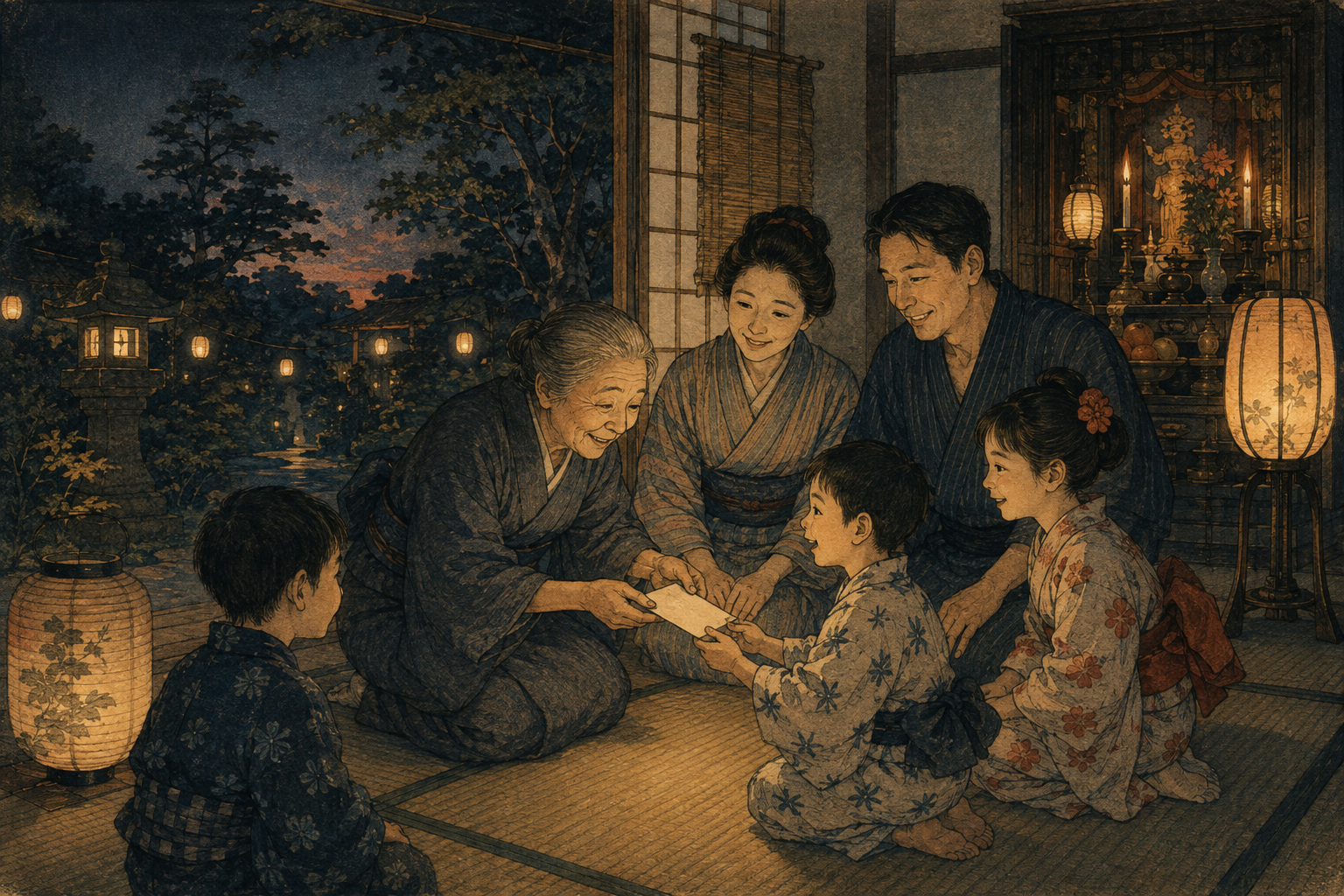
The envelope is small enough to disappear inside an adult hand.
Its summer pictures may show a whale, a watermelon, a goldfish, a polar bear or a pane of blue sea. A folded banknote goes inside. The giver waits until a child, grandchild, niece or nephew is close enough to receive it directly. The amount is concealed, but the gesture is made visible. This is obondama: the summer cousin of New Year’s otoshidama, named for Obon and increasingly stocked as its own category of family gift.
The exchange looks timeless because it borrows the grammar of an established custom. Adults give; children receive. Cash is wrapped rather than exposed. The family is gathered. Yet the word on the envelope is younger than many of the people using it. Paper-products company Maruai says it coined and registered obondama in 2010, when it began selling summer-designed gift envelopes under the name.
That makes the packet an unusually clear case study in how traditions form. The act of giving money or goods around Obon was not invented in a factory. But naming an act, printing the name on a dedicated object and placing that object on a seasonal retail shelf can change what families believe the act is. A spontaneous “little something for the children” becomes a thing with a title. A titled thing can be remembered next year. Repetition can become expectation, and expectation can become custom.
Sixteen summers later, the experiment is unfinished. Maruai’s 2026 survey found that 26.2% of adults recognized the term. Among those who knew it, 30.6% planned to give an obondama that summer. The custom is neither nationwide nor obscure. It occupies the fascinating middle ground where commerce proposes a ritual and families decide whether to adopt it.
First, Keep the Denominators Straight
Maruai conducted a preliminary internet survey of 4,802 adults aged twenty and older. Of that group, 1,260 knew the word obondama. The company then asked that aware group whether they planned to give it; 30.6% said yes. A detailed survey covered 327 intended givers. It ran June 26–30 and asked about recipients, amounts, methods and year-on-year spending.
The nested design matters. It is inaccurate to say that 30.6% of all Japanese adults planned an obondama. The figure applies only to people in this sample who already knew the term. Nor are the 327 detailed respondents a cross-section of Japan. They are a deliberately selected group predisposed to the practice. The survey was commissioned and published by the company that owns the brand and sells the envelopes. It is useful market evidence, not an independent prevalence study.
Inside that group, children were the center of giving. Among intended givers, 64.2% named relatives’ children, 57.8% their own children and 56.3% grandchildren or great-grandchildren. Multiple answers were allowed. But the gift was not exclusively downward: 51.4% named parents, 50.2% siblings and 46.2% grandparents. The product label covers pocket money, gratitude and family support moving in several directions.
The amount most often selected was ¥1,000–¥4,999, regardless of relationship. Maruai did not publish a simple arithmetic mean per child. Its respondents reported ranges, and the company separately asked whether the total they intended to give would change. Some 39.8% expected the same total as in 2025 and 38.5% expected it to increase. “Average gift,” “largest group” and “total family outlay” are not interchangeable.
| Number | Correct interpretation | Common misreading |
|---|---|---|
| 26.2% | Share of Maruai’s preliminary sample that recognized the word. | Share of Japan that gives obondama. |
| 30.6% | Share of respondents who knew the term and said they would give. | Three in ten Japanese adults. |
| ¥1,000–¥4,999 | The modal range for each relationship category. | An exact mean or a formal etiquette rule. |
| 38.5% | Share of selected givers expecting their total spending to rise. | A 38.5% increase in yen, or evidence that participation grew. |
Is the Custom Actually Growing?
The answer depends on what “growing” means. Maruai’s comparable headline surveys do not show expanding recognition. Awareness was 27.2% in 2024, 26.8% in 2025 and 26.2% in 2026. The share of aware respondents who intended to give was 31.6% in 2025 and 30.6% in 2026. Small sample and design differences counsel against treating those tenths as a precise trend, but they certainly do not demonstrate rapid national adoption.
Spending intensity tells a different story. In 2025, 26.5% of detailed respondents expected their overall obondama total to increase; in 2026, 38.5% did. People gave several explanations: children had grown older, there were more grandchildren, and prices had risen. The custom may therefore be deepening inside participating families without spreading to many new ones.
That distinction changes the headline. Obondama is not marching steadily toward universal status. It is becoming more financially consequential for some of those who already use it. A family with three young recipients given ¥3,000 each has a ¥9,000 bill even though no child receives anything close to ¥10,000. Add an older teenager, a gift to a parent and two branches of relatives, and a modest packet becomes a substantial summer category.
A separate 2019 Aozora Bank survey helps explain how the ¥10,000 idea entered public discussion. Among adults aged 55–74 with children or grandchildren, excluding zero-yen responses, the average planned obondama was ¥6,100. The largest band was ¥5,000 to below ¥10,000; 32.0% selected ¥10,000 to below ¥15,000. That was a defined senior sample seven years earlier—not a 2026 national per-child average. But high-value responses and a visually prominent “up to ¥10,000” band are easy to detach from their denominator.
An Old Gesture and a Young Name
The modern product has been given a historical ancestry. When Japan Post began selling obondama envelopes nationwide in 2014, it said that in some Edo-period communities merchants gave servants an Obon allowance or practical goods such as clothing and footwear when they returned home. According to the postal account, the practice gradually changed into pocket money for children by the early Shōwa years.
That genealogy is plausible. Obon was a natural moment for employers, households and relatives to settle obligations, reward labor and equip travelers. But the surviving public accounts repeat a general origin story rather than documenting an unbroken chain from a particular Edo ledger to the branded envelope. It is safest to call it a precursor, not proof that the 2010 product is an ancient custom under a forgotten name.
Summer giving already had many forms. Ochūgen gifts moved between households around the seventh lunar month and became an expression of gratitude to people who had provided help. Families brought omiyage when returning home. Money and goods were offered at temples, flowers and incense were bought for graves, and host households fed arriving relatives. Children could receive an informal allowance without anyone calling it obondama.
Maruai’s innovation was semantic and material. The company combined Obon with tama from otoshidama, printed the new label on a small envelope and proposed a use. The company had credibility in the field: founded in 1888 in the paper-making area of Ichikawadaimon, Yamanashi, it produces hundreds of varieties of envelopes for congratulation and condolence. It understood that in Japan, the paper around money is part of the message.
Edo period Later postal accounts describe some merchants giving returning servants goods or an Obon allowance; the direct continuity to today is not fully documented.
Early Shōwa era The same account says summer gifts increasingly became pocket money for children.
2010 Maruai registers “obondama” and begins selling dedicated summer envelopes.
2014 Japan Post sells six types of obondama envelope through post offices nationwide, giving the proposed custom extraordinary visibility.
2019 Aozora Bank reports recognition above 40% in its 55–74-year-old survey, illustrating how population choice changes the number.
2026 Maruai offers sixteen designs in four series, including a new full-length banknote envelope in its polar-bear line.
The Shadow of New Year’s Otoshidama
Obondama feels instantly intelligible because otoshidama already provides the script. New Year’s gifts were once rice cakes and other objects associated with the year deity and the household’s hope for health. Over centuries the word expanded to other presents. Cash became dominant in the postwar era, placed in a decorated pochibukuro and given by parents and relatives to children and younger family members.
The envelope disciplines cash. Unwrapped money can look like payment; wrapped money can become affection, blessing, condolence or gratitude depending on the paper. Pochi conveys the modesty of “just a little.” The giver minimizes the sum even as the receiver knows it matters. The amount remains private until later, and good manners discourage opening it immediately in front of the giver.
By borrowing that format, obondama inherits an entire choreography without having to explain itself. The adult produces a small envelope. The child receives it with both hands and thanks the giver. Parents decide when it may be opened and who will manage the money. The packaging converts a banknote into a scene.
But the summer practice remains looser than its New Year model. Maruai’s own 2026 New Year survey found that 40.4% of adults planned to give otoshidama, versus a much smaller conditional group around obondama. New Year amounts are often calibrated by school age, and families have debated a stopping point for generations. Obondama has no equally settled scale. That flexibility can make it warm; it can also make the giver wonder whether a new obligation has appeared.
How an Envelope Manufactures Social Reality
Commercialization is often narrated as corruption: a company takes a pure custom and turns it into a product. Obondama is more complicated. The company did not seize an established national rite. It gathered scattered acts of summer generosity, attached a name and invited consumers to make the category real.
A dedicated envelope performs several kinds of work. It tells the buyer that other families may be doing the same thing. It solves the awkward question of what to write on an ordinary packet. It marks the gift as seasonal rather than an extension of allowance. It gives a retailer a shelf label and a journalist a story. Most importantly, it makes the action repeatable: when the same designs return next April, the giver is reminded before the family has gathered.
Japan Post’s 2014 entry amplified that process. A product on a stationery website is a proposal. Six designs beside familiar postal goods across Japan look more like infrastructure. The post office also suited the emotional geography of Obon: it connects distant households and reaches older consumers who may be both the principal givers and the people waiting for children to return.
The 2026 product line shows the category learning from its users. Maruai released sixteen designs across four series—window envelopes, polar bears, Japanese motifs and animals. A full-length “ten-thousand-yen envelope,” which holds a banknote without folding, joined the popular polar-bear line. The product does not prove that the average gift is ¥10,000. It proves that the manufacturer sees demand for a more formal packet and higher-value notes.
- A gesture becomes a category: “Here is something for you” becomes “Here is your obondama.”
- A category gains a season: annual retail placement reminds adults before the reunion.
- A season gains an expectation: children can learn the name and anticipate the packet.
- An expectation gains a budget line: the giver must choose an amount and multiply it by recipients.
- A budget line gains data: the envelope seller surveys the practice, generating publicity that further establishes the name.
The Hand Still Matters in a Cashless Country
More than half of the 2026 detailed respondents—54.4%—planned to put cash in a small envelope and hand it over. Electronic-money transfers were selected by 12.2%, and bank transfers by 9.5%. Multiple methods may have been possible, so the figures should not be forced into a single total. The hierarchy is nonetheless clear: obondama remains a physical exchange.
This is not simply technological delay. The hand-to-hand moment is part of the product. It allows the giver to see the child’s face and the child to feel that the money came from a particular person. The envelope stores a message and a memory after the banknote is spent. Cash can be counted, divided and saved; the wrapping adds a social origin.
Digital money solves a different problem. It can reach a grandchild who cannot travel, avoid a lost envelope and fit the way older children pay. But a silent transfer arrives in the same interface as a refund, a shared restaurant bill or a marketplace purchase. The app moves value efficiently. The paper announces a relationship.
The contrast is sharper in summer because reunion itself is under pressure. In Maruai’s separate 600-person summer survey, only 10.0% planned a relatives’ gathering, 21.7% said they would visit family, and 49.7% said they would do nothing in their dealings with relatives. These are company-survey results, not national rates, but they frame the paradox: fewer physical encounters can make the encounters that remain more ceremonial.
A Gift Inside an Expensive Homecoming
The little envelope does not travel alone. It sits inside the cost of getting to the family house: rail or air tickets, tolls and fuel, a box of gifts, grave flowers, incense, restaurant meals and the host’s enlarged grocery bill. Japan.co.jp’s companion investigation, The Price of Going Home, found that one travel-company survey had half of intended returnees reporting higher costs than a year earlier.
Obondama can raise both sides of that bill. A visiting uncle may carry packets for five children. A grandparent may hand over cash while also paying for food and part of the family’s transport. A 2019 Aozora survey offers older—not current—scale: among seniors who helped with returning children’s or grandchildren’s transportation, the average contribution was ¥29,700; hosts expecting a return reported ¥43,700 in other spending. Those figures use restricted bases and should not be added into a universal “cost of Obon.” They show how generosity accumulates around the visit.
Inflation turns the amount into a moral calculation. In Maruai’s 2026 responses, some givers held the sum steady because prices made their own budget difficult. Others raised it because prices made the recipient’s life difficult. The same inflation therefore produces opposite decisions. “I cannot afford more” and “they need more” can both be loving conclusions.
Age adds another ratchet. A packet considered suitable for an elementary-school child may feel too small for a teenager. The birth of another grandchild increases the total even if the amount per person is unchanged. Because gifts to siblings and cousins are often compared, one child’s growing sum can reset the scale for everyone in that age group. A private gesture becomes family arithmetic.
When Kindness Becomes Obligation
A named custom carries a risk that an unnamed gift does not. Before the term exists, receiving nothing may be normal. After children and adults know the word, an empty hand can look like omission. The envelope creates delight, but it can also create a test.
That burden is distributed unevenly. Children in large, nearby and affluent kin networks may receive several packets; children whose relatives live far away, have limited income or do not practice the custom receive none. No child is owed a commercially proposed gift, yet comparisons can make the difference feel personal. Adults likewise face different numbers of nieces, nephews and grandchildren. A “small” ¥3,000 gesture multiplied by ten recipients is ¥30,000 before travel.
The 2026 survey also complicates the idea that obondama is merely adults indulging children. Roughly half of detailed respondents selected parents or siblings as recipients, and nearly as many selected grandparents. These high shares may partly reflect the survey’s broad definition and multiple-answer format. They reveal a useful ambiguity: obondama can be pocket money downward, appreciation upward or assistance sideways.
That flexibility may be the custom’s best defense against becoming a second compulsory New Year. It can be an envelope with a message, a book voucher, help for a parent or spending money for an outing together. Maruai’s commercial definition describes “a token or pocket money” for children, grandchildren and grandparents. The value is not required to be large, and participation is not required at all.
What Does the Child Receive?
Cash gives a child a rare form of discretion. Unlike a toy chosen by an adult, money lets the receiver decide—within whatever rules the household applies—whether to buy, combine, wait or save. That can make the packet an informal lesson about value. It can also produce conflict over whether the money belongs immediately to the child or should be held by a parent.
The 2026 obondama survey did not ask children how they used the money. Claims about saving, games or school supplies would therefore be borrowed from research on otoshidama, not evidence about this summer gift. New Year studies do show that parents commonly retain or jointly manage at least some child gift money, and that saving remains a major use. Obondama may follow that pattern, but it has not been demonstrated in the principal source.
What is observable is the relationship encoded in the handover. The gift says that the child’s arrival was noticed. It lets an older relative give something that does not require knowing the latest character, game or clothing size. If the child later uses the cash during the visit, the packet can become an outing: the grandparent who gave it accompanies the child to choose.
The educational opportunity lies less in forcing a lesson than in making the amount discussable. Why did the giver choose this sum? How much will be spent and saved? Should siblings receive the same amount or an age-adjusted amount? Is a thank-you call part of the exchange? The little envelope can hide the money at the table and open a conversation afterward.
Why It Fits Obon—and Why It Can Feel Strange
Obon is devoted to the return of ancestors. At first glance, adding cheerful cash packets for children can look like retail noise intruding on grave visits, memorial services and the quiet work of remembrance. The objection deserves respect. Not every family wants another expense attached to a sacred or emotionally difficult gathering.
Yet Obon has always joined the dead and the living. Ancestors return because living descendants prepare a place. Relatives travel because the memorial calendar creates a common time. Children meet elders, learn names at the grave and become the next people who may maintain the altar. A gift moving from grandparent to child makes generational continuity tangible, even if the branded name is new.
The deeper tension is not sacred versus commercial. Japanese memorial life has long required material things: candles, flowers, incense, food, priestly offerings and transport. The question is whether the purchase serves the relationship or the relationship begins serving the purchase. An envelope can assist a moment that would happen anyway. It should not make a family feel that the moment is incomplete without money.
That is why the verified modest range matters. ¥1,000–¥4,999 is not trivial, but it is different from announcing a new ¥10,000-per-child standard. False inflation in the story about inflation can create the very social pressure journalism should examine.
A Tradition Is a Proposal Repeated
Maruai’s obondama is a remarkable piece of cultural entrepreneurship by a long-established, unlisted manufacturer in a Yamanashi paper town. It identified a scattered behavior, borrowed an understood ritual form and gave retailers, post offices and families a word. It did not need to persuade everyone. At roughly one-quarter recognition, it created a durable niche.
The company’s own data now show the limit and the achievement. Recognition has not clearly expanded in three years. Most adults do not know the term, and most who know it do not plan to give. But thousands of shops can stock the packets, millions of people can understand the idea when they see one, and a participating family can treat the ritual as completely natural.
Traditions do not need to be ancient to be meaningful. They need memory, repetition and people willing to invest an action with more significance than the action strictly requires. Commerce can provide the object and the reminder. It cannot supply the affection.
On August 15, a child may receive a tiny envelope beneath the gaze of relatives living and remembered. The cash inside may be ¥1,000, ¥3,000, ¥10,000 or nothing. Its social weight cannot be averaged cleanly. To one giver it is a new expense; to another, an old generosity finally given a name. To the child it may be spending money. To the family it is a claim that despite distance, prices and changing households, something can still pass directly from one generation’s hand into the next.
Reporting note and principal sources
This article uses public information checked through August 14, 2026 at 7:04 AM JST. Company surveys are reported with their sponsor, selection method and denominator. A modal range is not described as an average. The often-repeated Edo-period origin is presented as a reported precursor, not as proven unbroken continuity.
- Maruai: 2026 obondama survey, principal findings and methodology
- Maruai/PR Times: full 2026 tables, recipient shares and survey bases
- Maruai: 2026 obondama product line and company account of the brand
- Maruai: 2025 survey for year-on-year context
- Maruai: 2024 survey, awareness and high-value gift ranges
- Japan Post: 2014 nationwide launch of obondama envelopes
- Mynavi: 2014 Japan Post product details and its account of earlier summer gifts
- Aozora Bank: 2019 senior survey of obondama and homecoming support
- Nippon.com: Japanese cash-gift etiquette and the development of otoshidama
- Web Japan: historical forms and modern etiquette of otoshidama
- Web Japan/Niponica: the history and social meaning of pochibukuro
- Maruai: 2026 New Year otoshidama survey for comparison
- Intage: 2026 otoshidama budget and cashless-preference survey
- Statistics Bureau: June 2026 national consumer price index
- Government of Japan: Obon’s family and memorial customs