The ambition is not to replace the sea, but to give young clams a better chance to survive it.
The future of a tidal flat may begin in a tank
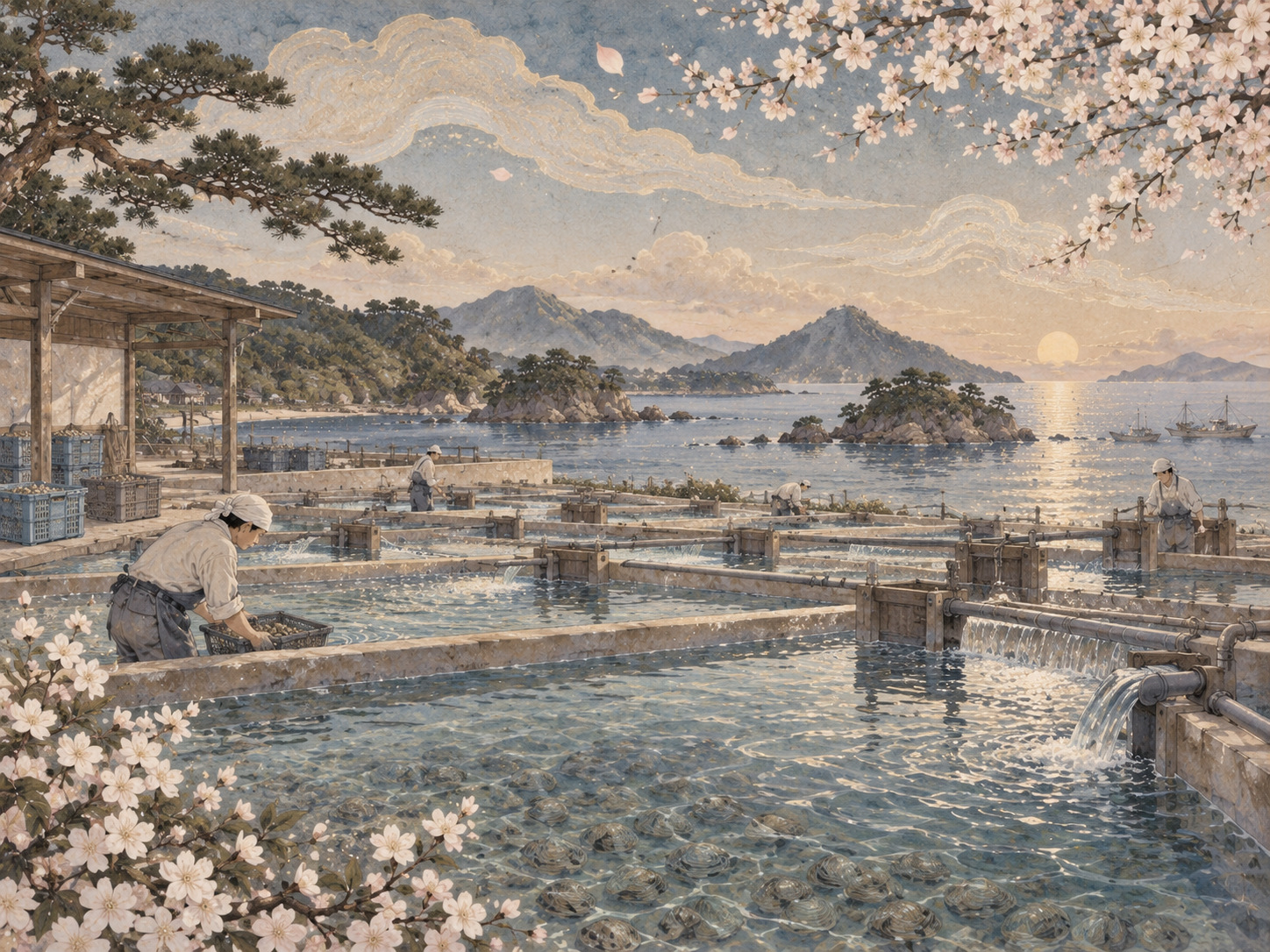
On the shores of Japan’s Ariake Sea, one of the country’s largest construction companies is testing a surprisingly modest proposition: shelter young clams on land through hazardous conditions, feed them with inexpensive recycled nutrients, and eventually return them to the tidal flats. The ambition is not to replace the sea. It is to give a depleted fishery a better chance of recovering. On October 14, 2026, Obayashi Corporation announced that it had begun a large outdoor demonstration in Nagasu, Kumamoto Prefecture.
A fisheries experiment, not a commercial clam factory
The equipment pairs tanks for cultivating diatoms, the microscopic algae clams eat, with tanks holding juvenile clams. Researchers will adjust feeding schedules, water quality and seawater exchange while investigating how to scale the system. No commercial harvest, annual production target or confirmed restoration outcome was announced. Those distinctions matter: a promising engineering experiment is not yet a new source of seafood for shoppers.
Five institutions with different things to contribute
The project builds on a December 2, 2025 agreement among Nagasu Town, the Kumamoto Northern Fisheries Cooperative, Obayashi, Nishinippon Institute of Technology and Ajinomoto’s Kyushu plant. The town’s own account, published December 12, confirms the partnership’s aim: sustainable fisheries and regional revitalization. Fishers supply knowledge of local tidal flats; researchers can measure survival and growth; industrial partners bring process control and nutrient streams. Real success will require all of them, not simply another tank.
A decline measured in generations
Asari clams, generally known as Manila clams, once supported substantial catches, restaurants and recreational clamming around Japan. The Fisheries Agency’s historical survey records a national peak of roughly 170,000 metric tons in 1983. By 2016, national landings had fallen below 10,000 tons. These are different-year nationwide figures, not measurements of Nagasu alone, and catch totals are not a direct census of every clam in the water. They nevertheless show why restoration matters.
Why the tidal flats became difficult places to survive
Summer heat and heavy rain can expose clams to temperature and salinity shocks. Predators, including rays, can also destroy vulnerable beds. But the historical Fisheries Agency assessments describe a more complicated picture: altered sediments, low oxygen, storm-driven disturbance, predators, diseases and too few breeding adults can reinforce one another. Climate change belongs in that analysis, but it would be simplistic to declare it the sole cause of the decline.
The hidden bottleneck: feeding a small animal cheaply
Controlled rearing allows people to regulate water flow and food more precisely than a tidal flat can. Yet hatchery-style operations face a stubborn expense: preparing reliable living feed. Obayashi’s system grows diatoms and delivers them to the juvenile clams. The company will examine whether stable nutrient delivery and water management can make the arrangement viable outside controlled laboratory conditions.
From amino-acid production to algal nutrients
One candidate input comes from Ajinomoto’s Kyushu operation in Saga Prefecture. A liquid by-product from amino-acid manufacturing contains nitrogen compounds and other nutrients useful for growing phytoplankton. Reusing that stream could reduce reliance on purpose-made inputs. But any claim of net environmental benefit would need to count processing, transport, equipment power demand and waste handling rather than treating a recycled ingredient as automatically sustainable.
The one-tenth cost proposition
Obayashi says earlier indoor trials found that rice bran and other accessible secondary resources could substitute for much of the diatom feed. If the approach works at scale, the company projects feed expenses of roughly one-tenth those of an all-diatom feeding approach. That is an estimate for feed costs under a specified comparison, not a demonstrated 90 percent reduction in the total cost of farming clams. Electricity, labor, tanks, seawater pumping and survival losses may change the economics.
Protecting juveniles rather than replacing the sea
The original release describes a three-year journey to market size for the clams. The conservation strategy is to protect juveniles during dangerous periods, then return them to natural flats where they can grow and contribute to breeding populations. That is distinct from a permanently land-based seafood factory. The most meaningful measure will come after release: how many clams survive, reproduce and support subsequent cohorts.
A longer history inside the construction company
Obayashi had been thinking about fisheries before this demonstration. Its 2024 corporate quarterly devoted an issue to fishing and set out a conceptual “Fish Ranch” for Osaka Bay. That proposal explored using ecological relationships and nutrient circulation to sustain aquatic production. The Nagasu pilot is an applied step in a related direction, not evidence that the proposed Osaka Bay installation has been built. It also says something about how Japanese infrastructure companies are searching beyond conventional roads and buildings for environmental work.
Ariake Sea restoration needs more than an engineering solution
Habitat protection, sediment management and predator controls remain relevant, whether the nursery succeeds or not. The Fisheries Agency’s research has examined the ways sediment conditions and breeding-stock depletion undermine recovery. A tank may keep clams alive during a vulnerable phase; it cannot independently restore the hydrology or ecology of every tidal flat into which they are released.
The business questions behind the optimism
A credible cost analysis will need the price of each surviving juvenile at release, not merely the expense of one feed ingredient. Managers will need answers about diatom cultivation stability, bacterial contamination, energy consumption, water discharge, operational labor and capacity utilization. Policymakers will need to know whether any gains persist in the wild and whether fishers see better income. None of these outcomes is established by the initial announcement.
What to watch next
The release does not specify the total project budget, juvenile population, exact outdoor trial duration, release schedule or economic break-even point. It also does not publish an independently reviewed field-survival dataset. Future reporting should seek those measures from Obayashi, the university and the cooperative. If the method proves effective, Japan could gain a useful new tool for shellfish conservation. If it does not, documenting why would still offer valuable evidence about the limits of technology in a changing coastal ecosystem.