A heavier tomato plant is an encouraging result. A larger harvest is a different result. Keeping those two ideas separate is essential to understanding a Japanese study that uses machine learning to select communities of microbes capable of supporting tomato growth.
Announced on September 9 by researchers at Tohoku University, Kyoto University and RIKEN, the work combines biological experiments with computational prediction. Corresponding authors are Yuichi Aoki, a lecturer at Tohoku Medical Megabank Organization, and Akifumi Sugiyama, a professor at Kyoto University’s Research Institute for Sustainable Humanosphere. Their paper appeared in The ISME Journal on August 26. [1]
The advance is a method for deciding which combinations deserve an experiment. For agriculture, that is a consequential task: a promising organism is only the starting point when its performance depends on companions, plant chemistry and growing conditions.
A manageable version of a complicated world
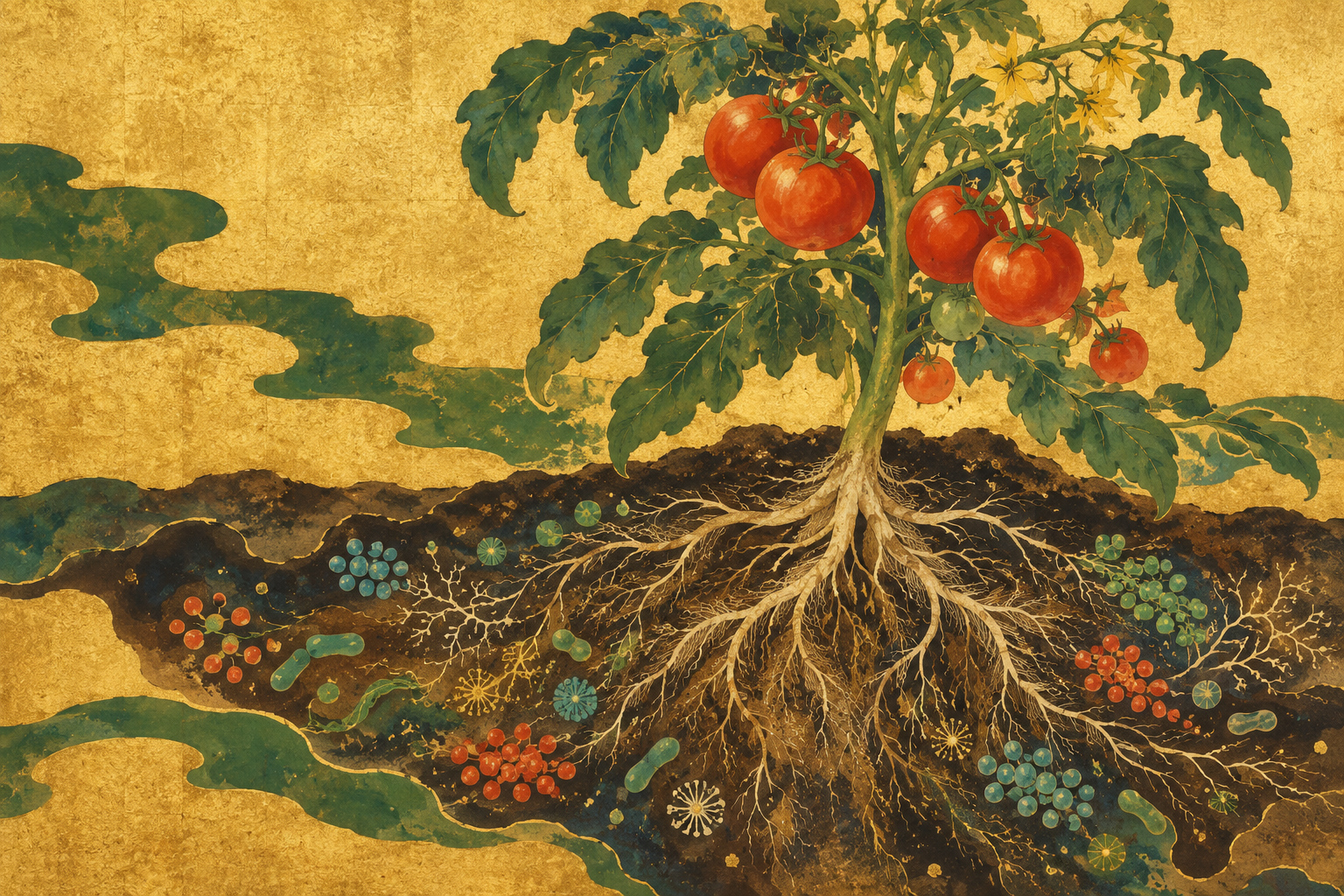
The rhizosphere is the zone influenced by plant roots. JST’s account of its rhizosphere research describes a chemical environment shaped by metabolites from plants and soil microbes. Understanding growth means investigating those exchanges, as well as the organisms involved. [8]
A defined microbial community, or DMC, makes part of that complexity experimentally manageable. Researchers specify its members so they can compare outcomes after changing the mixture. Such communities are also called SynComs. In the new study, the starting materials included nine root-derived bacteria and the plant compounds tomatine and daidzein, tested with different temperature conditions. [3]
Even a small collection creates many possibilities. With nine bacteria treated simply as present or absent, there are 512 possible selections, including the empty selection. This is Japan.co.jp’s illustrative calculation, not the reported number of experiments. Add other experimental choices and the practical value of prioritizing candidates becomes clear.
“Design” here concerns the selection of a community. It is not a claim that a computer has recreated the entire soil ecosystem. The scientific advantage of a smaller, specified system is that researchers can ask a sharper question about what changes when a member or condition changes.
What the model learned—and what it cannot settle
The paper’s abstract identifies a quality-controlled modeling dataset of 301 plants representing 102 community compositions. The team used Elastic Net regression; adding microbial genomic features improved predictive performance. Model-selected communities then went into laboratory and field validation. [2]
Elastic Net has a history extending well before the present enthusiasm for AI. Hui Zou and Trevor Hastie introduced the method in 2005. It combines coefficient shrinkage with variable selection and can handle groups of correlated predictors. Its purpose is to manage a statistical model when many possible explanatory variables compete for attention. [4]
In Japan.co.jp’s assessment, the useful question is not whether the method sounds advanced. It is whether its ranking sends researchers toward better experiments. A model must earn its place by helping allocate scarce growing space, time and analytical effort.
Genomic information adds another dimension to that task. An organism’s identity is not a complete description of its potential functions. Equally, possession of a gene does not guarantee that a function will operate effectively in a particular field. Better prediction and a complete explanation of causation remain different achievements.
The finding that matters
The joint release reports that DMC G2, a six-bacterium community combined with tomatine, improved growth and heat-stress tolerance in laboratory testing. It also reports a significant increase in aboveground fresh weight with G2 in a field trial. [3]
Fresh weight measures plant material without first drying it. It is a growth measure, distinct from the number, quality or saleable weight of harvested tomatoes. A grower ultimately needs evidence about the crop reaching market, including whether any benefit survives the costs of applying the treatment.
The distinction identifies the next experiment rather than diminishing the completed one. Japan.co.jp reads this as progress in selecting and validating growth-supporting communities. It should not be converted into a claim of proven commercial yield gains, sweeter fruit or a replacement for ordinary crop management.
Why a tomato’s own chemical enters the story
Tomatine brings a particularly relevant history. In 2021, Kyoto University reported work showing that tomato roots release the compound in both hydroponic and field cultivation, and that it changes surrounding bacterial assemblages. A substance associated with plant defense also helped explain which bacteria gather around roots. [7]
That history makes the present experiment easier to understand. Supplying organisms is one intervention; considering the chemical conditions around them is another. The plant itself participates in shaping those conditions. A community therefore cannot always be understood as a list of microbes added to an otherwise passive host.
The new release identifies a correlation between growth and the abundance of the tomatine-metabolizing strain Sphingobium sp. RC1. It also reports increased expression of heat-shock-factor and heat-shock-protein genes in roots under heat stress. [3] These are clues to investigate, not proof that one bacterium independently explains the entire benefit.
There is a practical reason to care about that distinction. If a response depends on partners and chemical context, isolating the most conspicuous organism may not reproduce it. Japan.co.jp’s interpretation is that the community should remain the unit of investigation until experiments establish which contributions can be separated.
A decade of learning to reconstruct plant microbiomes
One important precedent appeared in Nature in 2015. Bai and colleagues established bacterial culture collections from Arabidopsis leaves and roots and used synthetic communities to investigate colonization of germ-free plants. The work helped connect observations of natural communities with systems whose membership could be controlled experimentally. [5]
The conceptual step matters: identifying organisms in a sample answers a different question from rebuilding a community and changing its members. The latter offers a route toward testing function, while still simplifying what happens outside the laboratory.
Japan’s research history includes another complementary development. In 2020, RIKEN and collaborators reported multi-omics work integrating plant, microbial and soil information in komatsuna cultivation on farmland in Chiba. [6] That was a separate study, not an earlier round of the present tomato experiment. It nevertheless illustrates the move toward studying agricultural outcomes through relationships across several biological and environmental layers.
JST’s account of its rhizosphere chemical-world project likewise connects metabolite analysis, community construction, computational selection and field testing. [8] The background to this news is therefore a sustained effort to make root-zone biology measurable and experimentally useful.
In Kyoto University’s Japanese announcement, Sugiyama describes the collaboration across laboratory work, field experiments and informatics, and looks toward further investigation of root-associated microbes and metabolites. [9] The work depends on those disciplines meeting: computation can propose a candidate, but cultivation must establish what the candidate does.
The road from a trial to a usable input
Japan.co.jp’s analysis is that the next decisive tests concern reproducibility and agricultural value. Does a benefit persist across soils, cultivars and growing seasons? Can a community be prepared consistently, stored and transported, and applied within a workable cultivation routine?
Those questions require evidence beyond model performance. So do costs, compatibility with other inputs and effects on harvested fruit. A statistically detectable increase in a measured trait does not automatically establish that a farmer should change practice.
The same care applies to environmental stress. Evidence concerning heat does not establish protection against drought, salinity or disease. Each proposed extension needs its own comparison and outcome measures. A promising research platform can justify that work without pre-empting its results.
The enduring contribution may be the discipline of the process: assemble a tractable biological system, learn from it, select the next candidates, and return to experiments. Instead of treating beneficial microbes as interchangeable additions, the study makes their relationships part of the design problem.
For tomato farming, the commercial destination remains to be demonstrated. For science, the advance is already concrete: a better way to turn a crowded set of biological possibilities into questions that can be tested in living plants.
- Tohoku University, Japanese institutional announcement, September 9, 2026
- Yamazaki et al., Model-guided design of defined microbial community reveals interactions underpinning plant growth and stress tolerance, The ISME Journal, August 26, 2026; abstract and publication record
- Tohoku University, Kyoto University and RIKEN, detailed joint release, September 9, 2026
- Zou and Hastie, Regularization and Variable Selection Via the Elastic Net, JRSS Series B 67, 301–320, 2005
- Bai et al., Functional overlap of the Arabidopsis leaf and root microbiota, Nature 528, 364–369, 2015; university-hosted paper
- RIKEN, digitizing the agricultural ecosystem through multi-omics, June 9, 2020
- Kyoto University, tomato-root tomatine and rhizosphere bacteria, February 26, 2021
- Japan Science and Technology Agency, the rhizosphere chemical world and crop robustness, CREST project account
- Kyoto University, research announcement and Akifumi Sugiyama’s Japanese comments, September 9, 2026