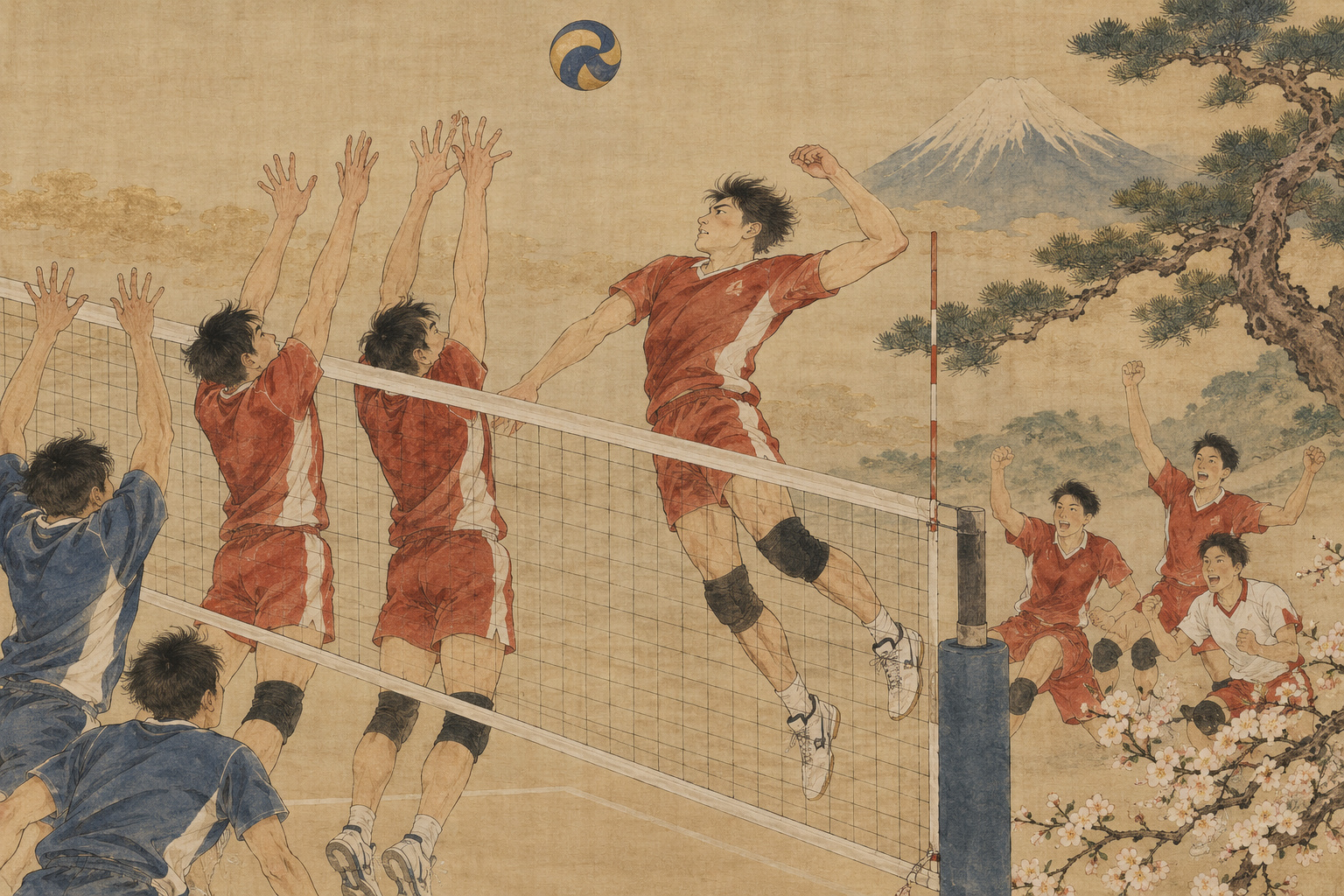
Japan’s reward for beating Iran in the Asian Championship final was unusually valuable: a continental title and almost two years of certainty about its Olympic destination. The Japanese federation confirmed that the September 13 victory in Kitakyushu secured a place at Los Angeles 2028. Qualification is now an achieved result, not a projection based on the world rankings.[1]
The final finished 3–0, with set scores of 25–21, 26–24 and 25–23. Those last two margins tell a more useful story than the word “sweep.” Japan completed the decisive work in close sets, turning a competitive final into a clean result. The next challenge is to make that execution reliable against the strongest teams beyond Asia.[3]
The work behind the winning attack
According to the Japan Volleyball Association’s account, Yuki Ishikawa ended the second set with an ace. The championship-clinching rally depended on another skill first: Tomohiro Yamamoto covered a blocked ball, allowing Ishikawa to attack again and score off the opposing block. The finisher had been given another chance by a teammate.[1]
That sequence is a useful way to understand a collective sport often presented through individual highlights. A blocked attack need not end a rally if teammates are positioned to retrieve it. Covering the hitter is part of offense as well as defense: it preserves the possibility of another swing. The final point rewarded both the player who finished and the player who kept the exchange alive.
Volleyball World reported 18 points for opposite Yuji Nishida and 17 for outside hitter Ran Takahashi. Nishida contributed three scoring blocks and two aces; Takahashi served three aces. Japan captured its 11th Asian title, with Takahashi named tournament MVP. These figures show scoring contributions across several skills, rather than from attacking alone.[2]
An ace settles a rally without permitting a constructed reply. A serve that stays in play can also be valuable if it limits the receiver’s options, but counting that effect requires more than the ace total. Reception quality, setting position and the subsequent attack all matter. The available headline statistics should not be stretched into a complete account of Japan’s tactical superiority.
The individual awards recognized several roles. Alongside Takahashi’s MVP and best outside hitter honors, Hideomi Fukatsu was selected as best setter and Taishi Onodera as a best middle blocker. The recognition extended from the wings of the attack to its distribution and its work at the center of the net.[1]
Why this Asian title carried an Olympic place
The qualification mechanism is explicit. Under the system approved by the IOC and FIVB and announced in December 2025, each of the five 2026 continental championships awards one Olympic quota place per gender. Winning Asia therefore delivered a direct berth, rather than merely improving Japan’s prospects in a later ranking race.[5]
There are 12 places in the men’s Olympic tournament: one for host United States, five through continental championships, three for the highest eligible teams at the 2027 global championship, and three through the world ranking at the end of the 2028 VNL preliminary phase. The latter two routes exclude teams already qualified. Japan no longer needs either of them to obtain its place.[5]
The final should also be distinguished from qualification for the 2027 World Cup. FIVB’s continental arrangements give that tournament places to the three highest eligible finishers in each confederation. Japan and Iran secured theirs by reaching the Asian final. The extra prize at stake on Sunday was the Olympic berth, along with the continental crown.[6][13]
There is a terminology change behind the World Cup reference. FIVB announced in March 2026 that its World Championship would take the name FIVB Volleyball World Cup from 2027. The next men’s edition is in Poland. Readers familiar with the older Japan-hosted World Cup should understand that this is the renamed global championship, not simply a return to the old qualifying event.[7]
A different test from the semifinal
The Fukuoka competition brought together 12 teams in three groups of four. The top two in each group and the two best third-place teams advanced to an eight-team knockout stage. That structure concentrates the title race into matches in which a poor performance cannot be repaired by winning the next fixture.[14]
Japan beat India in straight sets in the quarterfinal and Korea in straight sets in the semifinal. Against Korea, it conceded only 13, 11 and 14 points across the three sets. Iran presented a substantially closer final, judged by the two-point margins in the second and third sets. Japan had to move from controlling a match comfortably to resolving it under tighter pressure.[3]
A close finish places a premium on repeatable decisions: where to serve, when to challenge the block, how to protect an attacker and how to recover after a disrupted first touch. Winning such exchanges is evidence of execution on the day. It is not a permanent certificate of superior nerve. The useful question is whether the same work survives different opponents and different match situations.
A history of podiums—and a harder Olympic threshold
Japan’s men have their own foundational Olympic history: bronze at Tokyo 1964, silver at Mexico City 1968 and gold at Munich 1972. The Japanese Olympic Committee’s historical account records that sequence. It belongs alongside the better-known story of the Japanese women, rather than being absorbed into it.[8]
The recent rise also predates this championship. At the 2023 Nations League, Japan defeated Italy 3–2 in the bronze medal match. In 2024, it reached the final and took silver after losing 1–3 to France. These were results against a broad international field, demonstrating that Japan could contend well beyond its continent.[9][10]
Then came the more severe lesson of Paris 2024. In the Olympic quarterfinal, Japan won the opening two sets against Italy before losing the remaining three, 25–27, 24–26 and 15–17. A team capable of reaching a major international final still fell short in the match that controlled access to the Olympic semifinals.[11]
The most recent VNL supplies another necessary check on triumphalism. Japan finished fourth in 2026, losing its semifinal to the United States in five sets and its bronze medal match to Slovenia in four. Those results and the Asian gold belong in the same assessment. Japan can challenge leading international opponents; converting that competitiveness into a podium finish remains demanding.[12]
The historical comparison is useful because it separates progress from inevitability. A continental victory does not erase earlier defeats, but earlier defeats need not define the next cycle either. Results identify the standard already reached and the situations that still require work. Olympic qualification creates room to address those questions without simultaneously fighting for admission.
Depth means more than names on a roster
JVA’s championship roster lists Laurent Tillie as head coach and multiple options at specialist positions: Fukatsu and Yudai Kawahigashi at setter, Nishida and Kento Miyaura at opposite, and Tomohiro Ogawa and Yamamoto at libero. Selection offers the possibility of depth; match-ready coordination is what makes that possibility useful.[4]
Changing a setter can change the timing a hitter expects. A poor reception can force someone other than the setter to deliver the second contact. Covering a blocked attacker requires several players to anticipate the same possibility. A substitute becomes a genuine option when those shared decisions hold together after the lineup changes.
The tournament roster also spans domestic clubs and clubs in Turkey, Poland and Italy. Different club environments can expose players to different serving patterns, blocking systems and competitive habits. That diversity is an opportunity for the national team, but overseas employment is not itself an explanation for victory. Experiences have to become a common way of playing when the squad assembles.[4]
Early qualification gives the coaching staff more scope to balance experimentation with continuity. They can consider which matches should develop combinations, which should test alternatives and how preparation fits around club commitments. These are potential benefits of the berth, not an announced Japanese training or rest program. A longer horizon still has to be used deliberately.
What Japan has earned time to do
The Olympic place belongs to the team; it does not settle the eventual playing roster. Form, fitness and competition for roles will continue to matter. For developing players, the achievement can make the target more concrete: contribute to a side that must become more adaptable while preserving the connections that already work.
The final’s scores also offer a sensible measure for the next stage. Japan did not need to overwhelm Iran in every exchange; it needed to win the sets. Against stronger or less familiar opposition, maintaining that ability will require dependable reception, several attacking options and the discipline to keep a blocked ball alive. These are development priorities suggested by the match, not guarantees extracted from it.
Kitakyushu delivered a title and a destination. The value of the second prize will emerge in how Japan prepares between now and Los Angeles. The last rally offers an appropriate image for that task: an attack stopped, a teammate keeping it alive, and another opportunity made good. The work ahead is to produce that cooperation when the next opponent makes it harder.
Sources and references
- JVA: Japan beats Iran and earns Olympic qualification, September 13, 2026
- Volleyball World: Japan triumph as Asian champs and qualify for LA 2028, September 13, 2026
- JVA: 2026 Asian Championship results
- JVA: 2026 Asian Championship Japan roster and head coach
- FIVB: approved LA28 qualification systems, December 11, 2025
- FIVB: continental championships and Olympic/World Cup qualification, August 8, 2026
- FIVB: World Championship renamed World Cup from 2027, March 5, 2026
- Japanese Olympic Committee: historical volleyball overview for Beijing 2008
- JVA: 2023 VNL final standings and results
- JVA: 2024 VNL final standings and results
- JVA: Paris 2024 Olympic match results
- JVA: 2026 VNL final standings and results
- Volleyball World: Japan and Iran reach final and qualify for World Cup, September 12, 2026
- JVA: 2026 Asian Championship competition format and venue
Evidence reviewed September 14, 2026, Japan time. The September 13 final result and Olympic qualification were checked against federation and competition records. Interpretations are Japan.co.jp analysis unless otherwise attributed.