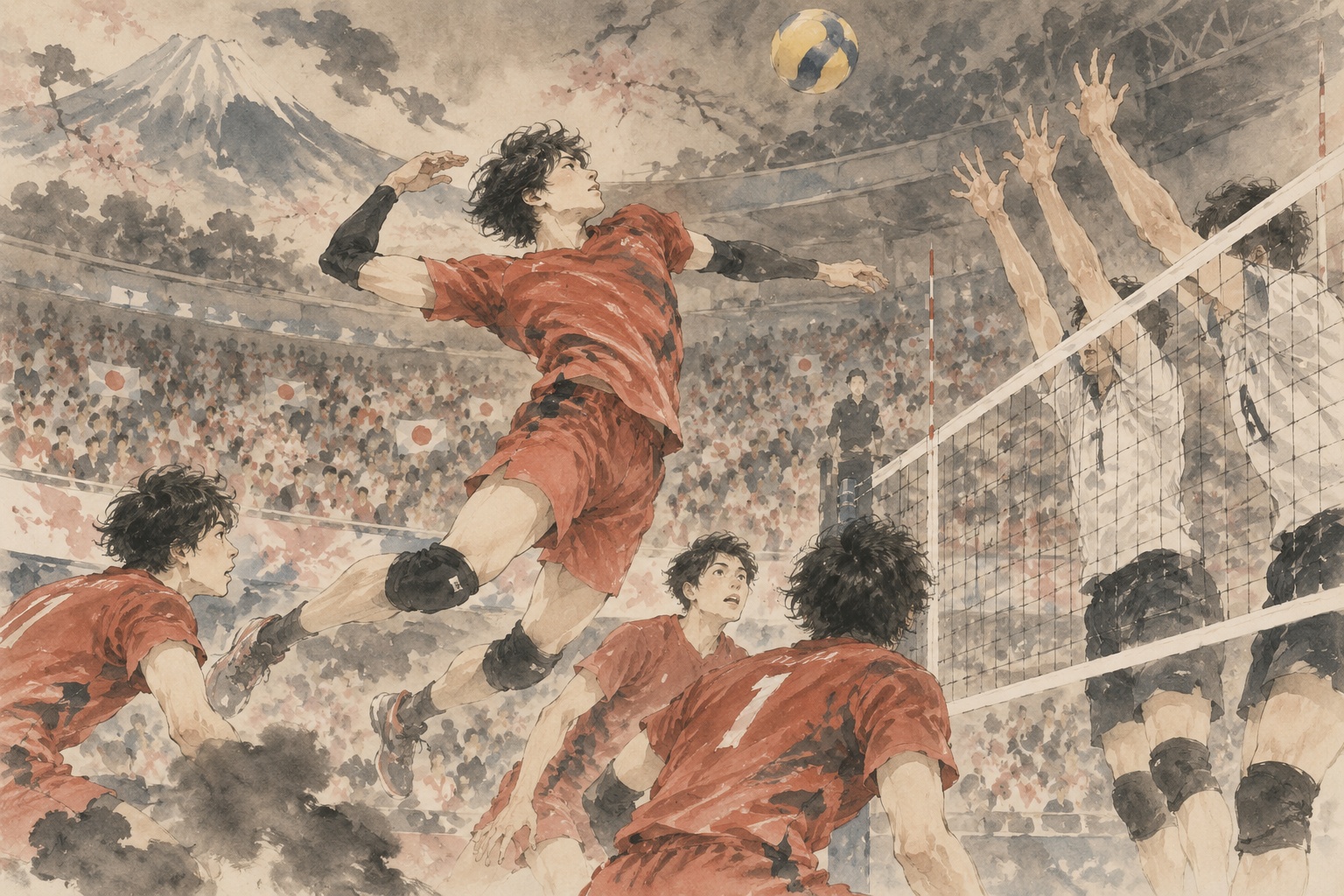
Japan is one win from the shortest possible road to Los Angeles. On September 12 in Kitakyushu, the men’s national team swept Korea 3–0 (25–13, 25–11, 25–14) to reach the AVC Men’s Asian Championship final. Iran, which defeated Australia 3–1 in the other semifinal, waits on Sunday. The stakes are unusually clean: the winner takes the Asian title and the continental berth for the men’s volleyball tournament at the Los Angeles 2028 Olympic Games.[6] [7] [8]
By reaching the final, Japan has already secured qualification for the 2027 World Cup under the tournament pathway described by Volleyball World. But the larger prize is still on the floor. Before the tournament, captain Yuki Ishikawa said Japan had to win the championship and secure the Olympic ticket. Five victories later, that goal has been reduced to one match.[9] [13]
Japan reaches the final having lost only one set
The campaign began against Oman on September 4. Japan dropped the third set but won 3–1. Yuki Ishikawa and Ran Takahashi scored 19 points each, Yuji Nishida added 14, and Japan finished the fourth set 25–9 after working through the early-tournament stiffness.[2] [4]
Japan has not lost a set since. Bahrain was swept 25–15, 25–15, 25–23. Australia went down 25–20, 25–13, 25–21, leaving Japan first in Pool A at 3–0. The quarterfinal against India was another straight-set win, 25–17, 25–15, 25–19. Takahashi scored 14; Ishikawa and Nishida each had 12.[2] [5] [9]
Then came the most emphatic performance yet. Korea managed only 13, 11 and 14 points in the semifinal. Ishikawa led with 15 points, Takahashi had 14 and Nishida 10. Across five matches, Japan has dropped just one set — the third against Oman on opening night.[6] [7]
| Date | Opponent | Result |
|---|---|---|
| Sept. 4 | Oman | 3–1 |
| Sept. 6 | Bahrain | 3–0 |
| Sept. 8 | Australia | 3–0 |
| Sept. 11 | India | 3–0 |
| Sept. 12 | Korea | 3–0 |
Iran has earned its place in the last match too
Iran came through Pool B by beating New Zealand 3–0, India 3–0 and China 3–1. In the quarterfinal it defeated Chinese Taipei 3–1. Volleyball World reported that 22-year-old outside hitter Porya Khanzadeh scored 24 points in that match, attacking at 67% and adding two blocks. Captain Amin Esmaeilnezhad and Morteza Sharifi added 12 points each.[9]
In the semifinal, Iran defeated Australia 3–1, 25–21, 17–25, 25–17, 25–22. It has not moved through the tournament quite as cleanly as Japan, but it has shown the ability to lose a set, reset, and reassert pressure with serve and block.[8]
That is the obvious danger for Japan. Iran can change a match with a small number of high-impact plays: a serving run, a stuff block, a transition swing off a poor pass. If Japan’s reception is pushed away from the net, its offense becomes easier to read. If Hideomi Fukatsu can keep the middle available and play at speed, Iran’s size becomes much harder to organize.
A third straight Asian Championship final between Japan and Iran
This final has history behind it. In the 2021 Asian Championship in Chiba, Japan and Iran met for the title. Iran won 3–0, but every set was competitive: 27–25, 25–22, 31–29. Ishikawa was named a best outside hitter and Kento Miyaura the best opposite, but Iran took the championship.[10]
Two years later in Urmia, Iran, the result flipped dramatically. Japan beat the hosts 3–0, 25–20, 25–18, 25–18. Ishikawa was named tournament MVP, while Taishi Onodera and Ran Takahashi were selected to the best six. Japan’s win was built not only on Ishikawa’s scoring but on Tomohiro Yamamoto’s defense, varied setting, serving pressure from Takahashi and Nishida, and middle offense from Onodera.[11]
Now, in 2026, the teams meet in the final for a third consecutive edition. In simple narrative terms, Iran won in Japan in 2021 and Japan won in Iran in 2023. Sunday brings them to Fukuoka with something more valuable than the series narrative at stake: an Olympic place that can be secured immediately.
Laurent Tillie’s first major one-match test with Japan
Japan is coached in 2026 by Laurent Tillie. The tournament roster includes Ishikawa, Takahashi and Nishida, setter Hideomi Fukatsu, middles Taishi Onodera, Akihiro Yamauchi, Larry Evbade-Dan and Keigo Nishimoto, and liberos Tomohiro Yamamoto and Tomohiro Ogawa among the 14 selected players.[3]
The basic architecture is familiar. Ishikawa and Takahashi carry both reception and scoring. Nishida gives Japan a left-handed high-ball option from the opposite position. The middle blockers add size and first-tempo pressure. The liberos give Japan the defensive platform needed to play multiple transition phases rather than relying only on first-swing offense.
The final, however, will demand more than reproducing the Korea match. Iran offers more blocking height and more serving pressure. If Japan is pushed into repeated high balls, its speed advantage shrinks. The challenge is to keep Fukatsu able to use the middle and the pipe attack even when reception is not perfect.
Key 1: serve before Iran can use its height
Japan’s best way to beat a taller block is often to prevent that block from forming in ideal conditions. Strong serving can force Iran’s reception off the net and narrow the setter’s options. If quick middle attacks become less available, Japan’s blockers can close more aggressively toward the pins.
Against India, Japan produced seven aces and held a 42–26 advantage in attack points, according to Volleyball World. Against Korea, early serving and transition runs created separation before the sets became tactical. In the final, the balance will be between pressure and waste: Japan needs serving aggression without donating too many errors.[9]
Key 2: Ishikawa and Takahashi matter even when they are not scoring
The two outsides are Japan’s visible stars, but their value in a final extends beyond point totals. They have to pass well enough to remain available in attack, defend in long rallies, recycle difficult swings off the block and turn broken plays into neutral balls instead of direct points for Iran.
Ishikawa scored 15 and Takahashi 14 against Korea. Takahashi had 14 against India and Ishikawa 12. Their scoring has been stable. Iran may therefore try to make them work before the attack even begins — serving them repeatedly, forcing movement, and making Japan’s left-side offense start under pressure.[7] [9]
Key 3: Nishida’s left hand is strongest when the middle is still alive
Nishida gives Japan a terminal attacker who can score from imperfect positions. But if Iran can commit early to him because the middle attack has disappeared, the advantage shrinks. Onodera, Evbade-Dan and Yamauchi need to be credible early so the Iranian middle blockers cannot simply wait for Nishida or the outside hitters.
That puts a great deal on Fukatsu. His job is not merely to run the fastest offense when the pass is perfect. It is to keep multiple zones available when the ball is slightly off the net, to use back-row attacks at the right moments, and to prevent the match from becoming a predictable sequence of high balls into a tall block.
Why taking the Olympic ticket now matters
Los Angeles is still almost two years away, and defeat in this final would not end Japan’s Olympic pathway. But securing qualification now would change what every tournament afterward means. Instead of playing future events with qualification pressure, the national team could use them more aggressively for selection, tactical experimentation and the development of younger players.
Japan left Paris 2024 without a men’s volleyball medal despite proving that it could compete with the world’s best. The lesson from elite knockout volleyball was also harsh: being good enough to contend is not the same as winning the one match that decides a tournament. The LA28 cycle now offers another opportunity to change that story.
That is why world ranking and Japan’s one-set-lost record should not be mistaken for guarantees. Iran has the same one-match incentive. Once the first serve is struck, the difference between sixth and seventeenth in the world ranking means less than the quality of the next side-out.
- Whether Japan can push Iran’s first five receptions away from the net with serve pressure.
- Whether Ishikawa and Takahashi can pass and still enter the offense on time.
- Whether Fukatsu can establish Onodera, Evbade-Dan and the middle attack early.
- How Japan chooses to contain Porya Khanzadeh — with block positioning, floor defense, or both.
- Whether Japan avoids service errors and direct block points after 20 in tight sets.
Finish the Olympic qualification story in Fukuoka — or continue it elsewhere
Japan has been almost spotless through five matches. That record disappears at the first whistle of the final. Iran has also survived every challenge placed in front of it and enters with the same objective.
The rivalry goes back beyond 2021 and 2023. Japan also defeated Iran 3–1 in the 2015 Asian Championship final. Across the modern history of Asian men’s volleyball, the two countries have repeatedly found each other near the top of the bracket.[12]
The 2026 final is scheduled for 19:30 JST on September 13 at Kitakyushu City General Gymnasium. Win, and Japan becomes Asian champion and qualifies for Los Angeles 2028 on the same night. Lose, and the Olympic campaign continues. That is the cleanest way to understand the match. Everything Japan has done in Fukuoka has brought it to one contest. The phrase Ishikawa used before the tournament — a match Japan cannot afford to lose — has finally become literal.
- Japan Volleyball Association: Fukuoka 2026 tournament format, venue and field
- Japan Volleyball Association: Japan's results against Oman, Bahrain, Australia and India
- Japan Volleyball Association: Japan roster and head coach Laurent Tillie
- Japanese Olympic Committee: Japan 3-1 Oman and LA28 qualification stakes
- Japanese Olympic Committee: Japan 3-0 India in the quarterfinal
- Kyodo/Kumamoto Nichinichi Shimbun: Japan 3-0 Korea in the semifinal
- The Answer: Korea semifinal set scores and scoring leaders
- NTV News: Iran 3-1 Australia in the semifinal
- Volleyball World: quarterfinal details and 2027 World Cup / LA28 qualification stakes
- Japan Volleyball Association: 2021 Asian Championship final, Iran 3-0 Japan
- Japan Volleyball Association: 2023 Asian Championship final, Japan 3-0 Iran
- Japan Volleyball Association: historical Asian Championship record
- Japanese Olympic Committee: Yuki Ishikawa's pre-tournament comments on winning the title and Olympic berth
Editorial note: This is a pre-final preview prepared with information available through early September 13 JST. It does not contain the Japan–Iran final result. The Japan–Korea semifinal result, set scores and leading scorers are confirmed through Kyodo/domestic sports reporting; Japan's roster, tournament structure, earlier results and historical Asian Championship record are anchored primarily in JVA/JOC material. Japan.co.jp will publish a separate results story after the final.