On June 9, Toray put a blunt sentence into a presentation about carbon-fibre composites. Hydrogen infrastructure had been delayed. The cost of introducing hydrogen had remained high. Hydrogen-vehicle demand had therefore failed to expand, reducing demand for hydrogen tanks and fuel-cell electrode materials. The admission mattered because Toray was not an outside critic. It makes the carbon paper, gas-diffusion layers, membrane-electrode components and tank materials that a fuel-cell vehicle needs.
The slide was an industrial echo of an empty forecourt. Japan had spent three decades building the technical pieces of a “hydrogen society”: world-class fuel cells, 70-megapascal tanks, filling stations, a liquefied-hydrogen carrier, a 10-megawatt-class electrolyzer in Fukushima and turbines capable of burning hydrogen-derived ammonia. Much of it worked. Yet a supplier that expected those pieces to become a large vehicle market was now explaining why its business plan had missed.
That distinction—technical capability versus economic system—is the key to Japan’s next hydrogen chapter. An electrolyzer can split water. A pump can move liquid hydrogen at cryogenic temperature. A stack can turn hydrogen back into electricity. None of those facts guarantees that the completed chain will beat a battery, natural gas, direct electrification or simple energy conservation for a particular customer. Nor does the absence of carbon in the molecule guarantee that its production was low-carbon.
The future once arrived as a passenger car
Japan’s faith in fuel cells grew from real engineering. During the 1990s, the New Energy and Industrial Technology Development Organization supported proton-exchange-membrane fuel-cell research; Toyota and Honda began road trials; and Japan looked for an answer to oil dependence, urban air pollution and carbon emissions. Fuel cells offered quiet electric driving with fast refuelling and long range. Their exhaust was water.
Honda leased an FCX in Japan and the United States in 2002. Toyota did the same with its FCHV. The second-generation Honda FCX Clarity reached limited customers in 2008. In December 2014, Toyota put the Mirai on sale in Japan. Its name meant “future,” and the choreography was deliberate: cars and stations would be introduced together in the major metropolitan regions, costs would fall with volume, and a national network would follow.
The government gave that future numbers. The 2016 roadmap aimed for about 40,000 fuel-cell vehicles by 2020, 200,000 by 2025 and 800,000 by 2030. The station ambitions rose from 160 in fiscal 2020 to 320 in fiscal 2025. A 2019 revision retained the vehicle milestones and described roughly 900 stations by 2030. These were not forecasts scribbled by enthusiasts; they were organising targets intended to coordinate automakers, gas companies, station operators and buyers.
Then the coordination machine stalled. Station operators needed cars to sell enough kilograms. Consumers needed stations before trusting a car. Automakers needed both before manufacturing at scale. Hydrogen suppliers needed predictable throughput before reducing logistics costs. METI later called the commercial-mobility version a “three-way stalemate.” Passenger cars had already demonstrated the same trap.
1990s Japan expands polymer-electrolyte fuel-cell research and road testing.
2002 Honda and Toyota begin limited fuel-cell vehicle leasing.
2009 Ene-Farm residential fuel-cell systems go on sale.
December 2014 Toyota launches the first-generation Mirai in Japan.
March 2016 The roadmap targets 40,000 FCVs in 2020 and 200,000 in 2025.
December 2017 Japan adopts the world’s first national Basic Hydrogen Strategy.
June 2023 A revised strategy adds large supply goals and a ¥15 trillion public-private investment vision.
May–October 2024 The Hydrogen Society Promotion Act is enacted and takes effect.
June 2026 Toray says delayed infrastructure and high adoption costs prevented hydrogen-vehicle demand from expanding.
The scoreboard cannot be massaged
At the end of fiscal 2020, Japan had 5,170 passenger FCVs—13% of the 40,000 target. The latest official passenger-car stock is 8,289 at the end of fiscal 2024. That is only 4.1% of the 200,000 vehicles once targeted for 2025, or a shortfall by a factor of about 24. New sales did not show an imminent breakout: 523 passenger FCVs were sold in fiscal 2024, compared with 33,933 battery-electric passenger cars.
Station counts require care. Different public bodies count different networks and dates; closures and temporary service status can change the total. Japan H2 Mobility, the joint venture created to build stations, listed 142 supported sites on July 31, 2026. That is 44% of the old 320-station fiscal-2025 ambition. It is not valid to divide a July 2026 station count by a March 2025 vehicle stock and call the result a current utilisation rate. It is valid to say both sides of the programme remained far below the scale imagined a decade earlier.
| Measure | Earlier ambition or comparison | Latest dated public figure used here | What it says |
|---|---|---|---|
| Passenger FCV stock | 40,000 in 2020 | 5,170 at FY2020 end | 12.9% of target |
| Passenger FCV stock | 200,000 in 2025 | 8,289 at FY2024 end | 4.1% of target; latest official stock is not a live 2026 count |
| Hydrogen stations | 320 in FY2025 | 142 JHyM-supported sites, July 31, 2026 | 44.4%; definitions and dates differ across station lists |
| FY2024 passenger sales | Technology comparison | 523 FCVs; 33,933 BEVs | About 65 battery cars were sold for every FCV |
| Ene-Farm systems | Different fuel-cell market | 582,940 cumulative shipments by March 2026 | Fuel-cell hardware can scale when it uses an existing fuel network and a steady heat load |
The figures do not mean every station or car was wasted. Early users created operating data, codes, safety practice, maintenance skills and public familiarity. Japan’s automakers pushed stack durability and cold-start performance. Station developers learned to compress, meter and dispense at 70 MPa. But a demonstration asset and a self-supporting market are not the same category of achievement.
Ene-Farm proves the stack was not the whole problem
Japan has a mass-market fuel-cell product. It sits beside houses, not on highways. Ene-Farm systems went on sale in 2009 and had reached 582,940 cumulative shipments by March 2026, according to the industry partnership. That is roughly 70 times the latest official stock of passenger FCVs.
The comparison has to be handled honestly. Ene-Farm is not generally supplied with green hydrogen. A household unit typically reforms city gas or LPG on site, extracts hydrogen and feeds it to a fuel cell, while captured heat supplies hot water. Its climate benefit comes from combined heat and power and improved fuel utilisation, not from replacing fossil molecules with electrolytic hydrogen.
Yet its commercial history is revealing. Ene-Farm piggybacked on an existing gas distribution network, entered a home with a predictable electricity-and-hot-water load, operated many hours and displaced two household services at once. The customer did not have to drive to a new chemical installation. The system still relied on subsidy and cost reduction, but its supporting infrastructure was already under the street.
A hydrogen station is a chemical plant with a retail sign
A petrol station stores a liquid that arrives through a mature global system. A fast charger connects to an electrical network that already serves almost every building. A hydrogen station must receive or make hydrogen, purify it, compress it, chill it for fast dispensing, store it at multiple pressures, meter it safely and maintain specialised equipment under strict regulation. Low utilisation makes every kilogram carry more of that fixed cost.
The scale of public support shows the burden. For fiscal 2024, a large station with at least 500 normal cubic metres per hour of supply capacity could qualify for up to two-thirds of eligible construction cost, capped at ¥450 million. Separate operating support has offered annual caps in the tens of millions of yen, depending on capacity and opening hours. These policies can be justified as market-building; they are also evidence that dispensing infrastructure has not yet become ordinary retail real estate.
In 2014, Iwatani announced an initial retail price of ¥1,100 per kilogram before tax, consciously matching the running cost of a gasoline hybrid at the market’s opening. It was a strategic launch price, not proof that every kilogram covered the full cost of production, delivery, station capital and operation. There is no single public 2026 national pump price: supply route, station, contract and subsidy vary. Treating an old launch price as today’s unassisted market price obscures the central question.
Japan’s current commercial-vehicle policy is more explicit. In five priority regions centred on Fukushima, Tokyo–Kanagawa, Aichi, Hyogo and Fukuoka, the government said additional support of roughly ¥700 per kilogram would cover about three-quarters of the stated fuel-cost gap between diesel and hydrogen, alongside help for fixed and variable station costs. A subsidy can buy time for scale and learning. It cannot by itself demonstrate that the post-subsidy customer will remain.
Electricity has a shorter road to a passenger-car wheel
For green hydrogen, renewable electricity first powers electrolysis. The hydrogen is then compressed or liquefied, stored, transported and dispensed before a fuel cell turns it back into electricity. Each stage adds equipment, energy loss and financing risk. A battery-electric car sends grid electricity through a charger into a battery and motor. In an urban passenger car, where vehicles spend most of the day parked and trips are comparatively short, the shorter chain is a formidable advantage.
Hydrogen offers real qualities: light fuel relative to stored energy, fast refuelling and the possibility of separating energy production from the timing of use. But passenger cars seldom value those benefits enough to pay for a parallel fuel network. Home charging turns the car’s long parking time into an advantage. Battery prices and charging networks improved while hydrogen vehicles waited for scale; the competitor did not stand still.
This does not make every battery solution effortless. Apartment residents can lack chargers. Grid connections and high-power truck charging require investment. Cold weather, towing and very long daily distance can alter the comparison. Minerals, battery manufacturing and recycling carry environmental costs. The economic test is not “hydrogen has losses, therefore ban it.” It is “what service does hydrogen provide here that a simpler option cannot provide at lower system cost?” For most ordinary passenger trips, Japan’s sales record shows buyers have not found a convincing answer.
Trucks change the denominator, not the laws of economics
A heavy truck can consume much more fuel than a private car, operate almost every day and follow a planned route. Fifty trucks returning to one depot can create a dependable station load that thousands of scattered motorists cannot. Fast refuelling may protect payload and driver time on long duty cycles. The station can negotiate with professional fleet managers rather than wait for retail traffic.
This is why Japan’s policy has shifted toward commercial vehicles and corridors. METI’s 2023 mobility strategy brought vehicle makers, logistics companies, cargo owners and hydrogen suppliers into regional coordination. Its five priority regions seek clusters rather than uniform national coverage. JH2A’s Hydrogen Backbone discussion described an illustrative network of about 30 large stations, 50 trucks per site, 1,500 trucks and roughly 7,500 tonnes of annual hydrogen consumption. Those numbers are a scenario, not an order book, but they reveal the new unit of planning: kilograms per station, not vehicle logos at a motor show.
Toyota’s May 2026 Hyroad collaboration in California follows the same logic. Forty Class 8 fuel-cell trucks will be deployed with dedicated fuelling support, not sprinkled among household drivers. Toyota’s third-generation fuel-cell system is aimed at commercial vehicles as well as stationary and rail or marine uses. Honda, while ending production of its current GM joint-venture stack before the end of 2026, is developing an independent next-generation system for mobility and stationary power. The retreat is from one production arrangement and one market assumption, not from the electrochemical technology.
Still, not every truck becomes a hydrogen truck merely by being heavy. Battery trucks can be compelling on shorter, repeatable routes with depot charging, especially where electricity is cheap and dwell time is available. Fuel-cell fleets must prove total cost of ownership: vehicle price, fuel, station availability, maintenance, residual value, payload, uptime and the carbon intensity of every kilogram. High utilisation helps divide fixed cost; it also makes a fuel-price premium accumulate faster.
| Use | What hydrogen may solve | The economic and climate gate |
|---|---|---|
| Private passenger car | Fast refuelling and long range | Must beat convenient charging and a much shorter electricity pathway; dispersed demand weakens stations |
| Short-haul depot truck | Operational familiarity and central fuelling | Must beat battery truck plus depot charger on route-specific total cost |
| Long-haul, high-use truck or bus | Rapid fuelling, range, payload and shared corridor station | Needs high throughput, reliable stations, durable stacks and contracted low-carbon fuel |
| Refining, chemicals, steel, heat | Replace existing fossil hydrogen or perform a process difficult to electrify | Clean production, retrofit cost, product premium and durable offtake contract |
| Shipping and synthetic fuels | Store renewable energy in ammonia, methanol or e-fuels for long voyages | Multiple conversion losses, safety, port infrastructure, fuel standards and lifecycle emissions |
| Stationary or backup power | Resilience, long-duration storage, use of by-product hydrogen | Must value reliability or otherwise-stranded fuel enough to cover equipment and supply cost |
Industry and ports can turn scattered demand into a cluster
Hydrogen already has large industrial uses. Refineries remove sulphur and upgrade fuels; chemical plants make ammonia and methanol. Globally, hydrogen demand exceeded 100 million tonnes in 2025, according to the IEA, but almost all remained in established refining and industrial applications and almost all production remained fossil-based. The most direct decarbonisation task is therefore not inventing a new hydrogen use. It is cleaning the hydrogen already consumed.
Other processes may pay for hydrogen’s chemical properties rather than merely its heat. Hydrogen can replace carbon as a reducing agent in parts of ironmaking. It can supply high-temperature combustion or become a feedstock where direct electrification is difficult. Ammonia can carry hydrogen across oceans and be used as fertiliser feedstock, fuel or hydrogen carrier. Synthetic aviation and marine fuels can turn renewable hydrogen plus captured carbon into energy-dense liquids.
A port-industrial cluster makes those uses share assets. An import terminal, storage tank, pipeline, ammonia cracker, power generator, steelworks, chemical plant, truck station and ship bunker can draw from the same hub at different hours. Large anchor customers can sign contracts. Waste heat and by-product hydrogen can find nearby users. Japan’s projects in Fukushima, Hekinan, Kobe and coastal industrial zones are increasingly valuable not as isolated spectacles but as possible pieces of such systems.
The cluster is not magic. If every anchor project needs the same subsidy, the cost has merely been concentrated. If imported hydrogen is converted to ammonia, shipped, stored, cracked and reconverted, each step adds loss and capital. If the power used at origin is not additional and low-carbon, the emissions claim weakens. If one factory closes, a dedicated pipeline may lose its customer. Clustering improves the denominator; it also concentrates counterparty risk.
Japan is paying to cross a price gap, not declaring victory
The 2024 Hydrogen Society Promotion Act formalised Japan’s next approach. Approved projects can receive long-term support for the gap between the cost of low-carbon hydrogen or derivatives and a reference fuel, while strategic hubs can receive infrastructure support. The 2025 Energy White Paper described roughly ¥3 trillion for price-gap support. This is closer to industrial policy than consumer enthusiasm: government selects supply and demand projects, imposes carbon requirements and helps make early contracts financeable.
Japan’s 2023 Basic Strategy targets as much as 3 million tonnes of hydrogen and derivatives a year by 2030, 12 million tonnes by 2040 and around 20 million tonnes by 2050. It aims for a 2030 landed supply cost of ¥30 per normal cubic metre and ¥20 by 2050. Using the conventional approximation of 11.2 normal cubic metres per kilogram, ¥30 equals about ¥336 per kilogram before compression or liquefaction, domestic transport, station capital and retail operation. A national supply target is therefore not a pump price.
The IEA’s global review supplies the external reality check. Low-emissions hydrogen production was still near 1 million tonnes in 2025—about 1% of global demand. The announced 2030 project pipeline had shrunk to 27 million tonnes, but projects already operating, under construction or with strong potential amounted to just over 6 million. Only about one-fifth of 1.7 million tonnes of newly announced offtake in the previous year was backed by firm agreements. The missing technology was often a customer willing and able to sign.
Subsidising the first plants can be rational. Solar, wind, batteries, semiconductors and LNG infrastructure all grew through combinations of public research, deployment support, standards and scale. The test is disciplined learning: does each project reduce cost, reveal a durable high-value customer and create reusable infrastructure? Support that preserves low utilisation indefinitely is not a bridge. It is a destination.
Green at the tailpipe is not a lifecycle result
A fuel cell emits water at the vehicle. Hydrogen contains no carbon. Those statements are chemically correct and climatically incomplete. Hydrogen made from unabated natural gas or coal carries upstream emissions. Electrolytic hydrogen is only as low-carbon as the electricity and construction system behind it. Leakage can indirectly affect atmospheric chemistry. Ammonia avoids carbon at combustion but creates nitrogen-oxide and ammonia-slip challenges, and its hydrogen may still be fossil-derived.
Japan’s dependence on imports complicates the ledger. Liquefaction, conversion to a carrier, ocean transport, unloading, storage and reconversion consume energy. Carbon capture on fossil-based hydrogen does not capture every upstream or process emission. A credible contract therefore needs a measured lifecycle carbon intensity, system boundary, certification method and rules against double counting—not merely a colour adjective.
Imports can still have strategic value. Japan is resource-poor, and a portfolio of hydrogen, ammonia, synthetic fuels, LNG, nuclear power and renewables may diversify geopolitical and weather risk. Molecules can store energy longer than batteries and move it where power lines do not. But an imported hydrogen chain is diversification, not energy self-sufficiency. Its resilience depends on supplier concentration, shipping routes, terminal redundancy and the buyer’s ability to afford the cargo.
- Need: What job cannot be done more cheaply by direct electrification, efficiency or another fuel?
- Throughput: How many kilograms will each shared asset handle, and under binding contracts?
- Full cost: Who pays for production, conversion, transport, storage, dispensing and financing after support ends?
- Carbon: What is the certified lifecycle intensity, including power, methane, capture rate and shipping?
- Reliability: What backup keeps a furnace, truck route or data centre operating during a supply interruption?
- Learning: Which cost or risk should demonstrably fall before the next tranche of public money?
A smaller hydrogen strategy may be the more serious one
Japan is not abandoning hydrogen. It is abandoning the convenient assumption that one molecule should win everywhere. The emerging portfolio is visible across this August package: a fuel-cell excavator tested on a working construction site; a containerised Japanese electrolyzer exported to Finland; Fukushima hydrogen converted to green ammonia; six years of operating data from a 10-megawatt-class electrolyzer; a Nikkiso cryogenic pump in Kobe; Honda fuel cells repurposed for stationary and data-centre power; Toyota’s heavy-truck programme; Iwatani’s station network; JERA’s ammonia work; international corridor studies; and a procurement campaign designed to pull demand into the market.
Each project answers a different question. The excavator tests duty cycle and local emissions. The container tests manufacturability and export service. Fukushima tests flexible production and a carrier. Kobe tests cryogenic machinery. A data centre tests whether by-product hydrogen that might otherwise be underused can provide resilient power. Trucks test high-throughput refuelling. Ammonia tests bulk imports and existing thermal assets. They should not be added into one undifferentiated claim that “hydrogen works.”
The better portfolio rule is selectivity. Prioritise existing fossil-hydrogen users where a low-carbon replacement yields a measurable emissions cut. Back industrial processes that genuinely need a molecule. Concentrate commercial mobility on routes that can support stations. Use ports and industrial zones to share infrastructure. Treat passenger FCVs as a specialised option unless the economics change, not as the organising centre of national road transport. End projects that cannot show a path from demonstration to repeated, lower-support operation.
Toray’s June slide is valuable precisely because it records consequences. A slow vehicle market did not merely disappoint a sales forecast; it reduced demand upstream for tanks and electrode substrates, delayed capacity, intensified price competition and forced adjustment. That is how a system teaches—through the balance sheets of companies that built for the promised curve.
What success should look like by 2030
The old scorecard counted cars and stations. The new one should count contracted tonnes of certified low-carbon hydrogen, utilisation at each hub, delivered cost without temporary support, avoided lifecycle emissions per yen, hours of reliable operation and the share of customers that renew contracts. It should publish failures as carefully as records: stations closed, projects cancelled, carbon intensities missed and cost targets not reached.
Passenger-car numbers will remain useful because they prevent historical amnesia. A government cannot coordinate a market around 200,000 vehicles and then quietly redefine success when only a small fraction appears. But missing that target does not require Japan to discard every electrolyzer, stack, tank, pump or engineering skill developed along the way. It requires moving those capabilities to services where their unusual properties are worth paying for.
The hydrogen economy will not be won by proving that a beautiful machine can run once. Japan has done that repeatedly. It will be won, if at all, by a less cinematic achievement: the same clean molecule delivered every day, through shared equipment used close to capacity, to customers whose alternatives have been honestly compared and who sign again when the subsidy declines.
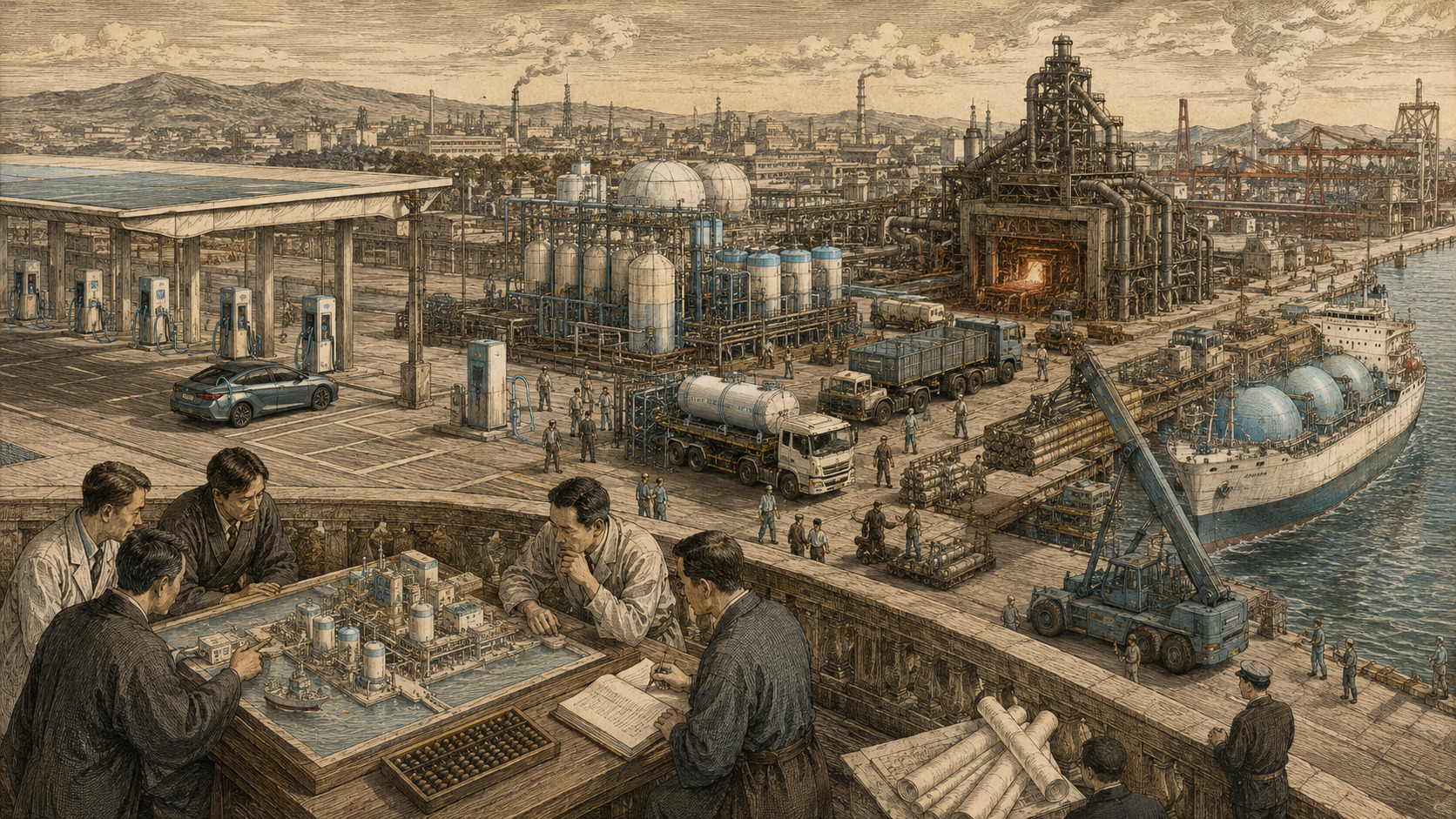
In the Renaissance theater of invention, the foreground was crowded with workers measuring, feeding furnaces, loading ships and keeping accounts. The lesson was that invention lived inside an economic world. Japan’s empty passenger forecourt and busy industrial port now belong in the same engraving. The technology works. The ledger has finally become the main experiment.
Reporting notes and principal sources
Vehicle stocks are year-end figures from Japan’s Next Generation Vehicle Promotion Center and lag the publication date; the latest available passenger-FCV stock used here is fiscal 2024. JHyM’s station figure is a July 31, 2026 count of its supported network, not necessarily every operating dispenser in Japan. The old 2025 vehicle and station targets are coordination goals, not forecasts. Percentages and ratios are Japan.co.jp calculations from the dated public figures. Ene-Farm and passenger FCVs use different fuels and deliver different services; the comparison illustrates infrastructure and utilisation, not identical climate performance. Toray’s June 9 statement is paraphrased from page 6 of its Japanese IR presentation.
- Toray: June 9, 2026 carbon-fibre composites briefing, hydrogen-vehicle demand and business impact
- Toray: commercial fuel-cell and hydrogen-tank materials
- Next Generation Vehicle Promotion Center: passenger-vehicle stock by powertrain
- Next Generation Vehicle Promotion Center: annual passenger-vehicle sales
- Japan H2 Mobility: supported hydrogen-station count
- Agency for Natural Resources and Energy: 2019 hydrogen and fuel-cell roadmap
- Agency for Natural Resources and Energy: 2017 Basic Hydrogen Strategy
- Government of Japan: early FCV and station targets
- TV Asahi: 2016 roadmap targets and contemporary station-cost estimates
- Ene-Farm Partners: fiscal 2025 and cumulative shipments
- Energy White Paper 2017: Ene-Farm’s 2009 market launch and early scale
- Next Generation Vehicle Promotion Center: fiscal 2024 hydrogen-station capital support
- Next Generation Vehicle Promotion Center: station operating support
- Iwatani: 2014 market-opening hydrogen price
- METI: the commercial-mobility “three-way stalemate”
- METI: five priority regions and commercial-vehicle fuel support
- Car Watch: Hydrogen Backbone meeting and 1,500-truck scenario
- Toyota: 2026 Hyroad heavy-truck collaboration
- Toyota: third-generation fuel-cell system and commercial applications
- Honda: end of current GM joint-venture production and next-generation system
- Honda: by-product hydrogen and stationary fuel-cell data-centre demonstration
- METI: Hydrogen Society Promotion Act design
- Energy White Paper 2025: price-gap and hub support
- Energy White Paper 2025: technology, industrial use and social implementation
- Energy White Paper 2024: national volume and cost targets
- IEA Global Hydrogen Review 2026: production, projects and offtake
- IEA Global Hydrogen Review 2026: industrial, transport, shipping and power demand
- IEA Global Hydrogen Review 2026: policy and Japan’s support selections
- JH2A: Hydrogen Backbone and one-percent demand initiative