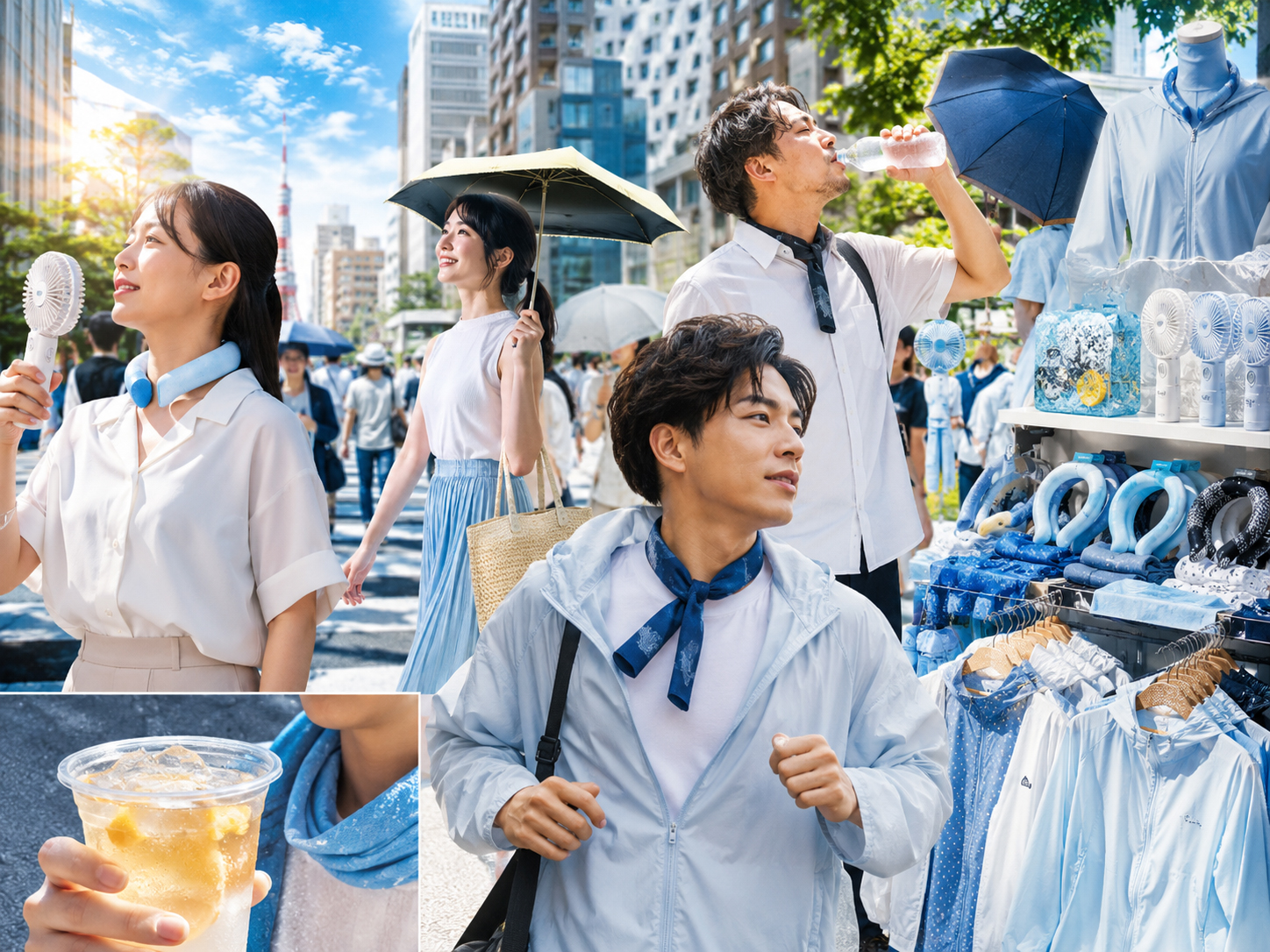
Japanese summer used to be a season of wind chimes, hand fans, shaved ice and sudden evening rain. Now it also comes with handheld electric fans, cooling neck rings, contact-cool shirts, fan-fitted jackets, heat-blocking parasols, cooling sheets, frozen neck wraps and salt tablets. Extreme heat is no longer just weather. It is lifestyle design. And companies have found a large market in helping people survive it.
Ahead of summer 2026, Japanese companies have been rolling out cooling products for commuters, seniors, children, outdoor workers and shoppers. As heatwaves lengthen, electricity costs rise and heatstroke becomes a public-health problem, consumers want ways to stay cool without relying only on air conditioning. This is not simply a gadget story. It is where climate change, aging, work culture, retail design, tourism and Japanese product ingenuity meet.
From Cool Biz to wearable cooling
The starting point for Japan’s modern summer-business story is Cool Biz. In 2005, the Ministry of the Environment encouraged offices to set air conditioners around 28°C and let workers dress more lightly. At first, it sounded almost radical. Could Japanese salarymen really remove their ties and still be taken seriously?
After the 2011 earthquake and power crisis, Cool Biz became more practical. Dress, electricity, work culture and climate policy began to blend. By 2026, Tokyo was again experimenting with cooler office wear. Japan’s heat response has moved from custom, to policy, to retail, to workplace common sense.
Why cooling products are everywhere
The reason is simple: heat has become dangerous. Nippon.com, summarizing Japanese weather and emergency-transport data, reported that 97,578 people were taken to hospital for heatstroke from May to September 2024. About 60% were seniors aged 65 and older. Older people may sense heat less strongly, avoid using air conditioning because of cost, or become dehydrated before they realize the danger.
But the risk is not only for seniors. Sales staff, delivery workers, construction crews, security guards, farmers, students, tourists, parents with strollers and office commuters all move through concrete and asphalt that store heat. Train platforms, bus stops and intersections often have little shade. This is how parasols, neck rings, cooling towels and wearable fans moved from “nice to have” to “I need this.”
The economy around the neck
The symbol of 2020s Japanese summer is the neck. Cooling rings use phase-change materials that freeze and melt around a comfortable temperature, cooling the neck where major blood vessels are close to the skin. Neck fans move air toward the face. Cooling towels use evaporation. The neck has become the new battlefield of summer product design.
Fashion matters. If a device looks too much like industrial safety gear, people may not wear it on a commute or shopping trip. Color, weight, battery life, fan noise, hair safety, child sizing and senior-friendly controls matter. Japanese companies are good at turning tiny daily inconveniences into products. Extreme heat is testing that talent.

The fan-fitted jacket
Another star of the heatwave economy is the fan-fitted jacket. Small fans built into the back or waist circulate air inside the garment, helping sweat evaporate and lowering perceived heat. Once associated mostly with construction sites, factories and farms, these jackets now appear around warehouses, outdoor events, delivery work, gardening and security jobs.
It is a very Japanese invention in spirit: not a giant cooling system, but a small personal climate around the body. Cities cannot erase all heat from every street, but a product can cool the few centimeters around a worker’s skin. That is practical engineering at human scale.
The parasol gets rebranded
Parasols have also changed. Once seen mainly as beauty accessories for women, they are now heatstroke-prevention tools. Men’s parasols, children’s parasols, commuter parasols, heat-blocking umbrellas and dual-use rain/sun models have spread. Men using parasols on Tokyo sidewalks no longer looks quite so strange.
This is cultural change. When heat becomes dangerous, safety begins to outrank appearance. Cool Biz loosened the necktie. Reiwa heat is slowly dissolving old assumptions about who gets to carry a parasol.
Air conditioning is necessary — but not enough
Air conditioning, hydration, rest and shade remain the core of heatstroke prevention. But air conditioning has limits: electricity costs, power constraints, uneven home cooling and the fact that people must leave the house. Some older people still avoid using it to save money. Personal cooling products do not replace air conditioning. They fill the gaps.
- Cooling neck rings, neck fans and cooling towels
- Fan-fitted jackets, cooling innerwear and breathable workwear
- Heat-blocking parasols, hats and UV/infrared-cut fabrics
- Salt and hydration products, frozen drinks and cooling bedding
- Senior-oriented temperature sensors, alerts and home monitoring
A climate-adaptation business
The heatwave economy is shifting from seasonal retail to climate-adaptation business. Stores build summer-cooling aisles earlier. Manufacturers launch products in spring. Local governments operate cooling shelters and heatstroke alerts. Employers increasingly treat heatstroke prevention as occupational safety, not just employee comfort.
The World Economic Forum has noted that heatstroke deaths in Japan rose from an average of 67 a year before 1993 to an average of 1,253 a year from 2020 to 2022. The numbers show that heat is no longer something to endure. It is a risk to manage.
Fun — but not only fun
There is something delightful about this story. A person walks through a Japanese summer wearing a frozen ring, carrying a tiny fan, dressed in a jacket with air blowing through it. The season has acquired a box of futuristic props. But the background is serious. Heat punishes seniors, children, outdoor workers, farmers and lower-income households unevenly.
So cooling products cannot only be cute. They must be affordable, simple, durable and genuinely useful. Japan may be good at summer ingenuity. But if the climate keeps changing, ingenuity will not be enough. Housing, city shade, working hours, healthcare, electricity and public space will all have to change with it.
Sources and references
This Japan.co.jp report is based on Ministry of the Environment material, heatstroke transport data, Reuters, Nippon.com and World Economic Forum background.
- Ministry of the Environment: Result of the 2005 Cool Biz campaign
- Ministry of the Environment: Cool Biz Collection at Expo 2005 Aichi
- Nippon.com: 2024 heatstroke emergency transports in Japan
- World Economic Forum: innovative cooling materials in Japan
- Reuters: heatstroke risk among Japan’s aging farmers
- Reuters: firms protecting outdoor workers from heat