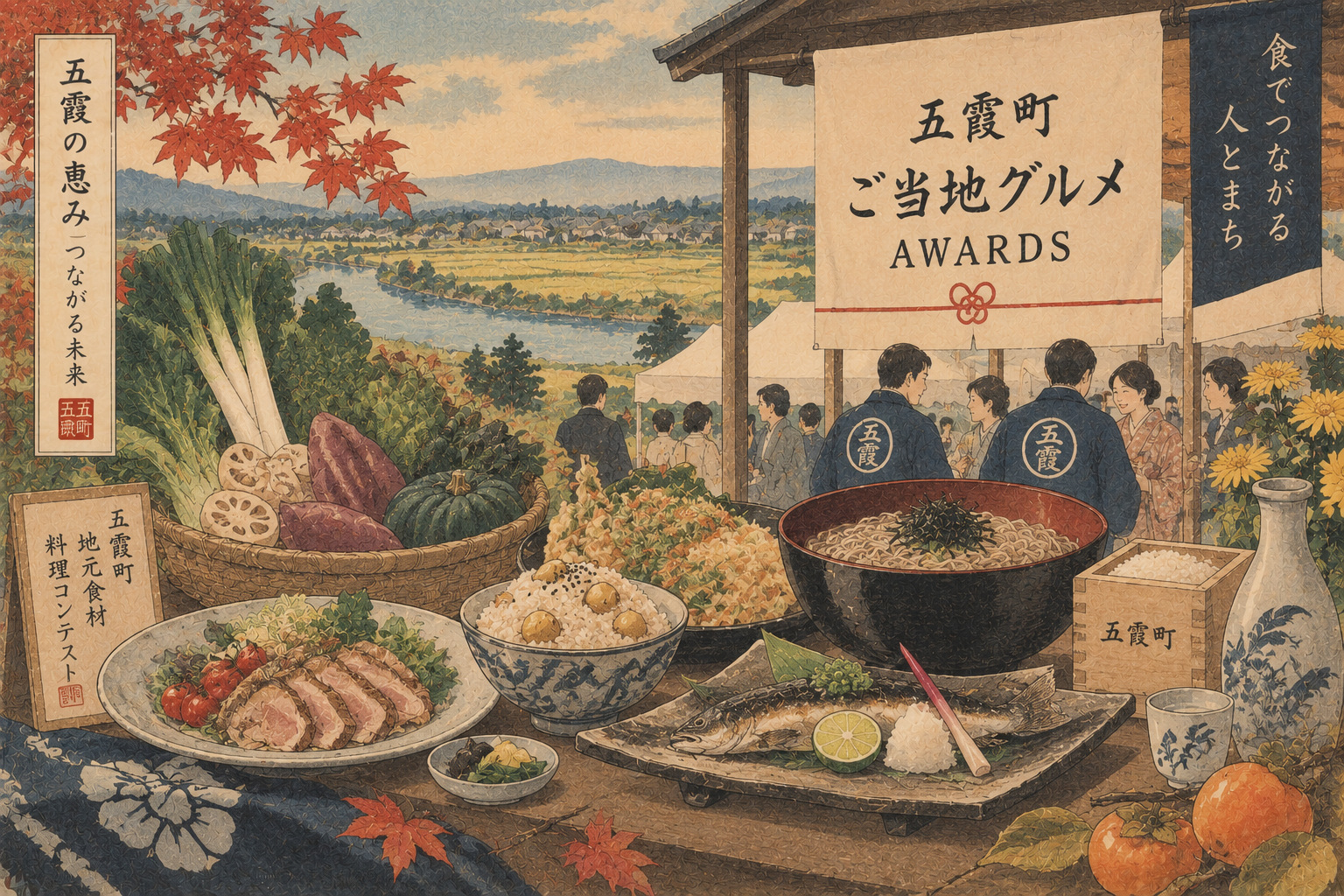
An award can put a town on the map. A business must keep it there.
A tiny town wins twice without taking the crown
A steamed bun crowned with fried noodles is not the obvious signature dish for a Japanese municipality. Nor is a five-layer sweet-potato dessert designed around a single character in the town's name. Yet those are the two products that earned Goka, a small town in Ibaraki Prefecture, runner-up honors in both categories of the 2026 Shin Ibaraki Meshi food contest, announced at an October 12 awards ceremony in Mito.
The distinction matters: Goka was not this year's overall winner. Kashima City won the savory category and Hitachi City won the sweets category. What makes Goka notable is the double placing—and a successful effort to build on a 2024 savory grand prize rather than simply recreate it.
Meet Gokabau: a bun with three textures
Goka's savory entry, Gokabau (五霞包), starts with a steamed pork bun made using Ibaraki's Rose Pork. It adds a vegetable-rich sauce containing locally specified prefectural ingredients, including Chinese cabbage, carrots and long onion, then tops the combination with crisp noodles made from Hitachi Aki soba buckwheat. The organizers describe the contrast as crisp, fluffy and silky.
The recipe has a striking logic: the bun offers familiarity, the sauce connects it to Ibaraki agriculture, and the fried soba recalls the town's 2024 championship-winning Shin Ibaraki Agesoba. It is a new product with a recognizable local predecessor, not a centuries-old village specialty.
Five layers, five in the town name
The sweet entry, Shin Ibaraki OIMOnblanc, borrows the visual language of Mont Blanc pastry and the rich flavor of baked sweet potatoes. According to Goka Town, its five layers are a rice-flour waffle, roasted-sweet-potato paste, whipped cream, piped sweet-potato Mont Blanc cream and sweet-potato chips. The number is a reference to the Japanese character 五, meaning five, at the start of 五霞.
The recipe uses prefectural products including Beni Haruka sweet potatoes and Koshihikari rice flour. That does not establish that every ingredient was grown within Goka itself. The distinction between prefectural sourcing and strictly local production is essential when assessing the economic impact.
How a competition became regional policy
The Shin Ibaraki Meshi contest debuted in 2024 as an initiative to identify compelling regional foods and turn them into tourism and retail assets. Goka won the inaugural savory prize with Shin Ibaraki Agesoba. Its return in 2026 illustrates how contest success can shape a second generation of products, with recognizable ingredients and presentation carried over into new recipes.
The 2026 event ran October 10–12 at Ibaraki Prefecture's Sannomaru government complex in Mito. All 44 municipalities participated, entering 40 savory dishes and 42 sweets. Organizers said total attendance over three days was approximately 63,000 visits. This is an organizer-reported attendance figure, not a count of unique people or a measure of subsequent tourism.
The vote did not directly select the winners
Public voting was important, but the competition was not decided exclusively by raw online popularity. Advance and on-site ballots helped determine finalists. A judging process then considered flavor, appearance, novelty, presentation and prospects for commercial distribution and tourism appeal.
This means a runner-up finish signals performance against a mixed set of criteria. It is not a controlled blind taste test and does not imply a majority of Ibaraki residents preferred the winning dishes. Readers should distinguish a place-branding contest from a scientific assessment of food quality.
Japan’s long tradition of inventing food traditions
Many foods marketed today as regional specialties have histories that cross the boundaries of old household recipes, restaurant invention and modern branding. Local governments, roadside stations and culinary festivals now play a visible role in shaping what visitors associate with particular places. Such projects fit into a wider history of rural revitalization and the promotion of food-related travel.
Goka offers a revealing case. It is the name and presentation of the dish as much as its ingredients that create a memorable hook. A bun layered with soba can be photographed, explained and shared; a five-part dessert offers a visual shorthand for the place that created it.
Can a trophy turn into a retail business?
Goka Town says it plans to sell both runner-up dishes at Michi-no-Eki Goka, its roadside station. As of October 15, however, the official announcement had not specified a launch date or established a permanent retail program. The town reported a 500-yen price during the three-day event; this cannot be treated as the eventual roadside-station price.
For any food business, repeatable quality, procurement, training, shelf life, kitchen capacity and margins matter more than a launch-day queue. The contest outcome may help publicity, but whether the products can reliably earn revenue is a separate and still unanswered question.
A supply chain hidden inside a snack
Consider the network behind Gokabau: farmers raise hogs and vegetables, growers cultivate buckwheat, processors make noodles and fillings, and vendors cook and serve the assembled dish. The sweet entry similarly connects sweet-potato cultivation, rice flour and pastry skills. Each link could capture value—if procurement is sustained at commercial scale.
The available municipal material does not disclose what share of ingredients comes from Goka rather than other Ibaraki communities, the retail price, unit economics or contracted production partners. Those details would determine whether the awards translate into direct local income.
What counts as a win for a small town?
Visitor spending, repeat purchases and familiarity with the town are more meaningful long-term indicators than a single trophy. Municipalities could measure how many food-festival customers later travel to Goka, buy at the roadside station or explore other nearby businesses. They could also measure how much procurement remains with regional producers.
None of those outcomes is established by the award announcement. A successful regional food policy requires patient follow-up, not the assumption that social-media attention automatically means lasting growth.
The next chapter starts at the counter
Goka's two silver finishes are still a remarkable act of culinary reinvention after a 2024 gold. A pork bun with buckwheat crunch and a five-tier sweet-potato confection offer two different solutions to one challenge: how can a place that many travelers pass without noticing create something they remember?
The next verifiable milestone is not another award ceremony. It is a date on the roadside station's sales calendar, followed by evidence that people actually return for another bite.