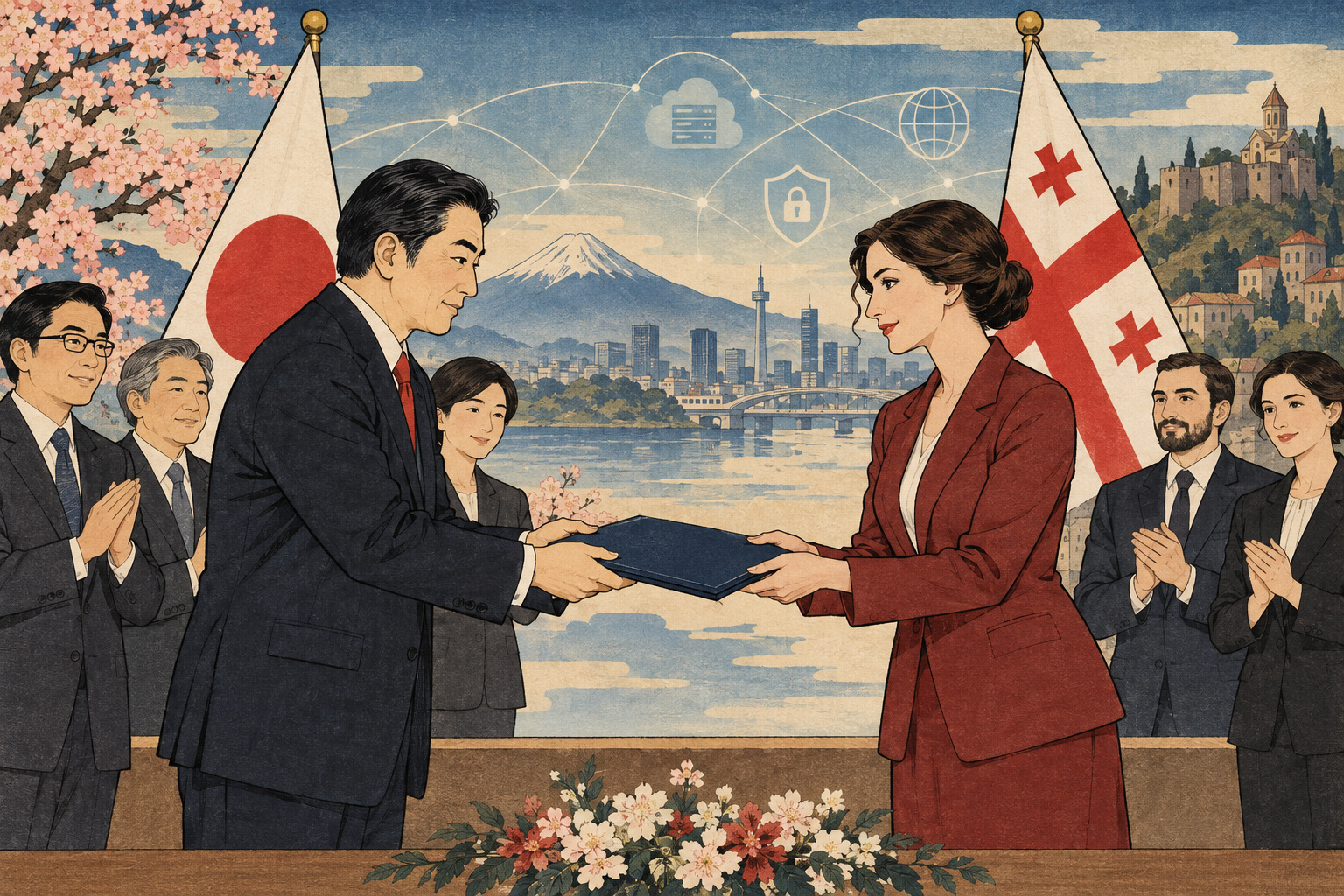
On paper, the relationship is four pages long. It has no appropriated budget, procurement schedule or city selected for a pilot. Yet the Memorandum of Cooperation signed by Japan’s Digital Agency and Georgia’s Ministry of Economy and Sustainable Development contains an unusually revealing list of problems: how to move data across borders without abandoning trust; how to make public services work around citizens; and how digital replicas of roads, buildings and infrastructure might improve congestion and disaster response.
Hideto Kawasaki, Japan’s Parliamentary Vice-Minister for Digital Transformation, and Georgian Deputy Economy Minister Tamar Ioseliani signed the document in Tbilisi on September 3. Japan’s Digital Agency announced it on September 7. The framework begins with the signatures, runs for three years and then renews annually unless either participant gives six months’ written notice.
A practical agenda hiding inside diplomatic language
The headline list has five parts. The two sides will cooperate toward operationalizing Data Free Flow with Trust, or DFFT; share practices in e-government, digital public services and emerging technologies including artificial intelligence; exchange knowledge about digital twins for transformation in quasi-public sectors; arrange digital study visits; and pursue other cooperation they jointly decide.
The signed text supplies more detail than the public summary. Possible methods include exchanges of information and experience, visits among officials and specialists, jointly organized symposia, conferences, workshops and hackathons, and encouragement of digital business and public-private partnerships. English will be the working language. Each participant bears its own costs within available funds and resources.
| Field | What the MoC enables | What it does not yet specify |
|---|---|---|
| Trusted data | Dialogue on making DFFT operational | Data categories, transfer mechanism, safeguards |
| Public services and AI | Exchange of practices and expertise | Product, algorithm, agency or success measure |
| Digital twins | Knowledge sharing for transport and disaster response | City, data owners, model or operator |
| People and business | Visits, workshops, hackathons and PPP encouragement | Calendar, participants, procurement or budget |
The agreement is a door, not a purchase order
That distinction matters. A government memorandum can be reported as though software, investment and contracts are already on their way. This one says the opposite. It creates no legally binding rights or obligations. It does not identify a vendor, allocate money or promise implementation. Amendments require mutual written consent.
The information clauses are cautious as well. Documents exchanged under the framework are to be used for its purposes. Neither side may pass received material to a third party without prior written consent. Disclosure required under domestic law calls for prior notification to the other participant. The memorandum lowers the administrative barrier to talking and experimenting; it does not lower each country’s legal protections.
Georgia brings its own public-service laboratory
It would be misleading to cast Georgia as an empty digital canvas awaiting Japanese expertise. The country has spent years consolidating government transactions through Public Service Halls and community centers. Georgia’s Ministry of Justice says its Digital Governance Agency is responsible for e-government development and information-security policy, while the hall model brings services from multiple agencies into one place.
In June 2026, the Justice Ministry said more than 400 public and private services were available through the unified MY.GOV.GE portal. Another official announcement marked the opening of the 125th Public Service Hall branch, offering as many as 500 services at that location. These are Georgian government figures, not independently audited usage or service-quality measures. They nevertheless show why the exchange can run in both directions: Georgia has experience joining front desks, registries and online access around a citizen transaction.
Ioseliani’s ministry described the national objective as a modern, secure and innovative digital ecosystem spanning better state services, a stronger digital economy, responsible AI and closer public-private cooperation. Its account points to a 2025–2030 strategy emphasizing digital governance and citizen-centered services. The ministry also said Japanese experience would be valuable. The relationship, however, is framed in the signed text as an exchange between participants—not a donor delivering a finished model.
The December journey explains the September document
The agreement began to take shape nine months earlier. Kawasaki traveled through Georgia from December 20 to 23, 2025, visiting far more than a single ministry. At the Business and Technology University, discussions centered on digital twins and an extended-reality laboratory. In the Imereti region, the subject was regional digital transformation. With Ioseliani’s ministry, the agenda included digital government and disaster-response technology, and officials agreed to begin working-level talks with a memorandum in view.
The route continued through the Finance Ministry, where officials discussed budget transparency and linking budgets to policy; the Innovation and Technology Agency, where startups, skills and public-private cooperation featured; and Silknet, where data centers and the digital divide were raised. Justice-sector meetings covered digital service delivery, while a visit to a public-service facility showed an operation combining in-person and online channels.
Read against that itinerary, the MoC’s vocabulary becomes less generic. Digital twins, study visits, business activity and public-private partnerships were already visible in the institutions Japan’s delegation encountered. The document is partly a map of the questions left behind by that trip.
DFFT travels from the G20 to a bilateral table
Japan proposed Data Free Flow with Trust in 2019. Then-Prime Minister Shinzo Abe introduced the concept at the World Economic Forum in January; the G20 Osaka Leaders’ Declaration in June linked freer data flows with protections for privacy, personal data, intellectual property and security. The accompanying Osaka Track sought progress on international rules for data and electronic commerce.
Later work moved through a 2021 G7 roadmap, a 2022 action plan and, under Japan’s 2023 G7 presidency, agreement to establish an institutional arrangement within the OECD for making DFFT concrete. The difficulty is embedded in the name. Data may have economic and social value when it crosses borders, but legal systems differ on privacy, localization, government access, cybersecurity and sensitive information. Trust is not decoration applied after the flow; it is the condition that makes legitimate flow possible.
The Japan–Georgia memorandum does not harmonize those laws or create an adequacy decision for personal data. It establishes a bilateral place to compare policy and operational obstacles. Its contribution to DFFT will depend on whether later work identifies a bounded use case and the safeguards around it.
Why digital twins belong beside disaster policy
A digital twin uses current data to represent a physical system—such as roads, buildings, utilities or flows of people—in a virtual environment. The model can support simulation, prediction and operational decisions. The MoC specifically mentions congestion reduction and improved disaster response as examples in quasi-public fields.
For two countries exposed to earthquakes, landslides and other natural hazards, the attraction is evident. A common operational picture could combine road status, weather, infrastructure damage and shelter capacity. It could test an evacuation assumption before a crisis or redirect resources during one.
But a persuasive model can be wrong. Sensors may be late, location data incomplete, private datasets inaccessible and responsibilities divided across agencies. Mobility information can also reveal sensitive patterns. No pilot location, source-data standard, privacy rule, accuracy threshold or accountable operator appears in the memorandum. Those omissions are normal at framework stage, but they are exactly what a future project must answer.
A relationship that predates both digital states
Japan’s Foreign Ministry records an unusual early episode: Japan recognized the state then rendered in Japanese as “Jiyorujia” in January 1921. After the Soviet breakup, Japan recognized Georgia on April 3, 1992, and diplomatic relations began on August 3. Georgia opened its embassy in Tokyo in 2007; Japan opened one in Tbilisi in 2009. In 2015, Tokyo officially changed the country’s Japanese name from Gurujia to Jōjia.
The economic relationship remains narrow and lopsided. Japanese Finance Ministry trade statistics reproduced by the Foreign Ministry put Japan’s 2024 exports to Georgia at ¥84.4 billion, led by vehicles, tires and parts. Imports were ¥2.25 billion, including fruit, aluminum, clothing and wine. A bilateral tax convention and investment agreement took effect in 2021.
Digital cooperation could add institutional services and business relationships to a trade pattern dominated by goods. That is a possibility, not an announced result. The MoC encourages digital business and public-private partnerships but names no company or commercial opportunity.
January 1921 Japan’s historical recognition of the Georgian state.
April–August 1992 Recognition after the Soviet breakup and establishment of diplomatic relations.
2007–2009 Embassies open in Tokyo and Tbilisi.
April 2015 Japan changes its official Japanese name for Georgia.
2021 Tax and investment agreements enter into force.
December 2025 Kawasaki visits Georgian digital and public-service institutions.
September 3, 2026 The digital cooperation memorandum is signed.
The first named project will be the real announcement
Framework agreements are useful because governments need permission, contacts and repeatable channels before specialists can work together. They are also easy to overvalue because the photograph arrives before the outcome. This agreement should be judged by the specificity that follows: which agencies participate, what problem they choose, what data are involved, who pays, how privacy and security are tested, and what improvement a resident can measure.
Japan.co.jp’s analysis is that a limited pilot would be more credible than an immediate grand platform. The two sides might compare one-stop service design, choose one local data-integration problem, or model one disaster-response decision. A useful exchange would share failed interfaces and institutional bottlenecks, not only showcase successes.
The memorandum’s restraint is not a flaw. It prevents a cooperative intention from masquerading as an accomplished transformation. Japan contributes a policy lineage around trusted cross-border data, a national coordinating agency and work on mobility and disaster systems. Georgia contributes direct experience with consolidated service halls, registries, regional access and a unified portal. Both bring unresolved questions about inclusion, security and coordination.
The signatures create a workshop in which those experiences can meet. Whether it produces a better service will depend on what comes after the ceremonial table: a named problem, a responsible institution, a defensible data arrangement and a result visible to the public. Until then, the most accurate description is also the simplest. Japan and Georgia have agreed to begin working.
- MoC: Memorandum of Cooperation. This document expressly creates no legally binding rights or obligations.
- DFFT: Data Free Flow with Trust, Japan’s formulation for enabling data flows while addressing privacy, security and other protections.
- Digital government: The redesign of public administration through technology, data and service operations—not merely putting forms online.
- Digital twin: A data-based virtual representation of a physical system used for analysis, simulation or operations.
- Quasi-public field: A service area such as transport or disaster response in which government and private operators may both hold infrastructure or data.
- Digital Agency of Japan: Signing of the Memorandum of Cooperation—date, signatories, fields and duration.
- Original Japan–Georgia Memorandum of Cooperation—legal status, methods, costs, information clauses and renewal.
- Digital Agency of Japan: Kawasaki’s visit to Georgia—December 2025 itinerary and discussions (Japanese).
- Digital Agency of Japan: Hideto Kawasaki profile—official name, reading and office (Japanese).
- Georgian Ministry of Economy and Sustainable Development announcement—Georgia’s policy objectives (Georgian).
- Ministry of Justice of Georgia: About the ministry—roles of the Public Service Hall and Digital Governance Agency.
- Ministry of Justice of Georgia: Citizen-centered public services—published MY.GOV.GE service count and strategy.
- Digital Agency of Japan: DFFT history and implementation—policy chronology from 2019.
- Digital Agency of Japan: 2024 annual report—agency establishment and role.
- Ministry of Foreign Affairs of Japan: Georgia basic data—diplomatic history, trade and agreements (Japanese).
Editorial policy: Official service counts and policy objectives are attributed to the governments publishing them. The article does not infer an undisclosed budget, procurement, data-transfer arrangement or project. Forward-looking judgments are labeled as Japan.co.jp analysis. The English report was written independently from the Japanese edition.