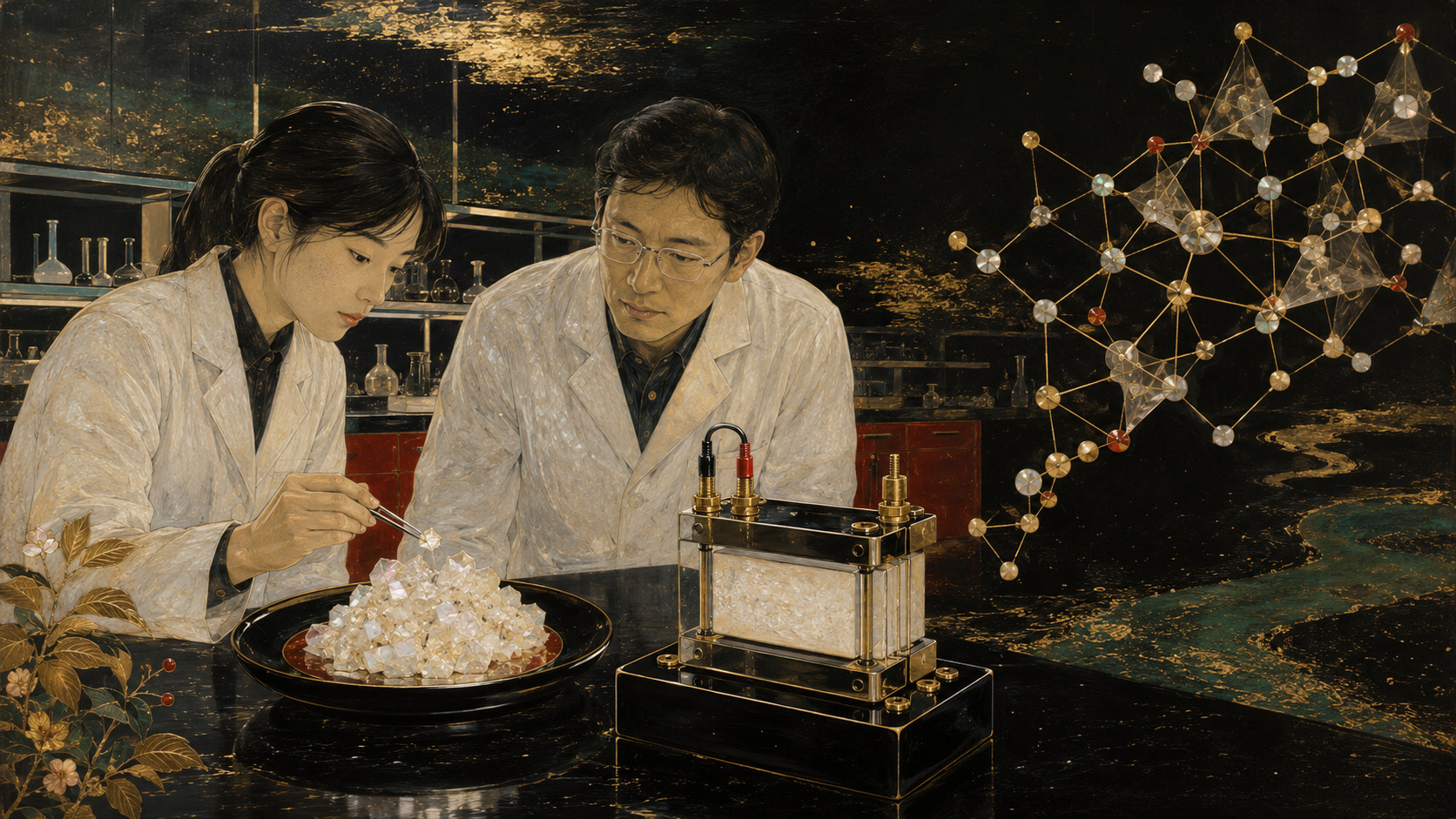
At 340 degrees Celsius, the “wrong” crystal appeared first. A glassy lithium thiophosphate powder began to organize into α-Li₃PS₄, a phase normally stable only at far higher temperature. Given more time, it yielded to β-Li₃PS₄. The handoff unfolded in seconds, fast enough to disappear between the frames of a conventional laboratory experiment.
Researchers at SPring-8 caught it by recording an X-ray diffraction pattern every half-second. Their result reframes a familiar materials question. The useful structure is not determined only by chemical composition or the final furnace temperature. It can be selected by how quickly a sample arrives, how long it stays, how large its crystallites are allowed to grow, and when cooling begins.
The international team, led by Professor Akira Miura of Hokkaido University's Faculty of Engineering and Woohyeon Baek of the University of Michigan, reported the work in Nature Communications on August 22. By combining first-principles calculations with live synchrotron measurements and electron microscopy, it explains why rapid heating can create α-Li₃PS₄ below its normal stability range—and why part of that phase can survive after cooling.
Three structures compete inside one formula
Li₃PS₄—lithium thiophosphate—is a sulfide solid electrolyte. Instead of carrying ions through a flammable organic liquid, it allows lithium ions to move through a solid lattice. That makes it a candidate component for all-solid-state lithium batteries. But the formula alone does not specify the lattice. Its atoms can adopt several polymorphs with sharply different transport properties.
The γ phase is the thermodynamic ground state at low temperature. Its reported room-temperature ionic conductivity is only about 10⁻⁷ siemens per centimeter. The intermediate β phase reaches roughly 2.0×10⁻⁴ S/cm. The high-temperature α phase, with more disordered lithium positions and better-connected pathways, conducts most readily. In earlier rapid-heating work, α-containing material exceeded 10⁻³ S/cm at room temperature.
In a large, equilibrated specimen, α-Li₃PS₄ is stable only above about 480°C. Cool it slowly and it should change to a lower-temperature structure. Yet a 2023 study showed that heating a glass precursor at roughly 400°C per minute could crystallize α between 243°C and 374°C and retain it at room temperature. Slow heating produced β. The process worked, but equilibrium thermodynamics did not explain why.
The phase vocabulary
- γ-Li₃PS₄: the stable bulk phase at low temperature and the least conductive of the three.
- β-Li₃PS₄: an intermediate-temperature structure favored during slower crystallization.
- α-Li₃PS₄: the high-temperature structure and the best lithium-ion conductor among these polymorphs.
- Metastable: not the lowest-energy state under the present conditions, but able to persist because the route to another state is blocked or slow.
Bulk thermodynamics says γ; the surface says α
The new calculation separates two energetic accounts. The first is the free energy of the crystal interior. At room temperature it ranks γ as most stable and α as least stable, just as the conventional phase sequence suggests. The second is surface energy. There the order reverses: α has the lowest calculated value at 0.43 joules per square meter, followed by β at 0.50 and γ at 0.58.
For a large grain, the interior overwhelms its outer boundary, so bulk stability decides. Shrink the grain toward nanometer dimensions and surface area becomes large relative to volume. The low-cost α surface can then compensate for the less-favorable α interior. The calculation predicts that for particles with a radius of 8.5 nanometers, the γ-to-β transition falls to 127°C and the β-to-α transition to 180°C. The corresponding bulk calculations were 296°C and 385°C.
Size therefore changes the effective phase diagram. The label “high-temperature phase” describes a large crystal near equilibrium, not every possible nanoparticle. The team also calculated that α has the lowest nucleation barrier across the examined range, with its easiest nucleation near 217°C. When a glass is heated abruptly, α can win the race to form even where a mature α crystal would not be the final equilibrium choice.
The researchers anchored the amorphous precursor's free energy with differential scanning calorimetry because a non-periodic glass cannot be treated as simply as a periodic crystal in density-functional calculations. The measured glass-to-β exotherm at 230°C and enthalpy change of −4.746 kilojoules per mole tied the computational landscape to experiment.
A half-second clock at SPring-8
To watch that competition rather than infer it afterward, the team used beamline BL13XU at SPring-8 in Hyogo Prefecture. A glassy Li₃PS₄ specimen was moved into a preheated nitrogen stream and reached its target in under two seconds. Diffraction patterns were then collected every 0.5 seconds at 220°C, 340°C, 380°C, 440°C and 547°C.
At 220°C, β crystallized slowly and dominated, with only trace α. Between 340°C and 440°C, α appeared first and then transformed toward β as the hold continued. The 380°C test was strikingly hesitant: trace α emerged during the first second, crystallization was largely suppressed for more than 100 seconds, and only then did weak β diffraction appear. The “nose” of a transformation map is not always a smooth race.
At 547°C, bulk α was genuinely stable and remained during the high-temperature measurement. But it did not remain α on cooling. Making a large, equilibrium α crystal at high temperature was not enough to make it quenchable. Retention belonged to the small-grain route at intermediate temperature.
Crystallite estimates support that reading. After 100 seconds at 340°C, α grains were about 35 nanometers and β grains about 52 nanometers. At 440°C they reached roughly 72 and 78 nanometers. α at 547°C reached about 92 nanometers. Each rise in temperature and time moved the material away from the scale where α's low surface energy could dominate.
| Evidence | Fast route | Slow route | What it establishes |
|---|---|---|---|
| Thermal history near 350°C | About 10 seconds | About 5 minutes | Time changes the path even at a similar target temperature |
| Room-temperature product | α+β mixture | Well-crystallized β | The fast route did not produce a pure α phase |
| TEM crystallite scale | About 15 nm grains and 40–60 nm aggregates | 20–200 nm grains | Smaller grains accompany α retention |
| Ionic conductivity | 5.8×10⁻⁴ S/cm | No comparison value reported in this paper | This is electrolyte conductivity, not cell performance |
A map borrowed from steel and glass
Steelmakers learned long ago that a final temperature tells only part of a material's story. Hold, cool or quench the same alloy along different paths and it can emerge hard, tough, brittle or ductile. Glass scientists likewise use heat-treatment schedules to decide whether and how crystals grow. Time-temperature-transformation diagrams, or TTT diagrams, turn those histories into maps.
Temperature runs on one axis, elapsed time on the other. Curves show when one structure begins to appear or gives way to another. The underlying concepts are established in metals and glasses. Functional ceramics have had fewer predictive TTT maps, and many depend on ex-situ specimens examined only after processing. That approach can miss a phase that appears and disappears within seconds.
The Li₃PS₄ study links a temperature-and-size thermodynamic calculation to direct kinetic observations. The combined map identifies the window in which α nucleates first, the longer period in which grains grow and β takes over, and the high-temperature region where bulk α forms but cannot be retained. It changes process design from “reach this temperature” to “follow this route.”
2013 Nanoporous β-Li₃PS₄ is reported with room-temperature conductivity about three orders of magnitude above earlier material.
2023 Rapid heating at roughly 400°C per minute demonstrates that high-temperature α-Li₃PS₄ can be retained at room temperature.
2026 Surface energy, particle size, nucleation and time are integrated into a TTT framework explaining why the route works.
The authors argue that the framework could help seek useful metastable phases in other ceramics, electronic materials and glass-ceramics. That is a research proposition, not a result already demonstrated across those families. Its value is the testable rule it offers: calculate when surfaces reverse bulk stability, then measure the narrow kinetic window in which that nanoscale state can be captured.
A better electrolyte is still not a battery
All-solid-state batteries replace a conventional lithium-ion cell's organic liquid electrolyte with a solid. Japan's New Energy and Industrial Technology Development Organization, NEDO, identifies potential gains in pack design, volumetric energy density and fast charging. It also identifies the fundamental obstacle: solids do not flow into gaps, so contact must be formed and maintained across solid–solid interfaces as electrodes expand, contract and chemically evolve during cycling.
Sulfide electrolytes attract attention because they can combine high ionic conductivity with mechanical compliance. They are also highly moisture-sensitive, complicating handling and compatibility with existing manufacturing environments. Conductivity inside a pressed electrolyte pellet does not answer whether a cathode interface will remain stable, a sheet can be produced uniformly, or a cell can survive thousands of cycles.
The 2026 fast-treated α+β specimen measured 5.8×10⁻⁴ S/cm at room temperature. That is far above γ-Li₃PS₄, but it is not a new conductivity record and is below the greater-than-10⁻³ S/cm result reported in the 2023 rapid-heating study. More importantly, neither number is a battery capacity, charging rate or safety test.
The laboratory geometry matters. Small protected samples can be heated rapidly and uniformly. A factory would need to deliver the same seconds-long thermal history through a thicker powder bed or continuous sheet, control grain-size and phase distributions over large areas, prevent moisture exposure, and integrate the material with electrodes. None of those engineering steps was tested here.
Japan.co.jp fact check: five unproven claims
- That the method mass-produces pure α-Li₃PS₄.
- That an α-containing full battery charges faster or stores more energy.
- That the retained phase remains stable through long-term cycling and storage.
- That a seconds-long heat treatment lowers total manufacturing energy or cost.
- That moisture control, electrode interfaces and sheet processing are solved.
The next experiment must make every grain follow the map
A useful process window has four dimensions: heating rate, target temperature, hold time and cooling rate. Scale adds several more—sample thickness, thermal gradients, atmosphere, pressure and throughput. A route that creates the desired phase near a surface but a different phase at the center would produce inconsistent conductivity. The first engineering test is therefore not simply “make more.” It is “make more while every region experiences the same history.”
Researchers will also need to determine how much α is enough. The best-performing composite may not require a pure phase if a connected α-rich pathway conducts efficiently, but phase boundaries could also create resistance or instability. Mapping phase fraction, grain size and conductivity across the TTT window can answer that question before a material is built into electrodes.
Then comes the battery test: cathode and anode compatibility, interface resistance under pressure, electrochemical stability, phase changes during charge and discharge, cycling life and abuse response. A cell may expose weaknesses invisible in an isolated electrolyte measurement.
The immediate achievement is more fundamental. A metastable phase is often described as something trapped from a forbidden high-temperature state. Here, α-Li₃PS₄ survives for a more precise reason. Rapid heating lets it nucleate first. Low surface energy makes it competitive while grains are small. Short holding suppresses growth. Cooling closes the window. Ten seconds does not manufacture a commercial battery—but it reveals how time can become a materials-design variable as powerful as temperature and composition.
Sources and documents
- Miura, A., Baek, W. et al., “Time-Temperature-Transformation Diagrams to Navigate the Nucleation and Quenchability of Metastable α-Li₃PS₄”, Nature Communications, August 22, 2026 (peer-reviewed paper; principal source for calculations, SPring-8 measurements, microscopy, conductivity and limitations)
- Japan Science and Technology Agency and partner institutions: “Mystery of synthesizing a metastable solid electrolyte by rapid heating solved”, August 31, 2026 (Japanese; official names, affiliations, terminology, research summary and funding)
- Kimura, T. et al., “Stabilizing High-Temperature α-Li₃PS₄ by Rapidly Heating the Glass”, Journal of the American Chemical Society, 2023 (prior study first demonstrating room-temperature retention by rapid heating)
- Liu, Z. et al., “Anomalous High Ionic Conductivity of Nanoporous β-Li₃PS₄”, Nature Materials, 2013 (historical background on lithium thiophosphate electrolyte development)
- NEDO: “R&D project launched to accelerate practical application of all-solid-state lithium-ion batteries”, June 16, 2023 (Japanese; expected benefits, solid–solid interfaces, scale-up and evaluation challenges)
- JST GteX: “Development of high-energy-density, high-safety sulfide all-solid-state batteries” (Japanese; research goals for sulfide systems, interface design and manufacturing processes)
Reporting was checked against material available by 9:30 PM JST on September 1, 2026. Japanese names, titles, affiliations and specialist terminology were verified in Japanese primary sources. The research team's interpretation of future applications is attributed, while measured results, computational explanations and Japan.co.jp analysis are distinguished. The reported conductivity belongs to an α+β electrolyte specimen, not a complete battery; claims about production scale, cycling, safety and cost are excluded.
Image rights: © 2026 Japan.co.jp. This AI-assisted editorial illustration may not be republished or reused without prior written permission. For licensing, use the contact page.