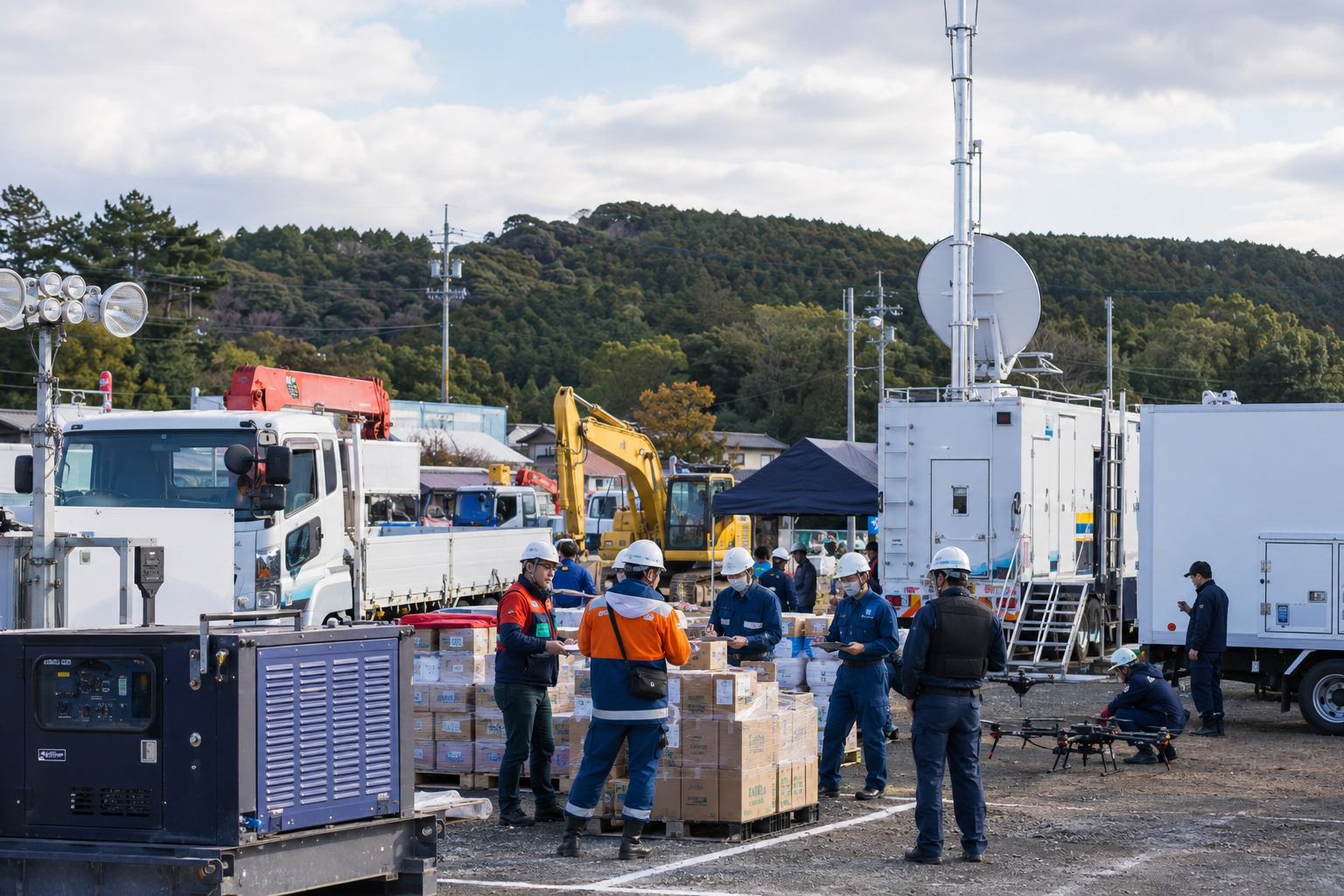
Disaster recovery often begins with companies that do not appear on camera
After a major earthquake or typhoon, the images that dominate the news are familiar: a broken wall, a muddy river, blankets in a shelter, officials at a microphone. But the work of recovery usually begins with quieter things: excavators, forklifts, generators, mobile base stations, fuel tanks, delivery trucks, road data, rainfall gauges, satellite maps, drone imagery and damage-assessment software. A city does not recover through emotion alone. It recovers when people, machines and information begin moving in the same direction.
The June 2026 Iwate offshore earthquake and the simultaneous storm watch around Japan are a reminder that disaster readiness is not only about the moment of evacuation. It is also about what happens after people reach safety: who clears the road, who restores power, who brings back communications, who delivers water, who maps the damage, and who decides where the next truck or crew should go.
This is not an advertisement. It is not a ranking of companies. It is a guide to the sectors that make disaster recovery possible in Japan. The company names matter only because they make the systems visible: construction equipment, telecommunications, power, logistics, drones and data.
Construction equipment: no open road, no rescue route
The first infrastructure problem after many disasters is the road. Landslides, fallen trees, broken poles, cracked pavement, collapsed walls, liquefaction, stranded vehicles and damaged bridges can all block access. When roads close, ambulances, fire crews, Self-Defense Forces, water trucks and relief supplies cannot reach the people who need them.
That is where construction equipment becomes disaster equipment. Excavators remove soil and debris. Wheel loaders move large volumes of rubble or material. Bulldozers open and level routes. Forklifts move supplies at warehouses and shelters. Generators and lighting towers support night operations. These machines are ordinary at construction sites, but after a disaster they become tools for restarting the community.
Komatsu says construction equipment is vital for recovery and reconstruction after natural disasters and that in emergencies it works to understand local conditions and provide equipment needed by affected areas. After the 2024 Noto Peninsula earthquake, Komatsu reported support that included lending construction equipment, forklifts and generators free of charge. Hitachi Construction Machinery has also provided machinery and financial support after major earthquakes, and more recently has described mobile energy storage systems that can serve as emergency power sources during disasters. Kobelco and other equipment makers matter not simply because they manufacture heavy machines, but because recovery requires maintenance, transport, fuel, operators, parts and judgment at the work site.
Why Noto changed the recovery conversation
The January 1, 2024 Noto Peninsula earthquake exposed how difficult recovery can be in Japan’s geography. Noto had a peninsula shape, mountain roads, scattered communities, tsunami impact, coastal uplift, winter conditions and an aging population. The problem was not only damage. It was access.
That lesson matters for any later earthquake or typhoon. Disaster impact is not determined only by magnitude, shindo, wind speed or rainfall. It depends on terrain, roads, ports, communications, electricity, population, season, time of day and the number of visitors in the area. Recovery companies are tested most severely in places that are hard to reach: peninsulas, islands, mountain towns, ria coastlines and snow country.
In those places, no single actor is enough. National companies, local contractors, municipal governments, firefighters, the Self-Defense Forces, utilities, telecom companies, port operators and neighborhood groups all become part of one recovery chain.
Telecommunications: being connected is a form of relief
The first thing many people want after a disaster is to confirm family safety. They call. They send messages. They look for shelter information. They check blackout maps, train delays and river warnings. At that exact moment, the network can become congested, base stations can lose power, fiber lines can be damaged and repair crews can be blocked by broken roads.
NTT Group, KDDI, SoftBank and Rakuten Mobile all treat disaster network restoration as a social function. In December 2024, Japan’s telecommunications carriers announced a cooperative framework to speed restoration of communication networks in large-scale disasters. The framework involved the NTT Group, KDDI, SoftBank and Rakuten Mobile, among others. Ship-based mobile base stations, portable base stations, generators, fuel, mobile phones, water and food supplies are all part of the wider recovery picture. Restoring communications is not only about radio waves; it is about transport, power and coordination.
In 2025, telecom carriers also conducted joint training around shared refueling stations, and later expanded cooperative disaster-support frameworks to include evacuation support area allocation. These steps matter because companies that compete in normal times may need to cooperate as public infrastructure during a disaster. In ordinary life, mobile service is compared by price, coverage and speed. In a disaster, it becomes the line between families, shelters, hospitals and officials.
Power: generators and batteries are the quiet heroes of shelters
When power fails, the problem is not just darkness. Phones cannot charge. Air conditioning and heating stop. Medical devices may be at risk. Water pumps can fail. Traffic lights go dark. Stores cannot run registers. Elderly-care homes and hospitals can move quickly from inconvenience to emergency.
That is why power is one of the least glamorous but most decisive parts of recovery. Diesel generators, gasoline generators, propane generators, batteries, solar-plus-storage systems, vehicle-to-load systems and mobile energy storage all have roles. The right answer depends on the site: hospital, shelter, telecom base station, municipal office, water point, temporary housing, port or road-repair site. Each has a different requirement for output, runtime, fuel, noise, exhaust and safety.
After the Great East Japan Earthquake, microgrids using solar cells and storage batteries drew attention because they could keep critical loads supplied during outages. More recently, mobile battery systems have been promoted for construction sites and possible emergency use. Power restoration is not only the work of electric utilities. It also involves generator makers, battery companies, construction-equipment firms, telecom carriers, fuel suppliers and municipal planning.
Logistics: donated goods only help when they can be sorted, moved and received
When disaster strikes, many people want to send water, food, clothing or blankets. The impulse is generous. But in a disaster zone, “arriving” is not the same as “helping.” Unsorted boxes, unwanted items, unknown quantities, blocked roads, limited warehouse space and constantly changing shelter needs can create a second burden for the affected community.
Japan’s logistics networks — Yamato Transport, Sagawa Express, Japan Post and others — are everyday delivery infrastructure in normal times. During disasters, logistics companies may support transport of supplies, provide delivery-status information, coordinate with municipalities or relief organizations, and adjust to road restrictions and service suspensions. Yamato Holdings describes its disaster prevention and support work as part of community safety, including activities based on disaster-response agreements.
Logistics is not only speed. It is sorting, routing, cold storage, fuel, driver safety, road data, shelter population counts and local priorities. For individuals, the best support is often not sending random goods, but following the instructions of municipalities and trusted relief organizations.
Drones and data: do not send people first into places machines can inspect
One of the most dangerous periods after a disaster is when responders do not yet know what has happened. Is the bridge passable? Is the slope still moving? Can the port be used? Are there isolated communities? Is someone on a roof? How far does the road crack continue? If responders can see before entering, they can reduce secondary disasters.
Drones, satellite imagery, GIS, weather data, river cameras, mobile-location data, social media, search data and AI image analysis are becoming disaster-response tools. The World Economic Forum has described Japan’s 2026 disaster-preparedness shift toward a disaster-management agency, data sharing, AI, digital transformation and deeper public-private collaboration. Drone conferences and industry projects increasingly frame drones not only as gadgets, but as tools for disaster response, infrastructure inspection and damage assessment.
But data is not magic. Drones face flight restrictions, weather limits, battery limits, operator requirements, communications problems and privacy concerns. AI can misread damage or amplify misinformation. Mobile-location data can be useful, but anonymization, consent and data protection matter. Disaster technology needs reliability and ethics more than futuristic drama.
| Sector | Recovery role | Disaster caution |
|---|---|---|
| Construction equipment | Road clearing, debris removal, landslide response, temporary site work | Needs fuel, operators, road access and checks for secondary collapse. |
| Telecommunications | Network repair, portable base stations, ship-based stations, charging support, 171/Web171 | Keep safety messages short and prioritize official information. |
| Power | Electricity for shelters, medicine, telecom, water pumps and night work | Generators can cause carbon-monoxide poisoning and fire if used incorrectly. |
| Logistics | Transport and sorting of water, food, hygiene goods, medicine, blankets and materials | Unrequested goods can burden the site. Follow official donation instructions. |
| Data and drones | Damage mapping, isolated-area checks, dangerous-site observation, recovery prioritization | Requires privacy protection, safe flight rules and verification of AI outputs. |
The company name matters less than the local network
Large national companies matter. But disaster recovery also depends on local construction firms, electrical contractors, civil engineers, fuel stations, warehouses, neighborhood associations, fire brigades, schools, hospitals and care facilities. Local people know which road is weak, which bridge is old, which neighborhood has many elderly residents, and which shelter has run out of water.
Japan’s disaster-prevention future is likely to involve deeper public-private collaboration. National systems, municipal responsibility, private technology and resident preparedness must connect. Large companies bring heavy machines and networks. Local governments bring evacuation authority and community responsibility. Local firms bring proximity. Residents survive the first few minutes. None is enough alone.
In a disaster, a company is not a logo. It is a function. An excavator opens a road. A generator lights a shelter. A mobile base station connects a family. A truck delivers water. A drone looks first at a dangerous slope. Data helps set priorities. Recovery begins when these functions point in the same direction.
- Disaster recovery is not only rescue; it is the restoration of roads, communications, power, logistics and information.
- Construction equipment is often the first practical force for clearing roads and removing landslides or debris.
- Telecom companies compete in normal times, but disaster frameworks increasingly require cooperation.
- Generators and batteries support shelters, medicine, communications, water and night work.
- Send help through official or trusted channels. Random goods can overwhelm local workers.
- Drones and AI can help, but safe flight, privacy and verification remain essential.
Sources and references
This article draws on public information from Komatsu, Hitachi Construction Machinery, KDDI, NTT, Rakuten Mobile, Yamato Holdings, the Cabinet Office, the World Economic Forum, UAS Japan and the Japan Construction Equipment Manufacturers Association.
- Komatsu: Disaster relief
- Komatsu: Assistance after the 2024 Noto Peninsula Earthquake
- Hitachi Construction Machinery: Mobile energy storage systems
- KDDI: Telecommunications carriers join forces for disaster response
- NTT Group: Disaster support collaboration framework
- Rakuten Mobile: Ship-based base stations and relief supplies
- Yamato Holdings: Disaster prevention and support
- World Economic Forum: Japan and disaster preparedness through data
- Japan Drone 2026: AI-driven drone technologies and disaster response
- CEMA: Disaster recovery support by construction equipment