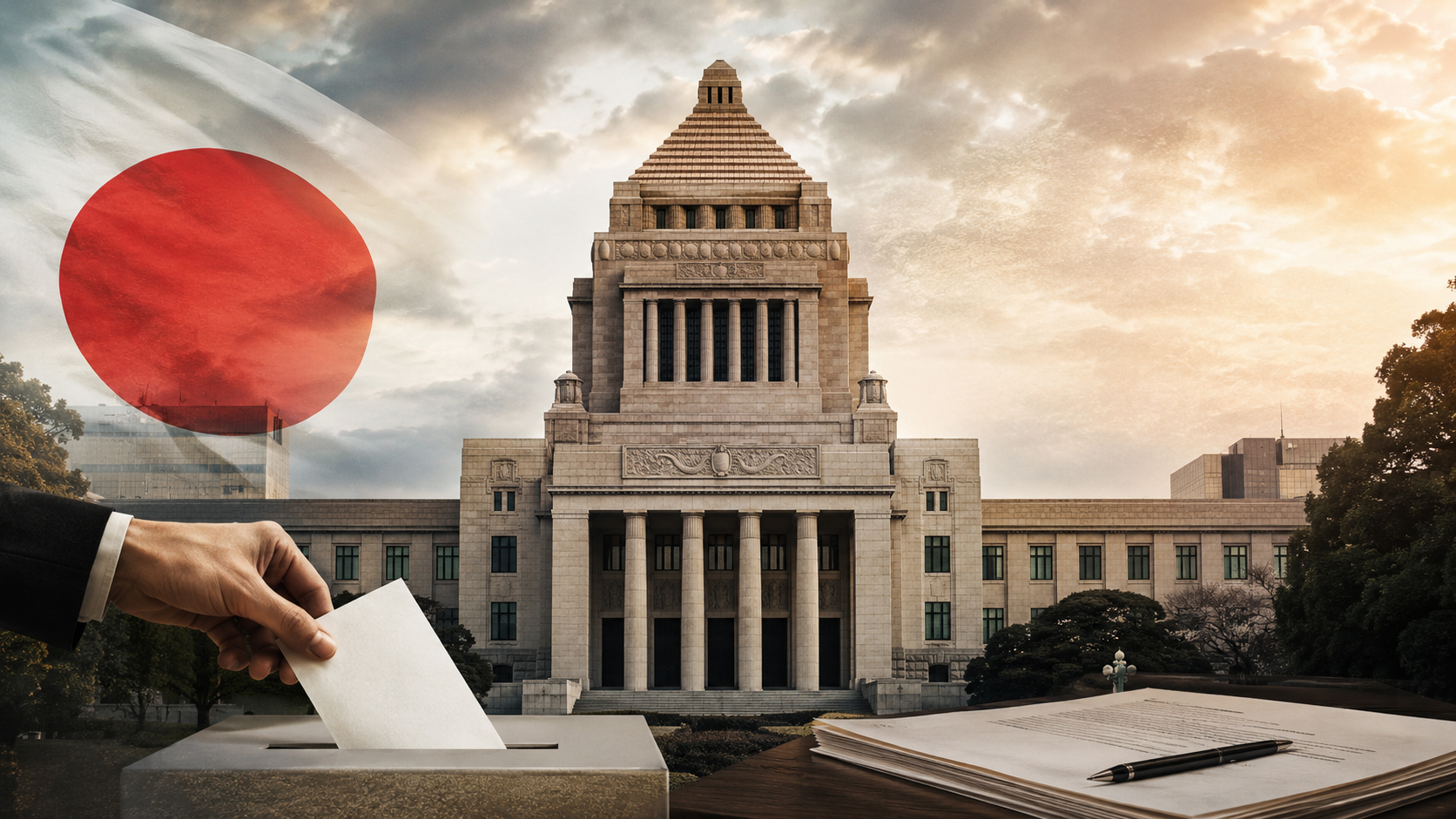
A small procedural change can open a very large door
The news looks technical at first. A constitutional commission in Japan’s House of Representatives has approved a bill to revise the national referendum law used for constitutional amendments. Reports say the bill would allow votes on remote islands to be counted locally when ballot boxes cannot be transported and would relax some requirements for appointing polling station observers in areas facing shortages.
That sounds like election administration, and in one sense it is. Japan has remote islands, aging towns, shrinking municipalities and weather risks. A national vote cannot be truly national if some communities cannot operate polling places or move ballot boxes in bad weather.
But in Japan, a technical change to referendum law is never only technical. The law governs the final stage of constitutional amendment. To change the Constitution, both houses of the Diet must first approve an amendment by a two-thirds majority. Then voters must approve it in a national referendum. Japan has never completed that process. The postwar constitution has stood unchanged since 1947.
The surface issue: making the referendum system workable
The bill’s stated purpose is practical. If remote-island ballot boxes cannot be transported because of weather or logistics, local counting may be necessary. If towns cannot find enough polling station observers because of population decline or staffing shortages, rules may need adjustment.
That matters. A referendum on the constitution would be one of the most consequential votes in modern Japanese history. Supporters and opponents alike need a voting process that is fair, clear and workable. Democracy is not only an ideal. It depends on polling stations, staff schedules, boats, seals, forms and counting procedures.
Seen that way, revising the referendum law is a form of democratic maintenance. But timing gives the move a second meaning. Japan is again talking seriously about constitutional revision, and that means every change to referendum rules is read as preparation for a possible vote.
The deeper issue: Article 9 and Japan’s postwar nerve
The referendum law debate is inseparable from Article 9. Article 9 renounces war and the threat or use of force as a means of settling international disputes. It also says land, sea and air forces, as well as other war potential, will not be maintained. At the same time, Japan has the Self-Defense Forces and relies on the U.S.-Japan alliance as the core of its security system.
For decades, that tension has defined Japanese security politics. Supporters of revision argue that the constitution should recognize the Self-Defense Forces and match Japan’s legal text to geopolitical reality. China’s military rise, North Korea’s missiles and nuclear program, Russia’s behavior and Taiwan Strait tensions all make the 1947 text feel incomplete, they argue.
Opponents see Article 9 differently. To them it is not a legal embarrassment but a civilizational restraint. It is a promise that Japan will never again become a country that uses military power casually. They worry that adding the Self-Defense Forces to the constitution could dilute Article 9 and clear the way for broader collective self-defense, counterstrike capabilities, arms exports and overseas deployments.
The special weight of the postwar constitution
The Constitution of Japan was written and adopted under U.S.-led occupation after defeat in World War II. Some conservatives have long described it as an imposed document and have treated constitutional revision as a mission of political independence.
But the constitution did not remain merely an occupation-era document. Postwar Japan rebuilt under it, rejoined the international community, produced high-speed growth and cultivated an identity as a peaceful state. Article 9 became tied to the memory of war, Hiroshima and Nagasaki, Okinawa, the Tokyo air raids, repatriation, defeat and recovery.
That is why constitutional revision in Japan has two layers. One is a policy debate: should the legal framework be updated for today’s security environment? The other is a memory debate: how much of the postwar moral story should be rewritten?
Shinzo Abe’s unfinished project
Former Prime Minister Shinzo Abe made constitutional revision a defining ambition. After returning to office in 2012, he pushed through major security changes, including legislation linked to limited collective self-defense. In 2017 he proposed adding an explicit reference to the Self-Defense Forces to Article 9 and hoped to achieve revision by 2020.
He did not succeed. Parliamentary numbers were not enough. The Komeito coalition partner was cautious, opposition parties resisted, public opinion was divided, legal wording was difficult and a national referendum carried enormous uncertainty. Constitutional revision was a symbolic mission for conservative politics, but also one of the hardest tasks in Japanese democracy.
Takaichi-era constitutional politics therefore sits in Abe’s shadow. The question is whether Japan will constitutionally ratify the security-policy path that began under Abe, or whether it will continue strengthening defense while leaving the constitutional text untouched.
The Takaichi calendar
Prime Minister Sanae Takaichi has long been associated with the conservative wing of the Liberal Democratic Party and with support for constitutional revision. In the current political environment, pro-revision forces have strength in the Lower House, but the Upper House, coalition politics, public opinion and referendum risk remain formidable obstacles.
A constitutional amendment must clear both houses by two-thirds. Lower House momentum is not enough if the Upper House is not secured. Even after a Diet proposal, the public must approve the text. A referendum is not a normal election. Party loyalty matters, but wording, campaign rules, advertising, turnout, youth participation, regional opinion and trust in government matter just as much.
The referendum law bill matters because it prepares the floor of the final stage. Once the floor is ready, the next question becomes what performance politicians intend to put on it.
Not only Article 9
Article 9 dominates the debate, but it is not the only revision topic. Emergency powers, free education, electoral district issues in the House of Councillors, local autonomy, digital rights and environmental provisions have all appeared in constitutional discussions. Politically, combining several less polarizing topics with security-related revision may be one way to build a broader coalition.
But Japan’s referendum process is expected to ask voters to judge specific amendment items. The question will not simply be “Are you for or against constitutional revision?” It will be: do you approve this language? In that moment, wording becomes everything.
That gives politicians a heavy responsibility. Vague slogans may help a campaign begin, but they cannot carry a constitution. The constitution is not a place for pleasing phrases. It is where a state defines what power may do and what power may not do.
Public opinion is not simple
Japanese public opinion often takes a complex form: many voters support stronger defense but remain cautious about changing Article 9. They see North Korean missiles, Chinese maritime activity and Russia’s war against Ukraine, but they also fear being drawn into conflicts beyond Japan’s direct defense.
Younger voters are not easily captured by old left-right categories. Some understand the need for deterrence while rejecting automatic involvement in foreign wars. Some value the U.S. alliance while worrying about dependence on U.S. strategy. Some support the Self-Defense Forces but do not want Article 9 hollowed out.
If Takaichi pushes revision, her hardest task will not be rallying committed supporters. It will be explaining to undecided voters why now, why this wording and why the change will strengthen rather than weaken Japan’s democracy and security.
Foreign policy and regional memory
Constitutional revision is not only a domestic matter. China, South Korea, North Korea, the United States and Southeast Asian countries will interpret Japan’s debate through their own histories and security interests. Some partners may welcome a Japan that plays a larger security role. Others will watch for signs of remilitarization.
For the United States, a more capable Japan can mean greater alliance burden-sharing. Inside Japan, however, the question is more complicated. Would constitutional revision increase Japanese autonomy, or would it pull Japan more deeply into U.S. strategic decisions?
Regional diplomacy depends not only on the final text but on the language used to sell it. Strong domestic rhetoric can create foreign anxiety. Weak explanation can lose domestic support. Constitutional debate is a message to voters and to the world at the same time.
A referendum would test Japanese democracy
Japan has never held a national referendum on constitutional amendment. That is a major institutional unknown. A referendum reduces a complex constitutional question to a simple yes-or-no choice. That simplicity is powerful, but dangerous.
Campaign advertising, internet campaigning, foreign information operations, funding imbalances, media fairness, misinformation and turnout could all shape the result. Other countries’ referendum experiences show that one vote can settle a legal question while leaving society divided for years.
That is why technical revisions to referendum law may be necessary but not sufficient. Japan must think about the integrity of information, the fairness of campaigning, the treatment of minority views and how the country would live together after the vote.
How to read this step
It would be too much to treat the commission vote as a decisive step toward changing Article 9. The bill still must move through the broader parliamentary process, and referendum-law revision is not the same as a constitutional amendment proposal. Fair referendum rules matter to both supporters and opponents of amendment.
But it would also be naïve to treat the vote as merely administrative. When referendum rules are updated, a pro-revision government is in office and the Lower House balance is favorable to revision, constitutional politics becomes more concrete. The next questions are text, timing, issue selection and campaign design.
The constitution can feel distant from everyday life. But it is the basic design for war and peace, rights and power, central authority and local autonomy, ordinary time and emergency time. A small revision to referendum law may be one of the first practical signs that Japan is preparing to ask whether that design should finally be rewritten.
- A House of Representatives constitutional commission approved a bill revising Japan’s national referendum law.
- The stated changes involve practical issues such as remote-island counting and polling observer requirements.
- The larger context is Japan’s first possible constitutional referendum and the unresolved Article 9 debate.
- Shinzo Abe’s unfinished revision agenda is now returning under Prime Minister Sanae Takaichi.
- The decisive test would not be Lower House support alone, but whether voters approve specific amendment language in a national referendum.
Sources and reference
This article is based on reporting that a House of Representatives constitutional commission approved a national referendum law revision bill, plus public materials on the amendment process, the referendum system, Article 9 and postwar Japanese politics. Bill text and parliamentary timing may change.
- Nippon.com/Jiji: Japan Lower House Commission OKs Referendum Reform Bill
- ConstitutionNet: Japan legislators propose changes to referendum law
- Mainichi/Kyodo: Parties submit bill to revise referendum law
- Council on Foreign Relations: The Politics of Revising Japan's Constitution
- Prime Minister's Office of Japan: The Constitution of Japan
- House of Representatives: National referendum system discussions