Two road wins, two different endings
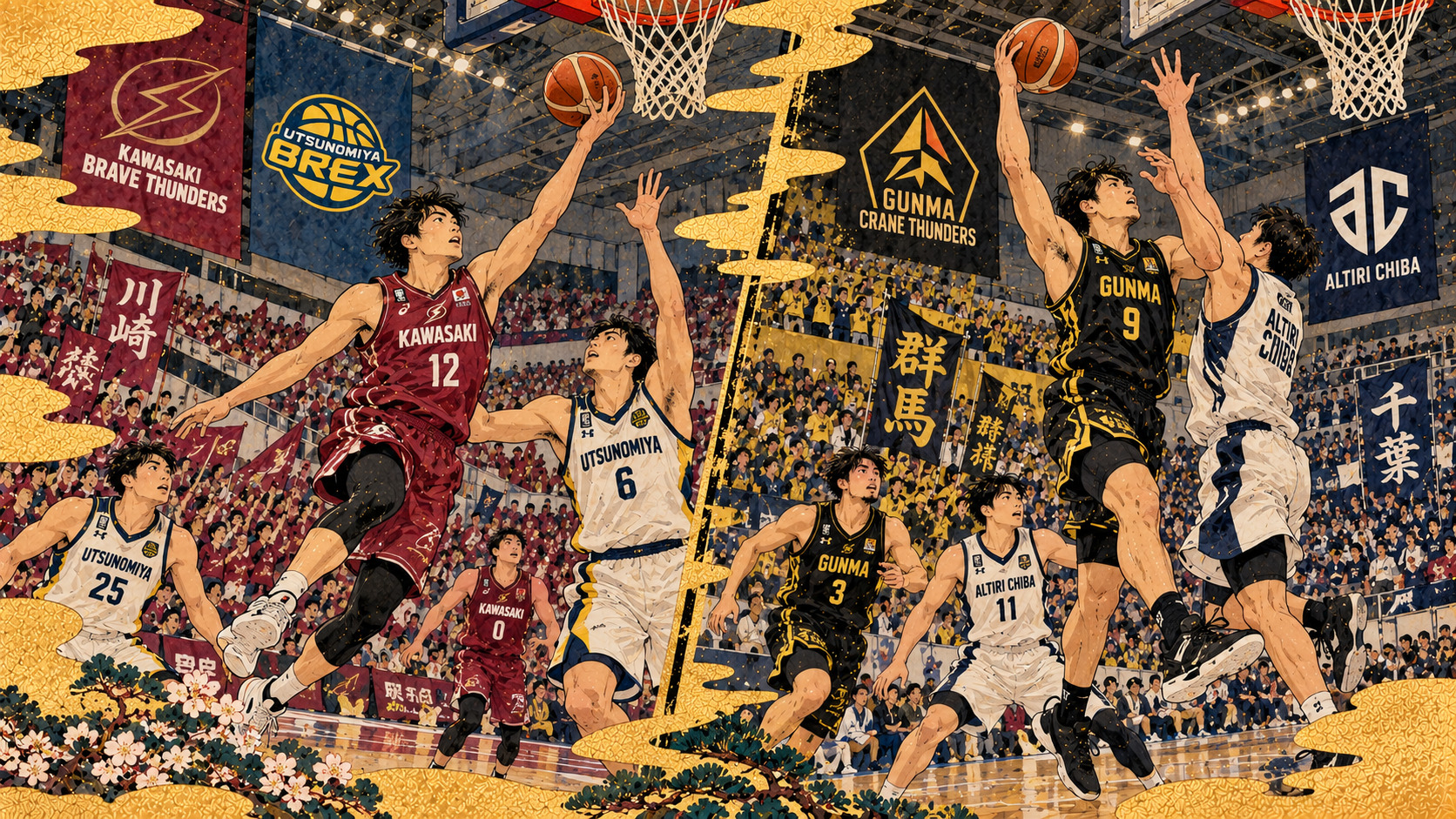
The final scores from October 26 suggest two straightforward away victories in Japanese professional basketball: Kawasaki Brave Thunders 92, Utsunomiya Brex 89; Gunma Crane Thunders 85, Altiri Chiba 74. Yet the official quarter-by-quarter records tell a more compelling story. Kawasaki was eight points behind entering the fourth period in Utsunomiya. Gunma was five points behind entering the fourth period in Chiba. Each found a path to victory over the final ten minutes, in markedly different ways, during the inaugural season of Japan’s reorganized B.LEAGUE PREMIER.
Kawasaki refused to accept the first-quarter script
At Tochigin Brex Arena Utsunomiya, the home team opened 26–17. The second quarter went Kawasaki’s way, 24–20, but the home team won the third 25–22 and took a 71–63 lead into the last period. Kawasaki then outscored Utsunomiya 29–18 to finish 92–89. This was not a wire-to-wire upset or a game decided by an invented last-second shot. Its essential drama lies in the documented nine-point opening gap, the eight-point deficit after three quarters and the reversal across the final ten minutes.
What the box score says about the comeback
Kawasaki made 15 of 32 three-point shots, 46.9%, and 32 of 67 field-goal attempts overall, 47.8%. Utsunomiya actually made one more three-pointer, 16, but needed 42 attempts. It shot 41.1% overall. The clearest possession-related difference was rebounding: Kawasaki collected 46 to Utsunomiya’s 35. The visitors also scored 19 second-chance points to the hosts’ 10. Those figures help explain how Kawasaki overcame a significant disadvantage in a different column: it committed 13 turnovers, while Utsunomiya committed only four.
An instructive contradiction in the numbers
Basketball results resist single-cause explanations. It would be wrong to claim that Kawasaki won because it protected the ball better; the official numbers say the opposite. Nor can a rebounding margin prove precisely which sequence decided the result. But when one team shoots much more efficiently and creates extra opportunities after misses, it can offset the cost of turnovers. That balance of possession, shot quality and conversion makes Kawasaki’s victory a useful case study for fans learning to read a box score beyond the two headline totals.
Gunma’s 33-point finish changed everything
In Chiba, Altiri led 21–15 after one quarter. Gunma answered 26–15 in the second to lead 41–36 at halftime. Altiri then won the third 21–11 and took a 57–52 advantage into the fourth. Gunma’s response was emphatic: 33 points in the final quarter against Altiri’s 17. The 85–74 final tells the outcome but conceals the shift in control. A five-point third-quarter deficit became an 11-point win. This was a late offensive surge, not evidence that Gunma dominated every stage of play.
Were these really two upsets?
Describing both games as “shocking upsets” would go beyond the evidence available from final scores alone. Kawasaki won on a difficult road floor after a prolonged deficit. Gunma, by contrast, entered with a stronger position in the contemporary official league listings than Altiri Chiba. League standings displayed on dynamic websites can also change after the games, making a present-day table a poor substitute for verified pregame rankings. Our assessment therefore emphasizes the genuinely dramatic finishes rather than manufacturing equal underdog status.
The club naming trap international readers should avoid
The Chiba team was Altiri Chiba, abbreviated A-Chiba in the B.League schedule. It is not the Chiba Jets, a separate club, and it is not Alvark Tokyo. Japanese regional and abbreviated names can look deceptively similar in translation. Kawasaki Brave Thunders, Utsunomiya Brex, Gunma Crane Thunders and Altiri Chiba are the four clubs in these two contests. Getting them right is more valuable than inventing a star narrative unsupported by the official game report.
A decade after launch, a new league begins
Japan’s B.League began competition in 2016, joining the country’s professional basketball landscape under a new structure. Ten years later, the 2026–27 season introduced B.LEAGUE PREMIER, B.LEAGUE ONE and B.LEAGUE NEXT. PREMIER has 26 clubs divided into eastern and western conferences, and all four clubs in these October 26 games belong to the East. Calling the current competition simply “B1” misses the significance of the change. The new hierarchy is intended to reshape the commercial and competitive setting in which these local teams operate.
Why the arenas matter as much as the highlights
The league recorded 4,232 spectators in Utsunomiya and 4,171 in Chiba. These are meaningful local sports gatherings, even if they cannot by themselves establish any national attendance trend. They also highlight a defining characteristic of the Japanese game: teams based in regional cities can create rivalries and civic identities beyond the country’s largest media markets. The Utsunomiya and Chiba arenas were not interchangeable settings. They were the home stages on which the visiting teams earned their finishes.
Japan’s basketball story is bigger than its NBA exports
International attention often follows individual Japanese players overseas. Domestic competition asks a different question: can teams build regular audiences, player-development systems and sustainable organizations at home? The new PREMIER structure makes this a particularly important season to follow. These two games offer an accessible introduction because the scorelines are verifiable, the stories are easy to understand and the stakes extend beyond a single highlight clip.
The next test is consistency
Kawasaki’s late shot-making and rebounding, and Gunma’s fourth-quarter scoring surge, explain why October 26 is worth remembering. They do not predict a championship. For a genuine picture of performance, the next step is to follow whether those advantages survive different opponents and road conditions. That is the promise of covering a developing professional league as journalism rather than publicity: the result is the beginning of the question, not the end of the story.
Sources and verification
Original B.League game records, quarter scores and competition announcements checked. No invented athlete quotes, unsupported play-by-play sequences or inferred pregame odds.