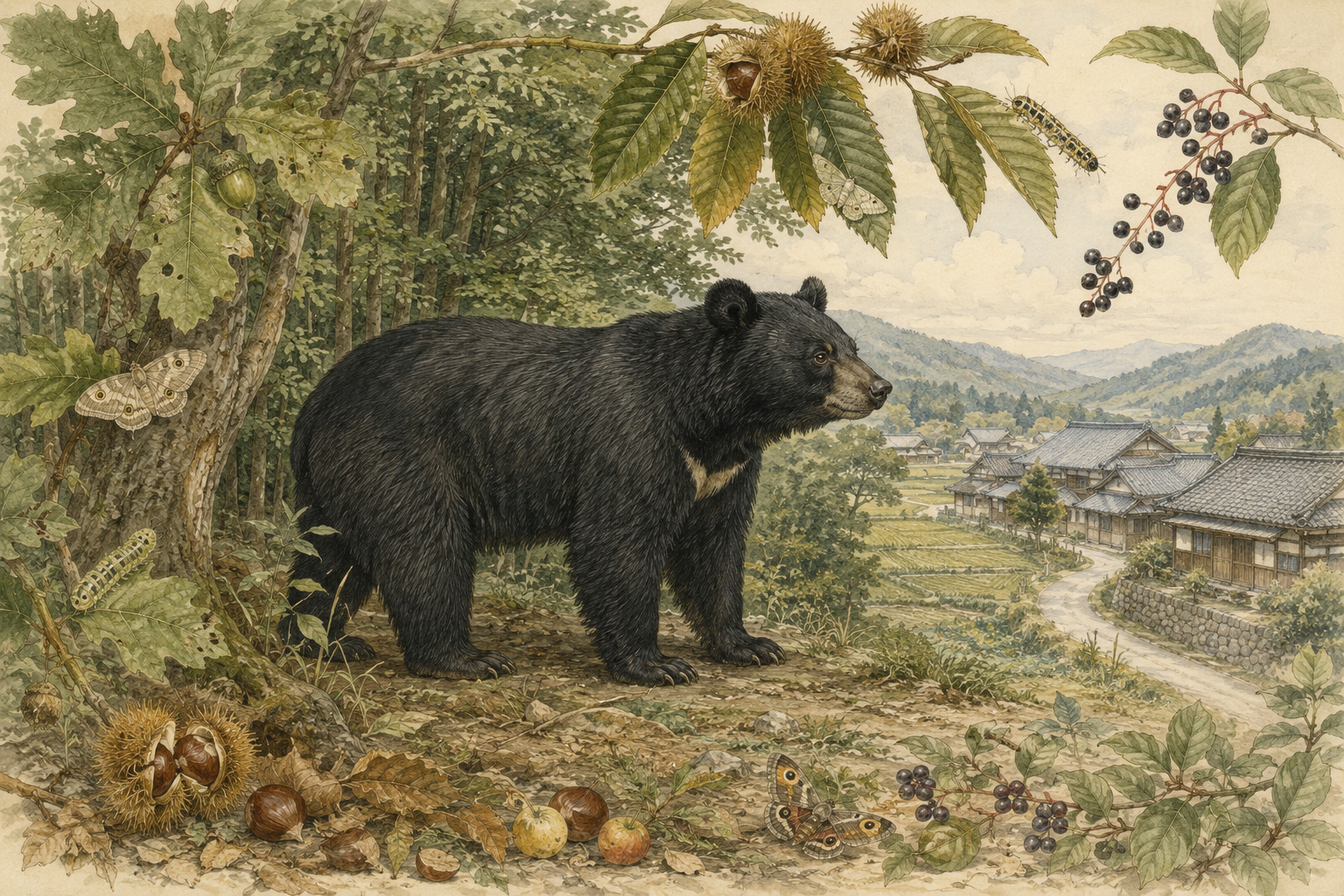
THE immediate duty is uncomplicated: protect people. When a bear enters a residential district, approaches a school or becomes conditioned to human food, a local government may have minutes—not months—to remove the danger. The harder question comes later. Did that intervention make the community safer, and will the effect last?
Japan’s Environment Ministry counted 14,741 bears taken in officially permitted capture operations during fiscal 2025, which ran from April 2025 through March 2026. Of them, 14,618 were killed and 123 were recorded as non-kill captures. The killed animals included 12,479 Asian black bears and 2,139 Hokkaido brown bears.
That same fiscal year produced the country’s worst bear-attack figures in the government series: 216 incidents involving 238 people, with 13 deaths. The collision of record killing and record harm does not prove that capture failed. Nor does it prove that killing more animals will solve the conflict. National totals cannot answer a local causal question by themselves.
A Record Year on Both Sides
Fiscal 2023 had set the previous human-cost record, with 198 incidents, 219 victims and six deaths. The following year fell to 82 incidents, 85 victims and three deaths. Then fiscal 2025 exceeded every earlier total: 216 incidents, 238 victims and 13 deaths.
The danger was concentrated but not confined. Iwate recorded five deaths, Akita four and Hokkaido two—11 of the national 13. Sightings and injuries extended well beyond those areas. By the end of July 2026, the new fiscal year had already brought 49 incidents, 53 victims and six deaths, according to figures updated on August 12.
Japan Bear Network’s account of the 2025 emergency separates established trends from open questions. Bear distribution roughly doubled over the 40 years through 2018 as people withdrew from many farming and mountain communities. Poor crops of beech-family nuts can widen autumn ranging, while unmanaged fruit trees, crops and other food attract bears toward human activity. Yet the organization says the sharp rise in fatal encounters and the behavior of bears appearing in unfamiliar urban areas are not fully explained and vary by region.
The Number Is Precise. Its Meaning Needs Care.
The Environment Ministry category is kyoka hokaku, or permitted capture. It covers operations authorized for damage prevention and population adjustment under prefectural management plans. It is separate from the ordinary hunting total and does not describe one centrally directed, one-time national cull.
More than 99 percent of the 14,741 permitted captures in fiscal 2025 ended in death. The 14,618 killed were about 2.85 times the 5,136 killed in fiscal 2024 and well above the 9,094 recorded in fiscal 2023. Tohoku’s six prefectures alone reported 8,849 permitted captures: 2,691 in Akita, 1,684 in Fukushima, 1,591 in Yamagata, 1,265 in Aomori, 1,153 in Iwate and 505 in Miyagi.
Those totals combine actions with different purposes. A bear trapped after repeatedly entering a farm, an animal presenting an imminent risk inside a town and one removed as part of broader population reduction are not equivalent interventions. A meaningful safety assessment needs the location, reason and later outcome of each operation.
- 14,741 bears were captured under permits.
- 14,618 were killed; 123 were classified as non-kill captures.
- 12,479 of those killed were Asian black bears.
- 2,139 were Hokkaido brown bears.
- The ministry labels the prefecture-supplied figures preliminary and subject to revision.
Population Reduction Becomes National Policy
Japan’s policy turn preceded the record year. In April 2024, brown bears and Asian black bears were added to the national designated management wildlife category, with the endangered Shikoku black-bear population excluded. The designation opened broader support for coordinated population management.
On September 1, 2025, a legal amendment introduced emergency shooting. Under specified safety conditions, a municipality can commission a qualified shooter when a bear or wild boar enters an area of daily human activity and creates an urgent danger. A November package and a government roadmap adopted on March 27, 2026, then widened the response from emergencies to a program running through fiscal 2030.
The roadmap sets provisional fiscal 2026 capture targets of 3,800 in Tohoku, 600 in Kanto, 3,500 in Chubu and 900 in Kinki-Chugoku—a combined 8,800 for the four mainland regions. Hokkaido’s separate brown-bear plan calls for 12,540 captures over 2025–2034, not in a single year.
Capture is only one of the roadmap’s seven strands. The plan also covers emergency systems, prevention of entry into human areas, local staffing and equipment, habitat conservation, zoning, public information and research. It promises nationwide population estimation and later revision of provisional targets as the underlying data improve.
A Cull Is Not a Controlled Experiment
Reducing a bear population can reduce encounter opportunities if other conditions remain equal. Removing an identified animal that repeatedly enters homes or seeks human food may stop a specific threat. The urgent case for lethal action is therefore real.
But the national figures do not provide the comparison needed to calculate the benefit. No one observes the same prefecture, in the same food year, with the same bear abundance and human activity, both with and without the captures. The continuation of fatal incidents in 2026 does not prove that the earlier deaths achieved nothing; the toll might have been worse without them. It also cannot be used as proof that more killing alone will work.
Attractants and access routes can recreate the conflict. Unharvested fruit, household waste, livestock feed, beehives, crops and compost reward a bear for approaching people. Brush and river corridors can provide concealed paths. If one animal is killed while those conditions remain, another may occupy the same opportunity.
| Indicator | What it can show | What it cannot establish alone |
|---|---|---|
| Bears killed | The scale and regional distribution of permitted lethal action. | How many injuries or entries would have occurred without it. |
| Human incidents | Events, victims and deaths recorded by prefectures. | The separate effects of abundance, food, weather and human behavior. |
| Sighting reports | Where and when residents reported possible bears. | Clean comparisons where reporting and collection methods differ. |
| Population estimates | A basis for setting regional management targets. | An exact national total when methods, dates and data coverage vary. |
| Long-term outcome | Whether repeat entries and harm decline in the same places. | Which element of a multi-part program produced the change. |
Karuizawa Manages a Boundary Every Night
Karuizawa, a resort town in Nagano Prefecture, offers a useful—not universal—contrast. The town says no bear-related human-harm incident has occurred in its human-activity zones since September 2010. Fiscal 2025 still produced a record 208 sighting reports, and two human-harm incidents occurred in national forest. The program has managed proximity rather than eliminated bears or risk.
The work grew in layers. Picchio began local research in 1998; the town commissioned full countermeasure work in 2000. Japan’s first bear dogs were introduced there in 2004, a dedicated municipal wildlife position followed in 2006, and land-use zoning began in 2007. Bear-resistant waste stations replaced vulnerable ones over several years.
From June through October, teams patrol at night and use radio transmitters to locate individual bears. Bear dogs and handlers push animals away from human-use areas. Captured bears can be assessed individually, fitted with transmitters and released with aversive conditioning; animals that present an unacceptable risk can be removed. As of August 19, 2026, 36 transmitters were active.
The system depends on residents and businesses denying food rewards. A bear that finds garbage or fruit learns a lesson stronger than a patrol can easily undo. Karuizawa’s result therefore rests on specialist staffing, surveillance, rapid response, waste management, zoning and public cooperation accumulated over decades. It is a case study, not a controlled national trial.
Coexistence Is Infrastructure, Not Sentiment
Japan Bear Network’s proposal starts with the priority of human life. It supports removing problem animals and lowering bear density around human activity, while pairing that work with damage prevention, control of attractants, buffer-zone maintenance, trained officials and scientific monitoring.
In comments on the government’s management guideline, the network accepted population management, habitat management and damage prevention as three essential pillars. Its objection was to setting a target from population level alone. Vegetation, land use, food availability and the local pattern of conflict matter, and policy should be adjusted as results are measured.
The government roadmap increasingly reflects that multi-part logic. It targets bear-resistant equipment, electric fencing, removal of unmanaged fruit, river-corridor vegetation work, better response manuals, more trained municipal personnel and national population surveys. Its 2030 goals include complete emergency readiness and zoning plans across municipalities with established bear presence.
Data quality remains a constraint. The mainland estimates behind the provisional capture targets are sums of prefectural medians produced at different times and with different methods. The roadmap notes that seven prefectures lack population estimates. National surveys beginning with Tohoku are intended to replace that uneven base.
APRIL 2024 Most Japanese bear populations enter the designated management wildlife system.
SEPTEMBER 2025 Emergency shooting becomes available under defined municipal safety conditions.
FISCAL 2025 Japan records 216 incidents, 238 victims, 13 deaths and 14,618 bears killed.
MARCH 2026 The government adopts its bear countermeasure roadmap through fiscal 2030.
JULY 2026 The new fiscal year reaches 49 incidents, 53 victims and six deaths.
FISCAL 2030 Japan evaluates emergency readiness, population targets and municipal zoning.
Measure Conflict, Not Effort
Some regions may need substantial population reduction. Immediate removal of a bear presenting a clear danger is indispensable. But the number killed is an input, not the public-safety outcome. Treating it as the principal measure of success risks repeating the same emergency operation while the conditions producing conflict remain.
A stronger record would connect each capture to the animal’s behavior, location and management purpose; track population confidence intervals; document attractant removal, fencing, brush clearance and hazing; and follow later entries and injuries in the same area. Results could then change next year’s target instead of merely confirming it.
The 14,618 deaths reveal the scale of fiscal 2025’s response. They do not, by themselves, promise safety in fiscal 2026 or 2030. Lasting protection will come from removing genuine threats while making towns unrewarding to bears, keeping boundaries legible, and adjusting population management to evidence from each distinct bear population.
- Ministry of the Environment — Official bear information and policy hub
- Ministry of the Environment — Preliminary permitted bear-capture figures, updated August 6, 2026
- Ministry of the Environment — Preliminary bear-related human-harm figures, updated August 12, 2026
- Interministerial Council on Bear Countermeasures — Bear Countermeasure Roadmap, March 27, 2026
- Japan Bear Network — Recommendations for preventing bear-related harm, November 6, 2025
- Town of Karuizawa — Official Asian black bear countermeasure program, updated August 19, 2026
This English report was written independently from Japanese government, municipal and specialist-organization primary material available through August 29, 2026. The Japanese terms distinguish permitted capture, killing and non-kill capture; the capture series does not include ordinary hunting. Fiscal 2025 and fiscal 2026 totals remain preliminary and may be revised. Organizational policy positions are attributed, and no interview quotation has been reconstructed or translated as a direct quote.