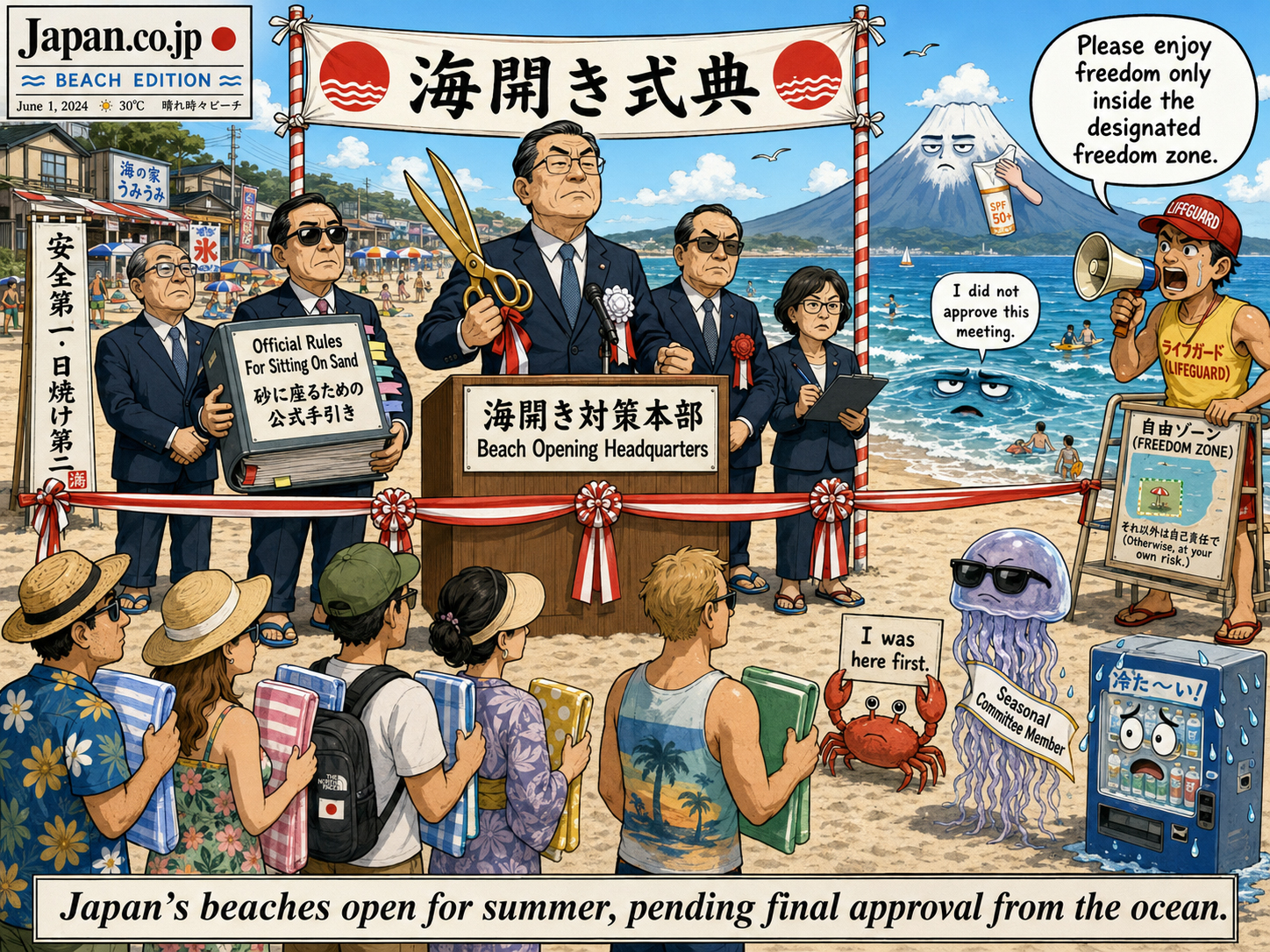
The ocean did not approve this meeting
In today’s cartoon, a full official ceremony has appeared on the sand. The podium reads “Beach Opening Headquarters.” Serious adults in suits hold giant scissors. Tourists line up with towels like immigration documents. A lifeguard shouts, “Please enjoy freedom only inside the designated freedom zone.” A crab holds a sign saying, “I was here first.” A jellyfish is a seasonal committee member. The ocean contributes one sentence: “I did not approve this meeting.”
This is not a cartoon against beach openings. Umi-biraki is a lovely and useful Japanese summer ritual. Lifeguards, swimming zones, water checks, first-aid stations and beach houses all matter. The joke is not safety. The joke is what happens when safety becomes the excuse for managing every small human pleasure until the pleasure files a resignation letter.
Japan is kind, clean and beautifully organized. Trains arrive on time. Trash is sorted. Streets are safe. Signs are polite. But sometimes the politeness becomes a cage. Before lying on the sand, people wonder whether they are doing it correctly. Before a child runs, a parent scans the social atmosphere. Before fun begins, everyone reads the room. It is summer, but the soul is wearing a necktie.
Low birth rates are not only about wallets
Japan’s demographic crisis is real. Births to Japanese nationals fell to 671,236 in 2025, and the total fertility rate dropped to 1.14, according to recent reporting based on official vital statistics. The government has also warned that the years before the 2030s are a crucial window for trying to reverse the declining-birth trend.
Money matters. Wages, housing, education costs, childcare, working hours, gender roles and career insecurity all matter. Telling young people to “just have more children” while ignoring those pressures is not a policy; it is a greeting card with bad economics.
But there is another factor that is harder to measure: daily joy. When young people imagine marriage or children, they do not picture only subsidies. They picture weekends. Can they take a child outside? Can a toddler cry without the parent being treated like a failed public servant? Can a stroller move through town? Can kids kick a ball? Can a family put a towel on the sand without feeling they have entered a compliance zone?
An over-managed society is not romantic
The danger of over-management is not only the rule itself. It is the exhaustion that arrives before anything begins. In a place with too many rules, fun becomes paperwork. Parents with small children become constant apology machines. Will the child cry? Run? Spill something? Bother someone? Consideration is necessary. But when consideration becomes permanent fear, raising children becomes less like social participation and more like a punishment tour.
That is why the beach cartoon lands. The beach should be a place of basic freedom: waves, sand, sun, wet feet, cheap shaved ice, strange tan lines. But add too many ceremonies, zones, forms and committees, and freedom becomes a tiny rectangle on a map. Approved freedom. Timed freedom. Freedom with a signboard, a QR code and a person in a vest explaining the terms and conditions.
People do not build futures in places that feel like that. People build futures where life seems worth joining. Children grow through mud, sand and laughter, not through perfectly administered silence. So do adults. Love, families and communities need the same oxygen: the feeling that trying something is allowed.
The old guard needs to step back from the towel
By “old guard,” this article does not mean age alone. Some young people adore control. Many older people are wonderfully generous to children. The real old guard is an attitude: regulate first, forbid first, avoid blame first, and ask later whether anyone is still smiling.
Safety officials are necessary. But a country cannot be run only by people whose first instinct is to reduce the possibility of inconvenience to zero. Public beaches, parks, festivals, shopping streets, schools and local events need adults who protect joy, not only managers who eliminate risk.
A beach house is not just a business. It is where parents rest, children eat yakisoba, teenagers make summer memories and visitors are absorbed into local life. If every such place is viewed mainly as a possible source of nuisance, summer gets thinner. And a thin summer is not exactly a national fertility strategy.
Bring back sand between the toes
Governments can budget. Municipalities can design programs. Companies can improve parental leave. All of that is needed. But below policy sits atmosphere. If the everyday atmosphere says children are a burden, noise is failure and public joy is suspicious, the numbers will not easily move.
A child-friendly society is not a perfect society. It is a society that can absorb a little noise, a little delay, a little sand, a little mess. It is a society where adults sometimes smile instead of scold. It is a society where the beach is not merely a managed asset, but a place where families can remember that life is supposed to feel good.
The real subject of the cartoon is not the politician, the crab or the jellyfish. It is the human feeling before stepping onto the sand: “Am I allowed to enjoy this?” Recovering that feeling may seem far from the population problem. It is not. A society that welcomes joy is more likely to welcome children.
The beach does not need another meeting. It needs lifeguards, local wisdom, basic manners, tolerance and sand between the toes.
The ocean has not approved the committee. But it probably approved the child laughing there long before anyone brought a clipboard.
- Safety management, lifeguards, water checks and swimming zones are necessary.
- The problem is the social habit of managing ordinary joy beyond what safety requires.
- Birthrate policy needs money and services, but also child-friendly public space and tolerance.
- Beaches, parks, festivals and shopping streets are where a society proves whether it welcomes children.
Sources and references
This opinion piece is based on public reporting on Japan’s vital statistics, government child-policy material, and Japan.co.jp’s beach-opening coverage.