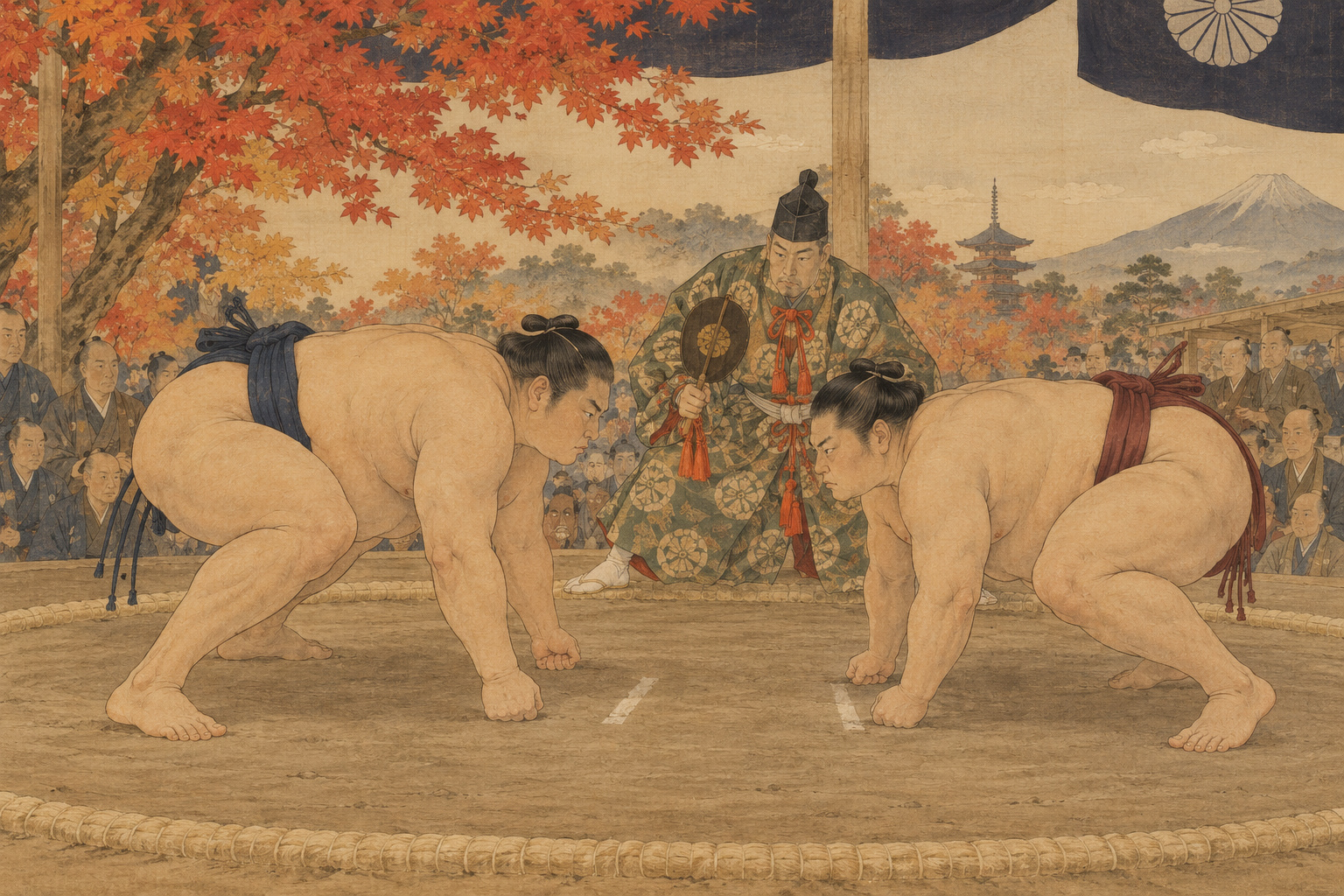
Results through September 13, Day 1. Onosato opened the Autumn Grand Sumo Tournament with a victory, as did all three ozeki and both sekiwake. With fellow yokozuna Hoshoryu absent from the start, the highest-ranked wrestlers who took the ring avoided an immediate setback. Yet the identical 1–0 records conceal very different stories: a grand champion rebuilding consistency, a returning ozeki carrying the previous tournament’s title, and newcomers testing themselves at unfamiliar ranks.[1][2][3]
| Winner | Loser | Technique |
|---|---|---|
| Onosato | Daieisho | Hatakikomi |
| Kirishima | Kotoshoho | Uwatenage |
| Kotozakura | Takayasu | Yorikiri |
| Aonishiki | Kotoeiho | Yorikiri |
| Atamifuji | Gonoyama | Yorikiri |
| Fujinokawa | Yoshinofuji | Yorikiri |
| Churanoumi | Hakunofuji | Yorikiri |
Source: SportsNavi. Each listed winner finished 1–0; each loser, 0–1.[1]
A title race with more than one starting point
Aonishiki provides the clearest reason to look beyond the opening-day scoreboard. The official record shows a 12–3 championship in January, a losing 7–8 finish in March, an entire tournament missed in May, and another 12–3 title in July. He is back at ozeki after competing at sekiwake in July. His September victory over Kotoeiho therefore begins a campaign of consolidation after a remarkable reversal of fortunes.[5]
Calling him simply a rising prospect misses how much has already happened. Calling him secure because he won the most recent championship goes too far in the other direction. His recent season demonstrates both the capacity to win and how quickly a wrestler’s position can change. The useful question now is whether he can make successive tournaments resemble July more closely than the difficult months that preceded it.
The Japan Sumo Association explicitly identifies his September status as a return to ozeki. That distinction matters: this is a restoration of a previously held rank, carrying a different history from a first promotion. For readers encountering the sport through a single headline, the September rankings are a snapshot of movement, not a permanent list of ability.[3]
Onosato: an opening win is a step, not a diagnosis
Onosato’s recent record supplies a more cautious frame. March ended with no wins, four losses and 11 absences; he missed all of May, then completed July at 9–6. His opening September success against Daieisho is valuable because it begins another attempt to establish consistency. Those records support a story about rebuilding. They cannot, on their own, establish complete physical recovery.[4]
For a yokozuna, winning one bout and imposing himself across a tournament are different achievements. Readers should watch whether he gains the initiative at the opening charge, whether opponents repeatedly force him to recover position, and whether his victories become reproducible. These are questions for the coming bouts, rather than conclusions that can be extracted from a single winning-technique label.
Hoshoryu’s absence changes the immediate field. The association’s notice lists him, Wakatakakage and Wakanosho as withdrawing from the opening day. It does not, by itself, settle whether any will return later in the tournament. Describing Onosato as the only yokozuna competing on Day 1 is accurate; assuming that this arrangement must last all fifteen days would extend the announcement beyond what it says.[2]
Kirishima’s repeated 12s and Kotozakura’s narrower recovery
Kirishima brings a different kind of evidence to the championship discussion: three consecutive 12–3 tournaments, in March, May and July. March’s record won him the championship at sekiwake; he returned to ozeki in May. His September opening win over Kotoshoho follows a sustained run of results rather than an isolated surge.[6]
That consistency is a sound reason to watch him closely. It is not a reserve of wins that can be spent in September. Every tournament starts a fresh championship count, and an early defeat can make later meetings with the strongest opponents more consequential. Discussion of higher rank should not obscure the practical task of staying close enough to the lead to control the closing stages.
Kotozakura, who beat Takayasu, arrives from a more precarious sequence: 3–9 with three absences in May, followed by 8–7 in July. His first September win creates room to build. The distinction to watch is whether he moves from securing a winning record to remaining involved at the top of the standings. His ozeki rank matches Aonishiki’s and Kirishima’s, but their recent records do not tell the same story.[7]
The sekiwake tier offers two different tests
Atamifuji followed May’s 9–6 with 12–3 in July and opened September by defeating Gonoyama. He has accumulated 21 wins over the preceding two tournaments, both at sekiwake. That arithmetic explains the interest in his next step without establishing an automatic promotion requirement. September’s results still have to be earned, and a discussion of advancement must remain distinct from an announced decision.[8]
Fujinokawa is encountering a new rank. His July record was 8–7 from the highest maegashira position on the east side, accompanied by the Outstanding Performance Prize. He began his first tournament at sekiwake with a victory over Yoshinofuji. The association identifies him as Isenoumi stable’s first new sekiwake since Ikioi in May 2016, giving the promotion significance beyond one wrestler’s place on the sheet.[9][3]
For him, establishment at the new level is an immediate story in its own right. An opening win makes that task easier, but it does not turn a debut at a high rank into a championship forecast. The coming matches will test whether his results can remain steady as the opposition changes, and whether a setback is followed by adjustment or another loss.
Hakunofuji’s first appearance at komusubi ended in defeat to Churanoumi. His official profile records the successive ring names Ochiai, Hakuoho and Hakunofuji, and marks September as his first tournament in the named upper ranks. One defeat is a difficult introduction, not a verdict on his promotion. His response is now part of the developing story.[10]
What a winning technique can tell the reader
Several of the leading bouts ended in yorikiri. In the association’s definition, this involves close body contact and forcing the opponent out, moving forward or sideways. Uwatenage, the technique recorded in Kirishima’s match, is a throw using a belt grip over the opponent’s inside arm. It can also win by sending the opponent outside the ring without a fall.[11][12]
These terms make a compact results table informative, but they describe how the contest ended. They do not tell us whether a wrestler controlled the opening charge, spent a long period defending, or recovered after losing a preferred grip. The association distinguishes 82 winning techniques and five additional non-technique outcomes. That vocabulary is a classification system, not a ranking of the quality of victories.[16]
The distinction is especially useful in September’s opening week. Treating every force-out as effortless, or every slap-down as evidence of poor form, would substitute a label for observation. To evaluate a contender, the result has to be placed alongside the sequence of the bout and a longer record. Where the sequence has not been established, restraint produces a better account than an imagined reconstruction.
The history beneath the autumn spectacle
The familiar setting itself reflects change. The association’s chronology records the merger of the Tokyo and Osaka sumo organizations in 1927 and the enlargement of the ring to its present 4.55-metre diameter in 1931. In September 1952, the four supporting pillars were removed in favour of a suspended roof and coloured tassels. Kuramae Kokugikan opened in September 1954; the new Ryogoku Kokugikan followed in January 1985.[13]
Those dates connect institutional history to what spectators actually see: the space in which a wrestler can escape, the view across the ring, and the building to which the autumn tournament returns. Sumo’s continuity has been maintained through alterations to its organization and presentation. A new sekiwake or a restored ozeki belongs to that continuing process of renewal within an inherited form.
The next bouts will make the opening results more meaningful
The published Day 2 pairings for September 14 set Onosato against Kotoshoho, Aonishiki against Takayasu, and Kirishima against Hakunofuji. Atamifuji is scheduled to meet Churanoumi, the man who spoiled Hakunofuji’s debut. These contests had not taken place at this report’s results cutoff. They offer immediate tests of whether opening-day winners can repeat their success against different opponents.[15]
The tournament is scheduled to finish on September 27. There is ample time for the field to change. The strongest early assessment combines three things: recent championship-level results, consistency across tournaments, and the quality of the bouts being fought now. September opened with the leading ranks intact. The next task is to discover whose first win begins a sustained challenge.[14]
Sources and references
- SportsNavi: September 2026, Day 1 results
- Japan Sumo Association: withdrawal notice, top division updated September 11
- JSA: September 2026 ranking changes
- JSA: Onosato, official career and bout records
- JSA: Aonishiki, official career and bout records
- JSA: Kirishima, official career and bout records
- JSA: Kotozakura, official career and bout records
- JSA: Atamifuji, official career and bout records
- JSA: Fujinokawa, official career and bout records
- JSA: Hakunofuji, official career and bout records
- JSA: yorikiri technique definition
- JSA: uwatenage technique definition
- JSA: institutional history
- JSA: 2026 tournament calendar
- SportsNavi: Day 2 pairings, updated September 13 at 18:17 JST
- JSA: the 82 winning techniques
Evidence reviewed September 14, 2026, Japan time. Results cutoff: the end of Day 1, September 13. Rank, career and withdrawal information comes from the JSA; the Day 1 technique table is attributed to SportsNavi. Interpretations are Japan.co.jp analysis unless otherwise attributed.