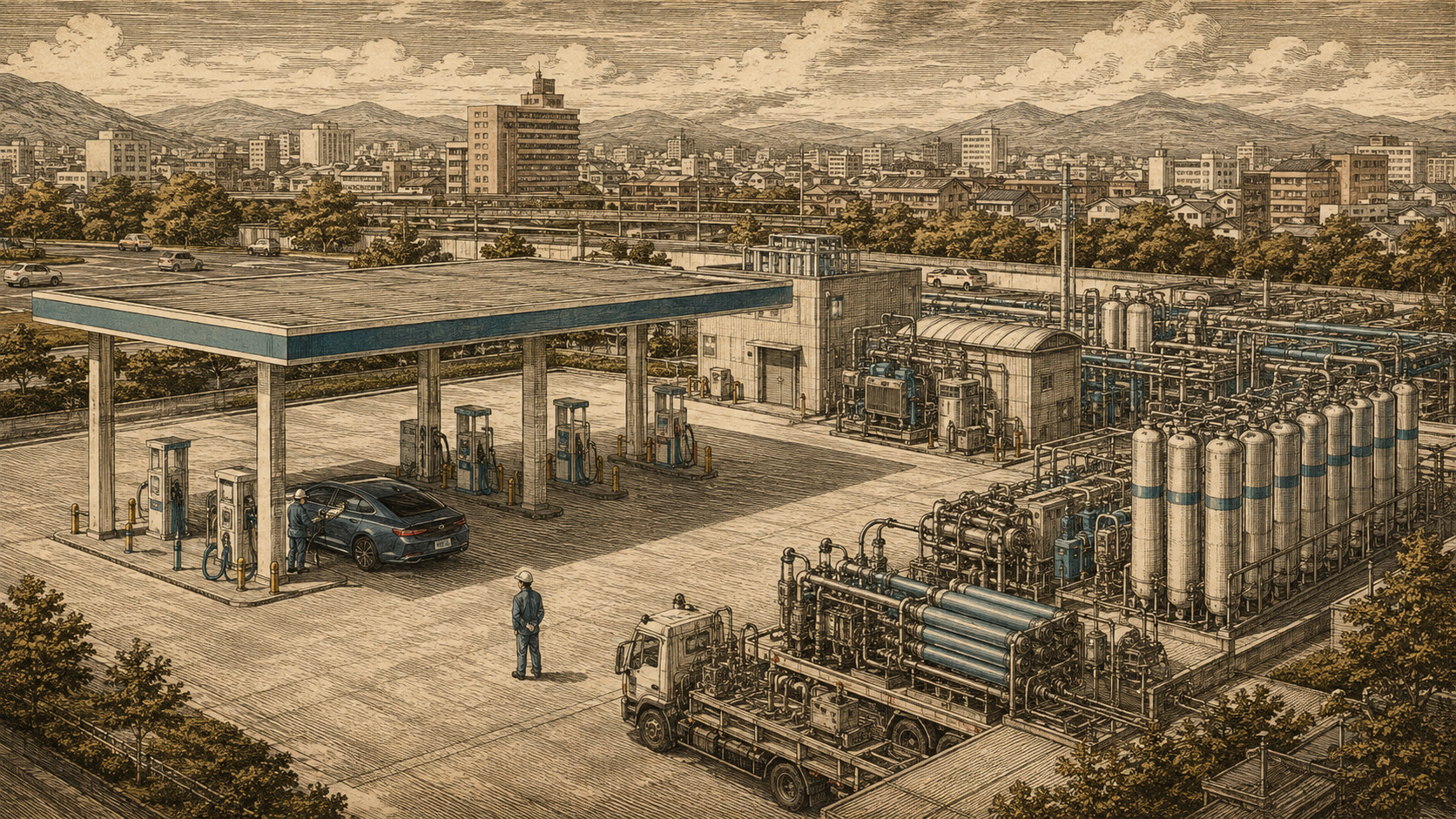
A hydrogen station is a small chemical plant disguised as a filling pump. The driver sees a hose and a price display. Behind the wall are vessels, valves, a compressor or liquid pump, cooling equipment and sensors doing something physically severe: preparing the lightest molecule for a fast transfer into a vehicle tank at 70 megapascals.
Iwatani’s typical liquid-hydrogen station begins even farther away. Hydrogen made at one of three domestic liquefaction bases travels by insulated tanker. At the station it sits near minus 253 degrees Celsius, is vaporized, raised to about 82 MPa, buffered in high-pressure accumulators and cooled to minus 40 degrees before dispensing. Iwatani says a 24-kiloliter liquid tank can hold enough for more than 500 passenger-car fills. The fill itself can take about three minutes.
That performance is real. So is the network. By April 2026 Iwatani—the industrial-gas company that opened Japan’s first commercial hydrogen station in 2014—said it operated 52 domestic sites. That is more than one-third of either current national count. Yet refueling remains the decisive objection raised by many prospective fuel-cell-vehicle owners.
The contradiction disappears once “station count” is separated from “refueling service.” A site can exist but be off route; operate only business hours; close on Sundays or holidays; pause for inspection, maintenance or lack of supply; have one fueling position; or need time to rebuild pressure after consecutive fills. A nationwide total measures installed geography. A driver experiences distance, hours, queues, uptime and price.
Before hydrogen was an energy dream, it was an unwanted industrial gas
Iwatani’s hydrogen story began not with a car but with waste. Founder Naoji Iwatani had opened a business in Osaka in 1930 selling oxygen, welding rods and carbide. In 1941 he noticed hydrogen produced as a by-product of industrial processes and often released to the atmosphere. Iwatani began selling it for uses that included welding, balloons and meteorological observation.
In 1958 the company created Osaka Hydrogen Industry—now Iwatani Gas—inside Osaka Soda’s Amagasaki works, recovering hydrogen from chlor-alkali production. Supply rose about sevenfold, according to Iwatani’s corporate history, just as Japanese electronics manufacturing needed hydrogen for transistor production. The business learned the unglamorous disciplines an energy carrier demands: purification, cylinders, logistics, quality measurement and high-pressure safety.
Liquid hydrogen widened the moat. Iwatani now calls itself Japan’s only commercial supplier of liquefied hydrogen, produced at Ichihara in Chiba, Sakai in Osaka and Shunan in Yamaguchi. It also operates ten compressed-hydrogen production sites and estimates a 70% share of Japan’s merchant hydrogen market as of February 2024. Most output still serves industry and space, not cars. That older market is why Iwatani could attempt a retail network at all.
1930 Naoji Iwatani starts selling oxygen, welding rods and carbide in Osaka.
1941 Iwatani begins selling hydrogen recovered from industrial by-product streams.
1958 Its first self-manufacturing venture expands hydrogen supply at Amagasaki.
2006 The company begins its Hydrogen Energy Forum as liquid-hydrogen infrastructure expands.
July 2014 Iwatani Hydrogen Station Amagasaki opens as Japan’s first commercial site.
December 2014 Toyota launches the Mirai in Japan; Iwatani sets an initial tax-exclusive price of ¥1,100/kg.
2018 JHyM is established to pool automaker, infrastructure and financial participation.
2023 Ashigara opens with commercial fuel-cell vehicles in mind.
2024 Heiwajima opens inside a truck terminal with 60 kg/h capacity.
2025 An Iwatani–Cosmo station opens inside Toei Bus’s Ariake depot.
April 2026 Iwatani reports 52 operated stations in Japan.
Amagasaki was a bet placed before the cars arrived
On July 14, 2014, Iwatani opened its Amagasaki station inside the company’s research-center grounds. The first Mirai would not reach customers until December. Liquid hydrogen arrived from Hydro Edge in Sakai; a Linde ionic compressor and standardized 14-foot fueling package pushed gas toward automotive pressure. The ceremonial first step was also an infrastructure company accepting demand risk.
The industry’s 2011 joint declaration had paired two promises: Japanese automakers would introduce FCVs around 2015, and 13 automakers and energy companies would support roughly 100 stations in four metropolitan areas and on connecting corridors. Iwatani pledged 20 of its own by the end of FY2015. The logic was familiar: no one buys a car without fuel, and no one finances a station without cars. Both sides would move first.
Iwatani’s November 2014 retail announcement captured the confidence of the moment. It set hydrogen at ¥1,100 per kilogram before tax at qualifying urban liquid-hydrogen stations, presenting that as equivalent to the fuel cost of a comparable hybrid. At the common early conversion of roughly 1 kilogram per 100 kilometers, the price worked out to about ¥11 per kilometer before tax. It was a market-opening price, subject to economic conditions—not proof that the full production, delivery and station cost was already profitable.
The distinction would become important. A pump price can be held below delivered cost by an operator, a capital grant, an operating subsidy or all three. Commercial independence requires enough kilograms sold, at a durable margin, to pay for hydrogen, delivery, electricity, inspections, land, staff, maintenance and replacement parts after public support ends.
Japan solved part of the chicken-and-egg problem with JHyM
In February 2018, 11 companies created Japan H₂ Mobility, or JHyM. Its structure allowed an infrastructure operator and JHyM to invest jointly in a site while automakers and financial companies supported the network around it. The initial goal was 80 JHyM-backed stations by the end of FY2021; its planned business period now runs through March 2028.
The consortium mattered because it spread early-stage risk. When JHyM’s first jointly developed station opened in Iwaki in March 2019, it noted that 101 sites had already been built nationally and 100 were operating. By its 2023 planning release, JHyM described 170 bases and 181 locations when earlier subsidized projects and mobile-station locations were included. That was a construction-and-adoption boundary, not a claim that 181 retail sites were simultaneously open.
The 2026 operating picture is smaller: 141 on the Next Generation Vehicle Promotion Center’s July list and 143 on JHyM’s June display. That does not mean a single, clean collapse from 181; the metrics count bases, mobile locations, adopted plans and operating subsidized sites differently. It does show why every station number needs a date and definition. “Built,” “adopted,” “location,” “base,” “operating” and “available now” answer different questions.
| Published number | What it measures | What it cannot tell a driver |
|---|---|---|
| 52 | Iwatani-operated Japanese stations as of April 2026. | Whether a particular site is open, supplied or compatible at this moment. |
| 141 | Subsidized sites listed as operating by the Next Generation Vehicle Promotion Center, July 1. | The center notes its own program boundary; it is not every possible private installation. |
| 143 | Nationwide station count displayed by JHyM on June 30. | Why two nearby dates differ without reconciling each organization’s list. |
| 181 | Locations associated with past adopted projects in JHyM’s May 2023 release. | Simultaneous retail operation; mobile bases can serve multiple locations. |
The network grew; the passenger fleet did not grow with it
The starkest utilization evidence is vehicle registration. The Next Generation Vehicle Promotion Center counted 8,289 passenger FCVs at the end of FY2024, up from 3,695 five years earlier. Annual passenger-FCV sales were 523 in FY2024. They had peaked at 1,997 in FY2021, then fell to 490 the following year and remained in the hundreds.
Divide 8,289 cars by 141 operating sites and the national average is about 59 passenger FCVs per station. That is not a forecast of actual station customers: vehicles and stations are unevenly distributed; taxis travel more; buses and commercial vehicles also refuel; and drivers can use several sites. But it exposes the order of magnitude.
Iwatani itself offers a useful consumption rule: an FCV driven 10,000 kilometers a year uses about 100 kilograms of hydrogen. If 59 such cars were attached to one station, they would average only about 16 kilograms a day in total. A modern passenger station rated at 300 Nm³ per hour can deliver roughly 27 kilograms per hour using Iwatani’s 11.2 Nm³-per-kilogram conversion. On that deliberately simplified comparison, the installed hourly machinery could serve a notional day’s average passenger demand in well under an hour.
This is not an estimate of any Iwatani site’s actual sales. It is a scale illustration built from national averages and company conversion figures. Its message is that capacity is not scarce everywhere; customers are. Sparse demand keeps expensive equipment idle, while sparse geography still makes the network feel inadequate to each driver. Hydrogen can suffer overcapacity and inconvenience at the same time.
A three-minute fill rests on an expensive chain of machines
Iwatani’s engineering pages show why a hydrogen nozzle should not be compared with a simple electric outlet. An off-site liquid station needs a cryogenic storage tank, vaporizer, compressor or liquid pump, accumulator, pre-cooler, dispenser, control system and safety equipment. Hydrogen is raised to around 82 MPa so it can flow quickly into a 70 MPa vehicle tank. Cooling to minus 40 degrees controls heat generated during the fast fill.
The equipment has improved. Iwatani says fueling-hose replacement intervals rose from 100 uses at early commercial stations to 1,000; composite accumulators became lighter; and a pre-cooler once about two meters by one meter shrank to less than one-fiftieth of the volume and moved inside the dispenser. Regulation evolved too: the required dispenser-to-road separation was reduced from eight meters to five in 2018, and water-supply rules were eased. In 2025 Japan also revised pressure and condition-monitoring provisions.
These are meaningful cost reductions. Yet the support schedule shows how capital-intensive the category remains. For FY2024 installations, the Next Generation Vehicle Promotion Center offered up to two-thirds of eligible cost and a ¥450 million cap for a large station of 500 Nm³/h or more. A 300-to-500 Nm³/h packaged station could receive up to ¥250 million. These are maximum grants, not average project prices and not evidence of Iwatani’s private costs.
Operating support is similarly revealing. Under the FY2025 demand-creation program, annual caps ranged from ¥10 million for a small fixed site to ¥45 million for a large 24-hour site; a 100-to-500 Nm³/h station could receive up to ¥21 million. Again, these are program ceilings. Their existence shows that technicians, inspections, utilities and maintenance do not disappear when few customers arrive.
Price at the nozzle contains more than the cost of making hydrogen
Japan’s famous hydrogen-cost targets—¥30 per Nm³ in 2030 and ¥20 in the longer term—are supply-chain ambitions, not guaranteed retail pump prices for pre-cooled 70 MPa fuel. Using 11.2 Nm³ per kilogram, ¥30/Nm³ is roughly ¥336 per kilogram before all downstream conditioning, transport, storage, station capital, losses, staffing, tax and retail margin.
The current policy gap is even more direct. When METI chose five priority regions for commercial fuel-cell vehicles in May 2025, it said hydrogen procurement remained more expensive than diesel and private station operators were bearing the difference. The ministry proposed roughly ¥700 per kilogram of additional support—about three-quarters of the stated fuel-cost gap—along with fixed and variable operating assistance.
That support does not mean every retail kilogram has one national price, and this article does not infer Iwatani’s current tariff from it. Prices, payment rules and hours should be checked with the operating station. It does mean the economics are not a minor rounding error. If policy must bridge roughly ¥700/kg before local support, a fleet’s fuel contract, utilization and carbon source become as important as the vehicle’s technical efficiency.
The carbon source matters as well. Iwatani says its present domestic supply is made from LNG or refined from industrial by-product hydrogen, while future low-carbon supply may increasingly depend on large overseas chains and renewable electricity. A fuel-cell car emits water at the tailpipe. The lifecycle emissions of the kilogram depend on production, liquefaction or compression, transport and losses. A station count contains no carbon information.
“Open” is a service standard, not a dot on a map
Conventional fuel has trained drivers to expect redundancy: several stations, long hours and another pump if one fails. Japan’s hydrogen sites often developed under a different operating model. JHyM’s first Iwaki site, for example, opened with weekday hours of 9 a.m. to 7 p.m. and a four-hour Saturday window. A 2024 Chita station listed Monday-through-Saturday operation and closure on Sundays and holidays. Iwatani extended selected stations as late as 10 p.m. in 2016 specifically in response to customer requests.
Those examples are historical and site-specific, not a description of all 52 Iwatani sites. They illustrate the issue: hours are part of infrastructure. So are real-time outage information, preventive maintenance, parts availability, supply redundancy and pressure recovery after a sequence of fills. A station that serves six cars an hour on paper may not sustain that rate indefinitely through one dispenser.
For a private owner, one unplanned closure can strand a trip. For a fleet, the same risk can idle revenue equipment. Fleets can respond with contracts, scheduled fueling, backup trailers and redundant hardware—but those measures add cost. The most useful national dashboard would therefore publish dispensing-position availability, kilograms sold per day, closures by cause, median queue time and delivered carbon intensity, not simply map pins.
The strategic answer is to bring many vehicles to one pump
Iwatani’s newest stations reveal its response. Ashigara, opened in September 2023, was placed where commercial-FCV demand was expected. In April 2024, Iwatani and Cosmo opened Heiwajima inside the Keihin Truck Terminal in Tokyo. It is rated at 60 kilograms per hour, stores about 3,000 kilograms and operates from 8 a.m. to 8 p.m. year-round except for statutory inspection closures. In March 2025 their venture opened a station inside Toei Bus’s Ariake depot—the first such bus-depot installation in Japan.
This is a different market architecture from the Mirai launch. A bus depot knows how many buses return, when they return and approximately how many kilograms each needs. A truck terminal aggregates independent freight movement in one place. A 60 kg/h station can serve heavy vehicles that each take far more hydrogen than a sedan, raising daily throughput without waiting for thousands of households to choose a new fuel.
National policy has followed. METI selected five commercial-FCV priority regions centered on Fukushima; Tokyo and Kanagawa; Aichi; Hyogo; and Fukuoka. The stated goal is to create a block of demand for large and small trucks and buses, then stimulate nearby users. It is an explicit move from scattering infrastructure toward clustering vehicles, stations, local government support, shippers and logistics operators.
| Passenger-network model | Clustered commercial model |
|---|---|
| Demand depends on thousands of unrelated household purchase decisions. | One depot, carrier or municipality can contract a fleet. |
| Drivers expect broad geography and consumer-retail hours. | Routes and fueling windows can be scheduled. |
| Each car consumes roughly 100 kg/year at 10,000 km. | A bus or truck can consume many passenger-car equivalents. |
| A closure strands dispersed individuals. | Redundancy can be designed into one operating contract—at a price. |
| Convenience must precede mass adoption. | Anchor demand can precede expansion. |
Fifty-two is evidence of capability—not yet proof of a self-sustaining market
Iwatani deserves credit for building before demand was assured. It transformed an industrial-gas chain begun in 1941 into cryogenic plants, quality laboratories, tanker logistics and a public network. It helped standardize equipment, trained operators and absorbed the practical lessons that do not appear in a fuel-cell brochure. Without that work, Japan would not know where the bottleneck actually lies.
The lesson is not that hydrogen technology failed. The dispenser can fill a car in minutes. The industrial chain can make, liquefy, transport, measure and safely transfer the gas. The failure was the assumption that technical availability plus station construction would quickly cause a passenger mass market. Battery vehicles improved, FCVs remained expensive and thinly offered, and the station network never reached ordinary-retail convenience. Demand and infrastructure remained mutually cautious.
Nor is 1,000 stations by 2030—the national infrastructure ambition—useful by itself. A thousand lightly used sites could deepen the subsidy burden. Fewer high-throughput, reliable stations might support more actual work if they sit inside freight terminals, bus depots, ports and industrial clusters. Japan should count what the network does, not only what it contains.
- Operating sites, dispensers and hours—published with one harmonized definition.
- Availability excluding planned maintenance, plus closure causes and recovery time.
- Kilograms dispensed per day, peak hour, vehicle class and repeat-customer share.
- Retail and contracted price per kilogram before and after every subsidy.
- Capital and operating support per kilogram sold, declining on a defined path.
- Fuel carbon intensity from production through delivery, not only tailpipe emissions.
- Queue time, consecutive-fill performance and backup-supply capability.
The next chapter is therefore less romantic than the first. It is about truck schedules, compressor uptime, technician callouts, kilograms per shift and contracts long enough to finance a supply chain. Iwatani’s 52 stations are not the end of the chicken-and-egg problem. They are the expensive experiment that revealed its true shape.
A Renaissance “theater of invention” celebrated the visible machinery of progress. Japan has built that machinery. The invention still required is an operating market: enough predictable low-carbon demand, at enough locations, to keep the machine busy without asking the public balance sheet to pay for every idle hour.
Reporting notes and principal sources
Counts are reproduced with the dates and definitions given by their publishers. The 59-FCV-per-site and 16-kg/day examples are Japan.co.jp calculations: 8,289 FY2024-end passenger FCVs divided by 141 operating subsidized sites, then multiplied by Iwatani’s illustrative 100 kg/year per car and divided by 365. They are national scale checks, not estimates of Iwatani utilization, sales or profitability. Subsidy values are maximum eligible amounts, not project averages or Iwatani costs. No public primary source found by the reporting cutoff provided a harmonized real-time national uptime series, station-by-station kilograms sold or Iwatani’s networkwide current retail price.
- Iwatani: 52 Japanese and ten U.S. stations as of April 2026
- Iwatani: station types, network history and throughput examples
- Iwatani: liquid-hydrogen station process, storage, pressure and equipment improvements
- Iwatani: corporate hydrogen history from 1941
- Iwatani: domestic production network and merchant-market share
- Iwatani: opening of Japan’s first commercial station at Amagasaki, July 14, 2014
- Iwatani: initial ¥1,100/kg before-tax retail price, November 2014
- Iwatani: hydrogen conversions and illustrative FCV annual consumption
- JHyM: establishment, membership and 2018–2027 business period
- JHyM: first joint station and pre-JHyM national count, March 2019
- JHyM: 2023 adopted-project count of bases and locations
- JHyM: 143-station nationwide display, June 30, 2026
- Next Generation Vehicle Promotion Center: 141 operating subsidized sites, July 1, 2026
- Next Generation Vehicle Promotion Center: passenger-FCV registrations through FY2024
- Next Generation Vehicle Promotion Center: passenger-FCV annual sales through FY2024
- Next Generation Vehicle Promotion Center: FY2024 installation-subsidy rates and caps
- Next Generation Vehicle Promotion Center: FY2026 demand-creation operating-support caps
- METI: five commercial-FCV priority regions and roughly ¥700/kg additional support
- METI: 2030 ambition for roughly 1,000 optimally located hydrogen stations
- Cosmo Energy: Heiwajima truck-terminal station opening, April 2024
- Next Generation Vehicle Promotion Center: current Heiwajima hours and station classification
- CJPT: Heiwajima’s approximately 3,000 kg storage
- Cosmo Energy: Ariake bus-depot and Shinsuna station plans
- Agency for Natural Resources and Energy: hydrogen supply-cost targets
- METI: 2025 station-pressure and condition-monitoring regulatory revision