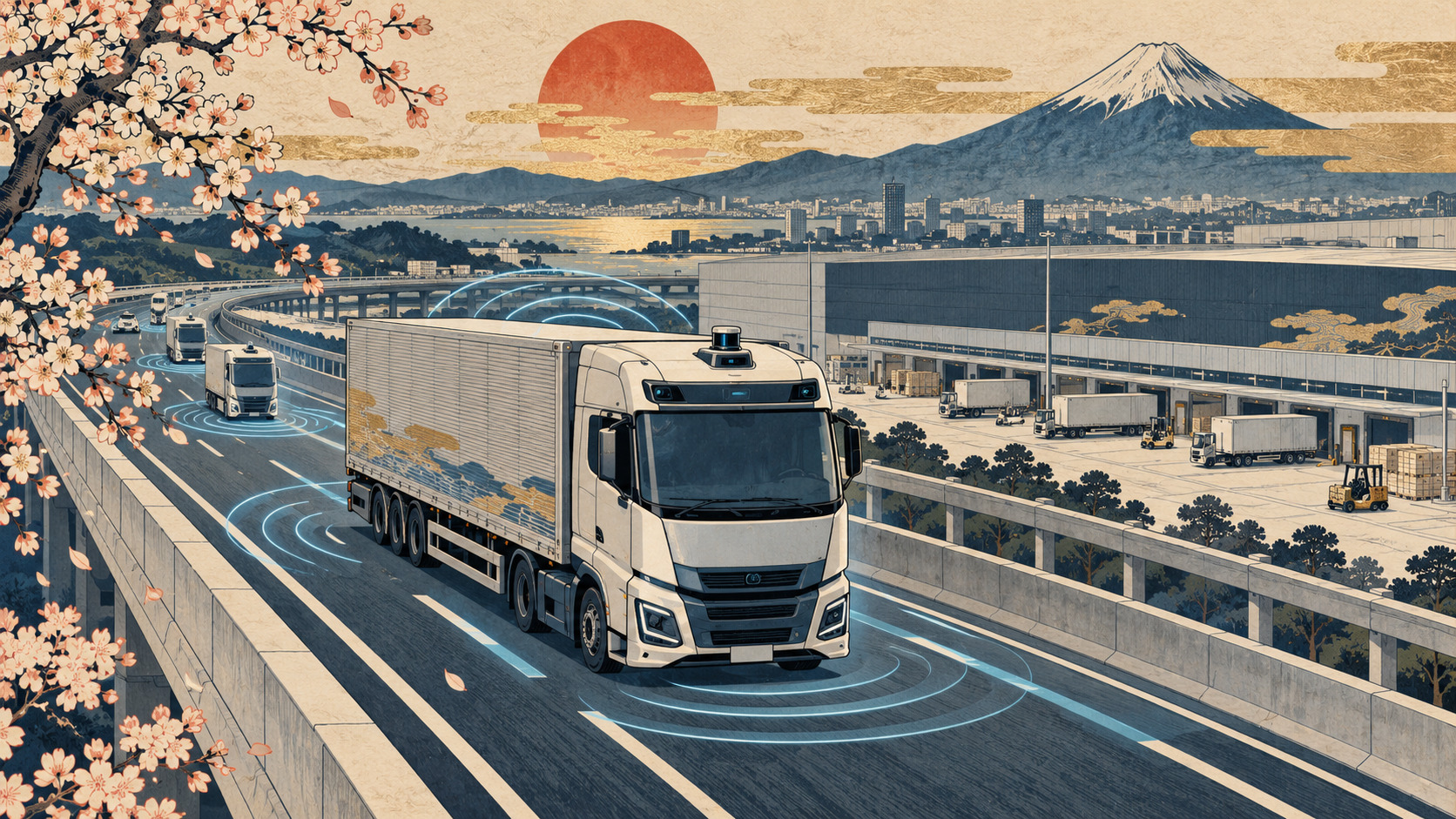
A driverless truck does not abolish work. It redistributes it. Someone loads the freight, releases the vehicle from a depot, deals with a broken pallet, monitors the communications link, responds when an obstacle blocks the lane and repairs the sensors before the next run. The person holding the steering wheel may disappear from one stretch of road. The operating system around that empty seat becomes larger.
That is the real experiment underway inside Isuzu Motors’ own parts network. The route runs roughly 450 kilometers between Isuzu Logistics’ Iwafune Parts Center in Tochigi City and its Chubu Parts Center in Ichinomiya, Aichi Prefecture. A four-axle, 25-ton Giga carries service parts as commercial cargo, operated by One Trans, a wholly owned Isuzu Logistics subsidiary. The eventual operating ambition is about five days per week and a round trip in one day.
Only part of that journey has initially been designated for automated driving: approximately 100 kilometers of the Shin-Tomei Expressway between Surugawan-Numazu and Hamamatsu service areas. Even there, a safety driver has remained in the cab. The road from the Tochigi depot to the automated corridor, the onward leg into Aichi, cargo handling and abnormal-event response remain separate operational problems.
The crucial words are “within its domain”
Japan’s official terminology defines Level 4 as automation of the entire driving task within a specified operational design domain, or ODD. The domain can restrict road, speed, weather, time and other conditions. Level 5 would remove those operating limits. Level 2, by contrast, is driver assistance: the person remains responsible for watching the road even while steering and speed are supported.
Isuzu’s phrase “driving assuming Level 4” marks the gap between development and deployment. The automated system is exercised, but a safety driver continuously supervises and can take control. True driverless operation would have to cope safely within its ODD without making an immediate human handover its fallback.
Japan created a permit framework for tokutei jidō unkō, or specified automated operation, when amended Road Traffic Act provisions took effect in 2023. Prefectural public safety commissions assess the operator and plan, with defined responsibility for an operation manager, remote support and emergency action. A test conducted with a legal driver aboard is not equivalent to permission for an enduring driverless service.
| Operating state | Who performs the driving task | Place in Isuzu’s program |
|---|---|---|
| Level 2 | The driver monitors continuously; automation assists steering and speed | Existing driver-assistance category |
| “Level 4-assumed” trial | The system drives, but a safety driver supervises and can intervene | Step 1 and development running |
| Level 4 | The system performs the entire task inside a declared ODD | Targeted business launch during fiscal 2027 |
| Level 5 | The system drives without an ODD restriction | Not the objective of this program |
The “2024 problem” was a labor reform colliding with old logistics
Japanese freight’s famous “2024 problem” began when the annual cap of 960 hours of overtime took effect for truck drivers in April 2024. The reform addressed punishing schedules. The crisis was not that drivers gained protection; it was that shippers and carriers had built a system around long waits, inefficient loading, fragmented consignments and the assumption that human time could absorb every delay.
A projection cited by the Ministry of Agriculture, Forestry and Fisheries estimated that, without countermeasures, commercial trucking capacity could fall 14.2% short of the fiscal 2019 baseline in fiscal 2024 and 34.1% short by fiscal 2030. Those figures are a no-action scenario, not a measured national shortfall today. Their significance lies in the scale of the structural risk.
Level 4 highway transport attacks one expensive portion of the problem: binding one driver to a long-distance vehicle from origin to destination. A relay model could use local drivers at each end and an automated tractor or truck between hubs, reducing overnight duty and broadening the pool of people able to do the remaining work. Yet the arithmetic fails if trailers wait for transfers, vehicles run empty, or the automated unit repeatedly stops for weather and requires a crew to recover it.
That makes Isuzu’s use of its own parts unusually useful. The company controls the cargo, schedules and two endpoints. It can test not only lane keeping but dock readiness, paperwork, loading and whether a delayed vehicle creates a cascade. It is also an unusually favorable environment. A system proven inside a coordinated group network must later survive multiple shippers, small carriers, seasonal surges and less standardized depots.
A second-generation truck built around data
The development vehicle starts with the production Giga, a common Japanese heavy truck. Millimeter-wave radar detects objects ahead and to the sides; lidar scans around the vehicle; cameras classify the scene. GNSS estimates location, and an inertial measurement unit tracks vehicle motion. Multiple sensing principles are needed because glare, spray, grime and darkness do not impair each device in the same way.
Applied Intuition, Isuzu’s Silicon Valley software partner, said in March that second-generation trucks were being introduced on the 450-kilometer route. It describes a new end-to-end model connecting perception to vehicle behavior, plus a data engine that takes rare situations from road operation, reproduces them in simulation and sends validated improvements back to the fleet. Isuzu’s announced plan calls for the end-to-end system to enter in Step 2 and for 30 autonomous vehicles to be introduced by the end of fiscal 2026 for data collection and driving evaluation.
The language of learning can obscure the hardest safety question: how to establish what a model will do outside familiar examples. A 25-ton truck has long stopping distances and changes behavior with its load. It may encounter a tire carcass, a crash vehicle on the shoulder, a pedestrian where none should be, an officer’s hand signal or a car cutting across the merge at the last moment.
A 2026 transport-ministry review of the national Shin-Tomei test reported continuous hands-off running from service-area departure through merging, mainline travel, exit and automated parking without a major system problem in the sequence. It also recorded manual interventions prompted by such events as a parked vehicle in an acceleration lane and risky behavior by surrounding traffic. The report covered the broader government-industry program, not a standalone certification of Isuzu’s truck.
Those interventions help define the ODD rather than simply count against it. The commercial questions are precise: at what visibility or rainfall does automated operation stop? How is a construction zone recognized? If the communications network disappears, where can the vehicle reach a minimal-risk stop? How quickly can a responder arrive without creating a second hazard on an expressway?
The highway becomes part of the machine
The corridor between Surugawan-Numazu and Hamamatsu is also a national infrastructure experiment. The roughly 100-kilometer section has been used to test an autonomous-vehicle priority lane and vehicle-to-infrastructure cooperation. Roadside systems can communicate information about merging traffic, obstacles and conditions beyond the truck’s direct sight line. The objective is a connected sequence from service-area departure to merge, mainline, exit and parking.
This shifts autonomous trucking away from the myth of an all-seeing vehicle operating alone. It is a system shared by automaker, expressway operator, mapping and communications suppliers, police, depots and the logistics company. If priority-lane rules are unclear to ordinary drivers, or infrastructure reports an obstacle imprecisely, excellent vehicle software may still face an unsafe choice.
Isuzu’s three-step plan reflects that system problem. Step 1 used one truck, actual parts and a safety driver to study different times, loads and weather. Step 2, planned during fiscal 2026, expands the technology and evaluates depots, remote monitoring and a dispatchable response service. Step 3 in fiscal 2027 is intended as the final validation before business introduction.
Remote monitoring is not remote driving by default. A supervisor may confirm status, coordinate a closure or dispatch help without steering the truck. How many vehicles one person can safely oversee—and what happens when snow or an earthquake disrupts several at once—will determine whether the labor economics scale.
Isuzu is trying to sell continuity, not only a truck
The strategy is the product of a broader transformation. Isuzu’s 2024 medium-term plan, ISUZU Transformation — Growth to 2030, puts autonomous-driving solutions beside connected services and carbon-neutral solutions as future businesses. It envisages ¥1 trillion in innovation investment through 2030 and aims for the three new-technology fields to grow toward ¥1 trillion in sales during the 2030s.
The alliances divide the task. Isuzu signed a partnership of up to five years with Applied Intuition for truck automation and internal software capability. It invested in Foretellix for safety-validation scenarios, formed a capital and business alliance with TIER IV in buses, and invested $30 million in Gatik to work on autonomous-ready chassis and business development. Isuzu and UD Trucks also participate in a government-backed heavy-truck program with other Japanese manufacturers.
A dedicated test facility under construction at Isuzu’s Hokkaido proving ground in Mukawa shows the industrial commitment. The company budgets about ¥7.4 billion for a 190,000-square-meter course, with full operation planned for September 2027. It will reproduce city streets, expressway merges, grades, rail crossings, ETC gates and V2X infrastructure, and accommodate long articulated vehicles. Severe but repeatable scenarios can be tested there without exposing public traffic.
2022 — UD Trucks and Kobe Steel test Level 4 heavy haulage inside Kakogawa Works.
2023 — Isuzu invests in validation specialist Foretellix.
2024 — Applied Intuition alliance begins; Isuzu joins wider Shin-Tomei road testing.
March 2025 — National testing begins on the Shin-Tomei priority-lane corridor.
Fiscal 2026 — Step 2 is planned with end-to-end AI, more vehicles and operating-system tests.
Fiscal 2027 — Isuzu targets final validation and the start of a Level 4 truck business.
What would count as success?
A spectacular demonstration is easier than dependable freight. Logistics customers buy arrival windows, utilization and recovery from disruption. A vehicle that drives flawlessly on a clear night but stops frequently in rain may be safe and still uneconomic. A system that saves driving hours but requires one remote supervisor per truck has not solved the labor equation.
The public metrics therefore need to move beyond autonomous mileage. Useful evidence would include disengagements with context, service cancellations by cause, response time after a minimal-risk stop, remote-supervisor workload, dock-to-dock journey time, empty running, maintenance cost and incidents. Labor outcomes matter too: whether remaining drivers gain more predictable shifts and better pay, or whether savings remain theoretical.
Autonomy is also only one tool. Shorter loading waits, standardized pallets and bookings, fair freight rates, shared distribution, rail and coastal shipping can free capacity sooner and across more routes. Treating the truck as a technological substitute for reform would preserve the inefficiencies that created the shortage.
Isuzu’s wager is nonetheless consequential. A company built around commercial vehicles is trying to become responsible for the movement that surrounds them: data, uptime, supervision and recovery. The decisive milestone will not be the first photograph of an empty cab. It will be an ordinary week in which parts arrive safely, on time and with fewer punishing human hours—and nobody outside the control room finds that remarkable.
- What roads, weather, speeds and hours will define the approved ODD?
- Who responds to a stopped truck, and within what maximum time?
- How much labor is saved after local driving, loading, supervision and maintenance are counted?
- Which vehicle approvals, specified-operation permits, insurance and liability rules will apply?
- Will safety, intervention, cancellation and cost data be published in comparable form?
- Isuzu Motors: launch of the Tochigi–Aichi autonomous-driving business trial (Japanese, November 18, 2025) — three steps, vehicle, route and operating design.
- Applied Intuition: autonomous truck deployment with Isuzu (Japanese, March 31, 2026) — second-generation system and company claims about end-to-end development.
- Ministry of Land, Infrastructure, Transport and Tourism: infrastructure cooperation with autonomous vehicles (Japanese, June 2026) — Shin-Tomei results and intervention examples.
- National Police Agency: automated driving (Japanese) — the specified automated-operation permit system.
- Transport ministry: terminology for automated vehicles (Japanese) — Levels 2–5 and ODD.
- Ministry of Agriculture, Forestry and Fisheries: responding to the 2024 logistics problem (Japanese) — overtime rule and conditional capacity projections.
- Isuzu Motors: strategic alliance with Applied Intuition (Japanese, August 27, 2024).
- Isuzu Motors: autonomous-driving test course in Mukawa, Hokkaido (Japanese, August 28, 2025).
- Isuzu Motors: ISUZU Transformation medium-term plan (Japanese, April 3, 2024).