The wish to help is good. The method matters.
After an earthquake, typhoon, flood or landslide in Japan, many people feel the same immediate pull: I want to do something. That instinct is human and valuable. Japan’s recovery from past disasters has depended not only on firefighters, medical teams and public agencies, but also on neighbors, donors, volunteers, companies, interpreters, drivers, cooks, social workers, builders and quiet people who helped in unglamorous ways for months.
But the first lesson of disaster aid is not “go now.” It is “help in the way the affected community actually needs.” In the first hours and days, roads may be damaged or reserved for ambulances, fire trucks, Self-Defense Forces, utility crews, water trucks and official logistics. Fuel may be scarce. Hotels may be needed by evacuees or recovery workers. Phone lines may be overloaded. Municipal staff may be operating shelters, answering rescue calls, checking roads, managing water supplies and updating evacuation orders.
That is why uncoordinated goodwill can become a burden. A car full of volunteers can block a road. Boxes of unsorted clothing can consume storage space and staff time. Reposting an old tsunami image can send people in the wrong direction. Calling a shelter repeatedly can tie up a line needed for urgent coordination. Helping after a disaster is not about proving how much one cares. It is about reducing the burden on people already carrying too much.
The first 72 hours belong mostly to trained responders
Immediately after a major disaster, the priority is life safety: rescue, medical care, fire suppression, evacuation, road clearance, power isolation, water access and damage assessment. Conditions can remain dangerous even after the main shock or storm has passed. There may be aftershocks, landslides, washed-out roads, unstable bridges, gas leaks, downed wires, contaminated mud, broken glass, exposed nails and rising rivers.
During this period, the most helpful thing most outside supporters can do is to avoid becoming part of the emergency. Do not enter restricted areas. Do not drive toward the disaster zone just to look or help. Do not call local offices unless you have a direct urgent reason. Use 171 or Web171, email or messaging apps for family safety checks when available. Save official websites. Decide where to donate. Share only verified information.
This is especially important during typhoons and heavy rain. Danger often continues after the rain weakens. Hillsides remain saturated. Rivers can rise later. Roads may be undercut beneath the surface. A person who goes to “check the situation” can become a person who needs rescue.
Cash donations are often the fastest useful help
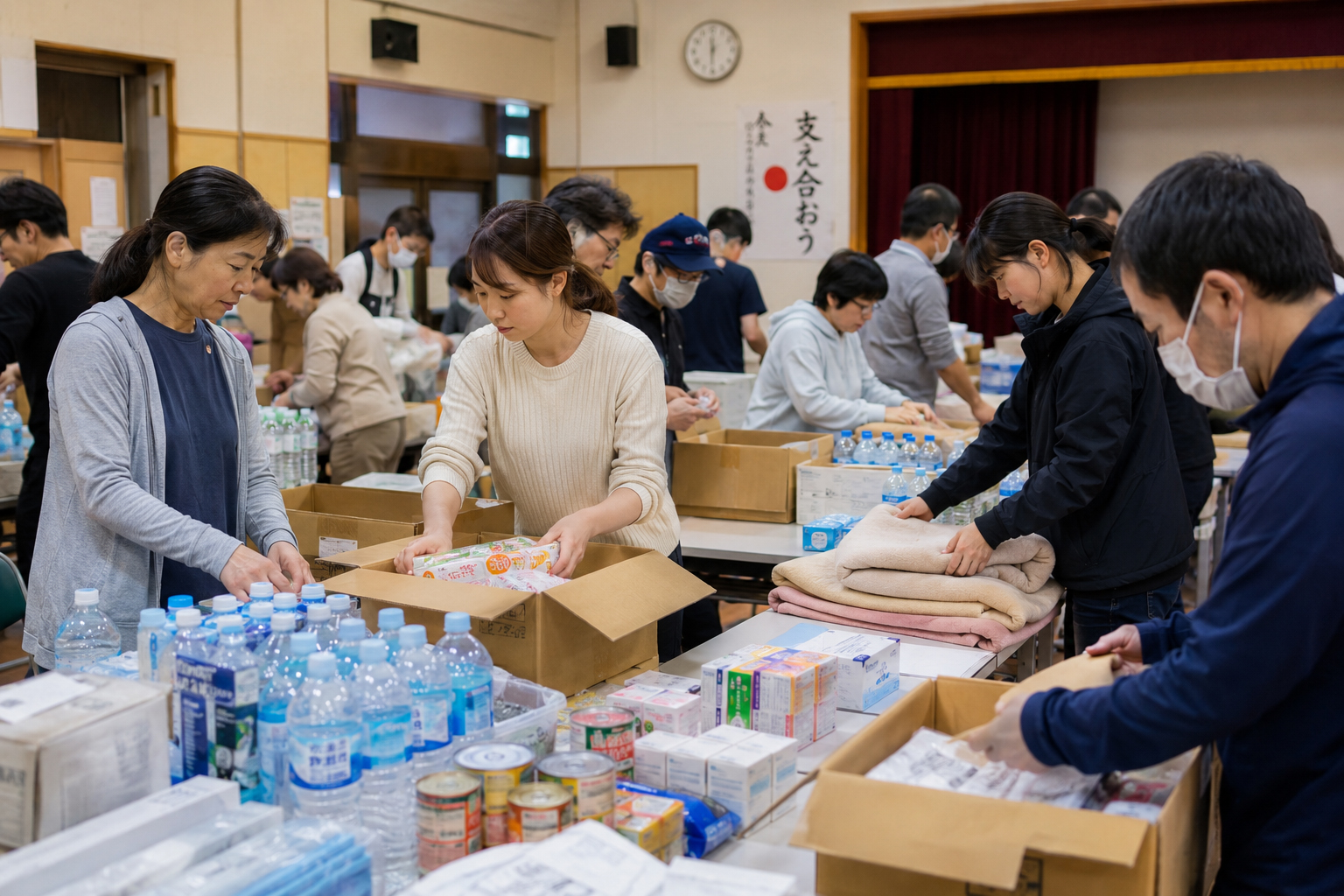
People naturally want to send things: water, blankets, food, clothes, diapers, batteries. Sometimes specific goods are absolutely needed. But random goods create problems: sorting, expiry dates, hygiene, sizes, storage, transport and mismatch with local needs. A truck of mixed items is not always a gift; sometimes it is a new job for exhausted local staff.
Cash donations through trusted organizations are flexible. Relief groups can turn money into food, fuel, water, hygiene kits, bedding, generators, medical supplies, interpretation, transport, shelter support, home visits or long-term recovery. The Japanese Red Cross Society operates domestic disaster relief and accepts donations for disaster victims, distributing them through committees organized with local authorities and charity groups. AAR Japan says it began emergency relief work in Japan after the 1995 Great Hanshin-Awaji Earthquake and has continued supporting people affected by natural disasters. Peace Boat Disaster Relief has experience supporting disaster-affected communities and coordinating volunteers and local needs in Japan and overseas.
| Support type | Best use | Avoid |
|---|---|---|
| Cash donations | Use the Red Cross, municipalities, established NGOs or official disaster donation channels. | Unverified bank accounts, vague social-media fundraisers or personal appeals without transparency. |
| Goods | Send only when a municipality or relief group clearly lists needed items, delivery address and period. | Used clothing, expired food, mixed boxes or unsolicited deliveries. |
| Volunteering | Register through disaster volunteer centers, local governments or experienced NGOs. | Arriving without lodging, food, equipment, insurance or an assignment. |
| Information sharing | Share JMA, local government, NHK, transport and trusted NGO updates. | Unverified tsunami claims, old photos, rumors, doxxing or unresolved rescue posts. |
Volunteering starts before you leave home
In Japan, disaster volunteer centers are often set up through local social welfare councils and municipalities. They match volunteers with needs: clearing mud, cleaning homes, distributing supplies, checking on isolated residents, supporting shelters, helping with paperwork and connecting people with services. The point is not bureaucracy for its own sake. It is coordination, safety and fairness.
A useful volunteer is self-sufficient. Bring your own water, food, rain gear, boots, gloves, mask, change of clothes, insurance, lodging plan, transport plan and return plan. Do not consume scarce local fuel, food or hotel rooms unless a coordinator has arranged it. Be ready for heat, cold, infection risk, mold, dust, nails, glass, mud, aftershocks and more rain.
Foreign residents and visitors can also help, but language and cultural context matter. Interpretation can be valuable, especially for foreign residents in shelters or tourists stranded by transport disruption. But interpreters should still work through municipalities, international associations, NGOs or volunteer centers. Language ability is not a free pass into a disaster zone.
Bad information can become a second disaster
Social media can save lives during disasters. It can help people find open shelters, water points, passable roads, pet-friendly evacuation options, multilingual information and missing family updates. But it can also spread old photos, false tsunami warnings, fake donation accounts, discrimination, panic and duplicated rescue requests that have already been resolved.
Before reposting, pause. Is this from an official source? Is the time clear? Is the image from this disaster? Has the rescue request already been handled? Is the donation link on the organization’s official website? Does the post expose someone’s address, face, medical condition or private suffering? The fastest post is not always the most helpful post.
- Is the post time-stamped and recent?
- Does it link to a primary source?
- Is the photo or video really from this disaster?
- Has a rescue request already been resolved?
- Can the donation link be verified from the organization’s official site?
How to choose a relief organization
A good donation decision does not have to be emotional. Look for practical signals: disaster-response experience, clear official website, transparent donation method, field updates, coordination with local governments or other groups, and a specific explanation of what support is being provided. Be cautious with appeals that use urgent emotion but do not explain who is receiving the money or how it will be used.
The Japanese Red Cross Society is central to Japan’s disaster-relief culture, including medical relief, emergency goods, cash grants and disaster donations. AAR Japan has domestic disaster experience dating back to the Great Hanshin-Awaji Earthquake. Peace Boat Disaster Relief grew out of long disaster-response experience and works with affected communities, volunteer coordination and disaster-risk reduction. These are not the only legitimate channels, but they are examples of how to think: choose organizations with experience, accountability and coordination.
Municipal donations can also matter. When prefectures or cities open official donation windows, funds may connect directly to affected residents or recovery projects. Use official websites and avoid overloading local offices with individual inquiries unless instructed.
Helping from overseas
People outside Japan often feel helpless when they see earthquake or typhoon images. The best first step is to reduce communication pressure. Do not call repeatedly if networks are congested. Use 171, Web171, email, messaging apps or a family point person where possible. Ask one person to coordinate family updates instead of dozens calling the same phone.
For donations, use organizations with English pages or international payment options. Sending physical goods from overseas is usually difficult because of customs, shipping, storage, sorting and mismatch with local needs. Companies offering large quantities of useful goods should coordinate with municipalities, logistics partners or relief organizations before shipping.
Overseas media and social-media users also have a role: share verified information, protect victims’ privacy, avoid disaster tourism, avoid reposting graphic or identifying images, and link people to official sources and donation pages. Dignity is part of disaster relief.
Companies can help best when they provide function, not advertising
Companies often have capabilities that individuals do not. Logistics firms can move goods. Telecom companies can provide charging, Wi-Fi and network recovery. Construction firms can clear debris. Hotels can house evacuees or response staff. Food companies can support kitchens. Technology firms can help with data, maps, multilingual information, secure donation pages and damage assessment.
The ethical line is simple: help first, promote later if at all. A responsible company explains what it is providing, where, with whom and for how long. It does not turn victims into marketing material. It does not send unrequested goods into a clogged supply chain. It coordinates with local needs.
Publisher’s Note: useful help is quiet work
This special edition is not only about the earthquake and the storms. It is about what people should do next: residents, travelers, families overseas, companies and readers who care about Japan.
Wanting to help is honorable. But in a disaster, honorable feelings need structure. The affected community must remain the center. Support should move through trusted channels, confirmed needs and safe timing. It should not make a road more crowded, a shelter phone busier or a rumor more powerful.
Japan is a disaster-prone country. That means its culture of support must also be mature: go when asked, wait when waiting helps, donate when money is the most flexible tool, share only what is verified and keep helping after the headline fades.
The best help keeps the affected people at the center
After a disaster, the urge to help can be one of society’s strongest forces. Japan has seen it after the Great Hanshin-Awaji Earthquake, the Great East Japan Earthquake, the Kumamoto earthquakes, western Japan floods, Typhoon Hagibis and the Noto Peninsula earthquake. Volunteers, donors, medical teams, companies, local governments, NGOs and neighbors all became part of recovery.
But disaster recovery does not end when the first news cycle ends. It can take weeks, months or years. Homes must be repaired. Schools must reopen. Work must return. Mental health needs attention. Festivals, shops, farms, ports, tourism and ordinary routines have to be rebuilt. The strongest support is often not the fastest support. It is the support that arrives in the right way and stays long enough to matter.
- Do not self-deploy into a disaster zone.
- Check official information first.
- Donate through trusted organizations or official municipal channels.
- Send goods only when requested.
- Volunteer through disaster volunteer centers or experienced NGOs.
- Bring your own food, water, gear, lodging, transport and insurance.
- Do not spread unverified photos, tsunami claims or rescue requests.
- Protect victims’ privacy and dignity.
- Coordinate company donations with local needs.
- Think in months, not only days.
Sources and references
This article draws on public information from the Japanese Red Cross Society, AAR Japan, Peace Boat Disaster Relief, JVOAD and JNTO Safety Tips.
- Japanese Red Cross Society — Emergency Relief
- Japanese Red Cross Society — Domestic Disaster Response
- Japanese Red Cross Society — Donate
- AAR Japan — Japan emergency relief history
- Peace Boat Disaster Relief — About
- Peace Boat Disaster Relief — Domestic Disaster Relief
- Peace Boat Disaster Relief — Volunteer
- Japan Voluntary Organizations Active in Disaster — volunteer and NPO coordination context
- Japan National Tourism Organization — Safety Tips