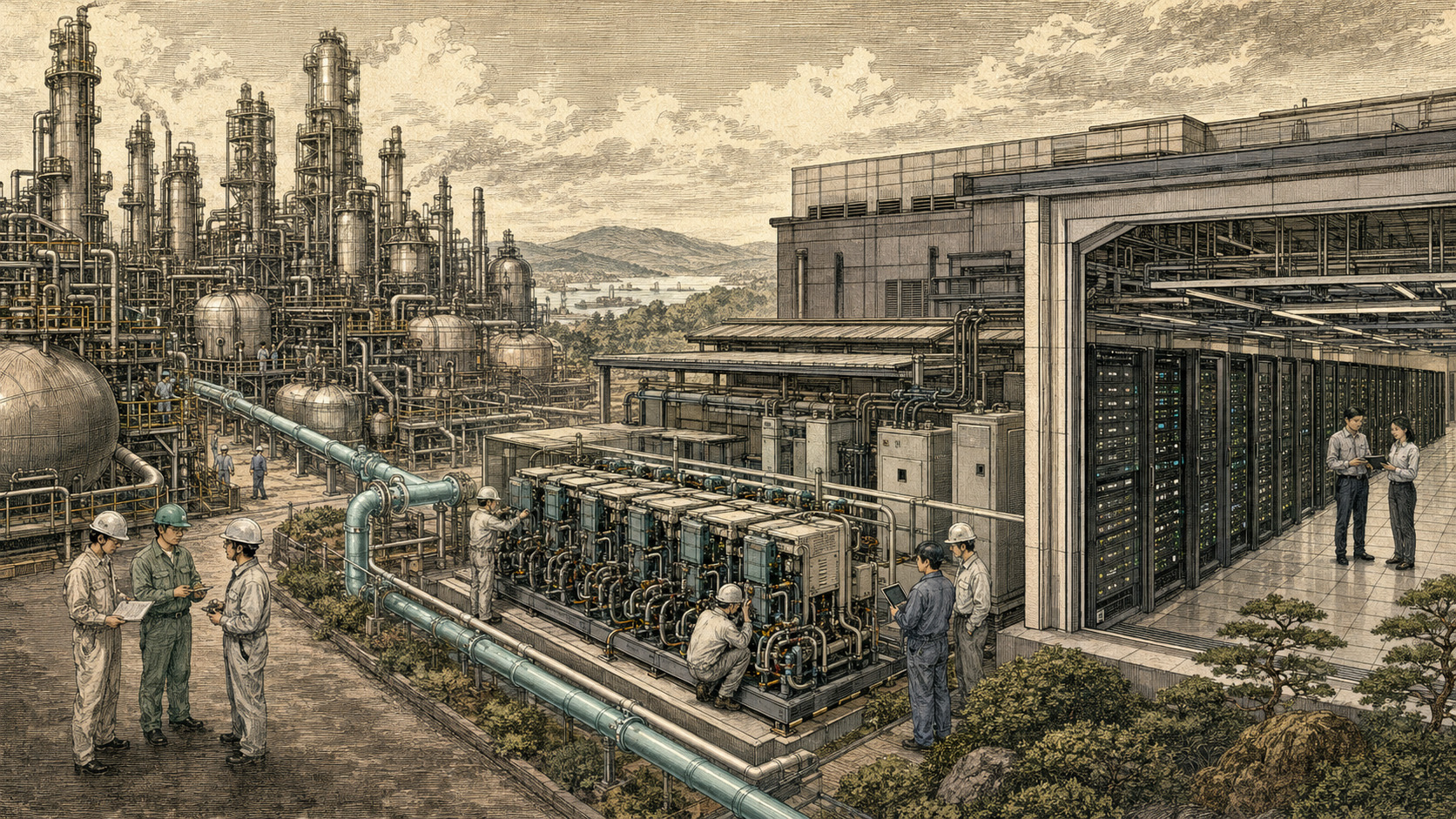
The computer room is the last link in a chain that begins with salt water. At Tokuyama's chemical works in Shunan City, electricity passes through purified brine. Chlorine forms at one electrode. Hydrogen forms at the other. Sodium hydroxide—caustic soda—emerges in solution between them. The chlorine and caustic soda are the reason the industrial process exists. Hydrogen arrives with them, whether the plant has found a premium use for every molecule or not.
Honda, Tokuyama and Mitsubishi Corporation saw a possible exchange. Tokuyama had a concentrated stream of high-purity hydrogen. Honda had fuel-cell systems designed for vehicles, including units whose automotive performance had degraded but which might still work efficiently at lower stationary loads. Mitsubishi had a plan for distributed computing: place GPU capacity closer to regional users and closer to useful energy. NEDO funded a demonstration to connect the three.
The result is more interesting than a claim that “hydrogen powered a data center.” It is a test of industrial symbiosis. One industry's co-product becomes another industry's fuel; an old vehicle component becomes infrastructure; a data center becomes both a customer and a controllable electrical load. The July 2026 findings show that the physical loop can operate. They also expose the three ledgers that must balance before it can scale: molecules, electrons and money.
Salt water produces three inseparable products
The chlor-alkali reaction looks simple on paper: 2NaCl + 2H₂O → Cl₂ + H₂ + 2NaOH. In an ion-exchange-membrane cell, chloride ions give up electrons at the anode and form chlorine gas. Water accepts electrons at the cathode and produces hydrogen and hydroxide ions. Sodium ions cross the membrane and join the hydroxide to make caustic soda. The membrane keeps chlorine away from hydrogen, a separation essential to product quality and safety.
The proportions are fixed by chemistry. Roughly two kilograms of hydrogen accompany every 80 kilograms of sodium hydroxide. That makes chlor-alkali hydrogen different from a dedicated water electrolyzer. The operator cannot simply raise hydrogen production because a data center is busy; chlorine and caustic-soda production, customer demand, plant schedules and storage all move with it. Hydrogen is a valuable co-product, but its availability is coupled to a larger chemical business.
“By-product” therefore does not mean “waste,” “free” or automatically “green.” It describes how the molecule enters the product slate. Some chlor-alkali hydrogen can be used inside a complex as chemical feedstock or fuel; some can be sold; some streams may remain underused because purification, compression, storage and transportation cost more than the available market will pay. The correct counterfactual is site-specific: what happened to this exact hydrogen before the new customer arrived?
That boundary is important in Shunan. The Environment Ministry explicitly called the stream used in an earlier 2017 Tokuyama-led project “unused” by-product hydrogen. The 2025 Honda announcement calls the new project's stream stable, high-purity and low-carbon, but does not publish its previous disposition or a lifecycle emissions figure. The earlier label cannot simply be carried forward to every later kilogram.
A hydrogen story that began as an import-substitution story
Tokuyama's roots precede the modern hydrogen economy by a century. Nihon Soda Kogyo was founded in Tokuyama in 1918 to make soda ash domestically when Japan depended entirely on imports. It became Tokuyama Soda in 1936, used soda-operation by-products in a cement business from 1938, and began electrolytic chlor-alkali production in 1952. Long before “industrial symbiosis” became policy language, the company was building new products around the material balances of an integrated works.
The cell technology changed. Tokuyama introduced diaphragm electrolyzers in 1975, ion-exchange-membrane units in 1976 and its own zero-gap technology in 1985. Its current technical page lists 30 electrolyzers across four lines, caustic-soda capacity of 500,000 tonnes a year and an estimated cell-only power intensity of 1,950 kWh per tonne of 100% NaOH as of 2022. These are capacity and engineering figures, not proof of actual annual production.
The stoichiometry gives a sense of scale. If all 500,000 tonnes of annual caustic capacity operated at full output, the associated theoretical hydrogen would be about 12,600 tonnes a year. That is an independent calculation, not Tokuyama's disclosed hydrogen production or the volume available to this project. Existing internal uses, operating rates, purification, maintenance and contracts all reduce the freely available stream.
Even so, the number explains why Yamaguchi calls itself one of Japan's leading regions for large-volume, high-purity hydrogen. A one-megawatt fuel-cell plant operating continuously would consume roughly 440–530 tonnes a year at an illustrative 50%–60% electrical efficiency. In theory, that is only about 3.5%–4.2% of the hydrogen associated with Tokuyama's full stated caustic capacity. The local molecule can be large relative to a distributed data center even when it is small relative to a chemical complex.
1918 Nihon Soda Kogyo is founded in Tokuyama to establish domestic soda-ash production.
1952 The company begins electrolytic chlor-alkali production.
1976 Ion-exchange-membrane electrolyzers are introduced.
1985 Tokuyama introduces its zero-gap electrolyzer technology.
2017 Unused caustic-soda by-product hydrogen supplies a swimming club's power and heat and fuels vehicles and forklifts in a regional demonstration.
2021–2022 A Shunan-model study identifies data centers as a possible use in port and research areas.
August 2023 The Honda–Tokuyama–Mitsubishi NEDO project formally begins.
February 2025 The project's GPU computing service begins trials with three Yamaguchi educational institutions.
August 2025 The Shunan fuel-cell demonstration opens.
July 2026 NEDO publishes qualitative technical and commercial results.
Before servers, Shunan's hydrogen heated a swimming pool
The data center did not appear from nowhere. In March 2017, an Environment Ministry project led by Tokuyama and joined by Tosoh began recovering unused hydrogen from caustic-soda plants. The system compressed or liquefied the gas for transport. A pure-hydrogen fuel cell supplied electricity and heat to the Shunan Swimming Club; hydrogen also went to fuel-cell cars and forklifts in Shunan and Shimonoseki.
A swimming pool was a clever first customer. It needs heat as well as electricity, allowing more of the hydrogen's energy to be used. It could accept a planned local supply rather than demand a nationwide station network. The demonstration tested the awkward middle of the chain—recovery, conditioning, transport and end use—not only the fuel-cell stack.
The 2020s model moves the demand still closer to the chemical source. NEDO's 2024 project diagram shows a hydrogen pipeline between Tokuyama's brine electrolysis and the test site. A short industrial connection avoids much of the repeated compression, trailer loading and road delivery that can make small hydrogen projects expensive. But it creates a different dependency: if the chemical line, purification train or pipeline is unavailable, the fuel-cell generator needs stored gas or another power source.
The history is a progression in load quality. Vehicles consume hydrogen intermittently. A pool consumes heat and electricity predictably. A data center can consume power continuously, change its electrical demand, and—in principle—move some computing jobs in time or location. Hydrogen supply needs a customer. The newest customer is valuable because it can be both steady and controllable.
Three companies supply the molecule, the converter and the load
The partnership divides the system along corporate strengths. Tokuyama produces the hydrogen within its salt-water electrolysis business and hosts the industrial setting. Honda supplies the proton-exchange-membrane fuel-cell systems and develops the stationary controls. Mitsubishi operates the distributed data center, works on hydrogen procurement and the integrated business model, and tests whether regional users will pay for the computing service. NEDO provides the public research framework.
| Participant | Principal role | Question it must answer |
|---|---|---|
| Tokuyama | High-purity chlor-alkali by-product hydrogen and industrial site | What volume, price, carbon intensity and availability can be guaranteed? |
| Honda | Reused vehicle fuel cells, stationary power system and coordinated controls | How cheaply and reliably can unequal, degraded systems be operated? |
| Mitsubishi | Distributed GPU data center, customers and integrated commercial model | Can enough useful computing demand be kept online to recover fixed costs? |
| NEDO and region | Demonstration support, evaluation and local stakeholder coordination | Does the model create transferable public value beyond one subsidized site? |
Mitsubishi's role is more than owning a server rack. In 2022 it invested in distributed-computing company Morgenrot, whose concept placed containerized GPU capacity near renewable or surplus energy. In 2025 and 2026 Mitsubishi separately advanced a much larger power-and-data-center plan with JFE at Ohgishima, initially targeting 60 MW and potentially hundreds of megawatts. The Shunan experiment is the small, local end of a broader strategy to treat electricity and computation as one infrastructure problem.
Japan's government now calls the same idea “watt-bit collaboration”: coordinate the power grid and communications network so that data centers can be developed where electricity and fiber make sense together. Shunan adds a molecule to that equation. Instead of moving only electrons over a constrained grid, it converts a local chemical stream into electrons beside a regional computing load.
The demonstration and the product are not the same size
The public documents show an evolving design, and the numbers should not be blended. NEDO's July 2024 presentation described an intended 80 kW data-center load, four 80 kW fuel-cell power systems and a 22 kWh battery. An example control diagram spread an 80 kW demand across four unequal fuel cells at roughly 18 kW each, with the battery filling the gap. The purpose of low-load operation was to keep degraded systems within usable output, improve efficiency and slow further deterioration.
Honda's August 2025 opening release presented a different, standard-product architecture: 250 kW units, four connectable for 1 MW, with 1 MW blocks installable in parallel. That table describes the developing commercial configuration under standby conditions. It does not say that the Shunan computer load suddenly became one megawatt, nor does it reconcile the installed demonstrator with the earlier 80 kW-by-four plan.
The 2026 results poster returns to “four fuel-cell systems” without publishing their installed rating or the center's peak IT load. The defensible reading is that the demonstration proved coordinated operation of four degraded systems, while Honda used the project to develop a larger modular product. Precise as-built net capacity, parasitic load and usable AC output remain unpublished.
- 2024 project plan: an 80 kW data-center load, four 80 kW fuel-cell systems and a 22 kWh battery were contemplated.
- 2025 product specification: 250 kW standard units, four for 1 MW, with multiple blocks possible.
- 2026 reported result: four degraded systems delivered stable power in all five modes while controls reduced hydrogen use; no measured kWh, efficiency or uptime was disclosed.
The technical result: make unequal old stacks cooperate
A vehicle fuel cell does not retire with a uniform certificate of remaining life. One system may have more voltage loss, another a weaker compressor or coolant pump, another a different history of cold starts and contaminants. Connecting four such systems as if they were identical would make the weakest unit dictate the plant or force good units into inefficient operating points.
Honda's answer was coordinated control. The system measures the available performance of each fuel cell, assigns lower loads where efficiency is better, uses the battery to absorb short differences and presents a stable power profile to the data center. The 2026 NEDO poster says four performance-degraded systems were run at low load and that stable supply was confirmed in all five modes while hydrogen consumption was suppressed.
Those five modes were emergency backup, normal or baseload supply, off-grid operation, peak shaving and grid supply-demand balancing. That is one more category than Honda's 2025 public release, which grouped the roles into four patterns. The distinction matters commercially. Backup power values readiness; baseload values efficiency; peak shaving values avoided demand charges; grid balancing values response; off-grid operation values independence. One machine earns—or saves—money differently in each mode.
The result is meaningful but qualitative. NEDO did not report how much less hydrogen the coordinated method used, how many hours the systems ran, how many starts succeeded, what AC efficiency was measured, how often the battery intervened or how the weakest stack degraded. “Stable” across five test modes is evidence of control feasibility. It is not yet a bankable availability guarantee.
The battery carries the first seconds; hydrogen carries the hours
Data centers cannot wait ten seconds for power. Honda advertises startup within ten seconds for its developing stationary product, but servers, storage and network equipment require continuity measured in milliseconds. The 2024 Shunan design therefore included a UPS and a 22 kWh battery between the changing sources and the computer load.
At a simple 80 kW load, 22 kWh equals 16.5 minutes of nominal energy before inverter losses, reserve margin and depth-of-discharge limits. That independent calculation explains the architecture: the battery is a bridge and a fast balancing device, not the long-duration fuel. Hydrogen inventory carries the extended outage. The grid and simulated renewable input provide other operating choices.
Layering also improves the reused fuel cells' life. The battery can absorb sudden server transients while the fuel cells move more gently; it can fill a shortfall if one module is held at an efficient load; and it can accept excess output when computing demand falls. NEDO's poster says predictive charge-discharge control using weather and load forecasts is a next optimization step.
Resilience still depends on the whole chain. Chemical production, gas conditioning, pipeline valves, buffer storage, fuel-cell auxiliaries, inverter, switchgear, battery and cooling must all be available. The project publications do not give stored hydrogen duration, black-start success rate, redundancy class or recovery time after a fault. A local pipeline removes truck logistics, but it does not remove single-point failures.
The data center served real students, but utilization remained the problem
The 2026 poster supplies an unexpectedly human result. Mitsubishi built the data center, installed GPUs and began offering computing capacity in February 2025 to three Yamaguchi educational institutions. Yamaguchi Core College used it to generate high-resolution 4K images as a rendering service. Shunan University used it for file-compression optimization. YIC Information Business College built an image-recognition AI through an API connection and evaluated the training environment.
The participants reportedly rated the GPU performance and AI environment highly. This is more than running a resistive load bank: actual users sent work to the machines. It also grounds the phrase “regional digital transformation.” A local school that cannot buy a powerful GPU cluster can use nearby shared capacity for teaching, research and experimentation.
Yet the same result identifies demand as a commercial weakness. Three educational trials do not keep an expensive center busy enough. Fixed costs continue whether the GPUs calculate or wait; fuel cells, network connections, security, cooling and staff must be paid. NEDO says a successful business requires high utilization and the creation or acquisition of substantially more computing demand.
The 2024 demand study had imagined several local customers: universities performing AI, medical, satellite, biomass and weather analysis; manufacturers processing factory IoT data inside the industrial complex; healthcare users needing secure local computation; communications companies; and application providers. The list is plausible. The 2026 poster does not say those prospects became paying long-term customers.
The economic result is the most valuable result
The project team built a total-cost-of-ownership model using expected capital and operating costs and hydrogen-price interviews with potential by-product suppliers in Japan, Europe and the United States. Its conclusion was blunt. The service needs a major cost reduction to establish an advantage over cloud computing, and it needs enough utilization to recover those costs.
Hydrogen dominates operating expense. The NEDO poster says the government's 2030 target of ¥30 per normal cubic meter or less may be one benchmark for stimulating demand. At standard conditions, a kilogram of hydrogen is roughly 11.1 normal cubic meters, so that target is approximately ¥330 per kilogram.
Using the U.S. Department of Energy's 33.3 kWh-per-kilogram lower heating value and an illustrative—not measured—fuel-cell electrical efficiency of 50%–60%, ¥30/Nm³ implies a fuel-only electricity cost of roughly ¥17–¥20 per kWh. That excludes recovery, purification, pipeline or storage, the fuel-cell plant, battery, cooling, maintenance, financing, replacement and data-center overhead. It is a useful target, not a proof of cheap power.
The actual Shunan hydrogen price was not published. Nor were actual project CAPEX, OPEX, cloud-service comparison, required utilization or target return. The poster says hydrogen incentives may also be required. That is an honest outcome: even with a nearby co-product, reused stacks and public demonstration support, the commercial model did not become self-evident.
| Question | What the project established | What remains undisclosed |
|---|---|---|
| Can degraded systems supply a data center? | Stable supply was confirmed in five operating modes. | Hours, availability, failure rate and degradation curve. |
| Can controls reduce fuel use? | Low-load coordinated operation suppressed hydrogen consumption. | kg/kWh, percentage saving and AC efficiency. |
| Is there regional computing demand? | Three schools used GPUs for real rendering, optimization and AI work. | Paid demand, utilization, customer retention and revenue. |
| Can it compete commercially? | Hydrogen price and high utilization were identified as decisive. | Actual hydrogen price, TCO, breakeven utilization and subsidy dependence. |
By-product hydrogen needs a carbon ledger
At the generator, pure hydrogen produces electricity, water and heat without carbon-dioxide, nitrogen-oxide or particulate exhaust. That is valuable beside workers, classrooms or urban facilities. It does not settle the lifecycle account. Brine electrolysis is electricity-intensive, and emissions must be allocated among chlorine, caustic soda and hydrogen under a stated method.
Tokuyama's own technical figure—1,950 kWh per tonne of caustic soda for the electrolyzer alone—shows why electricity matters. Applied mechanically to 500,000 tonnes of annual capacity, it would equal 975 GWh, though actual consumption and production are not disclosed and the electricity makes all three products. Tokuyama also states that operating coal-fired captive power plants makes reducing its emissions an urgent challenge. It targets a 30% reduction in Scope 1 and 2 greenhouse gases by fiscal 2030 from fiscal 2019 and carbon neutrality by fiscal 2050.
The demonstration release describes Tokuyama's hydrogen as low-carbon, but no grams of CO₂-equivalent per kilogram of hydrogen or per kilowatt-hour of data-center electricity are published. Without the power-source mix, allocation method, purification and compression energy, no reader can independently reproduce the claim.
The counterfactual can improve the case. If a specific stream would otherwise be vented or burned with little value, converting it efficiently into useful power avoids building dedicated hydrogen production and captures more value from the original electricity. If the same hydrogen already displaces natural gas in a chemical furnace or serves as feedstock, moving it to a data center may shift emissions rather than eliminate them. “Use at the point of production” is a strong logistics principle. It is not a substitute for lifecycle accounting.
A small data center can teach a large lesson
An 80 kW regional test is not an AI hyperscale facility. The International Energy Agency places conventional data centers around 10–25 MW and AI-focused hyperscale sites at 100 MW or more. Japan's energy authorities are tightening attention to facility efficiency, with a 2030 benchmark goal of PUE 1.4 or less and a PUE 1.3 requirement planned for certain new centers from fiscal 2029. Shunan occupies a different niche: shared regional computing near an industrial energy source.
Smallness can be an advantage. A regional center can serve latency-sensitive factory control, keep sensitive industrial data nearby, give universities access to shared GPUs and grow in modules. It can use a hydrogen stream far too small or geographically awkward for a national commodity market. It may be easier to match tens or hundreds of kilowatts to a co-product pipeline than to fuel a hundred-megawatt campus.
Smallness is also a burden. Cloud giants spread staff, software, security and hardware over enormous fleets. Their utilization is pooled across customers and time zones. A local center has fewer users over whom to spread every firewall, technician and idle GPU. Clean local power cannot rescue a server that is not earning.
This is why the hydrogen and digital businesses cannot be evaluated separately. Cheaper fuel lowers the cost of computation. More computation raises fuel-cell utilization and recovers capital. Flexible workloads can shift toward times when hydrogen, renewable power or grid-balancing revenue is favorable. But a contract for power is not a contract for computing, and both markets must clear.
What Shunan proved—and what it did not
The demonstration achieved a real technical milestone. Performance-degraded vehicle fuel cells did not need to be identical to work together. Controls and a battery could turn them into stable power across five roles. A real GPU service reached three educational institutions. A local chemical co-product crossed into a new industry.
It also produced a useful commercial warning. The business needs hydrogen near an ambitious national price target, much more computing utilization, continued component and control cost reduction, and perhaps policy incentives. Those conditions are not details postponed until after commercialization. They are commercialization.
The public record remains incomplete. The July poster gives qualitative results but not the operating dataset: generated MWh, hydrogen kilograms, AC efficiency, uptime, start success, stack degradation, carbon intensity, total cost or customer revenue. It does not identify a continuing commercial service after the demonstration or a buyer for Honda's developing stationary product. For the generator hardware and Honda's broader move outside automobiles, see our companion report on Honda's stationary-power strategy.
The next credible milestone is not another opening ceremony. It is a contract that names the hydrogen price and carbon intensity, guarantees power availability, discloses measured fuel use, and keeps enough paying computation on the machines to survive without demonstration economics.
Shunan's deeper lesson is older than hydrogen policy. Industrial cities prosper by finding a customer for what one process leaves behind. In 1938, Tokuyama used soda-operation by-products to enter cement. In 2017, unused hydrogen heated a swimming pool. In 2025 and 2026, degraded automotive stacks and a chemical co-product trained local AI models. The theater of invention is not a single miraculous machine. It is the pipe between machines—and the business agreement that keeps something valuable flowing through it.
Reporting notes and principal sources
The July 2026 NEDO poster is the newest results source and supersedes the earlier absence of public outcome data. Its findings are qualitative: it confirms stable operation and reduced hydrogen consumption but gives no numerical efficiency, usage, uptime or cost. The theoretical 12,600 tonnes per year is an independent stoichiometric calculation from Tokuyama's stated 500,000-tonne NaOH capacity, not actual output or available supply. The ¥17–¥20/kWh illustration uses ¥30/Nm³, approximately 11.1 Nm³/kg, DOE's 33.3 kWh/kg lower heating value and an explicitly assumed 50%–60% efficiency; it is not a measured Shunan cost.
- NEDO: Shunan demonstration results poster, July 22, 2026
- NEDO: 2024 project presentation, planned 80 kW load, four 80 kW systems and 22 kWh battery
- Honda, Tokuyama and Mitsubishi: demonstration opening, modes and standard-product specifications, August 2025
- Honda, Tokuyama and Mitsubishi: original project announcement, December 2023
- Mitsubishi Corporation: original business model and partner roles
- Honda: current developing stationary generator and Shunan use case
- Honda: 2023 Torrance proof using retired Clarity fuel-cell systems
- Tokuyama: brine electrolysis history, 500,000-tonne capacity and energy-intensity estimate
- Tokuyama: company history from 1918 soda ash through chlor-alkali modernization
- Tokuyama: business origins and integrated chemical-product portfolio
- Japan Environment Ministry: 2017 Shunan unused by-product-hydrogen supply-chain demonstration
- Yamaguchi Prefecture: 2025 pipeline and distributed low-cost hydrogen demonstration
- Yamaguchi Prefecture: current “advanced hydrogen prefecture” program
- Shunan City: regional high-purity hydrogen and carbon-neutrality program
- Tokuyama: coal-fired captive generation, 2030 emissions target and 2050 goal
- Euro Chlor: hydrogen as a co-product of chlor-alkali electrolysis
- Mitsubishi and Morgenrot: distributed GPU computing near renewable and surplus energy, 2022
- Mitsubishi and JFE: 60 MW Ohgishima power-and-data-center plan, April 2026
- METI and MIC: watt-bit collaboration for coordinated power and digital infrastructure
- Agency for Natural Resources and Energy: data-center growth and PUE policy, 2026
- International Energy Agency: data-center scales and global electricity demand
- U.S. Department of Energy AFDC: hydrogen lower heating value of 33.3 kWh/kg