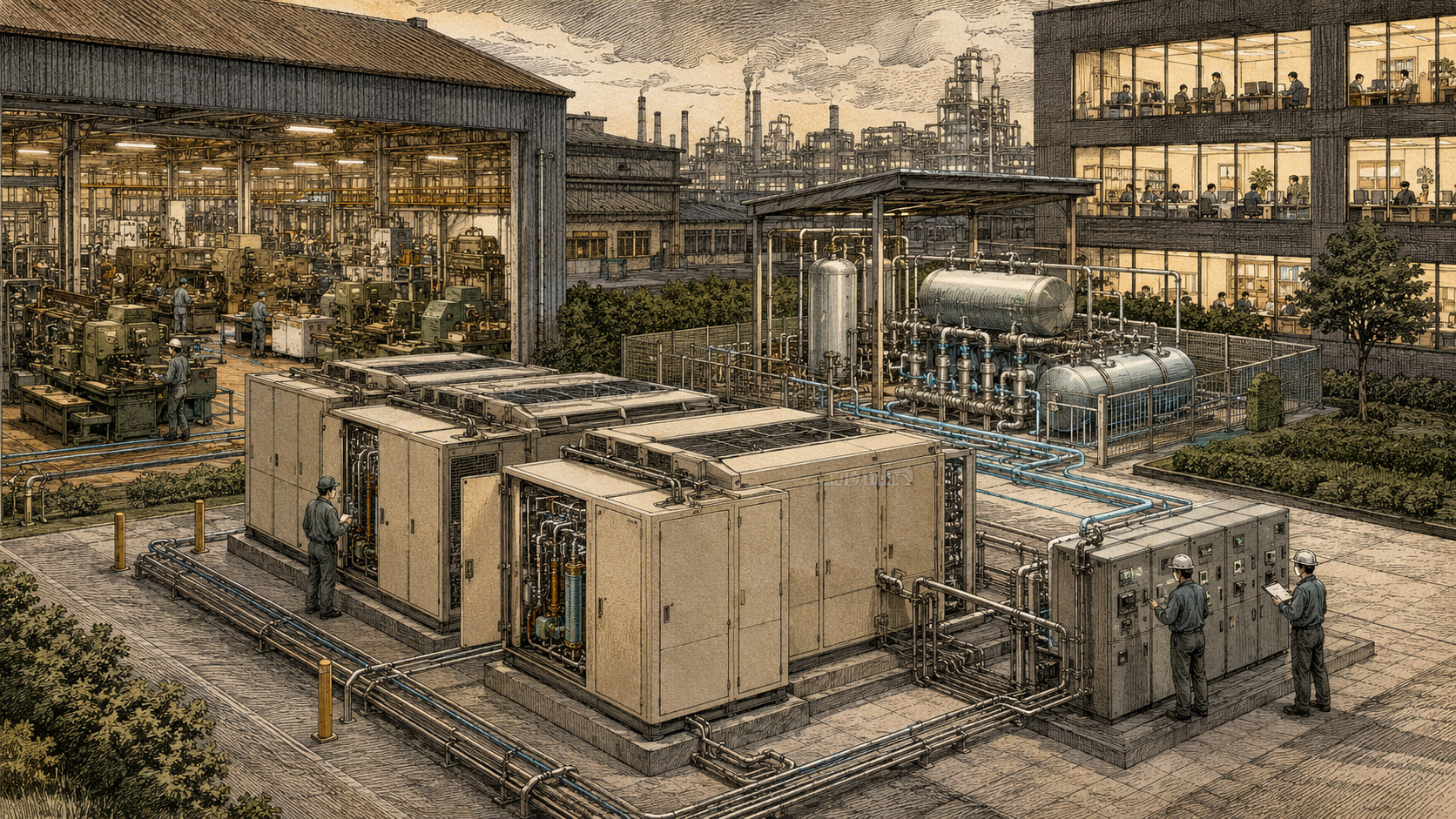
The first thing to understand about Honda's new generator is that it is not really new. Its electrochemical heart was shaped to fit beneath the hood of a car. Its oldest public ancestor was a household machine intended to make fuel for that car. Its first large stationary proof was assembled from systems taken out of previously leased Clarity sedans. Honda is not inventing a second fuel-cell business from a blank sheet. It is trying to turn three decades of automotive engineering into a modular industrial product.
The shift changes the infrastructure problem. Passenger vehicles demand a network: drivers want fuel near home, work and every route between them. A generator is an address. If a chemical plant already produces hydrogen, or a data center can contract a dependable delivery, the fuel can be planned around one load. Technicians can visit one site. Storage, ventilation and detection can be engineered once. The customer can value resilience, local air quality and peak-power control in addition to kilowatt-hours.
That is the opportunity. It is also why the machine must be judged as energy infrastructure rather than as a parked automobile. A factory manager will ask for guaranteed uptime, fuel cost, permitted storage, black-start performance, service response and a fifteen-year cash flow. Honda has published a compelling outline and operated demonstrations. It has not yet published enough data for that investment committee.
A fuel cell is a converter, not the fuel tank
Honda uses a proton-exchange-membrane, or PEM, fuel cell derived from vehicle technology. Hydrogen reaches the anode, where a platinum-based catalyst separates each molecule into protons and electrons. The polymer membrane passes the protons but blocks the electrons. Those electrons travel through an external circuit and become useful electricity. At the cathode, oxygen from air joins the protons and electrons to form water. Heat is produced with the water.
The reaction has no combustion flame, piston or turbine. That allows zero carbon dioxide and nitrogen-oxide exhaust at the generator when pure hydrogen is used. It does not mean the system has no machinery. Air must be filtered and compressed; hydrogen must be regulated and recirculated; coolant must remove heat; humidity and water must be controlled; DC electricity must pass through an inverter; sensors and controls must isolate faults.
Nor is the fuel cell itself an energy store. Honda's 2025 English release calls the station a “stationary power storage system,” but the module consumes hydrogen stored elsewhere. The fuel cell is more accurately the converter. Tanks, trailers, pipelines, an electrolyzer or a neighboring chemical process hold or supply the energy. A battery stores electricity inside its cells; a fuel-cell plant keeps its energy in the hydrogen inventory.
This distinction matters in an outage. A one-megawatt generator with no hydrogen has zero runtime. A one-megawatt generator with ten hours of fuel is a ten-megawatt-hour resource only if every tank, regulator, valve, cooling loop and control remains available. The product is not the stack alone. It is the complete chain from stored molecule to conditioned AC power.
Honda's first stationary dream fit beside a house
In October 2003, Honda and Plug Power began testing a Home Energy Station in Torrance, California. The prototype took natural gas into a reformer, extracted and purified hydrogen, compressed it into a high-pressure tank, fueled an FCX automobile and used some of the hydrogen in a stationary fuel cell to provide household electricity and hot water. The machine tried to solve three markets at once: mobility, heat and power.
Its carbon logic was transitional rather than renewable. Natural gas provided the hydrogen. The attraction was higher overall utilization and home refueling, not the elimination of fossil feedstock. By 2005, Honda's third-generation unit was about 30% smaller than its predecessor, produced about 25% more electrical power, started in roughly one minute and could supply as much as 5 kW during normal conditions or a blackout.
Home Energy Station IV arrived in 2007 with a 70% size reduction from the first unit. Honda estimated that a household using it for heat, electricity and an FCX could reduce energy cost by 50% and carbon dioxide by 30% compared with an average U.S. home using grid power and a gasoline car. Those were company estimates against a defined comparison, not broad proof that home hydrogen was economic.
Honda then removed the natural-gas reformer from its longer-term vision. A 2010 solar hydrogen station used a high-differential-pressure electrolyzer to eliminate a separate mechanical compressor, producing about 0.5 kilogram over an eight-hour overnight fill. In 2012, a station at the Saitama Prefectural Office paired solar and grid electricity with an FCX Clarity equipped to supply up to 9 kW as a mobile generator.
None became a mass household appliance. Yet the experiments created a durable idea: a fuel-cell vehicle is also a standardized package of electrochemical generating equipment, and hydrogen infrastructure can connect mobility with buildings. Honda's 2020s strategy keeps that idea while moving it from the garage to facilities where demand and engineering staff are concentrated.
1989 Honda says its fuel-cell research begins.
2003 The first Home Energy Station in Torrance makes hydrogen from natural gas and supplies home power and hot water.
2005 The third-generation home unit offers up to 5 kW of normal or emergency power.
2007 Home Energy Station IV is 70% smaller than the first prototype.
2010 A compressorless solar-hydrogen prototype is designed for an overnight 0.5 kg fill.
2012 The Saitama solar station pairs with an FCX Clarity capable of 9 kW mobile output.
March 2023 Honda begins operating an approximately 500 kW data-center backup proof in Torrance using retired Clarity systems.
December 2023 Honda, Tokuyama and Mitsubishi announce the Shunan by-product-hydrogen demonstration.
August 2025 The Shunan site opens with a 250 kW modular architecture scalable to 1 MW blocks.
January–March 2026 Honda announces the end of GM-joint-system production and exhibits its independent 150 kW successor beside a stationary-power mock-up.
Torrance: eight retired car systems become a small power plant
Honda's decisive change of scale came in March 2023 at American Honda's campus in Torrance. A demonstration station began supplying emergency backup power to a data center. Honda described it as approximately 500 kW. The detailed table listed one “quad” package of four Clarity systems at 288 kW DC and two quads at 576 kW DC, feeding a 600 kVA inverter and transformer. In other words, eight previously leased automotive systems were arranged into a stationary plant.
The installation revealed everything hidden by the phrase “reuse a car fuel cell.” The two-quad power plant and accessories weighed 7,757 kilograms and occupied a 17.1-square-meter footprint. It required an external cooling tower rated to reject 385 kW of heat with 930 liters per minute of coolant flow. It included hydrogen, smoke, temperature, current, voltage, isolation and enclosure-pressure monitoring, emergency stops, remote data acquisition and an inverter qualified for grid connection.
This was not eight powertrains placed on the floor. Engineers removed the drivetrain context and rebuilt the necessary lungs, bloodstream, nervous system and electrical interface around the stacks. Stationary packaging was flexible—Honda said the units could form cubic, L-shaped or Z-shaped layouts—but every arrangement still needed safe gas flow, ventilation, cooling and service access.
Reuse added another layer. Vehicle retirement does not mean every stack has identical remaining life. Mileage, humidity, cold starts, idle time, impurities and repair history create different degradation. A second-life operator has to test and grade modules, match them into groups, monitor the weakest unit and decide what power loss defines retirement. Honda did not publish the Torrance modules' prior mileage, remaining capacity, operating hours, availability or maintenance record.
Why a stationary module can be more than automotive leftovers
Repurposing is only one route. A common module can also be produced new for several markets. Automotive work has forced Honda to solve cold starts, vibration, compact packaging, transient response, hydrogen purity and high-volume quality. A stationary enclosure can accept more mass and external cooling, but benefits from those mature controls and compact dimensions.
Modularity changes service. If each 250 kW unit can be electrically and hydraulically isolated, a facility may maintain one block while others remain available. Capacity can be installed closer to demand growth rather than all at once. The same module architecture can serve a truck, generator or construction machine, spreading research and supplier costs across markets that would be too small separately.
There is a mismatch, too. Cars accumulate perhaps a few thousand operating hours over many years and swing rapidly through loads. A prime-power generator can run thousands of hours every year near a stable load. Backup equipment may sit idle for months, then has to start on command. Seals, catalysts, humidification and auxiliary components age differently in each duty. Vehicle validation is valuable, not sufficient.
Honda's own generational transition illustrates the risk. In 2023 it said future commercial stationary units would use the GM co-developed system later installed in the CR-V e:FCEV. Honda now plans to end production at that joint venture during 2026 and move to an independent 150 kW next-generation module. Its current stationary webpage does not name a saleable model or explain which generation underpins the final generator. The transition is part of the broader strategy examined in our report on the end of Honda–GM fuel-cell production.
Shunan places the generator where hydrogen already exists
Shunan City in Yamaguchi Prefecture gives Honda a more favorable geography than the retail car market. Tokuyama produces by-product hydrogen in its brine-electrolysis business. Mitsubishi operates a distributed data center. Honda supplies the fuel-cell station. Instead of trucking retail hydrogen to scattered motorists, three companies place a power load beside an existing industrial molecule.
The demonstration, selected for NEDO support in 2023 and opened in August 2025, was designed around fuel cells used in the CR-V e:FCEV and the assumption of future vehicle-system reuse. Its published station architecture begins with 250 kW units, connects four for 1 MW and allows multiple 1 MW blocks in parallel. The output is AC 200–480 V, three-phase, four-wire.
More important than nameplate capacity are the four planned operating modes. The energy-management system was to switch the fuel cells among emergency backup, off-grid primary power, peak shaving and grid balancing, while coordinating grid electricity, stationary batteries and renewable power. This “value stack” is an attempt to prevent expensive equipment from spending its life waiting for a rare blackout.
| Operating role | Value to the customer | Hard question |
|---|---|---|
| Emergency backup | Resilience, rapid start and no local diesel exhaust during an outage | How many hours of certified fuel are stored, and what availability is guaranteed? |
| Off-grid primary power | Electricity where grid capacity is limited or a dedicated low-carbon supply exists | Can delivered hydrogen compete with grid, gas, geothermal, nuclear or renewable-plus-storage power? |
| Peak shaving | Reduce maximum grid demand and associated charges | Does the avoided peak cost exceed fuel, degradation and service cost? |
| Grid balancing | Revenue for changing output to support supply and demand | Will market rules compensate the response, and how does cycling affect module life? |
The project documents said the trial would verify both technical operation and the economics of an integrated hydrogen-supply business. The announced period ran through March 2026. As of August 10, Honda's current hydrogen pages still describe the generator as under development and the Shunan work as a demonstration. This review did not identify a final release disclosing generated megawatt-hours, hydrogen use, efficiency, uptime, start success, degradation, electricity cost or revenue from grid services.
That absence does not show the project failed. It means the most decision-useful results remain outside the public record. An opening ceremony proves installation. A commercial market requires operating data.
Ten seconds is fast for a generator and too slow for a server
Honda says its developing generator complies with NFPA 110 Type 10 and can supply power within ten seconds. In emergency-power language, that is a meaningful target. In computing, ten seconds is an eternity. Servers, network equipment and storage systems cannot simply go dark while the fuel-cell air compressor spins up, hydrogen pressure stabilizes and the inverter synchronizes.
The missing bridge is a UPS or battery energy storage system. It carries the load with effectively no break while the longer-duration source starts. The U.S. Department of Energy makes this architecture explicit in its backup-fuel-cell targets: the startup number applies to the fuel cell, while hybridized batteries are expected to provide uninterrupted power. Shunan's published diagram similarly combines the fuel cell with a BESS and the grid.
A robust sequence is layered. Grid power fails. The UPS takes the load in milliseconds. Controls confirm the outage and start the fuel-cell plant. Modules reach stable output and the inverter assumes the load within the required interval. Batteries recharge or remain ready for a second transition. If a hydrogen train or module fails, another source must be available. Redundancy, not the average stack efficiency, determines whether a data center trusts the system.
The word “backup” also changes the economics. A unit that operates only during tests and outages consumes little annual fuel, so an expensive kilogram of hydrogen may be tolerable. But capital, storage, inspection and maintenance remain. A unit used for peak shaving or grid services earns more often and makes better use of the hardware, while consuming more hydrogen and accumulating degradation. The best operating mode depends on the local value of reliability and power, not a universal hydrogen advantage.
The unannounced fuel bill hidden inside 1 MW
Honda does not disclose the new generator's electrical efficiency or hydrogen flow. The U.S. Department of Energy gives hydrogen a lower heating value of 33.3 kWh per kilogram. As an illustration—not a Honda performance claim—a one-megawatt plant operating at 50%–60% electrical efficiency would consume roughly 50–60 kilograms of hydrogen an hour. Ten hours of full-load backup would require about 500–600 kilograms of usable hydrogen, before reserves and delivery constraints.
The formula exposes the business model. If delivered hydrogen costs H yen per kilogram, the fuel alone in this illustration costs about 0.05H to 0.06H yen per kilowatt-hour. At high annual utilization, small changes in hydrogen price overwhelm savings in stack cost. At low backup utilization, storage capacity and the certainty that fuel remains available during a regional emergency may matter more than the routine energy price.
Prime power is a far larger commitment. One megawatt operating continuously at that illustrative flow would consume roughly 440–530 metric tons of hydrogen a year. That is why Shunan is strategically important: an industrial by-product stream can avoid building a retail network and may provide stable supply. Honda and its partners have not published the demonstration's actual carbon intensity, transfer price, hourly flow or annual availability.
Scale also needs perspective. The International Energy Agency describes a conventional data center as roughly 10–25 MW and an AI-focused hyperscale site as 100 MW or more. Honda shows a size illustration for a 3 MW generator on its stationary-power webpage, but gives no detailed 3 MW specification. A four-unit 1 MW block is meaningful for a distributed data center, office campus or factory load. A hyperscale facility would require many blocks, much more hydrogen and an industrial-scale redundancy plan.
- Net AC efficiency at rated and part load, including air compression, cooling and inverter losses
- Hydrogen consumption per kilowatt-hour and required purity and inlet pressure
- Capital price, installation cost and after-sales contract
- Guaranteed availability, start-success rate and time between service events
- Stack life in hours, starts and allowable power degradation
- Hydrogen-storage footprint and certified runtime for each output configuration
- Water production, cooling-water demand and usable heat
- Launch geography, delivery date, warranty and first commercial customers
Local zero emissions—and an upstream carbon ledger
At the point of use, Honda's direct-hydrogen PEM generator produces no carbon dioxide, nitrogen oxides or particulate exhaust. Water and heat are the reaction products. That can be valuable near offices, hospitals and communities where diesel-generator testing adds noise and local pollution. The U.S. Environmental Protection Agency regulates stationary diesel engines for pollutants including NOx, particulate matter, sulfur dioxide, carbon monoxide and hydrocarbons.
“Zero emission” is nevertheless a site boundary, not a lifecycle result. Most hydrogen in the United States is still produced from natural gas, according to the Department of Energy. Electrolysis can be low carbon when its electricity is low carbon. Compression, storage and delivery also consume energy. A fuel-cell generator running on fossil-derived hydrogen can have clean local exhaust without having low upstream greenhouse-gas emissions.
By-product hydrogen needs careful accounting. In Shunan, the hydrogen emerges from Tokuyama's salt-water electrolysis business rather than a plant built only to make energy. Using a stream that is already available can be economically and environmentally attractive, particularly if it would otherwise be burned or wasted. Its carbon intensity still depends on the electricity, process allocation, purification and compression. The project release calls the supply stable and low in carbon emissions but does not publish a grams-CO₂-equivalent-per-kilowatt-hour result.
The circularity claim has a similar boundary. Reusing an automotive stack can extend its productive life and defer manufacture of a new stack. The stationary enclosure, cooling tower, inverter, hydrogen storage and replacement parts remain new industrial assets. Eventually, catalyst, membrane, plates and tanks require recovery or disposal. Second life improves the ledger; it does not close it automatically.
Safety moves from the highway to the facility permit
Hydrogen has been used industrially for more than a century, and proper systems can manage it safely. It is also colorless, odorless and highly flammable across a wide concentration range in air. A leak disperses rapidly in an open area because hydrogen is light, but an enclosure, roof pocket or poorly ventilated room can accumulate it. Flames can be difficult to see.
Honda's Torrance plant indicates the engineering response: hydrogen and smoke detection, forced ventilation, isolation monitoring, enclosure-pressure sensing, emergency stops and compliance work referencing NFPA 55, NFPA 853 and IEC 62282. The site also needs separation distances, compatible piping, pressure relief, vent routing, purging, fire-department access and trained maintenance.
Stationary use removes collisions and roaming refueling behavior, but concentrates more fuel at one address. A ten-hour, one-megawatt backup inventory is not a vehicle tank. Local code officials, insurers and emergency responders will judge the full storage-and-generation installation. Honda's promise to support customers from installation through after-sales service recognizes that the sale cannot end at the module cabinet.
Factories and offices may be the more realistic first customers
Data centers give the story urgency because their loads are growing. The U.S. Department of Energy's 2024 report estimated that American data centers used 176 TWh in 2023, 4.4% of national electricity, and could reach 325–580 TWh in 2028. Their strict continuity requirements make backup power valuable. Their scale, however, can dwarf Honda's first modular blocks.
A factory beside an industrial hydrogen source may be a better early fit. It can use power every day, avoid a long fuel journey and potentially use lower-temperature waste heat. An office or municipal facility may value quiet emergency power and local air quality. A hospital or evacuation center may value extended duration beyond an affordable battery. Each case is local.
Fuel cells do not replace batteries; Honda's own demonstration combines them. Batteries excel at immediate response and short-duration cycling. Fuel cells can convert a replenishable fuel for longer duration. The grid supplies efficient everyday electricity where it is strong. An energy-management system decides which asset should operate. Honda is therefore not selling a solitary box so much as proposing one component of a microgrid.
That places Honda in a different business. Automobile customers buy a product supported by dealers and public fuel. Industrial customers buy engineered availability: site study, permits, electrical protection, gas supply, commissioning, remote monitoring, preventive maintenance and response time. Honda's stationary page promises support from installation to after-sales service. Delivering that service organization may be as important as the stack.
A market created by staying still
Hydrogen passenger cars asked society to build a network before there were enough cars to use it. Stationary power turns the sequence around. Find a location where hydrogen already exists or can be contracted. Place a repeatable load beside it. Operate often enough to learn. Add modules when the economics support them. One good industrial cluster can mature without waiting for a nationwide map.
Honda's history gives the strategy continuity. The 2003 home machine joined fuel, power and heat at one address. The 2023 Torrance plant proved that eight retired vehicle systems could be reorganized into a half-megawatt-class backup station. Shunan joined a chemical hydrogen stream, a modular megawatt architecture, a battery and a data center. The 2026 concept adds an independent 150 kW module and a commercial-service ambition.
But the present evidence stops short of a product launch. Honda has not announced the customer price, fuel use, warranty or production date. It has not published the final Shunan economics. The GM co-developed module that underpinned the 2023 commercialization plan is entering its last production year, while the successor factory has been reduced and delayed. The technology path is visible; the delivery schedule is not.
The next milestone should not be another mock-up. It should be a customer contract with an identified hydrogen source, a permitted runtime, a guaranteed start rate, measured net efficiency and a disclosed service plan. Those numbers would show that Honda has moved from demonstrating automotive hardware in a building to selling dependable industrial electricity.
The automobile taught Honda how to make a fuel cell small, responsive and repeatable. The stationary market will teach it a different lesson: a generator earns trust by being ready on the worst morning of the year. The fuel cell may have left the car. Now it has to become infrastructure.
Reporting notes and principal sources
This article treats Honda's current generator as a developing product because Honda's own webpage uses that description. Shunan specifications are published for a standard product under standby conditions and may change. The 50–60 kg-per-hour hydrogen example is an independent illustration using DOE's 33.3 kWh/kg lower heating value and a clearly stated 50%–60% assumed efficiency; it is not a Honda measurement. No final Shunan results were identified on the public pages of Honda, Tokuyama, Mitsubishi or NEDO by the reporting cutoff.
- Honda: Stationary power generator under development and current product claims
- Honda, Tokuyama and Mitsubishi: Shunan demonstration opening and specifications, August 2025
- Honda, Tokuyama and Mitsubishi: Original Shunan demonstration plan, December 2023
- Honda: 500 kW-class Torrance stationary proof using retired Clarity systems, March 2023
- Honda: Independent 150 kW module and stationary-power mock-up at H2 & FC Expo, March 2026
- Honda R&D: Independent module design, durability modeling and four application domains
- Honda: End of GM-joint-system production during 2026
- Honda and Plug Power: First Home Energy Station experiment, October 2003
- Honda: Third-generation Home Energy Station and 5 kW backup power, November 2005
- Honda: Home Energy Station IV, November 2007
- Honda: Compressorless solar hydrogen station, January 2010
- Honda: Saitama solar station and 9 kW FCX Clarity mobile output, March 2012
- Honda: 2023 hydrogen-business briefing and stationary-power strategy
- Honda: GM co-developed system used in the CR-V e:FCEV
- U.S. Department of Energy: PEM fuel-cell operation and characteristics
- U.S. Department of Energy: Backup fuel-cell targets and the battery bridge
- U.S. Department of Energy AFDC: Hydrogen lower heating value of 33.3 kWh/kg
- U.S. Department of Energy: 2024 U.S. data-center energy-use report summary
- International Energy Agency: Typical and hyperscale data-center power ranges
- U.S. EPA: Pollutants regulated from stationary diesel engines
- U.S. Department of Energy: Hydrogen-production pathways and current fossil reliance
- U.S. Department of Energy: Hydrogen ventilation, purging and flame-detection practices