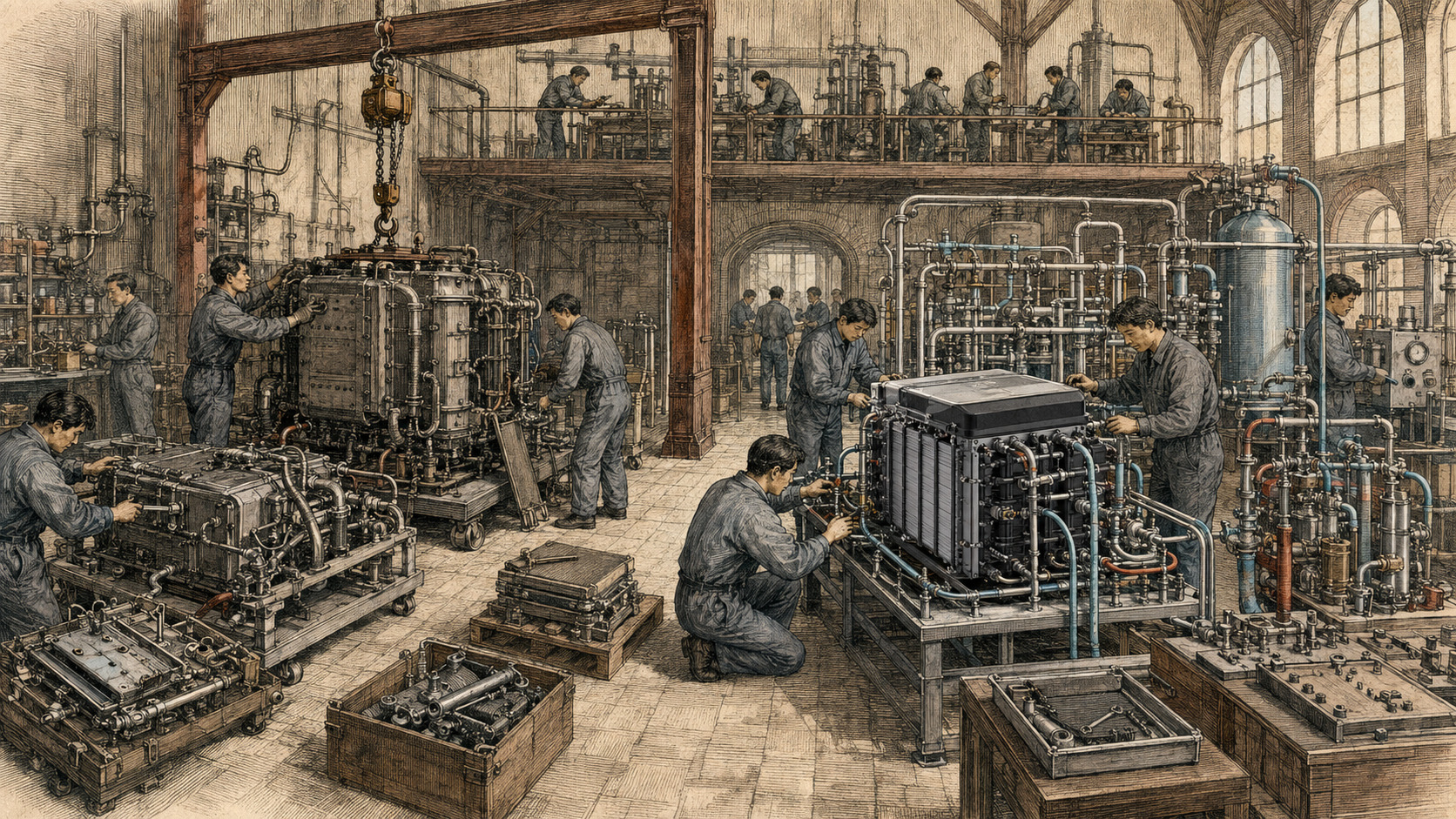
In January 2024, workers in Brownstown began making the component that was supposed to move hydrogen fuel cells out of the laboratory and into an industrial age. The factory had clean rooms for coating catalyst ink, equipment for assembling hundreds of thin electrochemical cells and production methods developed jointly by two of the world's largest automakers. Honda and General Motors called it the industry's first manufacturing joint venture for mass-produced automotive fuel-cell systems.
Two years later, the final chapter was already dated. Honda announced on January 20, 2026, that production would end during the year. Its statement praised the collaboration's results: durability, cold-weather performance, quality, advanced manufacturing, shared suppliers and lower cost. It did not publish production volume, orders, utilization, revenue, losses, jobs affected or an exact shutdown day.
The ending can be narrated in two misleading ways. One says hydrogen failed and Honda is retreating. The other says the partnership completed its mission and Honda is confidently graduating to better technology. The evidence supports neither simple story. GM had already stopped next-generation hydrogen development, saying the path to a sustainable fuel-cell business was long and uncertain. Honda, by contrast, displayed an independent successor in 2026 and continues to court trucks, construction equipment and stationary-power customers. Yet Honda had also reduced and delayed its own next factory before Brownstown's closure was announced.
This is not abandonment. It is a narrowing of the bet.
A machine that makes electricity without burning hydrogen
A proton-exchange-membrane fuel cell is an electrochemical engine. At the anode, a platinum-based catalyst separates hydrogen molecules into protons and electrons. The membrane lets the protons cross but forces the electrons through an external circuit, where they perform electrical work. At the cathode, oxygen from air reunites with those particles and forms water. A traction motor turns the electricity into motion; a small battery absorbs regenerative braking and supplies transient power.
The elegance of the reaction hides the industrial difficulty. An automotive stack contains hundreds of repeating cells that must share reactant gases, coolant, pressure and mechanical compression evenly. Water must be present to conduct protons through the membrane, then removed before it floods the flow channels—or freezes during a cold start. Air compressors, humidification, hydrogen recirculation, pumps, valves, sensors, thermal management and power electronics surround the stack. A fuel-cell “system” is the stack plus this balance of plant.
Cost and aging are connected to that complexity. Platinum resists the corrosive electrochemical environment but is expensive. Catalyst particles can grow or dissolve. Carbon supports corrode. Membranes can develop chemical attack, pinholes or mechanical cracks as temperature, humidity and load cycle. Seals must survive thousands of hot, cold, wet and dry transitions while preventing hydrogen and air from mixing. Every improvement that removes platinum, cells, pipes or controls can lower cost—but only if power, efficiency, start-up and life remain acceptable.
That is why the Brownstown achievements matter even if the factory closes. Honda says the GM system cut cost to one-third and doubled durability against the 2019 Clarity Fuel Cell system. It attributes the result to less platinum, fewer cells, common sourcing, scale effects, improved seals, corrosion-resistant materials and deterioration control. These are manufacturing and materials advances, not a change in basic chemistry.
Honda's long road began before the modern hybrid
Honda dates its fuel-cell research to 1989, a decade before it displayed the FCX-V1 and FCX-V2 prototypes in 1999. One prototype used a Ballard stack and stored pure hydrogen in a metal-hydride alloy. The other used Honda's own stack and attempted to extract hydrogen from methanol on board. The pair captured an uncertainty that still shapes hydrogen engineering: not only how to convert hydrogen into electricity, but what molecule should be carried and where the hydrogen should be made.
By 2002 Honda had chosen compressed hydrogen for the FCX. The vehicle became the first fuel-cell car certified by both the U.S. Environmental Protection Agency and the California Air Resources Board. It entered tiny lease fleets in Japan and California, initially about 30 vehicles over two to three years. The company's announcement was notably sober: it said there were no plans for mass-market sales and that cost, technology and infrastructure problems remained.
Honda then attacked problems that could be solved inside the vehicle. Its 2003 in-house stack used stamped metal separators and about half as many parts as the earlier structure, more than doubled output density and operated down to −20°C. In 2005 Honda leased an FCX to an individual. In 2008 the purpose-built FCX Clarity entered production on a dedicated line in Tochigi, with a plan for only a few dozen units in the first year and about 200 over three years.
The 2016 Clarity Fuel Cell placed its stack under the hood and offered an EPA-rated 366 miles in the United States. This was a real packaging achievement. It was also still a California-centered lease product dependent on a narrow station network. For two decades, Honda kept making the machine more carlike while the fuel system around the car remained exceptional.
1989 Honda begins fuel-cell research.
1999 FCX-V1 and FCX-V2 prototypes explore pure hydrogen and onboard methanol reforming.
2002 FCX gains EPA and CARB certification and enters limited lease use in Japan and the U.S.
2003–2005 Honda demonstrates sub-freezing operation with its own stack and leases an FCX to an individual customer.
2008 FCX Clarity production begins on a dedicated line in Tochigi.
2013 Honda and GM agree to co-develop a next-generation stack and hydrogen storage.
2017 The companies establish FCSM in Brownstown with a combined $85 million investment.
January 2024 FCSM begins commercial production; Honda starts CR-V e:FCEV production in June.
June 2025 Honda reduces and delays the planned Moka successor factory.
October 2025 GM ends next-generation HYDROTEC development.
January 2026 Honda says FCSM production will end during 2026.
March 2026 Honda exhibits a sample of its independent 150 kW module.
Why two rivals built one stack
Honda and GM began their formal fuel-cell collaboration in July 2013. The rationale was scale before either company possessed scale. They integrated development teams, shared intellectual property and planned common sourcing for the stack and hydrogen storage. In 2017 they committed a combined $85 million to FCSM inside GM's existing battery-pack factory south of Detroit. The 70,000-square-foot operation was expected to create nearly 100 jobs and begin mass production around 2020.
That schedule slipped. Commercial production did not begin until January 2024. The delay is important because volume manufacturing is a different engineering problem from building a demonstration stack. Catalyst ink must be coated consistently over large areas. Membrane-electrode assemblies need to be cut, sealed and inspected at automotive takt times. Bipolar plates must be formed with fine channels, joined without leaks and protected from corrosion. Hundreds of cells must be compressed into a stack without introducing uneven force. End-of-line tests have to find defects without making the product unaffordable.
Honda says the companies also unified suppliers and purchasing. That is mundane but decisive. A lower platinum loading does not lower the invoice if coating yield is poor; fewer cells do not help if plate forming is slow; clever seals do not survive if dimensional variation accumulates across hundreds of layers. The joint venture turned laboratory tolerances into production controls.
The original 2017 announcement expected the technology to move fuel cells closer to mainstream passenger propulsion. By the 2024 start of production, Honda was emphasizing four applications—FCEVs, commercial vehicles, stationary power and construction machinery—and sales to business customers. The engineering program reached the line, but the market thesis had already broadened away from ordinary private cars.
The CR-V e:FCEV is both a product and an admission
The clearest product of Brownstown is Honda's CR-V e:FCEV, assembled at the Performance Manufacturing Center in Ohio and launched through lease programs in 2024. The American version has an EPA range rating of 270 miles, including up to 29 miles of battery-only driving. Honda's Japanese announcement used the WLTP cycle and cited more than 600 kilometers from hydrogen plus more than 60 kilometers of battery range. The figures are not directly comparable because test cycles differ.
The plug is clever. Many local trips can begin with electricity from a home or workplace charger; the fuel cell can serve longer travel. It also means a driver can still move the vehicle when a nearby hydrogen station is unavailable, within the battery's limited range. The vehicle turns two incomplete infrastructures into one more resilient powertrain.
It is also an admission that fast hydrogen refueling is useful only when hydrogen is reliably available. Honda advertises a roughly three-minute fill. California's 2026 joint state assessment found 50 public stations open as of September 2, 2025, with 11 more temporarily non-operational and average network availability of about 60% over the previous year because of maintenance, equipment failures and supply disruptions. There were 14,128 registered light-duty FCEVs in April 2025. The network had enough theoretical capacity overall, yet geographic loss of access remained a problem.
A plug cannot make compressed hydrogen cheaper, reopen a broken compressor or move a station closer to a household. It can reduce how often the owner needs those things. The CR-V e:FCEV therefore embodies the wiser 2020s strategy: preserve fuel-cell experience, gather field degradation data and make infrastructure failure less punishing, without pretending the vehicle has entered an ordinary nationwide market.
Honda's new module: a striking ladder of relative claims
At the H2 & FC Expo in Tokyo in March 2026, Honda showed a sample of the independently developed successor. It states a rated output of 150 kW. Against the current GM co-developed model, Honda says manufacturing cost will be half, durability more than double and volumetric power density more than triple. Compactness matters because a heavy truck may need several modules in the space beneath its cab where a diesel engine now sits.
The arithmetic makes the ambition clearer. If the 2019 Clarity system is assigned a cost index of 100, the GM system is about 33.3 and the Honda successor would be about 16.7. If Clarity durability is assigned an index of 1, the GM system is 2 and the successor would exceed 4. These are chained relative statements, not yen-per-kilowatt or operating-hour data. Honda has not disclosed the baseline unit cost, its production-volume assumption, the exact durability test cycle or a warranted service life.
| Generation | Manufacturing-cost claim | Durability claim | What is publicly established |
|---|---|---|---|
| 2019 Clarity Fuel Cell | Baseline: 100 | Baseline: 1 | A series-produced reference system with customer field history |
| GM–Honda / CR-V e:FCEV | About 33.3, or one-third of Clarity | 2× Clarity | Commercial production began in 2024; exact volume and hours are undisclosed |
| Independent Honda successor | About 16.7, if both relative claims are chained | More than 4× Clarity, if claims are chained | A 150 kW sample has been exhibited; cost and life are Honda claims, not published customer-fleet results |
Honda says it is improving degradation models with Clarity development experience and operating data from the CR-V, automatically comparing predicted deterioration with observed results and using machine learning to refine the model. This is a serious method: a laboratory duty cycle cannot reproduce every combination of humidity, freeze, idle, contaminants and driver demand. It is not yet public proof of more than twice the life. The company has not supplied the dataset, fleet size, cumulative hours, failure distribution or independent validation.
Honda's design objective is parity with diesel in module size and lifetime cost, including initial cost, efficiency and durability. “Objective” is the important word. Diesel is supported by mature global production, fueling, repair and resale systems. Matching the box beneath a cab is only one layer of parity.
- At what annual production volume is the “half cost” comparison calculated?
- What duty cycle, temperature range and end-of-life power loss define “more than twice” the durability?
- What are stack and complete-system efficiency at rated and part load?
- How much platinum is used, and what replacement or remanufacturing value remains?
- What warranty will Honda offer in hours, years and starts?
- What is the delivered hydrogen price at the customer's depot or facility?
- When and where will commercial modules be made, and at what initial capacity?
Moka is the most important correction in Honda's story
In December 2024 Honda announced a dedicated successor plant at its former powertrain site in Moka, Tochigi Prefecture. The plan was specific: operation in the fiscal year ending March 2028, annual capacity of 30,000 systems, a 28,901-square-meter building and eligibility for up to ¥14.78 billion in government subsidy. Honda linked the factory to goals of a 5% share of the fuel-cell-truck market by 2030 and 30% around 2040.
On June 30, 2025, Honda revised it. Citing changes in the global hydrogen market, it said initial capacity would be reduced and full production delayed. It withdrew from the subsidy program because the new plan would no longer satisfy requirements to begin by the end of FY2028 with more than 20,000 units of annual capacity. Honda did not disclose the new capacity or date.
This reversal came before GM publicly ended next-generation hydrogen development and before Honda announced Brownstown's shutdown. It is the clearest evidence against reading the independent module as a confident handoff from one mass-production line to another. As of the public record checked for this article, there is a product direction and an exhibited sample, but no current volume-production timetable that can be placed beside Brownstown's ending.
The retreat was rational. A 30,000-unit factory built ahead of orders can turn every “low-cost” module into an expensive one through underutilized equipment and overhead. Reducing capacity protects capital while demand develops. It also weakens the scale assumptions that normally produce the claimed cost. The company is trying to solve a circular problem: it needs volume to lower cost, but customers need lower cost and reliable hydrogen before they order volume.
GM and Honda drew different conclusions from the same factory
GM's October 2025 statement was unusually direct. It stopped work on next-generation HYDROTEC fuel cells and said production through FCSM for data centers and power generation would end. It identified high costs, limited U.S. hydrogen infrastructure and uncertain business sustainability, then directed research and capital toward batteries, charging and electric vehicles.
Honda retained the opposite option. This does not mean it sees the economics differently in every market. Its Moka revision acknowledges the same weak demand. The difference is strategic position. Honda has more than three decades of proprietary stack and vehicle learning, has placed the GM system in a current vehicle and is developing external customers. An independent module lets it preserve that accumulated competence and sell into niches where the battery comparison is less decisive.
The joint venture can therefore end with asymmetrical meaning. For GM it is part of an exit from next-generation development. For Honda it is a supplier transition and a market reset. The shared factory's knowledge—quality controls, coating, sealing, testing, purchasing and field feedback—does not vanish when the legal vehicle stops production. But neither does a factory automatically transfer. Honda must recreate qualified equipment, suppliers, technicians and yield at a new site, at a smaller and later scale than once promised.
Four markets, one idea: bring the fuel to a fleet
Honda now names four core domains: FCEVs, commercial vehicles, stationary power and construction machinery. The list matters less as diversification than as a geography of refueling. A private passenger car can travel anywhere and expects thousands of convenient stations. A truck can return to a depot. An excavator can be fueled at a managed worksite. A generator never moves at all. Concentrated demand can support one reliable hydrogen supply point.
With Isuzu, Honda has road-tested a 25-ton GIGA FUEL CELL truck using four 103 kW Honda stacks and carrying 56 kilograms of hydrogen. The prototype was advertised with more than 800 kilometers of range in Isuzu's validation mode, and the companies have targeted a 2027 production introduction. That date remains a plan, not evidence of orders or economics. The use case is nevertheless clearer than a suburban passenger car: long duty cycles, payload sensitivity, short depot dwell times and predictable routes can give fast refueling more value.
Stationary power offers another route. At Honda's Torrance campus, retired Clarity systems were assembled into a 500 kW backup generator. In Shunan, Honda, Tokuyama and Mitsubishi began a demonstration using by-product hydrogen from brine electrolysis and automotive systems intended for reuse to serve a distributed data center. Honda's standard concept can combine four 250 kW units and targets power within ten seconds of start. A factory or data center can sign a hydrogen supply contract and value resilience as well as energy.
Construction machinery is attractive for similar reasons: high power, long shifts and a bounded site. But it is not one market. A small excavator may be better served by a swappable battery; a large machine far from the grid may justify hydrogen only if a mobile supply can arrive cheaply. Honda's portfolio includes battery collaboration with Komatsu as well as fuel-cell ambitions. That technology pluralism is more credible than assuming every diesel engine should be replaced by the same device.
| Application | Why fuel cells may fit | What can still defeat the case |
|---|---|---|
| Passenger FCEV | Quick fill, long range, quiet electric drive | Sparse stations, fuel price, battery-EV competition and low vehicle volume |
| Heavy commercial truck | High energy need, payload pressure, long routes and depot fueling | Hydrogen cost, tank volume, station utilization, stack life and electric-truck improvement |
| Stationary power | Modular, quiet, fast-start backup near contracted supply | Low generator utilization, hydrogen storage cost and cheaper batteries or grid redundancy |
| Construction machinery | High output at managed sites where charging may be difficult | Fuel delivery, ruggedization, transient duty and battery alternatives for smaller equipment |
The station problem did not wait for better stacks
Fuel-cell passenger cars have long faced a two-sided investment trap. Drivers will not buy without stations; station owners cannot earn a return without drivers. California spent $174 million from its Clean Transportation Program on light-duty hydrogen infrastructure by September 2025, according to the 2026 joint assessment. Yet the operating network averaged about 60% availability. Capacity exceeded the fuel needed by the registered vehicles in aggregate, while actual access worsened in some regions.
This distinction between capacity and service is crucial. A station rated to dispense hundreds of kilograms per day adds theoretical capacity even if its compressor, chiller or hydrogen supply repeatedly fails. A driver needs the correct nozzle at the correct location at the correct time. A truck operator needs much more fuel on a schedule and cannot tolerate a missed route. Industrial demand may solve the utilization problem, but it raises the reliability requirement.
The joint venture improved the numerator—power, life and manufacturability. It could not control the denominator formed by stations, hydrogen plants, transport, regulation and competing technology. During the same 2013–2026 period, lithium-ion batteries became cheaper, fast charging expanded and automakers deployed battery vehicles across far broader markets. The relevant comparison changed while FCSM was being built.
Water at the tailpipe does not settle the climate question
A fuel cell emits water at the point of use. That makes it valuable for eliminating exhaust carbon dioxide and local combustion pollutants from a vehicle or generator. It does not identify how the hydrogen was made. The U.S. Department of Energy says most American hydrogen is currently produced from fossil fuels, especially by reforming natural gas. Electrolysis can be low carbon when supplied by low-carbon electricity; the same electrolyzer drawing carbon-intensive grid power can yield a different result.
Compression, liquefaction, storage and transport also use energy. Hydrogen can still reduce emissions in a specific project, but the answer depends on production pathway, methane leakage, carbon capture, electricity mix, delivery distance and equipment efficiency. Honda's module improvements address the conversion device. They cannot make the upstream molecule clean or cheap by themselves.
That boundary should shape deployment. By-product hydrogen that would otherwise be wasted, a renewable-rich industrial cluster, or a depot near a dedicated electrolyzer can provide a stronger case than retail fuel moved long distances. Honda's shift toward stationary and commercial applications is therefore not just a search for customers. It is an attempt to place fuel cells where hydrogen supply and demand can be engineered together.
What Brownstown proved—and what it did not
The partnership's short production life should not erase its learning. Honda and GM developed a lower-cost, longer-lived system, built an automotive production process and put the result in a customer vehicle. Honda can take manufacturing knowledge and live degradation data into its independent design. That is real intellectual and organizational capital.
But the public record does not show that FCSM reached profitable utilization, the planned 2,000 external sales a year in the mid-2020s, or the 60,000 systems Honda once envisioned for 2030. Honda has not said how many modules Brownstown built or how current CR-V customers and other applications will be supported after production. It has not disclosed whether inventory will bridge the transition or when a saleable independent unit will leave a Honda line.
- Separate production from development. A displayed module is not a qualified, warrantied, volume product.
- Separate relative cost from a price. “Half” is meaningful only with baseline volume, yield and included components.
- Separate stack life from system availability. Compressors, pumps, sensors and hydrogen supply can stop the application first.
- Separate tailpipe emissions from life-cycle emissions. The hydrogen pathway determines much of the climate result.
- Watch committed customers and factory utilization. They are stronger evidence than distant market-share goals.
- Look for clusters. Depots, plants and work sites can coordinate fuel and demand more easily than scattered households.
Not the hydrogen future once advertised
In 2002 Honda warned that significant cost, technology and infrastructure issues remained before mass marketing. Twenty-four years later, the stack is smaller, cheaper, more durable and easier to start in the cold. The warning still survives because two of its three nouns—cost and infrastructure—extend far beyond the stack.
The company's response is neither to surrender nor to repeat the old passenger-car promise. It is to own the next design, spend more cautiously, collect operating data and seek customers whose machines return to the same fuel. A 150 kW building block can be multiplied for a truck or power station. A reduced factory can grow if orders become real. Used automotive modules may receive a second life in stationary systems. Each move preserves options while limiting exposure.
That is less romantic than the vision in which every service station becomes a hydrogen station. It may be more durable. Industrial transitions often begin not when a technology becomes universal, but when it finds a narrow job that pays for repetition.
Brownstown was meant to be the bridge to mass production. Instead, it became a bridge to Honda's independence—and a lesson that production technology cannot manufacture demand. Whether Honda's next module becomes a new business pillar will be decided not by its sample at an exhibition, but by disclosed warranties, factory dates, delivered hydrogen prices and customers willing to reorder.
The partnership is ending. The experiment is not. Honda's hydrogen ambition has become smaller in its first factory, broader in its applications and more honest in its dependence on economics. That is not a triumphant story. It is a credible one.
Reporting notes and principal sources
This article distinguishes reported facts from company targets. Honda's January release says FCSM production will end “during 2026”; it gives no exact day. Cost, durability and power-density comparisons are Honda claims, and no undisclosed dollar cost, operating-hour life or commercial volume has been inferred. The illustrative cost and durability indexes simply chain Honda's published relative comparisons. California's station figures describe the dates in the state's May 2026 assessment, not a real-time nationwide count.
- Honda: FCSM fuel-cell-system production to end during 2026, January 20, 2026
- General Motors: End of next-generation HYDROTEC development, October 10, 2025
- Honda: 150 kW independent module at H2 & FC Expo, March 17, 2026
- Honda R&D: Successor module, degradation modeling and application strategy
- Honda: Reduction and delay of the Moka production plan, June 30, 2025
- Honda: Original 30,000-unit Moka factory plan, December 18, 2024
- Honda: Commercial production begins at FCSM, January 25, 2024
- Honda and GM: Formation of the Brownstown manufacturing joint venture, January 2017
- Honda: 2023 hydrogen-business briefing and original volume ambitions
- Honda: CR-V e:FCEV system, plug-in function and comparative cost
- Honda: U.S. CR-V e:FCEV production and EPA range, June 2024
- Honda: FCX-V1 and FCX-V2 prototypes, September 1999
- Honda: FCX certification, lease limits and early cautions, July 2002
- Honda: In-house stack, parts reduction and cold operation, October 2003
- Honda: FCX Clarity dedicated production line, June 2008
- Isuzu and Honda: GIGA FUEL CELL truck specifications and launch plan
- Honda, Tokuyama and Mitsubishi: Stationary-power demonstration in Shunan
- California Energy Commission and CARB: 2025 hydrogen-network assessment, published May 2026
- U.S. Department of Energy: PEM fuel-cell operation, applications and platinum challenge
- U.S. Department of Energy: Hydrogen-production pathways and present fossil reliance