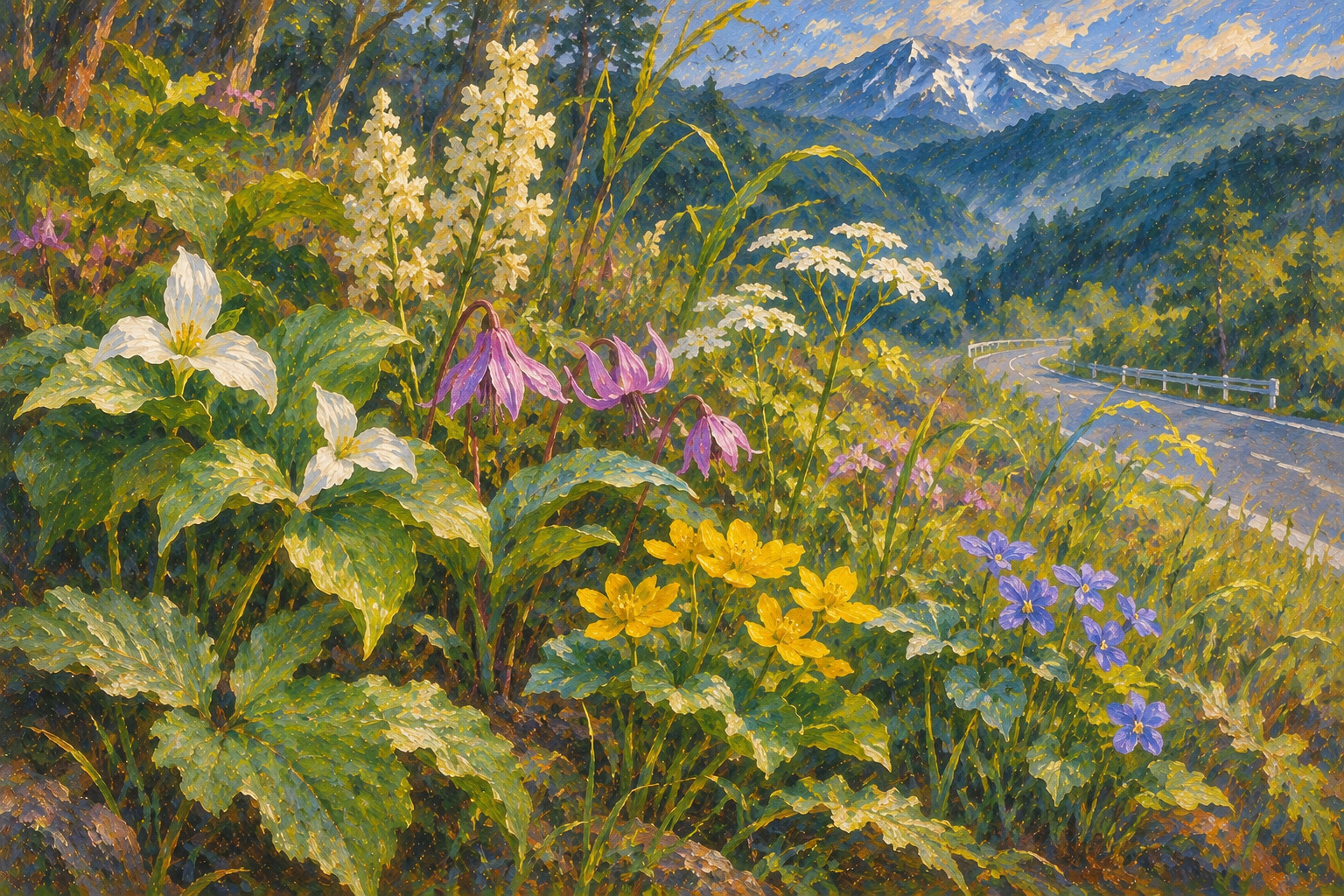
- A green slope is not necessarily a restored ecosystem
- A real highway project, and eight experimental plots
- The difference between moving soil and moving a living system
- An early advantage that did not persist in the same way
- Both treatments grew forests’ companions—not the same community
- How Japan learned to green its highways
- A collaboration beyond the university
- Why the findings matter to Japan’s biodiversity agenda
- What the decade of evidence does not prove
- The decade after construction may be the real test
A green slope is not necessarily a restored ecosystem
From a passing vehicle, a roadside embankment thick with plants may look repaired. What the eye cannot easily tell is whether those plants resemble the community that occupied the site before construction. A ten-year experiment in northern Japan suggests that this distinction matters profoundly—and that the way engineers handle a few inches of living topsoil can still shape a plant community a decade later.
Hokkaido University announced the findings on November 13, 2026, following the online publication of a paper in the journal Conservation Ecology Research on November 10. Researchers comparing two soil-reuse methods found that both produced developing vegetation. Yet the plots transplanted with intact blocks of local topsoil retained a species composition closer to the donor vegetation after ten years. This is not a claim that the other method failed to grow plants; it is a more demanding measure of ecological restoration.
A real highway project, and eight experimental plots
The study followed embankments within Hokkaido University’s Nakagawa Experimental Forest in connection with construction of the National Route 40 Otoineppu Bypass, now called the Oto-Naka Road. In each of two treatment categories, researchers established four replicates measuring seven meters by seven meters. Surveys were carried out from 2014 through 2023.
The team recorded plant cover, separating native and non-native plants, species counts, Shannon diversity, woody and herbaceous species, community height, forest-associated vegetation and similarity to the source vegetation. Recording similarity, rather than stopping at overall cover, made it possible to ask whether the slopes were becoming green in a familiar way or in a biologically different way. The design provides a ten-year comparison at one project location, not a nationwide randomized trial.
The difference between moving soil and moving a living system
In the intact-block approach, workers transfer sections of surface soil while retaining as much of their original structure as practicable. The blocks carry aboveground plants, roots, buried seeds, small soil animals and microorganisms. The object is not simply to deliver a seed supply: it is to move part of the ecological setting in which a local plant community already developed.
The comparison technique, referred to in Japanese as sukitori-do, strips topsoil and stores it in a disturbed form before spreading it back over the newly built slope. That approach also makes use of native soil and its buried seeds, and it can help vegetate and protect the embankment. The experiment does not show that engineers should abandon it everywhere. Rather, it separates two objectives too often bundled together: protecting exposed earth promptly and recreating a particular local assemblage of species.
An early advantage that did not persist in the same way
Initially, non-native plant cover was lower in the intact-block plots. The researchers suggest that established native plants and other living components transferred with the soil may have helped resist colonization. That is a plausible ecological explanation, but the experiment did not isolate a single causal mechanism that can account for every change.
Over time, non-native cover also declined in the stripped-and-replaced soil plots. By the tenth year, the two methods had roughly similar non-native cover. Reporting a permanent ten-year superiority in suppression of invasive or non-native vegetation would therefore misrepresent the findings. The enduring difference lay in the identity and relative abundance of the plants that formed each community.
Both treatments grew forests’ companions—not the same community
Vegetation developed in both experimental treatments, and forest-associated plants appeared even in the disturbed-topsoil plots. Yet the composition of the resulting communities remained different. Where intact soil blocks had been transferred, the researchers found a closer resemblance to the donor vegetation ten years later.
This matters because a roadside planting scheme can succeed by one metric and underperform by another. A project whose urgent priority is erosion control needs rapid and dependable ground cover. A project beside a protected forest or a rare native plant community may have an additional obligation: preserve regional ecological identity. The Hokkaido results suggest that transplanting intact topsoil blocks can be an option when the second objective is particularly important.
How Japan learned to green its highways
Japan’s road-construction program has long relied on vegetating engineered slopes. According to the Hokkaido University release, since the 1960s contractors have widely used sown non-native grasses and methods that strip and redistribute topsoil. Rapidly covering bare earth can help limit erosion in a country with heavy rain, steep terrain and snowmelt. Those practical functions are not invalidated by a newer biodiversity study.
What has changed is the definition of success. A green surface tells engineers something about stabilization but comparatively little about the plants that belong to a specific valley or forest. Earlier work by the same research group found promising results in the first two years after intact-block transplantation. The unanswered question was durability: would a community resembling the donor vegetation still be present after a decade? The new paper extends the evidence across that longer timescale.
A collaboration beyond the university
The research involved Hokkaido University professor Masahiro Nakamura and colleagues affiliated with the university, the Civil Engineering Research Institute for Cold Region, the Hokkaido Development Engineering Center and the Hokkaido Regional Development Bureau. It bridges conservation ecology and the realities of an actual public works project. The group has developed an approach that it says can be implemented using ordinary construction machinery with relatively simple attachments.
There are still engineering questions the study cannot settle by itself. How large a donor area is needed? What happens when soils are wetter, colder or more fragile? What are the additional labor, transport and storage costs, and how do they compare with alternative revegetation methods over decades? The official research summary does not give a comprehensive commercial cost comparison or establish performance across every slope gradient. Such factors matter before a technique becomes a general standard.
Why the findings matter to Japan’s biodiversity agenda
Japan’s National Biodiversity Strategy 2023–2030 calls for a nature-positive transition and links protected-area goals with broader improvement of ecosystems. Road verges and embankments do not substitute for intact forests, but they are places where engineering choices can either erase or retain traces of the original landscape. An embankment near a reserve may be small in area yet significant in ecological context.
The study offers a measurable way to discuss quality: compare plant communities against a local reference rather than counting greenery alone. It does not demonstrate a nationwide increase in biodiversity, nor prove that restored plant similarity necessarily means birds, insects, fungi and soil organisms have recovered equally. Its value is as a carefully observed example of how the initial construction method can influence long-term plant composition.
What the decade of evidence does not prove
The intact blocks contained soil organisms, but the main reported findings concern vegetation above ground. Hokkaido University explicitly calls for future measurements of the recovery of soil animals and microorganisms. It is therefore premature to say the whole underground ecosystem was restored for ten years, or that the treatment is already known to outperform alternatives on every ecological dimension.
The research team also discusses the possibility that distinct starting conditions can lead to different persistent plant communities. It cautions, however, that the experiment alone does not demonstrate the ecological concept of multiple stable states. Other locations, reference communities, soil conditions and longer observation periods would be needed to test generality. Scientific precision makes the result more useful, not less.
The decade after construction may be the real test
A road project generally declares completion when a functioning route and stable embankments are delivered. Ecological restoration asks a different question: what develops on that altered land in the years after crews leave? A serious monitoring program might track the return of local species, changes in plant composition, and soil-life recovery alongside erosion and maintenance needs.
The Hokkaido trial points to a practical lesson with international relevance. Decisions made while earth is being moved can have biological consequences visible long after construction. Preserving living topsoil is not a magic fix or a substitute for sound slope engineering. Where local vegetation matters, however, protecting the structure of that soil may be a way to give the next decade of recovery a better starting point.
Sources and methodology
Methodology: Reviewed the November 13 Hokkaido University announcement and full release, the peer-reviewed article’s bibliographic details, Japan’s official biodiversity strategy and earlier slope-restoration research. No field visit, researcher interview, reanalysis of raw observations or independent cost comparison was performed.
- 北海道大学/Hokkaido University, 2026-11-13
- 北海道大学 研究発表資料・研究手法と限界/Full research release
- 『保全生態学研究』論文・DOI 10.18960/hozen.2531/Peer-reviewed paper
- 環境省 生物多様性国家戦略2023-2030/National biodiversity strategy
- 2016年 表土マット移植13年後の評価/Earlier 13-year slope restoration study
- 北海道大学森林圏ステーション 技術開発課題/Forest research technical programs