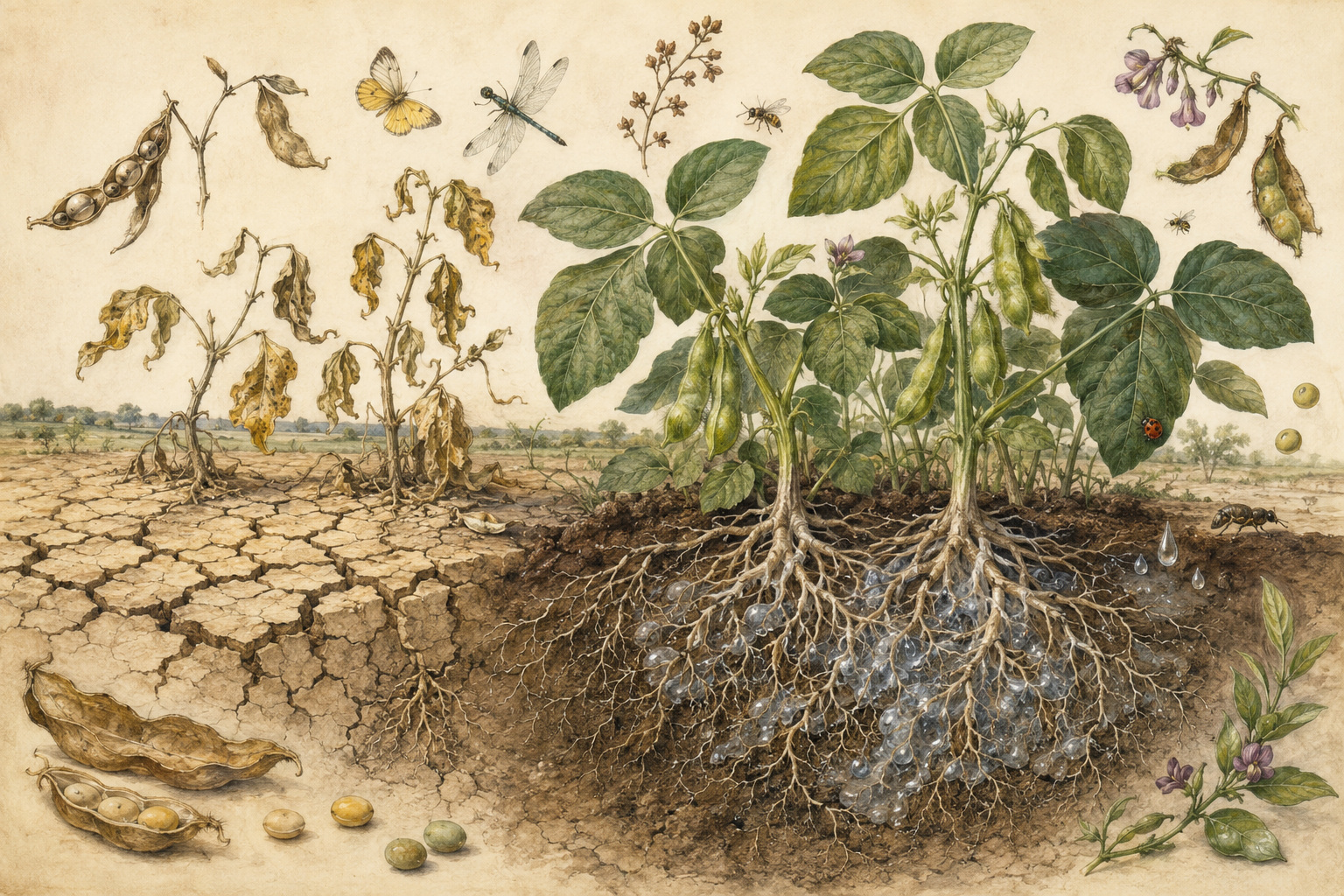
FUKAYA, Saitama — A carrot field here is becoming a small laboratory for one of farming’s oldest constraints: how to keep enough water near a plant’s roots when the weather turns hot and rain becomes unreliable.
EF Polymer Co., based in Onna, Okinawa Prefecture, and the Fukaya city government announced on August 28 that a new demonstration farm, the “EF Polymer Fukaya Field,” had been established inside the city. Carrots were to be sown in summer, with the trial continuing through the autumn harvest, expected around the second half of November.
The material being tested is a highly water-absorbent polymer manufactured from crop residues, including orange and banana peels. It is mixed into soil to hold water and nutrients near roots and release them gradually. That mechanism is straightforward to describe. Whether it produces a useful, affordable and repeatable result in Fukaya’s open fields is what the trial still has to establish.
A working field, not a product display
Fukaya describes itself as one of Japan’s important vegetable-producing areas. Its best-known crop is Fukaya negi, the thick, sweet green onion associated with the city, but its farming economy reaches across vegetables, livestock, rice, wheat and flowers. The city says managing water after the rainy season, when rainfall can fall away as summer heat persists, has become a serious problem for local growers.
That makes the choice of a water-retention material logical. It does not make its benefits automatic. Open-field performance depends on soil type, application rate, rainfall, evaporation, irrigation practices, planting depth and the crop’s root development. A polymer can absorb water in a controlled test and still deliver a modest or uneconomic result under farm conditions.
A useful trial therefore has to ask more than whether treated soil feels wetter. How much irrigation did the treated plot receive? What happened to germination, marketable yield and quality? Was less fertilizer used? What did the material and the labor to apply it cost? A farmer’s decision rests on the whole ledger, not a single physical property.
What EF Polymer says the material does
In its Japanese product information, EF Polymer describes the material as a 100% naturally derived superabsorbent polymer made by upcycling agricultural waste. It says the material can absorb roughly 50 times its own weight in water. Placed in soil, the company says, it holds water and nutrients that might otherwise drain away, then makes them available gradually in the root zone.
The company also advertises potential savings of up to 40% in water and 20% in fertilizer. “Up to” is important: it describes a possible upper result, not an average and not a forecast for Fukaya. Weather, crop, soil and farm practice all shape the outcome. The November harvest will be meaningful only if the local result is reported with those conditions attached.
The source material is part of the product’s appeal. Turning crop residues into an agricultural input suggests a circular path: waste from one harvest helps another crop use water more efficiently. But “natural” describes origin, not performance. Questions about field durability, decomposition, application, storage and cost still belong in the evaluation.
From an agritech award to a test plot
The project grew out of Fukaya’s broader attempt to attract technology companies to agriculture. The city calls the program “DEEP VALLEY,” borrowing Silicon Valley’s language for a regional cluster built around farm problems. The official project site defines agritech broadly: robots and data tools, but also climate adaptation, biotechnology and improvements across the food value chain.
Fukaya selected EF Polymer for the top prize in its 2024 DEEP VALLEY Agritech Award, a business contest intended to connect companies with agricultural problems. In April 2025, the product was added to the city’s agritech adoption subsidy program. The demonstration field is the next step in that relationship: a move from proposal and purchase support into an actual carrot crop.
2024 EF Polymer wins the top prize at the DEEP VALLEY Agritech Award 2024.
APRIL 2025 The product is added to Fukaya’s agritech adoption subsidy program.
SUMMER 2026 Carrots are sown at a test field inside Fukaya.
LATE NOVEMBER 2026 The announced trial period is expected to conclude after harvest.
“Cooperation among local governments, producers and companies, and working together to solve regional problems in the field, are essential to achieving sustainable agriculture,” EF Polymer Representative Director and CEO Narayan Lal Gurjar said in Japanese in the city’s announcement. He expressed hope that the field would become a model for wider adoption in Japan and abroad.
The collaboration is notable, but its legal and operational shape should not be overstated. The company established the field in cooperation with Fukaya. The releases do not describe it as a city-owned or city-operated municipal farm. They identify the location only as a test field within Fukaya.
Research site and visitor site
The field is expected to serve two audiences. For growers, it is a place to examine whether the material works under local conditions. For visitors—including agricultural organizations, municipalities and companies from Japan and overseas—it is intended as a demonstration and exhibition site. Plans also include seminars for local agricultural workers and a harvest event for residents.
That openness can be useful. Growers can see the soil and crop rather than evaluate a brochure. Public events can make climate adaptation tangible. Yet a field designed to communicate and a field designed to isolate an effect are not always the same. Visitor access, showcase plots and harvest activities should not disturb the comparable plots from which conclusions are drawn.
The announced trial at a glance
| Official name | EF Polymer Fukaya Field (EFポリマー深谷フィールド) |
|---|---|
| Organizer and partner | Established by EF Polymer in cooperation with Fukaya. The releases do not say the city owns or operates the farm. |
| Location | A test field within Fukaya, Saitama Prefecture; no detailed address was published. |
| Schedule | From summer 2026 sowing through the autumn harvest, expected to run until around late November. |
| Crop | Carrots |
| Planned work | Testing and analysis under heat and drought conditions, grower seminars, and a community harvest event. |
| Material | A 100% naturally derived superabsorbent polymer made from crop residues. Performance figures are supplied by the company. |
What a credible November result needs
The public releases provide the crop, general location and calendar, but not the size of the field, application rate, control-plot design, irrigation protocol or planned measurement methods. Those details determine what can be learned. A dry-looking untreated patch beside a green treated patch can be visually persuasive while revealing little if they did not receive comparable treatment.
The strongest result would pair a treated plot with a well-matched untreated control and publish total irrigation, rainfall, soil moisture, germination, total yield, marketable yield, fertilizer inputs and costs. Temperature and rainfall records would anchor the claim to the actual season. Repeating the trial across years and soil types would show whether an initial result travels.
WHAT TO LOOK FOR AFTER HARVEST
- Matched treated and untreated plots
- Field area, soil type, polymer application rate and sowing date
- Irrigation volume, rainfall, temperature and soil-moisture readings
- Germination, total yield, marketable yield and quality grades
- Fertilizer use, material cost, application labor and net farm value
- A public data plan and follow-up tests at other sites or in another season
A positive single-season result would still be a beginning. It could justify a larger test, not settle the product’s value for every farm. A weak or mixed result could be useful too: it might identify the soil, rate or weather conditions under which the material does not pay.
Fukaya’s experiment has a strong story—crop waste returning to the soil to help a new crop withstand heat. By late November, the story should give way to measurements. The real test of the field will be whether a grower can use those measurements to decide not only when to adopt the material, but when not to.
- Fukaya City Industrial Brand Promotion Office: “DEEP VALLEY Agritech Award 2024 top-prize company EF Polymer establishes the EF Polymer Fukaya Field” (Japanese, August 28, 2026)
- EF Polymer: “EF Polymer establishes the EF Polymer Fukaya Field demonstration farm in Fukaya, Saitama” (Japanese, August 28, 2026)
- EF Polymer product information (Japanese; source for the company’s material, absorption, water-saving and fertilizer-saving claims)
- Fukaya City’s official DEEP VALLEY site (Japanese; program purpose and agritech scope)
Japan.co.jp reviewed Japanese primary materials available by the morning of August 29, 2026. Official names, titles and the executive’s Japanese remarks were checked against the Fukaya and EF Polymer releases. Product performance numbers are attributed to the company and are not presented as Fukaya findings. The suggested evaluation measures in this report are editorial criteria, not announced trial results.