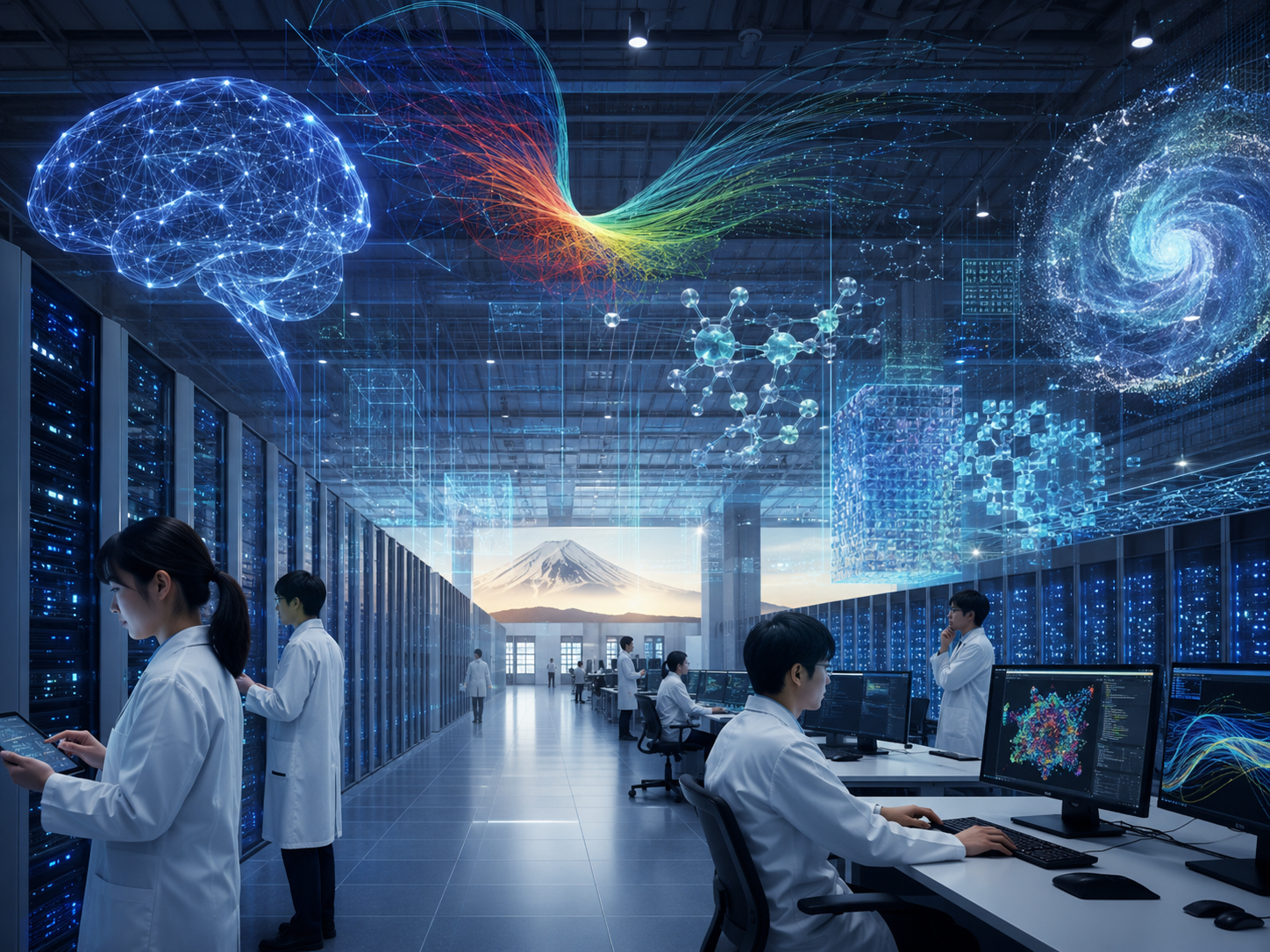
FugakuNEXT is not just Japan’s next supercomputer. It is a national infrastructure question: how should Japan connect science, industry, AI, semiconductors and energy efficiency in the 2030s? In May 2026, RIKEN’s Center for Computational Science announced the release of the basic design technical report for FugakuNEXT, the planned successor to the flagship supercomputer Fugaku. The report points to a future in which the next machine is not simply faster, but built for a world where simulation and artificial intelligence are becoming inseparable.
Fugaku changed Japan’s standing in global supercomputing. In 2020, RIKEN said Fugaku achieved 415.53 petaflops on the TOP500 LINPACK benchmark, returning a Japanese system to the No. 1 position for the first time since the K computer in 2011. It also reached 1.421 exaflops on HPL-AI and topped Graph500. But Fugaku was never only a trophy machine. It was designed to support weather, disaster resilience, drug discovery, materials, infection modeling and industrial research.
From K to Fugaku to NEXT
Japan’s supercomputer story is also a story of industrial and science policy. The K computer became a national symbol after reaching world No. 1 in 2011. Fugaku, its successor, was designed to do more than win a speed race: it had to run real applications across many fields. RIKEN R-CCS in Kobe became the center of Japan’s high-performance computing ecosystem, supporting universities, laboratories, companies and public-sector needs.
FugakuNEXT is harder because the era has changed. Supercomputers used to be kings of large-scale simulation: weather, fluids, earthquakes, molecules, structures, astrophysics. That remains essential. But late-2020s science increasingly combines AI models, experimental data, sensors, robotics, quantum computing and cloud workflows. The next flagship must handle not only equations but data, training, inference and learning loops.
What “AI for Science” really means
AI for Science does not simply mean using AI to summarize papers or write code. It means using AI to search molecular candidates, predict material properties, accelerate weather models, optimize experiments and replace parts of expensive simulations with learned surrogate models. It means embedding AI inside physics, chemistry, biology, climate science, medicine, manufacturing and engineering.
RIKEN’s 2025 call for naming proposals for a new “AI for Science Development Supercomputer” made the direction explicit. That system is optimized for high-speed AI training and inference, and RIKEN said it would work with Fugaku to enable research that combines AI with simulation. In other words, Japan is not waiting passively for FugakuNEXT; it is building an AI-science ecosystem step by step.
Supercomputers are semiconductor policy
A supercomputer is a research instrument, but it is also semiconductor policy. Fugaku drew attention because it used Fujitsu’s A64FX Arm-based processor to reach the top of the world rankings. FugakuNEXT raises an even broader question: how should Japan combine CPUs, GPUs, memory, network architecture and software in the age of AI? Computing power now affects research capability, industrial competitiveness, disaster resilience, medicine, materials and security.
Japan cannot build every component alone. But it can still keep system design, software, application knowledge, semiconductor development and human training inside a national ecosystem. The choice is not simply “domestic versus foreign.” It is whether Japan has a public scientific computing base of its own, or whether increasingly important research infrastructure becomes dependent on overseas commercial clouds.


The power problem is harder than the speed problem
The strictest constraint for AI-era supercomputing is electricity. It is possible to make machines faster by adding more chips and consuming more power. But a national research platform must also be sustainable, affordable and usable. AI training is power-hungry. A machine designed to study climate, disasters and energy cannot ignore its own footprint.
That means FugakuNEXT cannot be judged only by peak performance. The better questions are: how much useful science can it deliver per watt? How well can it combine AI and simulation? How many researchers can use it productively? How much software work is needed before real applications run well? The ranking table will matter, but application performance, power efficiency, accessibility and user support may matter more.
Who gets to use the machine?
One reason Fugaku mattered was that its role extended beyond a narrow community of supercomputing specialists. It served universities, national labs, industrial users, public policy, weather and public health. In the AI-HPC era, the user base could widen further: drugmakers, materials companies, automakers, aerospace, urban resilience, agriculture, energy systems and financial risk teams all have reasons to care.
But usability is a serious barrier. Supercomputers are not as simple as consumer cloud accounts. Users need optimized code, data management, security rules, industrial-confidentiality structures, pricing models and skilled staff. If FugakuNEXT is to become real infrastructure, hardware will not be enough. Japan will need software, education, user support and data platforms around the machine.
- The CPU, GPU and interconnect design choices in FugakuNEXT
- How FugakuNEXT connects with AI-for-Science systems
- Real application performance in climate, drug discovery, materials and disaster science
- Power, cooling and operating costs
- How easily universities and companies can use the platform
The next operating system for Japanese science
FugakuNEXT’s success cannot be measured only by rankings. The real question is whether it can speed the cycle of discovery: researchers form hypotheses, AI proposes candidates, simulation tests them, experiments feed back into the model, and the loop repeats. The supercomputer is becoming less like a single machine and more like an operating system for science.
If Fugaku put Japan back on the supercomputing map, FugakuNEXT is Japan’s attempt to stay on the AI-science map. Speed is necessary, but it is not the final goal. The goal is faster discovery, better forecasts, new medicines, safer infrastructure, stronger materials and a more resilient society. FugakuNEXT is ultimately about turning computing power into public intelligence.
Sources and references
This Japan.co.jp report is based on RIKEN, RIKEN R-CCS, TOP500 and Fugaku project materials.