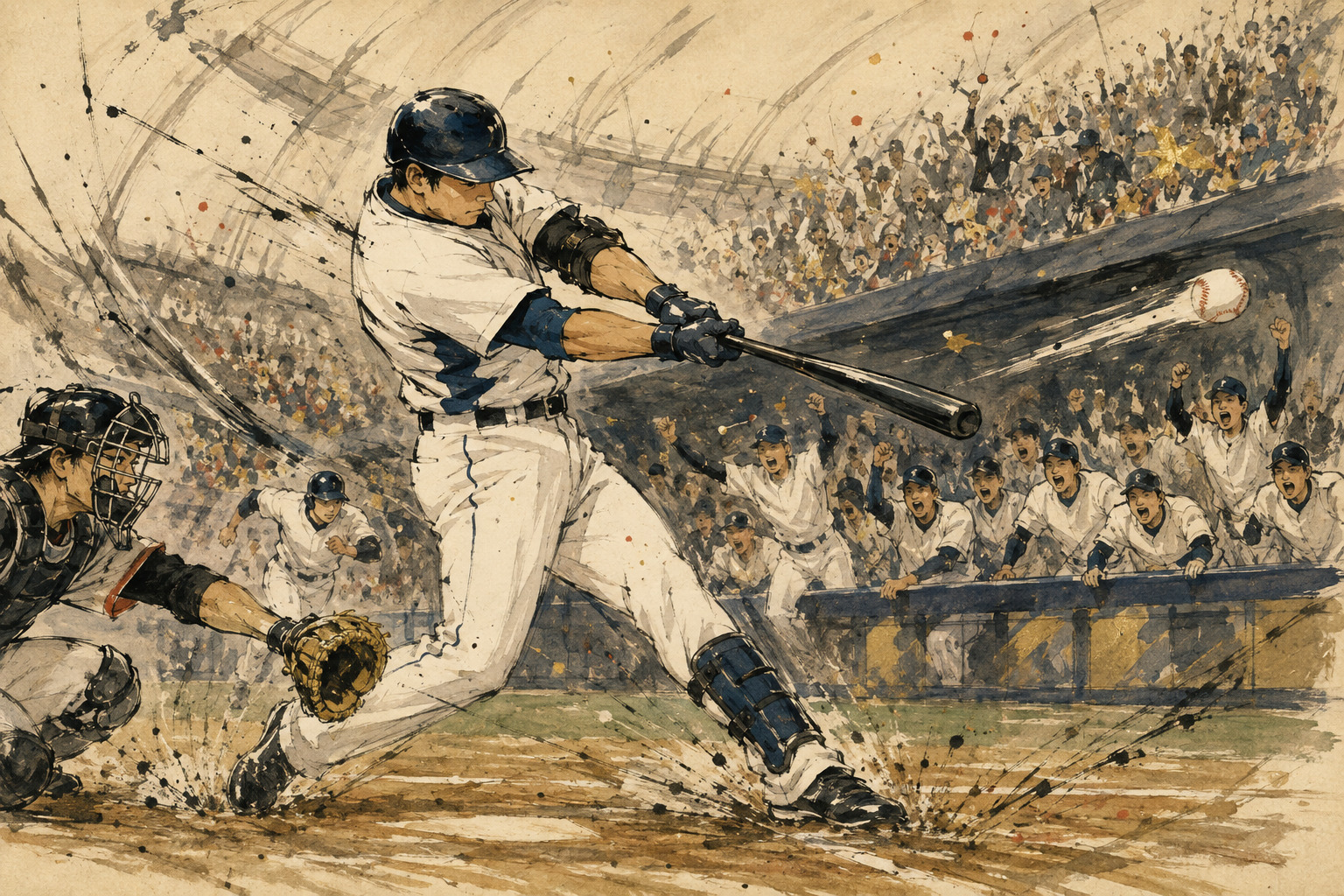
By the time Kotaro Kiyomiya came to the plate in the bottom of the 10th inning, the baseball game had spent three hours and 57 minutes refusing to choose a shape. It had been a SoftBank Hawks rout, then a Nippon-Ham Fighters resurrection, then a tie, then a test of which bullpen and which nerve could hold for one pitch longer. Kiyomiya saw a runner at third, one out and a full count. The next pitch arrived at a reported 157 kilometers per hour. He sent it through the right side, and the confusion became celebration.
Tatsuki Mizuno crossed home. Kiyomiya rounded first. The Fighters poured from their dugout toward the man who had ended an 8–7 game that seemed to contain several games inside it. The official duration was 3 hours 58 minutes, the attendance 31,443. SoftBank had more hits, 12 to 11. Nippon-Ham had the last one.
The winning run, assembled piece by piece
The walk-off is remembered as a swing, but it was constructed through four separate confrontations. Mizuno, already responsible for the night’s largest blow, opened the 10th with a single to center against Darwinzon Hernández. He did it after falling behind 0–2. Yua Tamiya then placed a sacrifice bunt—also with two strikes—to move Mizuno to second.
A wild pitch carried him to third. That changed the defense, the pitcher’s margin and Kiyomiya’s task. A fly ball could now be enough; a ground ball could become a race; a walk would pass the danger onward. Hernández pushed the plate appearance to 3–2. Kiyomiya did not need a grand gesture. He needed fair grass. His single to right delivered it.
The final hit looked sudden. The winning run was not. It required a two-strike single, a two-strike bunt, a pitch that escaped and a hitter who won the last full count.
That distinction matters because Mizuno’s run is easily edited out of the memory of a walk-off. Baseball’s ending privileges the batter: the camera finds him, the teammates surround him, the record assigns him the winning RBI. But a game-ending hit cannot exist without a runner placed close enough to end the game. Mizuno began the inning. Tamiya surrendered an out. Pressure did the rest.
How 0–6 became 8–7
SoftBank built its lead with the calm efficiency of a first-place club. In the fourth, a walk to Ryoya Kurihara and a single by Yuki Yanagita set up Hikaru Yamamoto’s sacrifice fly. Another walk followed. Tatsuru Hirose then drove a three-run home run off Haruki Hosono, turning a manageable inning into a 4–0 break.
The Hawks added two in the fifth. Ukyo Shuto singled, Kurihara drove him home and Yanagita doubled in another run. Hosono’s afternoon ended after 4⅓ innings, nine hits and six earned runs. SoftBank’s starter, Naoyuki Uwasawa, had allowed little. At 6–0, the game had the recognizable outline of a superior team closing down a challenger.
Then Yuma Imagawa appeared as a pinch hitter. Rubén Castro and Daiki Isobata had singled. Imagawa drove Uwasawa’s pitch over the wall for a three-run home run, his second homer of the season. The deficit had not disappeared, but it had been cut exactly in half by a player who had not been in the starting lineup.
The seventh supplied the game’s hinge. SoftBank loaded the bases with one out and failed to score when Yamamoto and Taisei Makihara struck out. In the bottom half, Yuki James Nomura singled, Castro walked and Imagawa singled after a flyout to load the bases. Hawks reliever Roberto Osuna reached 0–2 against Mizuno. One strike from an escape, he instead conceded a grand slam to right-center. A 6–3 deficit became a 7–6 Fighters lead.
| Inning | What changed | Score |
|---|---|---|
| Top 4th | Yamamoto sacrifice fly; Hirose three-run home run | Hawks 4–0 |
| Top 5th | Kurihara RBI single; Yanagita RBI double | Hawks 6–0 |
| Bottom 5th | Pinch-hitter Imagawa’s three-run home run | Hawks 6–3 |
| Bottom 7th | Mizuno’s grand slam after SoftBank strands three | Fighters 7–6 |
| Top 8th | Shuto’s sacrifice fly | 7–7 |
| Bottom 10th | Kiyomiya’s full-count RBI single to right | Fighters 8–7 |
SoftBank refused the neat comeback story. In the eighth, a walk and a single created the opening for Shuto’s tying sacrifice fly. In the ninth, the Hawks put Makihara at second and could not bring him home. The Fighters went down in order in their half. Only after Ren Fukushima retired the side cleanly in the top of the 10th could Nippon-Ham assemble the decisive run.
Fukushima received the pitching win, improving to 4–4. Hernández took the loss at 0–2. The scoring convention is accurate and emotionally incomplete: seven Fighters pitchers absorbed Hosono’s difficult start, while five Hawks pitchers attempted to protect or recover the lead. The victory belonged to the last reliever in the book, but its survival had been passed hand to hand.
The hero had already made a mistake
Kiyomiya’s line was two hits in four official at-bats, a hit by pitch and the winning RBI. Read chronologically, it is more revealing. He was hit by a pitch in the first, grounded out in the third, singled to center to open the sixth—and was picked off first base after Franmil Reyes struck out. He grounded out with the bases empty to finish the seventh. Then came the 10th.
The pickoff prevents the easy construction of a flawless protagonist. Nippon-Ham was still three runs behind when Kiyomiya reached in the sixth; losing that baserunner mattered. He did not erase the error by pretending it had never happened. Baseball gave him another turn, the innings gave him another situation, and he used it.
That is closer to how comebacks work than the mythology of destiny. Imagawa entered from the bench. Mizuno was behind in the count before both his grand slam and his 10th-inning single. Tamiya had two strikes before completing the bunt. The Hawks scored the tying run after losing a six-run lead. A walk-off is not purity. It is what remains when a team continues to create another chance after the previous chance has gone wrong.
Kiyomiya and the weight of being early
Kiyomiya has lived inside expectation since before professional baseball could properly measure him. At Waseda Jitsugyo, his widely reported total of 111 high-school home runs—including practice games—made him a national phenomenon. He won a Little League World Series with Tokyo Kitasuna and appeared at Koshien. In the 2017 NPB draft, seven clubs submitted his name in the first round. The Fighters won the lottery.
Lottery picks arrive with two clocks. The player has the ordinary clock of development; the public has the accelerated clock of anticipation. Kiyomiya hit seven home runs in each of his first three major-league seasons, but his batting averages were .200, .204 and .190. He made no first-team appearance in 2021. The early numbers encouraged the cruelest conclusion in prospect culture: that a 22-year-old’s unfinished development was already a verdict.
The following seasons complicated that judgment. He hit 18 home runs in 2022. In 2024 he batted .300 with 15 home runs and a .524 slugging percentage. He followed with a .272 average in 2025. Through this August 19 game, the 27-year-old was batting .246 with 12 home runs, 45 RBIs and a .334 on-base percentage in 105 games. Those are not the mythical numbers projected onto a famous teenager. They are the accumulated work of an established professional becoming useful in more than one shape.
The decisive single expresses that maturity better than another towering home run might have. The full count did not require him to fulfill every expectation attached to his name. It asked him to solve one pitch and use the open right side. He did.
A ballpark with a memory
Es Con Field Hokkaido opened in March 2023 as the center of Hokkaido Ballpark F Village and the Fighters’ new baseball economy: a club-controlled park designed to be inhabited beyond the nine innings. The first official game, on March 30, ended in a 3–1 loss to Rakuten. The first home victory arrived two days later.
That April 1 game also reached the bottom of the 10th. Nomura doubled. Kiyomiya singled to right. The winning run scored. When Kiyomiya later received the Pacific League’s monthly walk-off award, he described the result as something the pitchers and connected lineup had won together. The wording now sounds like a rehearsal for August 2026.
The symmetry is unusually clean: 10th inning, right-field single, Es Con Field, Kiyomiya at the center of the home team’s release. But the stadium is different now because the club is different. The Fighters finished last in 2022 and 2023 under Tsuyoshi Shinjo, then rose to second in both 2024 and 2025. The park’s first victory was evidence that a new home could produce a memory. This walk-off arrived with the heavier demand of a team trying to convert improvement into a pennant race.
Why the opponent changes the meaning
The Hawks are not merely another Pacific League visitor. Their lineage reaches to the Nankai club founded in 1938, through the move to Fukuoka and the Daiei years, to SoftBank ownership from 2005. The modern Hawks became a dynasty: Japan Series champions in four consecutive seasons from 2017 through 2020, then Pacific League champions again in 2024 and 2025. In 2025 they added another Japan Series title.
The Fighters’ modern Hokkaido story has its own peaks, including Japan championships in 2006 and 2016. But the latest climb has repeatedly encountered SoftBank. The Hawks finished 13½ games ahead in 2024 and swept Nippon-Ham in the Climax Series final stage. In 2025 the Fighters cut the regular-season gap to 4½ games, won 83 games and pushed the postseason rematch to its sixth game after taking three straight. SoftBank survived 2–1 and advanced.
Uwasawa made the August 19 meeting more intimate. A Fighters pitcher from 2012 through 2023 before leaving under the posting system, the right-hander now started for SoftBank. He worked six innings and allowed three runs—all on Imagawa’s pinch-hit homer. For Hokkaido spectators, the comeback’s first opening came against a pitcher whose best years had once belonged to the same uniform and crowd.
That history does not turn one August game into a championship. It explains why the six-run hole felt familiar and why climbing out mattered. SoftBank represented both the present leader and the recent ceiling above Nippon-Ham’s rebuild.
The standings refuse romance
After the game, the Hawks remained first at 68–40–1, a .630 winning percentage. The Fighters stood third at 63–50, 7½ games back and one game behind Seibu. Nippon-Ham had 30 games left in its 143-game schedule. The arithmetic was demanding before Kiyomiya’s hit and remained demanding after it.
That is important. Great games often invite oversized claims: the season turned, momentum became permanent, belief conquered probability. None can be established from one result. SoftBank had beaten the Fighters 7–1 at the same park the day before. Its deeper position in the standings survived the loss. Pennants are not awarded for the emotional amplitude of a victory.
Yet the modest claim is still substantial. A contender must be able to win games that escape its preferred plan. Hosono did not hold down the opponent. The middle of the order did not carry every inning. The first lead disappeared. Kiyomiya was picked off. Nippon-Ham won anyway. That capacity is not destiny; it is a tool, and serious teams need it.
The strange grace of the walk-off
Baseball is usually symmetrical. Each side receives three outs; an inning opens and closes; the teams exchange places. The walk-off breaks that rhythm. The home team scores the necessary run in the last inning and the game ends immediately. No answering half-inning exists. The losing team is still on the field when the winner’s bench empties into it.
That suddenness is why the final batter absorbs so much of the narrative. But the August 19 scorebook resists simplification. Imagawa supplied three runs from the bench. Mizuno supplied four with one swing and then the final baserunner. Tamiya moved him. Fukushima gave the offense a clean inning. Kiyomiya supplied the last hit after having lost an earlier opportunity of his own.
The image worth keeping, then, is larger than contact. It begins with a team six runs behind and continues through every imperfect recovery. It includes a full count against velocity, but also the bunt before it, the grand slam before that, the bases-loaded escape, the pinch hitter, the relievers and the mistake. Kiyomiya ended the game because baseball finally placed its last question in front of him. The Fighters won because, for four hours, they kept producing another answer.
- Nippon Professional Baseball — official game line, score, attendance, duration and decisions
- NPB official play-by-play — scoring sequence and the 10th-inning construction
- NPB official box score — batting, pitching and fielding records
- NPB 2026 standings — Pacific League records through August 19
- NPB player register — Kotaro Kiyomiya profile and career statistics
- NPB, October 26, 2017 — seven-club first-round draft lottery for Kiyomiya
- Hokkaido Nippon-Ham Fighters — 2017 draft scouting record and Kiyomiya’s amateur background
- Fighters, May 17, 2023 — Kiyomiya’s award for Es Con Field’s first walk-off victory
- Fighters — opening of Es Con Field Hokkaido in March 2023
- Fighters, November 28, 2023 — Naoyuki Uwasawa and the posting system
- NPB — review of the 2024 Pacific League Climax Series final stage
- NPB — the 2025 Hawks–Fighters postseason race and deciding sixth game
- Fukuoka SoftBank Hawks — official club history
Editorial note: This article is based on the cited public records and contains no independent interviews. NPB’s play-by-play confirms that Kiyomiya’s winning plate appearance reached a full count and ended in a right-field RBI single; it does not publish pitch velocity on that page. The 157 km/h reading comes from the supplied game brief and is treated here as a stadium or broadcast tracking figure. Kiyomiya’s 2026 statistics and the league standings are through August 19. The widely reported 111-home-run high-school total includes practice games. The exchange-rate strip is an editorial reference unrelated to the game.