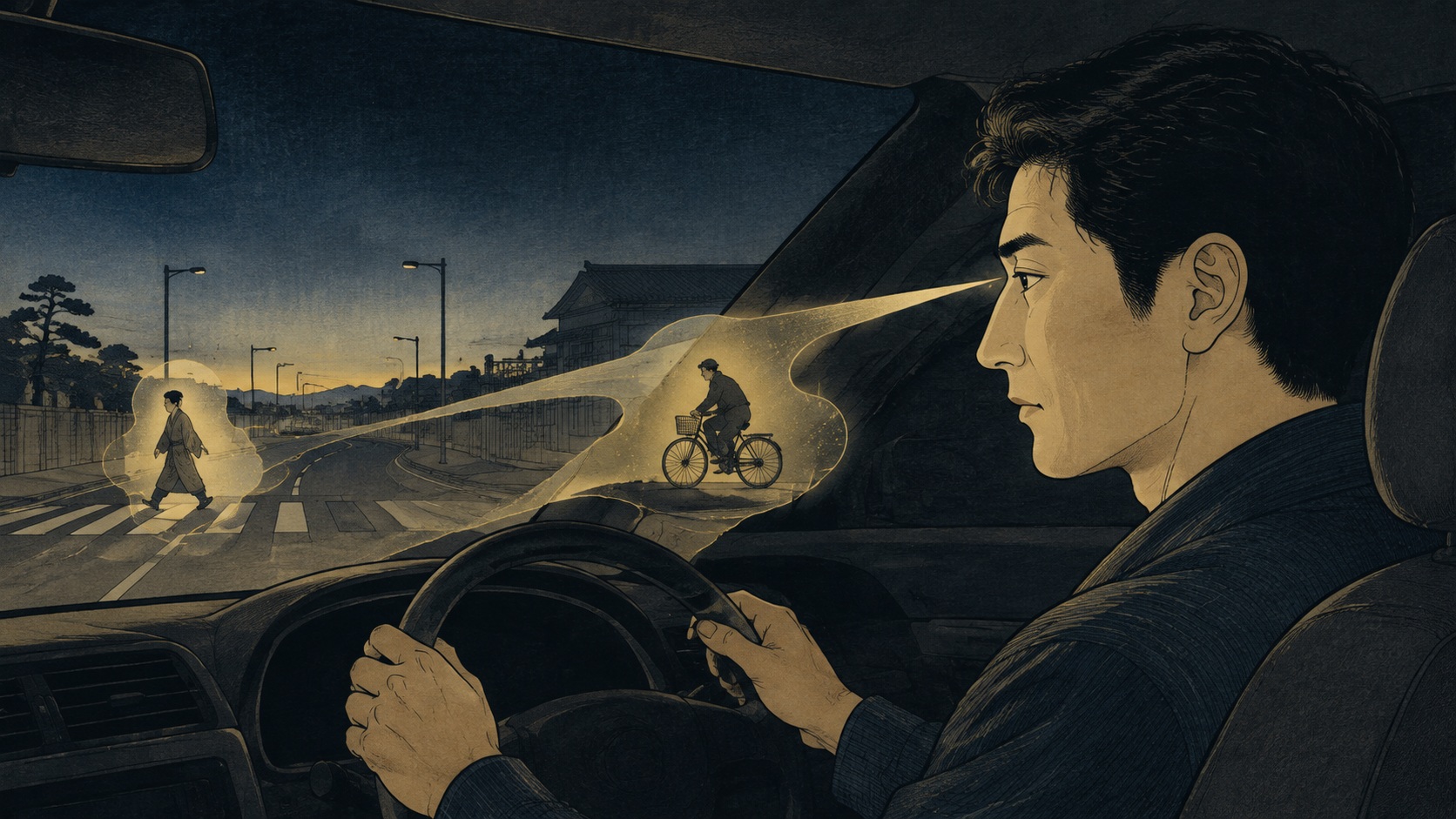
The road on the screen bends gently through a city. There are one or two lanes in each direction, traffic set at 20 percent and a cruising speed of 50 to 60 kilometers an hour. The participant’s hands hold a steering wheel. His feet work an accelerator and brake. Small wet electrodes sample the electrical activity of his scalp 128 times a second. During another three-minute interval, he watches prerecorded driving footage and looks for traffic objects relevant to safety. The scenery is similar. The job assigned to the brain is not.
A team led by Keiichiro Inagaki of Chubu University, Nobuhiko Wagatsuma of Toho University and Sou Nobukawa of Chiba Institute of Technology used that difference to ask a deceptively simple question: Does driving experience change how the brain moves from seeing to acting? Their paper, “Driving Experience Alters Brain Activity Related to Visual Perception and Vehicle Maneuvers During Driving,” appeared in IEEE Access on July 17 and was announced by the universities on August 5.
The result is not a picture of experienced brains running at full power all the time. Among the experienced group, alpha-band activity over the occipital, or visual, cortex remained comparatively high while they merely watched driving scenes. It dropped substantially when they had to steer and operate the pedals. Alpha activity also dropped among beginners, but the change was smaller. The researchers interpret this pattern as more flexible “alpha gating”: suppressing unnecessary visual input, then opening the gate when visual information has to guide action.
What counted as an “experienced” driver?
The word experienced does important work here. These participants were not racing drivers, police drivers or instructors. The researchers classified a driver as experienced if he had held a valid license for at least three years and drove more than five times a week. A beginner had few opportunities to drive or had held a license for less than one year. The resulting groups contained 14 experienced drivers, who reported driving 6.00 times per week on average, and 10 beginners, who averaged 0.79.
All 24 were men between 19 and 23, with a mean age of 21.1. They had normal or corrected-to-normal vision and reported no neurological or other relevant health problems. The team also checked arousal with the Japanese version of the Karolinska Sleepiness Scale so that obvious sleepiness would not become an alternative explanation. Tight control of age and sex made the comparison cleaner. It also made the population to which the result can be generalized much smaller.
Each participant first completed a 10-minute familiarization drive. He then performed two three-minute tasks, separated by rest and presented in a randomized order. In one, he drove the simulator as he normally would while obeying traffic rules. In the other, he watched prerecorded simulator footage and was asked to perceive the traffic objects that would need to be detected for safe driving. A 34-inch monitor presented the scene at 30 frames per second with an approximate field of view of 30 degrees to either side.
The experiment used a 14-channel Emotiv EPOC+ system. The analysis focused on O1 and O2, electrode positions at the back of the head commonly used to observe vision-related cortical activity. The researchers divided the signal into alpha (8–13 hertz), beta (13–30) and gamma (30–50) bands and compared the distribution of spectral power by experience group and task.
| Condition | What participants did | Overall EEG pattern |
|---|---|---|
| Perception only | Watched prerecorded driving and perceived traffic objects relevant to safety | Alpha activity was higher in both groups, with a particularly large elevation among experienced drivers |
| Perception plus control | Steered, accelerated and braked in the simulator | Alpha fell in both groups; beta and gamma rose compared with passive viewing |
| Experience comparison | The same two tasks were compared in 14 experienced and 10 beginner drivers | Alpha showed an interaction between experience and control condition; the experienced group made the larger switch |
Alpha is not a “paying attention” gauge
Alpha is a rhythm that repeats roughly eight to 13 times a second. It is prominent over the back of the head when a person rests with closed eyes and often weakens when the eyes open or a visual task begins. That history made alpha easy to describe as the sound of a brain idling. The modern picture is more active and more complicated.
One influential framework holds that strong alpha activity helps inhibit irrelevant regions or inputs. When processing is needed, alpha power falls—often called alpha suppression or desynchronization—and the flow of sensory information changes. Ole Jensen and Ali Mazaheri synthesized this account in 2010 as “gating by inhibition”: the brain shapes the routes through which information can influence ongoing processing, partly by controlling inhibition rhythmically.
That does not mean high alpha is universally good or low alpha universally attentive. Alpha can vary with task, brain region, timing, sleep, fatigue and the individual. Even the inhibitory account remains a model under continuing investigation. The informative feature of the new driving study is not a single high or low value. It is the change between conditions.
During passive perception, the experienced group kept stronger alpha activity. During active driving, its alpha fell toward the beginners’ level. The beginners also suppressed alpha during control, but with less pronounced modulation. The authors’ interpretation is that experienced drivers may hold the visual gate more selectively closed when no maneuver is required and release that inhibition when vision must be converted into steering and pedal actions.
From William James to electricity on the scalp
More than a century before researchers placed electrodes on drivers, William James described attention as the mind selecting one thing from several possible objects or trains of thought. His 1890 Principles of Psychology gave lasting language to a problem every driver encounters: traffic lights, pedestrians, mirrors, signs, instruments, other vehicles and advertising may all reach the eyes, but they cannot all receive equal processing at once.
It took another generation to turn that problem into a visible electrical trace. German psychiatrist Hans Berger recorded human brain activity from the scalp in 1924 and published his first report in 1929. He called the roughly 10-hertz rhythm that weakened when the eyes opened the alpha rhythm. In 1934, Edgar Adrian and B.H.C. Matthews reproduced the phenomenon in Britain, helping move electroencephalography from a disputed personal project into shared laboratory science.
In the 1950s, attention research increasingly adopted the language of filters and limited capacity. Donald Broadbent’s 1958 theory argued that the nervous system must select among incoming messages because it cannot deeply process all of them at once. Later research made that filter less rigid: selection depends on location, features, expectations, goals and the action being prepared. Alpha gating is one contemporary attempt to connect that selective architecture to the brain’s timing.
1890 William James frames attention as selection among competing objects
1924 / 1929 Hans Berger records human EEG and publishes the first report
1934 Adrian and Matthews reproduce the alpha rhythm
1958 Donald Broadbent formalizes an information-selection filter
1972 Mourant and Rockwell compare novice and experienced drivers’ visual search
2010 Jensen and Mazaheri synthesize “gating by inhibition”
2019 A meta-analysis of 18 studies finds novices search a narrower horizontal area
2026 Inagaki, Wagatsuma and Nobukawa compare passive perception with active control
Where the eyes point is not everything the brain admits
Driving researchers have spent decades measuring where drivers look. Early work in the 1970s suggested that novices tended to search a narrower area and concentrate nearer the vehicle, while more experienced drivers adapted their scanning to the road. Yet the literature became difficult to compare: some studies used real roads, others simulators, videos or still images; definitions of experience differed; and investigators reported many different eye-movement measures.
In 2019, Chloe Robbins and Peter Chapman screened 235 records, included 18 studies in a systematic review and found 13 with enough data for at least one meta-analysis. When the evidence was pooled, the robust overall difference was horizontal spread: novices searched a narrower area than experienced drivers. There was no consistent pooled difference in fixation duration, vertical spread or number of fixations.
That result resists an easy story that experienced drivers simply look more often or stare longer. Two people can make the same number of fixations while extracting different meaning. Looking at a green signal is not the same as anticipating the pedestrian who may step off the curb immediately afterward. Moving one’s eyes to a mirror is not the same as calculating the closing speed needed for a safe lane change.
The new EEG study does not replace eye tracking; it adds an inner layer. Occipital alpha cannot tell researchers which pedestrian or sign a participant looked at. It can, however, reveal a change in how vision-related neural activity is regulated when passive perception becomes perception for action. Future studies that synchronize EEG, eye position and steering could help separate “looked but did not process” from “processed but reacted too slowly.”
A research program, not an isolated result
The 2026 paper is the latest step in a line of work by the same researchers. In 2020, Inagaki and colleagues reported that EEG activation during perception of traffic scenes differed by driving experience, with more alpha and less beta activity among experienced drivers. In 2021, Inagaki, Wagatsuma and Nobukawa examined the P300 event-related potential, a response associated with attention to significant stimuli, and found a shorter peak latency among experienced drivers.
Subsequent work examined gamma-band functional connectivity and, in 2024, the relative effects of experience and deliberate attentional control on the P300. Those studies left a practical gap. Most experiments emphasized seeing or attending to a road scene, even though ordinary driving joins perception to continuous motor control. The new design directly separated watching from operating.
Beta and gamma activity increased during active driving and was generally lower among experienced participants. But the statistical interaction between experience and the presence of vehicle control appeared in alpha, not beta or gamma. That is why the paper’s clearest addition is not the proposition that experienced drivers have “more attention.” It is that the alpha response to a change in task demands differs with experience.
Where this finding fits in Japan’s road-safety story
Japan recorded 2,547 road deaths in 2025, according to the National Police Agency—the lowest annual figure since comparable records began in 1948 and 116 fewer than in 2024. Yet serious injuries increased by 278 to 27,563. The long decline in deaths is an achievement, but it does not erase the burden of injury, disability and disrupted lives.
Failure to confirm safety, looking away from the road and lapses of forward attention recur in crash analysis and driver education. Telling people to “pay more attention,” however, does not solve the fact that attention is limited and selective. No nervous system can process every sign, pedestrian, billboard, dashboard display and warning at equal depth. Training must teach which cues predict the next hazard and when a driver should redistribute attention.
Age and experience must also be separated. This experiment included no older drivers. Years behind the wheel may provide extensive knowledge even as vision, eye movements, reaction time, cognition and medication effects change with age. Conversely, a young person who drives infrequently is not automatically unsafe. The authors explicitly call for research across ages and sexes and beyond the occipital cortex to include motor and higher-order decision processes.
- Driver education: Review what a trainee searched for and when attention changed before a hazard emerged
- Driver monitoring: Study whether neural and behavioral responses adapt to road demand, not only whether eyes leave the road
- Assistance systems: Deliver fewer, better-timed warnings in forms a driver can process
- Automated driving: Investigate how to rebuild attention during a handover from monitoring to control
From the simulator to training and automation: the bridge is not built
The universities point to possible applications in driver-state estimation, safety support, assessment of older drivers and education. Those are plausible research directions, not ready products. A practical system would have to acquire useful signals with comfortable sensors, survive hair, sweat, vibration, neck movement and eye artifacts, establish individual baselines and avoid creating distracting false alarms. It would also have to show that detecting a brain pattern improves behavior or reduces crashes outside the laboratory.
The most dangerous shortcut would be turning one EEG feature into a score for a “safe person.” Alpha varies with sleep, fatigue, whether the eyes are open, medication, the task and individual anatomy. The study compared group distributions; it did not calculate any participant’s probability of a crash. Use in licensing or employment would require separate validation, fairness testing, privacy safeguards and a clear route for people to challenge decisions.
Automation requires equal caution. The passive condition in this experiment was a short prerecorded perception task, not supervision of a partially automated vehicle. In a Level 2 system, the driver must understand the system, monitor the road and be ready to resume control—sometimes after a long interval. Nothing in this study proves that the experienced group’s passive-viewing alpha pattern predicts a faster or safer takeover.
Six questions this experiment did not answer
| What the study supports | What remains unknown |
|---|---|
| An association between experience group and occipital EEG in 24 young men | Whether the pattern holds in women, older adults, professional drivers or people with health conditions |
| Experience defined by license duration and weekly driving frequency | Overall skill measured with mileage, crash history, violations and instructor assessment |
| Different alpha modulation during active control and passive perception | Whether experience caused the change, rather than pre-existing differences influencing who drives often |
| A difference during two three-minute simulator tasks | Replication at night, in rain, congestion, long journeys or a vibrating real vehicle |
| Analysis of vision-related O1/O2 electrodes | The full network for planning, decision-making, movement, hearing and body sensation |
| A statistical difference at group level | Diagnostic accuracy for an individual’s safety, crash risk or licensing fitness |
Active driving also changes more than visual attention. It adds steering, pedal movement, decision-making, bodily tension and agency. The difference between active and passive conditions cannot be assigned wholly to vision. Focusing on the occipital cortex made the experiment tractable, but actual driving is a multimodal action assembled across the brain and body.
The study is also cross-sectional. The researchers did not randomly assign years of experience or follow the same learners as they accumulated mileage. Frequent driving could have trained the larger neural switch. It is also possible that people who already switch attention efficiently are more comfortable driving and therefore do it six days a week. Establishing causation will require longitudinal studies beginning before licensure, controlled training interventions and objective records of mileage and safety outcomes.
- Follow the same people from before licensure through several years of driving
- Include women, middle-aged and older adults, professional drivers, and urban and rural populations
- Measure mileage, road types, crash and violation history, and hazard-perception performance
- Synchronize EEG with gaze, steering, pedals, heart rate and real-vehicle data
- Test whether hazard training changes both neural switching and behavior on the road
The expert brain is not the one that stares hardest
Learning to drive is tiring because so much remains conscious: vehicle width, speed, mirrors, signs, pedals and the mechanics of steering. With experience, some control becomes automatic and the driver can look farther into what may happen next. But familiarity can refine attention or produce complacency. The label “experienced” can never guarantee safety.
The value of this study lies in treating expertise not as permanently heightened attention, but as adaptation to demand. No brain takes in everything on a road. The useful skill is to suppress what does not matter, then admit the cue that determines the next action.
More than a century ago, attention was described as selecting one object from competitors. Researchers can now watch part of that selection as a rhythm rising and falling eight to 13 times a second. The small change recorded over the visual cortex of 24 young men is not the answer to safe driving. It is a more precise question for the road: perhaps seeing well is not keeping the gate wide open, but knowing exactly when to open it.
- Toho University, “Experience develops the brain’s ability to select necessary information”, August 5, 2026. Research summary, institutions, terminology and publication details.
- Inagaki, Wagatsuma & Nobukawa, “Driving Experience Alters Brain Activity Related to Visual Perception and Vehicle Maneuvers During Driving,” IEEE Access, 2026, DOI: 10.1109/ACCESS.2026.3714767.
- CC BY 4.0 author manuscript of the same paper, consulted for participant, apparatus, task, analysis and limitation details.
- Jensen & Mazaheri, “Shaping Functional Architecture by Oscillatory Alpha Activity: Gating by Inhibition”, Frontiers in Human Neuroscience, 2010.
- Klimesch, “Alpha-band oscillations, attention, and controlled access to stored information”, Trends in Cognitive Sciences, 2012.
- William James, The Principles of Psychology, 1890, and an academic history of Hans Berger and human EEG.
- Robbins & Chapman, “How does drivers’ visual search change as a function of experience? A systematic review and meta-analysis”, Accident Analysis & Prevention, 2019.
- Underwood et al., “Visual attention while driving”, Ergonomics, 2003.
- Inagaki, Wagatsuma & Nobukawa, “The Effects of Driving Experience on the P300 Event-Related Potential”, IJERPH, 2021.
- Inagaki, Maruno & Yamamoto, “Evaluation of EEG Activation Pattern on the Experience of Visual Perception in the Driving”, IEICE Transactions, 2020.
- National Police Agency, Japan, “Traffic accident conditions in 2025”, February 26, 2026.
Editor’s note: This article explains published research and public data; it does not assess any individual’s driving ability, medical condition or fitness to hold a license. “Experienced” and “beginner” refer to the paper’s operational categories, not a professional qualification or complete safety assessment. Alpha gating is a theoretical interpretation of the observed pattern, not a direct measurement of a single neural gate. The currency display uses the reader-supplied rate with its UTC timestamp converted to Japan time.