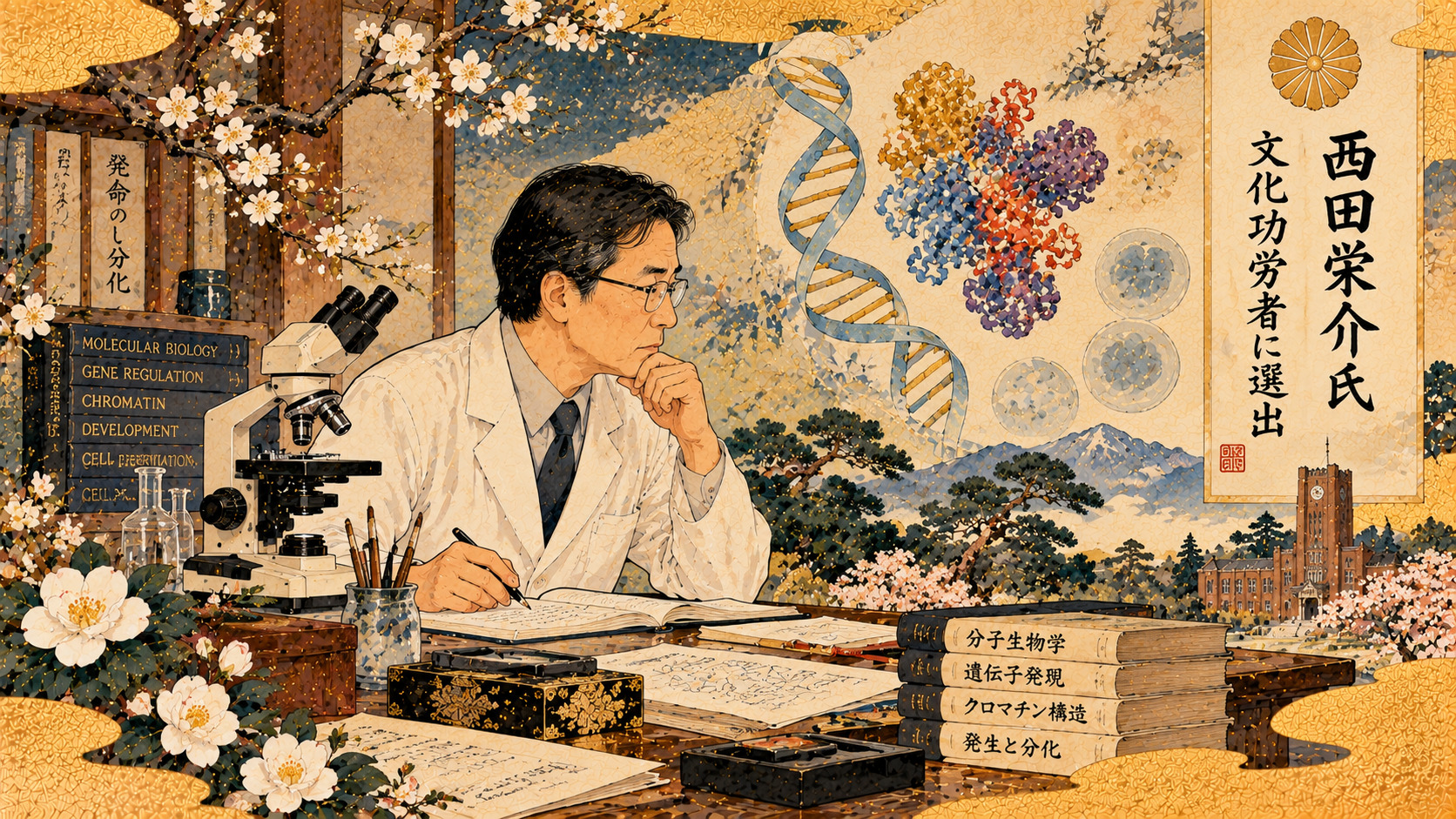
A national honor for a discovery inside every cell
Long before an experimental drug reaches a clinic, scientists must understand how a cell decides to grow, specialize or respond to danger. One of the foundations of that knowledge is a biochemical relay known as the MAP kinase cascade. Japan has now recognized a scientist central to its discovery: molecular biologist Eisuke Nishida, named a 2026 Person of Cultural Merit. RIKEN announced the recognition on October 27, and the formal ceremony is scheduled for November 4. This is recognition of a career of research, not the announcement of a new medicine.
Why a molecular biologist belongs in a cultural story
Japan's Person of Cultural Merit distinction reaches beyond painting, literature and performance. Established in 1951, it also honors scholarship that changes how society understands the world. Nishida's research gave biology a fundamental explanation for how an external signal can be relayed into a cell's interior and alter its behavior. That makes the honor an occasion to consider scientific knowledge as part of a nation's shared intellectual inheritance. It is not the same honor as the Order of Culture, which has a separate selection and presentation process.
The relay between the cell surface and the nucleus
Imagine a molecule outside a cell binding to a receptor on its surface. That encounter can start a sequence of chemical events, involving protein kinases that attach phosphate groups to other proteins. MAP kinases are among the crucial components of these networks. An upstream signal can activate a kinase, which in turn helps activate others, creating a cascade that can influence gene expression and cell behavior. The system is not a single universal switch: which proteins are present, the strength and duration of stimulation, and the identity of the cell all matter. The importance of this work is that it established a framework for testing those questions experimentally.
An unexpected route from the cell skeleton
Nishida studied biochemistry at the University of Tokyo, graduating in 1976 and completing his doctorate in 1981. In a substantial 2024 interview published by the Senri Life Science Foundation, he described pursuing kinase activity by using a microtubule-associated protein, MAP2, as an experimental substrate in work dating from the late 1980s. The approach helped open the way toward identifying a kinase involved in transmitting growth and differentiation signals. The similarity between MAP2's name and the expression MAP kinase can be confusing; they should not be treated as interchangeable molecular identities.
When biology began to see the circuitry
During the 1980s, researchers still lacked a clear molecular picture of how instructions could pass from membrane receptors to the nucleus. Nishida and colleagues helped establish the proteins and activation steps involved in this communication. Their work went beyond a biochemical identification. As the Japan Academy explained in its 2016 prize citation, they clarified activation mechanisms and roles in cellular proliferation, differentiation, oocyte maturation, embryonic development and lifespan regulation. This is why a kinase discovery could influence multiple areas of biology rather than remain a specialist result.
A bridge to cancer research—but not a cancer cure
Growth-control pathways are central to cancer biology because cells can become dangerous when proliferative signals are improperly regulated. MAP kinase pathways are now important across research on disease mechanisms and targeted therapies. RIKEN and Japan's medical research agency AMED credit Nishida's contributions with helping establish scientific foundations relevant to drug development. That is not the same as saying his 2026 award marks approval of a drug or that he alone invented a particular cancer treatment. Clinical therapies depend on many additional discoveries, trials and regulatory decisions.
From cellular growth to aging and inherited resilience
Nishida later explored questions that are harder to fit into a single molecular diagram: why organisms age at different rates, how tissues communicate, and how environmental conditions affect biology across generations. A RIKEN laboratory profile describes his group's use of the nematode C. elegans and small fish to investigate lifespan regulation by genetic and environmental factors. That profile also says the laboratory closed in March 2025, so it should not be read as a current laboratory roster. RIKEN's 2026 tribute specifically highlights his work on inter-tissue signaling and the inheritance of stress resistance.
The institutions that shaped the research
After beginning his academic career at the University of Tokyo, Nishida was appointed professor at Kyoto University's Institute for Virus Research in 1993. He subsequently held professorships in the Graduate School of Science and the Graduate School of Biostudies, serving as dean of the latter from 2005 to 2009. He became director of RIKEN's Center for Biosystems Dynamics Research in 2018. RIKEN's English executive biography lists an Executive Director of Science appointment in 2025; its October 27 Japanese announcement calls him a 領域総括. Rather than assume those job descriptions are exact translations of one title, this report follows each source's wording.
A decade of recognition
His contribution was already widely acknowledged before this week's news. Kyoto University lists the Medal with Purple Ribbon in 2010; the Japan Academy awarded him its 2016 prize for understanding MAP kinases and associated signaling; and the 2019 Fujihara Award cited the same broad field of achievement. Seen together, those honors trace the growing importance of molecular signaling research in Japan's scientific community. The Person of Cultural Merit designation gives that body of work a wider public frame.
The scientific value of a shared language
Discoveries in basic science are often most important not because they answer one question but because they allow researchers to ask better questions. A molecular pathway first investigated in specific cellular experiments can become a conceptual map for hundreds of subsequent studies. It also comes with limitations: MAP kinase signaling is context-dependent, and knowing one pathway does not mean researchers can predict every disease or intervention. Nishida's work is a reminder that advances in medicine require a durable body of knowledge before the clinical applications become visible.
An award before the ceremony, a career still being studied
RIKEN's statement of October 27 conveyed Nishida's gratitude to the people who supported his work and his intention to continue contributing. The formal commendation ceremony is set for November 4 in Tokyo; it has not yet occurred as of this edition. The enduring story is less a single moment of triumph than the long arc of asking how cells communicate—first through biochemical experiments, then through development and aging, and ultimately through a language that scientists around the world can use.
Sources and verification
Based on primary institutional records and Nishida’s published interview. No independent interview was conducted.
- RIKEN: October 27, 2026 recognition announcement (Japanese)
- Japan Academy: 2016 prize citation (Japanese)
- Kyoto University: biography and awards (Japanese)
- Senri Life Science Foundation: 2024 interview (Japanese)
- AMED: 2019 Fujihara Award announcement (Japanese)
- RIKEN: executive biography (English PDF)
- RIKEN BDR: former aging laboratory profile
- Agency for Cultural Affairs: cultural honors framework (Japanese)
- Cabinet Office: Order of Culture framework (Japanese)