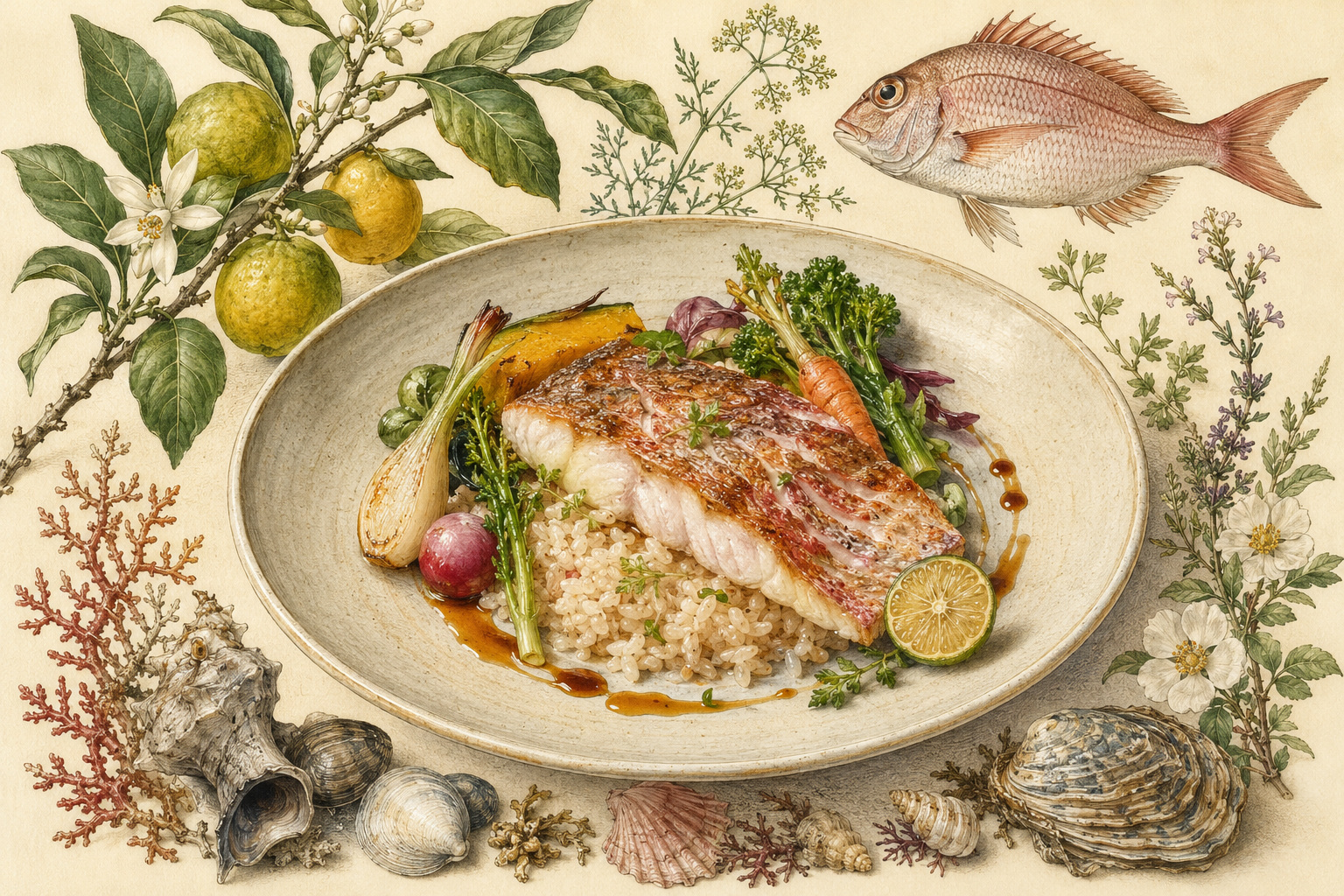
A REGIONAL dish is often defined by repetition. Ehime’s newest tai-meshi category is trying the opposite method. It fixes a few borders, then asks each kitchen to make something recognizably its own.
The prefecture’s current list, updated August 28, contains 21 participating restaurants in Saijō, Niihama and Shikokuchūō. Seven menus were announced the previous day: three in Saijō, two in Niihama and two in Shikokuchūō. The expansion takes the network beyond the 20-restaurant target in Ehime’s fiscal 2026 project plan.
The geography needs precision. Tōyo, the eastern region of Ehime, officially contains five municipalities: Imabari, Niihama, Saijō and Shikokuchūō cities, plus Kamijima Town. The 21 listed participants are located in only three of them. The project is a Tōyo brand, but it does not yet have a restaurant in every part of Tōyo.
The Category Regulates Boundaries, Not Sauce
The official definition has three parts. A restaurant must use red sea bream produced in Ehime and present the grilled fish in visible form rather than flaked. Farmed and wild fish are both permitted. The dish must include rice, but that can mean risotto or doria. Finally, the seasoning must be Western in character without suppressing the sea bream’s flavor.
Those conditions leave most of the culinary work open. The existing list includes burnt-butter soy, cream, coconut soup, green curry and mikan sauce. One kitchen serves the rice in a heated stone bowl; another makes a rice pizza. The brand’s consistency lies in ingredient and structure, not in a standardized flavor.
This creates a different bargain for the diner. There is no single plate against which every restaurant can be judged authentic. Instead, the promise is that each dish will remain legible as Ehime sea bream with rice while reflecting the kitchen that made it.
Government Is Building Coordination Around the Food
Ehime established the Tōyo Western-style Grilled Tai-meshi Promotion Council on May 25, 2026. Its members connect restaurants, the three participating cities and the prefectural administration. The published aims include recognition, visitor attraction, more participating restaurants, stronger restaurant networks and greater consumption of Ehime red sea bream.
The fiscal 2026 plan set a goal of 20 restaurants, up from ten in fiscal 2025. It also proposed a restaurant stamp rally, a multi-kitchen food competition, promotional material, training and stronger links among restaurants. Reaching 21 means the easiest numerical expansion target has already been met.
It does not establish that the food has become tradition. The public record reviewed for this article gives no consolidated sales volume, repeat-purchase rate, restaurant retention figure or measured tourism effect. Those outcomes will determine whether the category becomes self-sustaining after the promotional cycle.
Seven New Entrants Change Where the Dish Can Be Encountered
The additions are not seven versions of a tourist lunch. They include an izakaya, highway service-area counters, an overnight ferry restaurant, two reservation-only restaurants and a bar. That distribution makes the category available during a road journey, a sea crossing, a formal meal or a late evening.
| City | New restaurant | Menu listed by Ehime Prefecture |
|---|---|---|
| Saijō | Izakaya Enya | Tomato-and-egg red tai rice porridge |
| Saijō | Ishizuchiyama SA Gourmet Corner | Western-style grilled Setouchi red sea bream tai-meshi |
| Saijō | Orange Ferry onboard restaurant | Tōyo grilled tai-meshi |
| Niihama | European Restaurant Shinohara | Rolled tai-meshi |
| Niihama | Creative Teppan French Benkei | Benkei-style dish with a Hime no Rin and wild-rice croquette, plus Thai-style lemongrass bisque |
| Shikokuchūō | Amalfi | Red sea bream and porcini cream risotto |
| Shikokuchūō | Mishima Bar evoevo | Seared red sea bream Staub paella |
The prefectural list resolves the total as nine restaurants in Saijō, eight in Niihama and four in Shikokuchūō. Café Dining Tsujimaru and Sake Dining Tsujimaru share one menu heading but are separate daytime and evening venues, so each counts toward 21.
Seven Menus Test How Far the Rules Can Stretch
The new titles span tomato-egg rice porridge, a nori-wrapped preparation, porcini cream risotto and paella cooked in Staub cookware. Benkei pairs a croquette made with Ehime’s Hime no Rin rice and wild rice with a Thai-style lemongrass bisque.
At the Ishizuchiyama service area, operator Iyotetsu Shoji describes a plate of grilled Setouchi red sea bream with garlic butter and a special garlic-chive soy sauce, lemon and fried vegetables. It went on sale at 3 p.m. August 27 at counters serving both directions. The stated regular price is ¥1,750 including tax.
The Orange Ferry version is offered during evening restaurant hours. Shinohara and Benkei require reservations. Operational variety may be as important as recipe variety: a regional dish cannot build a market if diners cannot tell when it is available.
Raw, Cooked with Rice, Grilled: A Contemporary Map of Ehime
Ehime’s official tourism language now organizes tai-meshi into three memorable verbs. The “iki,” or fresh/raw, style associated with Nanyo in the south places sliced sea bream, sauce and condiments over rice. The “taki” style cooks a whole fish with rice and is associated with central Ehime, although it is also established in Imabari and other parts of Tōyo. The new “yaki” category makes grilled fish and Western-style preparation its distinction.
That last qualification matters. The slogan is tourism branding, not a rigid historical border. It would be inaccurate to suggest that eastern Ehime lacked tai-meshi until 2025. What it lacked, in the prefecture’s analysis, was a new shared dish positioned specifically as a visitor draw for eastern Tōyo.
The ingredient supply gives the project unusual scale. Ehime says it has ranked first in Japan for farmed red sea bream volume since 1990 and has produced more than half of the national total since 2006. The restaurant campaign is therefore not only cultural promotion; it is an attempt to create additional local demand around an established aquaculture industry.
A Staff Meal Became the Starting Point, Not the Franchise
Ehime’s tourism site traces the category to Marubun Komatsu Honten, a long-running Western-style restaurant in Saijō. A staff meal was reworked by the fifth-generation proprietor into Burnt Butter Soy Fifth-Generation Tai-meshi and later won the FNS Gotōchi Uma-dori Grand Prix television competition.
That success created an origin story, but not a requirement that other restaurants buy Marubun’s sauce or reproduce its plate. In August 2025, nine operators at ten restaurants began selling individual interpretations. The original dish became a proof of concept for a network rather than a franchise prototype.
The distinction protects both sides of the project. Marubun remains identifiable as the point of origin. Other cooks can participate without disguising their own styles, price points or dining formats.
A 21-Restaurant List Still Requires Planning
Availability is deliberately uneven. Some dishes are served only on weekends, some only on weekdays, and others only at lunch or dinner. Two of the new restaurants are reservation-only. Ehime’s current page advises diners to contact each restaurant before visiting.
| City | Count | Restaurants on the prefectural list |
|---|---|---|
| Saijō | 9 | Marubun Komatsu Honten; Albatross; Izakaya Enya; Ishizuchiyama SA Gourmet Corner; Ushiro no Shōmen Dāre; Orange Ferry onboard restaurant; Café Arles; Café Dining Tsujimaru; Sake Dining Tsujimaru |
| Niihama | 8 | European Restaurant Shinohara; Auberge Yuragi; Gasuya no Gohan; Creative Teppan French Benkei; Rihga Royal Hotel Niihama, Japanese Restaurant Yūgiri; Restaurant Adam & Eve; Restaurant Mori no Kaze; Wakamiya Shokudō |
| Shikokuchūō | 4 | Amalfi; Mishima Bar evoevo; Riisa café; Restaurant & café Riina |
- Use the prefecture’s current list to check serving days, hours, closures and reservation requirements.
- Confirm prices and quantity limits directly; there is no standard price for the category.
- Do not assume every Tōyo municipality has a participating restaurant.
- The lead image is illustrative and does not show a dish that can be ordered.
Twenty-one is evidence that restaurants will try the framework. The harder test begins after expansion: whether kitchens keep the dish, residents order it without a campaign prompt, and visitors discover reasons to compare one restaurant with another. A future folk dish will be built by repeat orders, not by a launch count alone.
AUGUST 2025 Nine operators launch individual dishes at ten restaurants.
MAY 25, 2026 The promotion council is established.
AUGUST 27, 2026 Seven restaurants present new menus.
AUGUST 28, 2026 Ehime updates the official network to 21 restaurants.
- Ehime Prefecture, Tōyo Regional Office — official list of 21 restaurants, seven additions, menus and hours
- Ehime Prefecture — Tōyo Western-style Grilled Tai-meshi Promotion Council and official category definition
- Ehime Prefecture — fiscal 2026 promotion budget, targets and programme plan
- Ehime Prefecture — official Tōyo, Chūyo and Nanyo boundaries and readings
- Official Ehime tourism site — origin and guide to the new category
- Ehime Prefecture — red sea bream production and aquaculture; Iyotetsu Shoji — Ishizuchiyama service-area launch
This English edition was written independently from Japanese prefectural, tourism and operator records available through August 29, 2026. Official Japanese names, menu titles, category rules, dates and regional boundaries were checked in Japanese. Hours and prices are treated as changeable, restaurant-level information. This is policy and food-culture reporting, not a restaurant review or account based on tasting the dishes.