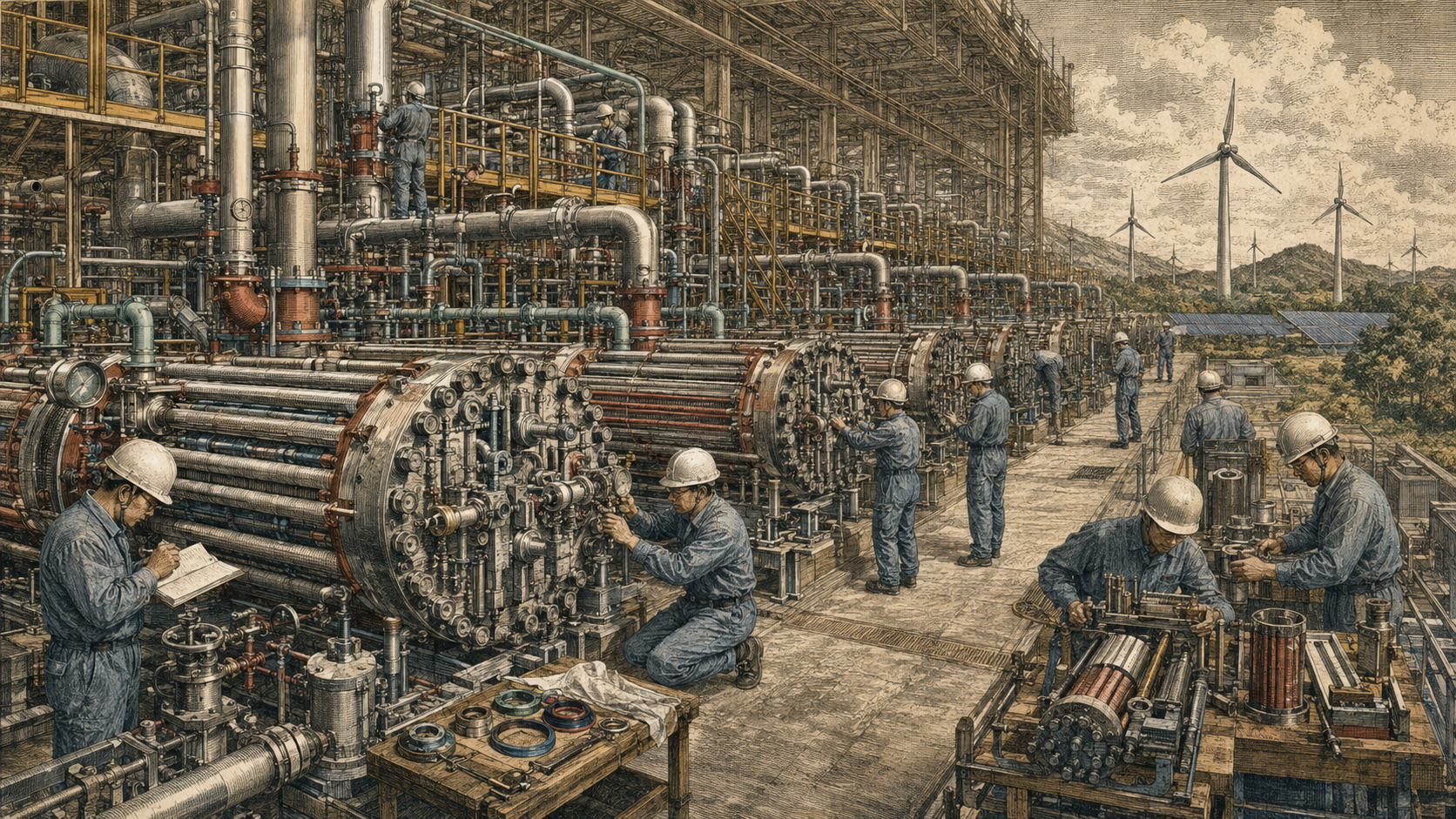
At 11:36 p.m. on March 16, 2022, a magnitude 7.4 earthquake struck off Fukushima Prefecture. Japan's seismic intensity reached upper 6. In Namie's Tanashio district, a line of 170 large electrolyzer cells held potassium-hydroxide electrolyte, hydrogen and oxygen. FH2R's control system detected the quake and shut the equipment down as programmed. According to Asahi Kasei's technical paper, there was no significant damage or leakage.
The plant had done the same during the magnitude 7.3 earthquake of February 2021. “Nothing broke” in two major earthquakes is not the sort of hydrogen production record that fills a launch-day press release. But industrial reliability is defined by what happens on the abnormal night. The control of the moments when an electrolyzer is not making hydrogen can matter as much to safety and lifetime as the hours when it is.
In March 2026, the Electrochemical Society of Japan awarded six Asahi Kasei engineers its Technology Award, the Tanahashi Prize. Their citation was the development and long-term demonstration of a 10 MW-class large alkaline water electrolyzer. A prize established in 1952 recognized more than a one-time size record. It recognized the work of making design, construction, commissioning, variable operation and maintenance function as one technology.
“Operated for a long time” is not “operated all the time”
FH2R opened on March 7, 2020. NEDO described it at the time as a 10 MW-class system rated to make 1,200 normal cubic meters of hydrogen an hour. A 2025 peer-reviewed paper by Asahi Kasei engineers gives a more detailed envelope: maximum AC input of 12 MW; variable production of 300 to 2,000 Nm³/h; internal pressure of about 70 kPa gauge; outlet hydrogen above 0.8 MPa gauge; and purity above 99.97% by volume. The hydrogen meets ISO 14687:2019 Type I, Grade D, the specification used for proton-exchange-membrane fuel-cell road vehicles.
The paper says cumulative operation had exceeded 13,000 hours. That equals about 1.48 years of continuous time, but it does not establish “roughly 25% availability over six years.” The disclosed number lacks the accounting boundary needed for that calculation: standby, planned demonstration outages, hydrogen demand, solar constraints and time at partial load are not separated. Capacity factor, utilization and failure rate are different measures.
Nor is 13,000 hours the end of a commercial lifetime. The U.S. Department of Energy's 2026 technical target for liquid alkaline electrolysis is 80,000 hours, with end of life defined as 10% voltage degradation at the same current density. FH2R's public record does not give a voltage-degradation curve or extrapolation to 80,000 hours. Six years are important intermediate evidence, not a simulation of an entire two-decade asset life.
A 200-year-old reaction, a century of Japanese industry
William Nicholson and Anthony Carlisle used Alessandro Volta's new battery to split water into hydrogen and oxygen in 1800. Alkaline electrolysis progressed toward industrial use in the late nineteenth century, and numerous installations were operating by the early twentieth. That old chemistry has advantages: nickel-based materials and alkaline electrolyte can limit dependence on scarce platinum-group metals, and the cells can be made with large active areas.
Asahi Kasei traces its own line to 1923. At Nobeoka in Miyazaki Prefecture, a predecessor used hydroelectricity to split water and make the hydrogen feedstock for Japan's first synthetic ammonia. In 1975, the company commercialized an ion-exchange-membrane chlor-alkali system, supplying large electrolytic plants that make chlorine, caustic soda and hydrogen from brine. Decades of dealing with membranes, electrodes, cells, corrosion, seals and maintenance became part of Aqualyzer's inheritance.
There is, however, a decisive difference between chlor-alkali production and an electrolyzer tied to renewables. A chemical plant tries to keep its chlor-alkali cells at steady, continuous output. A renewable-hydrogen plant ramps, stops and restarts. When Asahi Kasei began dedicated alkaline-water-electrolyzer development in 2010, the task was not merely to split water. It was to teach an old industrial technology a new work schedule.
A medium-size demonstration followed in 2013. From 2014, a roughly 130 kW system in Yokohama—four full-size 2.7 m² cells—accumulated 12,000 hours in long-duration testing. It was moved to Soma, Fukushima Prefecture, in 2018 and tested against variable solar power through 2023. FH2R then represented a jump from the order of 100 kW to 10 MW, almost two orders of magnitude.
Lesson one: a shutdown is not a rest—it is a corrosion event
During electrolysis, current flows in the intended direction and produces hydrogen and oxygen. Once the power is cut, electrical potential differences across a series stack and its shared manifolds can drive reverse current. Electrodes remain in a corrosive potential range. Repeated stops can damage catalysts and components, raising the voltage needed to make the same quantity of hydrogen. In a solar-linked machine that may stop each night, shutdown itself becomes a lifetime test.
Asahi Kasei developed a method that connects an external load during shutdown and deliberately accelerates discharge. It shortens the time at corrosion potential, distributes reverse current more evenly between cells and reduces localized deterioration in frames and header pipes. In comparative tests reported in the 2025 paper, the method suppressed the loss of electrolysis efficiency and approximately doubled life relative to the untreated condition.
The wording matters. The company has not disclosed that “FH2R's electrodes lasted twice as long in service.” The approximate doubling is a controlled comparison of the degradation-control technique, not FH2R's actual fleetwide replacement record. Even so, the result turns an abstract durability problem into something concrete: lifetime under renewable power can be determined as much by the electrical circuit used to stop a stack as by the catalyst's initial performance.
Lesson two: to follow clouds, predict the pressure
Raise the electrical input and the production of hydrogen and oxygen rises quickly. A giant stack, gas-liquid separators, piping and thermal mass respond more slowly. A conventional PID controller moves a valve after pressure has changed, which can lag a steep power ramp. Pressure peaks load the membrane and seals; a poorly controlled differential pressure can also increase the danger of gas crossover.
Aqualyzer combines feed-forward control—which calculates the expected gas generation from input current—with variable PID control tuned to operating conditions. In Asahi Kasei tests, the combination reduced the pressure-rise peak by about 40% compared with conventional feedback control. FH2R is designed to move from minimum to maximum output in no more than 20 seconds, at as much as 500 kW per second. Its published 300-to-2,000 Nm³/h range is a turndown ratio of about 6.7 to one.
Low load creates another problem. Small amounts of hydrogen and oxygen cross the membrane or dissolve in the electrolyte. When product-gas flow is low, those impurities occupy a larger share of it. Slower electrolyte circulation can reduce crossover, but high load needs ample circulation to carry away Joule heat. Asahi Kasei varies electrolyte flow automatically with current density, reconciling high-load temperature control with low-load purity.
| Reliability problem | Why it occurs | Aqualyzer response |
|---|---|---|
| Electrode corrosion at shutdown | Reverse current flows within the series stack | An external load accelerates discharge and shortens time at corrosion potential |
| Pressure peaks during rapid ramps | Gas generation moves before valve feedback catches up | Current-based feed-forward control plus variable PID |
| Gas purity at low load | Crossed-over and dissolved gas become a larger proportion of output | Electrolyte circulation changes automatically with current density |
| Gasket deformation or leaks | Stack pressure changes, making clamping force excessive or insufficient | Hydraulic clamping follows internal pressure dynamically |
| Human delay in an emergency | Hydrogen, electrolyte, fire, outage and earthquake risks can overlap | DCS operating modes and automatic unmanned safe shutdown |
Lesson three: a giant cell is a structure that “breathes”
Each FH2R cell has 2.7 square meters of electrode area. There are 170 in series, held together by a hydraulic press. Gas and liquid move along both sides of a membrane while temperature and pressure change. The zero-gap arrangement reduces electrical resistance, but the membrane must be pressed evenly and protected from friction damage. Asahi Kasei uses an elastic metal mattress to distribute the contact pressure.
The gaskets that contain the process also have a correct range of compression. Too much can deform them; too little can release hydrogen, oxygen or electrolyte. An operator can adjust a steady chlor-alkali electrolyzer manually, but the internal pressure of a renewable electrolyzer changes as it starts and stops. Aqualyzer changes the hydraulic clamping force automatically with internal pressure. The stack expands and contracts with generation, and the structure follows it.
Operators' actions are standardized as well. A distributed control system offers modes including Normal Operation, Cold Standby and Hot Standby, then executes the proper sequence of valves and auxiliaries. Hydrogen or electrolyte leakage, loss of power, earthquake and fire trigger safe shutdown without waiting for a person to decide. The two earthquakes off Fukushima tested that design philosophy in the field.
Lesson four: when maintenance windows are scarce, data become the eyes
With a first-of-its-kind 10 MW-class machine, engineers naturally want to open, inspect and measure it often. Asahi Kasei's Yousuke Uchino has recalled expecting extensive “debugging” because the scale was nearly one hundred times that of the preceding demonstration. But FH2R had multiple stakeholders and customers for its hydrogen. It could not be stopped whenever the development team wished, and maintenance windows were short.
The team therefore applied a digital twin and big-data analysis to predictive maintenance. Temperature, pressure, flow and voltage behavior could be compared with a model to find precursors before they became failures. Asahi Kasei says this work predicted potential problems and contributed to stable operation. It has not disclosed prediction accuracy, false-alarm rates or failures avoided. But the experience informed a broader offering: remote monitoring, data management and long-term maintenance alongside hardware.
That changes an electrolyzer maker's business model. A customer needs more than delivery of cells. It needs to know how to operate an asset for something approaching two decades under variable power and demand, when to replace components and how to keep outages short. The operating data accumulated at FH2R can become a service asset that helps Asahi Kasei compete on something other than the lowest hardware price.
Lesson five: one giant stack and a 100 MW plant are different problems
FH2R is one large stack of 170 cells connected in series. For a 100 MW-class plant, Asahi Kasei does not propose an even larger single stack; it proposes coupling as many as ten 10 MW modules. Parallel modules introduce a different set of questions. How many should be shut at low overnight load? How should the others run during maintenance or a module fault? Which balance-of-plant equipment should be shared? How can uneven degradation be managed?
That is why a four-module test facility began operating at Asahi Kasei's Kawasaki Works in March 2024. The company's announcement describes four 0.8 MW modules using cells and membranes of the same commercial scale as FH2R. The facility simulates variable solar and wind power, repeated starts and stops, low nighttime output and continued operation of remaining modules during maintenance. After Namie showed that one stack could be made large, Kawasaki asks whether many can be orchestrated intelligently.
The 2025 technical paper calls the Kawasaki units 0.75 MW each, while the company's 2024 announcement says 0.8 MW. This may reflect rounding or different operating definitions, but the public record does not explain it. We use the company's nameplate description here and preserve the discrepancy. Small inconsistencies are not the center of this story, but they should not disappear from a story about evidence.
1800 Nicholson and Carlisle split water into hydrogen and oxygen with a Volta battery.
1923 An Asahi Kasei predecessor turns hydroelectricity into electrolytic hydrogen for ammonia at Nobeoka.
1975 The company commercializes its ion-exchange-membrane chlor-alkali process.
2010 Dedicated alkaline-water-electrolyzer development begins.
2014–2018 A roughly 130 kW Yokohama unit accumulates 12,000 test hours.
2018 The smaller unit moves to Soma for testing with variable solar power.
March 2020 FH2R's 10 MW-class single stack begins supplying hydrogen.
2021 and 2022 Automatic shutdowns during magnitude-7-class earthquakes; no significant damage or leakage reported in the paper.
March 2024 Kawasaki's four-module test facility starts operating.
November 2025 More than 13,000 hours and the core technologies are reported in a peer-reviewed paper.
March 2026 Six Asahi Kasei engineers receive the Electrochemical Society of Japan's Tanahashi Prize.
After six years, what remains unknown?
Asahi Kasei's paper is unusually specific for this industry. It gives operating range, response speed, pressure, purity, cell count and earthquake behavior. Many of the numbers a customer or investor would require for a final decision, however, remain outside the public record.
- Public: More than 13,000 cumulative operating hours and continued operation.
- Public: A 300–2,000 Nm³/h range, 20-second transition and maximum 500 kW/s ramp.
- Public: Outlet purity above 99.97% by volume and compliance with the relevant vehicle-fuel ISO grade.
- Public: Automatic shutdown in the 2021 and 2022 earthquakes, with no significant damage or leakage reported.
- Not public: Annual operating hours, availability, capacity factor and total starts and stops.
- Not public: Stack-voltage history, efficiency-degradation rate and replacements of cells, membranes or electrodes.
- Not public: Maintenance expense, downtime, measured kWh/kg and total cost per kilogram of hydrogen.
- Not yet demonstrated here: An 80,000-hour-class commercial life or long-duration operation of a 100 MW multimodule plant.
Those blanks do not demonstrate failure. Confidentiality, NEDO's accounting rules and the fact that operation continues are all possible explanations. They do mean that the broad phrase “long-term stable operation” cannot be silently translated into 99% availability or zero degradation. A commercial warranty ultimately has to specify mean time between failures, scheduled outages, performance guarantees and replacement expense.
FH2R's value is also larger than its electrolyzer. The site coordinates a 20 MW solar array, grid electricity, hydrogen compression and loading, and demand. A reliable stack still makes costly hydrogen if cheap electricity and continuous customers are missing. The International Energy Agency's 2026 review found that the pipeline of low-emissions hydrogen projects had shrunk through delays and cancellations, with demand and regulation continuing to impede deployment.
After “we can make it” comes “we can keep using it”
FH2R hydrogen has supplied fuel-cell cars and buses, stationary fuel cells, boilers and research sites. In January 2026, the adjacent green-ammonia demonstration began production, giving the electrolyzer a new continuing outlet. Reliability at the hydrogen plant is becoming a feedstock obligation to a downstream chemical plant.
That year, NEDO commissioned Mitsubishi Research Institute to examine a medium- and long-term hydrogen vision centered on FH2R. Its task covers future R&D and Fukushima's hydrogen supply chain from both demand and supply. Six years of operation did not automatically determine the site's next purpose. That is not a defeat for the technology. It is the question that appears when a demonstration seeks to become regional infrastructure.
For Asahi Kasei, lessons from Namie are flowing to Kawasaki, a 1 MW containerized system in Finland and the planned architecture of 100 MW-class projects. But electrolyzers are entering severe global price competition, with Chinese manufacturers leading in scale. A Japanese supplier will not prevail solely because its initial efficiency is a few points higher. It will prevail if it can prove that, after thousands of stops over two decades, a machine returns safely, parts and service remain available, and promised hydrogen output is delivered.
Fukushima's definition of reliability
No single number can contain FH2R's six calendar years. Thirteen thousand hours show depth of experience but not a completed commercial lifetime. A 20-second response proves agility but not economy. Safe shutdown in two earthquakes is powerful evidence, but it cannot prove behavior in every disaster.
The lesson from Namie is nevertheless clear. An electrolyzer for the renewable era is an electrochemical reactor and a pressure vessel that stretches every day; an electrical circuit that can corrode itself while stopped; a fluid machine that protects purity; a safety system that judges an earthquake; and a maintenance service that reads failure from data. Reliability is all of those functions working together.
In a laboratory, bubbles of hydrogen can look like success. In commerce, success is seeing the same quality of bubbles ten years later, on a rainy day, during a thinly staffed night shift and after the ground has stopped shaking. FH2R remains partway through that long test. What Japan has learned in six years is that the reaction that makes hydrogen is easier than the system that keeps making it—and that the latter is where much of the value resides.
Reporting notes and principal sources
This article uses public information checked through August 10, 2026, 9:00 a.m. JST. Converting 13,000 hours to about 541 days and 1.48 years, and 300–2,000 Nm³/h to a turndown ratio of about 6.7:1, are simple calculations. Because the accounting boundary for operating hours is not public, we do not convert it into capacity factor or availability. The approximate doubling of life and 40% reduction in the pressure peak are technology-comparison results from Asahi Kasei's paper, not reported full-plant lifetime or annual performance at FH2R.
- Electrochemistry: Development and Demonstration of Large-scale Alkaline Water Electrolysis System “Aqualyzer”
- Asahi Kasei: Long-term 10 MW-class demonstration receives the 2026 Tanahashi Prize
- Electrochemical Society of Japan: Tanahashi Prize recipients and citation
- Asahi Kasei: FH2R development, digital twin and predictive maintenance
- Asahi Kasei Japanese history: hydrogen and electrolysis since 1923
- NEDO: FH2R completion, 20 MW solar, 10 MW-class electrolysis and 1,200 Nm³/h rating
- Asahi Kasei: FH2R begins hydrogen-supply operation in 2020
- Asahi Kasei: Purpose of the Kawasaki multimodule test facility
- Asahi Kasei: Kawasaki facility with four 0.8 MW modules begins operating
- Asahi Kasei: Production begins of green ammonia using FH2R hydrogen
- Japan Meteorological Agency: February 13, 2021 Fukushima earthquake, M7.3 and upper 6 intensity
- Japan Meteorological Agency: March 16, 2022 Fukushima earthquake, M7.4 and upper 6 intensity
- U.S. Department of Energy: Efficiency, degradation and 80,000-hour targets for liquid alkaline electrolysis
- NEDO: Mitsubishi Research Institute selected for FH2R medium- and long-term hydrogen vision
- IEA, Global Hydrogen Review 2026: Production pipeline, delays and demand barriers
- ACS Catalysis: The history of water electrolysis and oxygen evolution