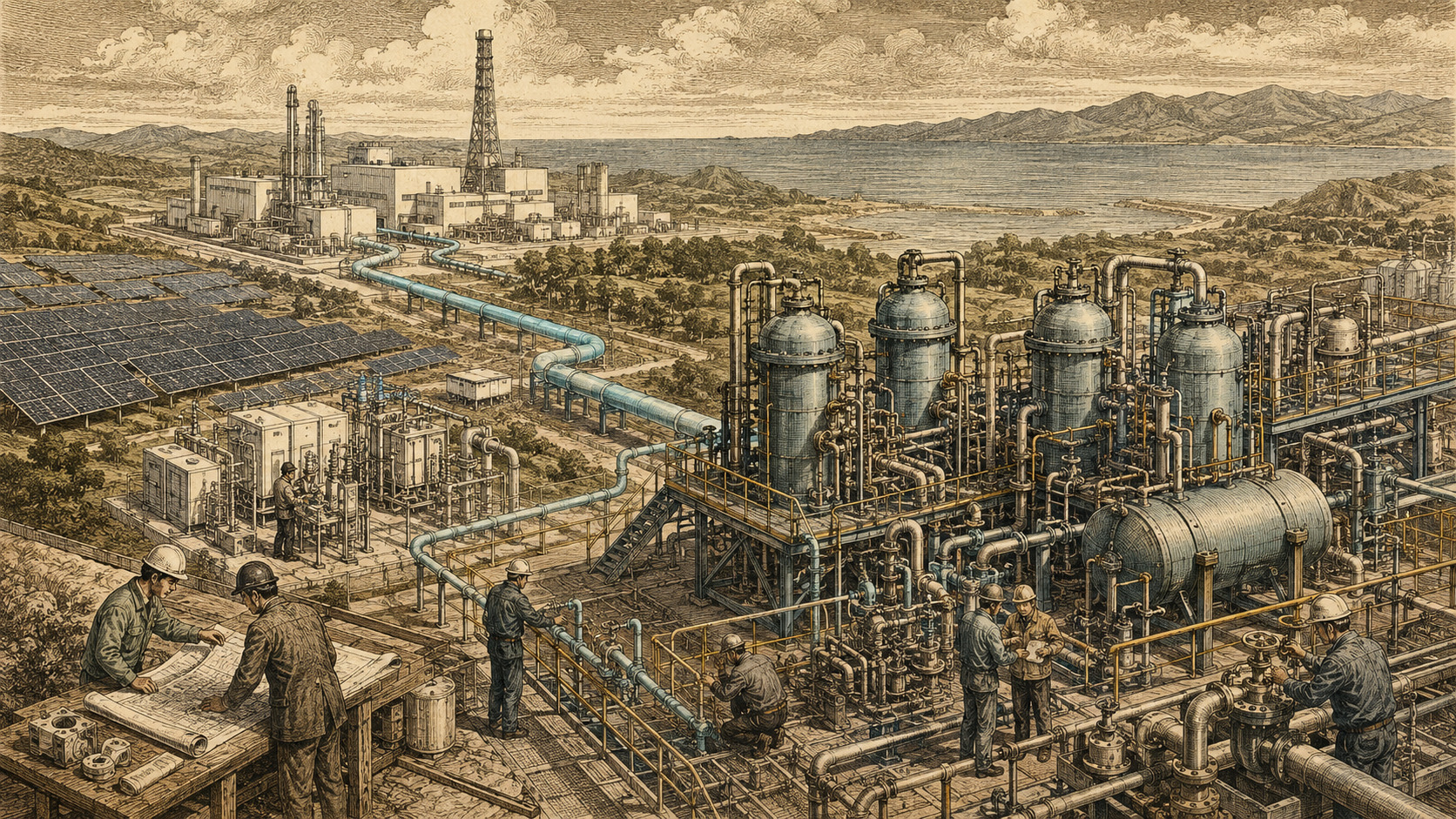
In January, Fukushima's hydrogen acquired another name. Hydrogen arriving from the neighboring Fukushima Hydrogen Energy Research Field, or FH2R, met nitrogen separated from the air inside NAMICS and emerged as NH₃—ammonia. The project moved from demonstrating that renewable hydrogen could be made to demonstrating that it could become an industrial product. A short physical connection closed a much longer policy gap.
The difficult part of a hydrogen economy is not only running an electrolyzer. Someone must buy its output every day. Hydrogen gas has low volumetric density, and compression, liquefaction and transport consume equipment, money and energy. Ammonia already has fertilizer and chemical markets and can be liquefied at a far milder temperature than hydrogen. Changing the molecule can move hydrogen from “the output of a demonstration” toward a commodity that can be stored, transported and sold.
The achievement still needs proportion. Four tonnes a day is a demonstration, not a world-scale ammonia works. Ammonia is not a harmless box for hydrogen; it is toxic and corrosive. And this product is not being burned as a zero-carbon fuel. It is being used to reduce nitrogen oxides in the flue gas of thermal power stations. Fukushima hydrogen has gained a useful destination. The power plants themselves have not thereby been decarbonized.
The pipe that changed what Fukushima hydrogen means
FH2R opened in 2020 as a Power-to-Gas demonstration: use renewable electricity to make hydrogen at large scale while helping balance power supply and demand. Its 180,000-square-meter site combines 20 MW of solar generation with a 10 MW-class electrolyzer and equipment to produce, store and supply as much as 1,200 normal cubic meters of hydrogen an hour at rated operation. A central research question was whether the electrolyzer could follow renewable and grid conditions without relying on batteries to absorb every fluctuation.
Hydrogen from the site went to fuel cells at facilities in Fukushima Prefecture, including J-Village, Azuma Sports Park and Roadside Station Namie. A heavy-duty vehicle refueling research center followed in 2022. These uses mattered, but many were discrete demonstrations rather than a single industrial customer capable of absorbing the output of a 10 MW-class plant over years. When Saudi Arabia's ambassador visited FH2R in 2025, NEDO recorded questions about hydrogen cost and large-scale demand. The problem had moved from equipment performance toward market design.
NAMICS answers through industrial chemistry. JGC and Asahi Kasei convert hydrogen into an established product and place an offtaker nearby. Instead of first moving hydrogen over a long distance, the project brings demand beside the hydrogen source. It makes a small industrial cluster out of the supply-and-demand integration NEDO has described as necessary for commercialization.
From water and air to ammonia
The inputs can be written in three simple words: electricity, water and air. Each must be transformed into industrial-quality feed. FH2R's alkaline electrolyzer splits water into hydrogen and oxygen. On the ammonia side, nitrogen is separated from air and blended with hydrogen. The synthesis reaction is N₂ + 3H₂ → 2NH₃. A catalyst, heat and pressure drive the reaction; unreacted gases circulate, and the ammonia is cooled and separated.
Stoichiometry says that 17 kilograms of ammonia contain three kilograms of hydrogen and 14 kilograms of nitrogen. Four tonnes of ammonia therefore require theoretically about 706 kilograms of hydrogen and 3.29 tonnes of nitrogen. Expressed as hydrogen volume at normal conditions, that is roughly 330 Nm³ an hour. Against FH2R's rated 1,200 Nm³/h, it would be about 27% if both plants ran continuously at nameplate capacity and losses were ignored. That comparison is arithmetic from public capacities, not an operating result.
| Stage | Principal role | Decarbonization question |
|---|---|---|
| Renewable and grid power | Supplies the electrolyzer and auxiliaries | Timing, additionality and actual carbon intensity |
| FH2R electrolysis | Splits water into H₂ and O₂ | Load-following, efficiency, availability and compression |
| Nitrogen separation | Extracts N₂ from air | Power consumed in separation and compression |
| NAMICS synthesis | Combines N₂ and H₂ into NH₃ | Heat, pressure, recycle and variable feed |
| Resonac and power stations | Sells, moves and uses ammonia for DeNOx | Leaks, safety and actual displacement of conventional product |
Ammonia's attraction as a carrier begins with its formula: hydrogen accounts for 17.6% of its mass. At atmospheric pressure it liquefies around minus 33°C. Liquid hydrogen must be held below minus 253°C. The temperature requirement for ammonia is far less extreme, and the world already has tanks, ships, pipelines and handling knowledge built for fertilizer and chemical commerce.
“Easier to move” does not mean easy. Ammonia can injure eyes, skin and lungs and can corrode unsuitable materials, particularly in the presence of moisture. Recovering hydrogen from it requires cracking equipment and more energy. Burning it releases no carbon dioxide at the point of combustion but can create NOx, nitrous oxide and ammonia slip unless carefully controlled. Its usefulness rests on engineered containment, detection, training and emergency response.
A 1913 invention meets twenty-first-century variable power
The chemistry is not new. Fritz Haber established how nitrogen and hydrogen could be synthesized into ammonia in the laboratory and received the 1918 Nobel Prize in Chemistry. Carl Bosch developed the steels and high-pressure equipment that made the reaction industrial. In 1913, BASF put the first commercial-scale synthesis plant into operation at Oppau. The Haber–Bosch process transformed agriculture and still underpins the food supply of billions.
Japan added its own early chapter. In 1923, a predecessor of Asahi Kasei used hydroelectricity at Nobeoka in Miyazaki Prefecture to electrolyze water and begin Japan's first synthetic-ammonia production. In modern language, the combination resembled renewable hydrogen feeding green ammonia. A century later, a large alkaline electrolyzer operated by the same corporate lineage is again sending renewable hydrogen into ammonia. The history appears to have closed a circle.
Industry took a different route for most of the intervening century. Very large plants made cheap hydrogen through natural-gas steam reforming or coal gasification. The International Energy Agency says just over 70% of ammonia production now relies on natural gas and most of the rest on coal. The industry produces about 450 million tonnes of direct carbon-dioxide emissions annually, averaging roughly 2.4 tonnes of CO₂ for every tonne of ammonia. It consumes around 2% of global final energy.
Namie is therefore not inventing the reaction. It is replacing the fossil-derived hydrogen at the front of the process with electrolysis—and learning how a twentieth-century continuous chemical plant can live with twenty-first-century power that changes with the weather.
This demonstration means something different because it is in Fukushima
Energy projects in Namie cannot use 2011 as decorative background. The Great East Japan Earthquake, tsunami and Fukushima Daiichi accident forced the evacuation of all of the town's approximately 21,000 residents. Evacuation orders for central areas were not lifted until 2017. Return, rebuilding, decontamination and decommissioning continue on different clocks. A new industrial plant does not compensate for lost homes and lives.
That is precisely why Namie's attempt to become a place that creates energy knowledge and industry, rather than merely receiving the consequences of energy policy, carries weight. Construction of FH2R began in the Tanashio area in 2018 and the site opened in March 2020. It supplied local facilities, supported research and became one node in the Fukushima Innovation Coast Framework.
NAMICS occupies about 9,000 square meters in the same Tanashio Industrial Area. Namie's mayor, METI, NEDO and JGC representatives attended its October 2023 groundbreaking. At that point JGC expected startup within fiscal 2024. Construction instead finished in November 2025 and production followed in January 2026 after commissioning. The roughly one-year shift is a reminder that moving a chemical project from announcement to operation takes real time.
The real invention is integrated control
An ammonia synthesis loop prefers a steady flow at controlled temperature and pressure. Solar-derived hydrogen varies by hour and weather. If every fall in hydrogen supply stops the high-temperature, high-pressure loop, efficiency, catalyst life, product quality and plant utilization suffer. If the project instead stores enough hydrogen to hide every fluctuation, tanks and compressors become expensive.
The integrated control system being developed by JGC and Asahi Kasei sits at that boundary. It coordinates the amount of hydrogen supplied from FH2R with operation of the ammonia plant, seeking stable and efficient chemical production from variable feedstock. The companies have not disclosed the control logic, buffer size or full operating range. It would therefore be premature to say the variability problem is solved. The purpose of operating through fiscal 2026 is to collect the evidence.
The IEA notes that electrolysis-based ammonia has previously been produced at industrial scale with high-load-factor electricity such as hydropower, while directly coupling ammonia plants to hydrogen from variable solar and wind remains challenging. If NAMICS creates an exportable result, it may be less a single reactor than an operating method that turns electrolyzers, storage, the synthesis loop and customer demand into one schedule.
1913 BASF starts the world's first industrial-scale Haber–Bosch ammonia plant.
1923 Asahi Kasei's predecessor makes Japan's first synthetic ammonia with hydroelectric hydrogen at Nobeoka.
March 2011 Earthquake, tsunami and nuclear accident force the evacuation of Namie's residents.
March 2017 Evacuation orders are lifted in central Namie and other designated areas.
2018 Construction of FH2R begins in the Tanashio area.
March 2020 FH2R opens with 20 MW of solar and 10 MW-class electrolysis.
August 2021 NEDO selects the Asahi Kasei–JGC Power-to-X program for Green Innovation Fund support.
October 2023 Ground is broken for the 4-tonne-a-day NAMICS plant.
November 2025 Construction finishes and commissioning follows.
January 2026 Green-ammonia production begins; demonstration operation is planned through FY2026.
The first customer is cleaning smoke, not burning ammonia
Resonac will channel NAMICS ammonia to nearby thermal power stations for flue-gas denitration. In systems such as selective catalytic reduction, ammonia reacts with nitrogen oxides so that the principal products are nitrogen and water. Power stations already buy ammonia for air-pollution control. NAMICS can replace a portion of that established demand with product made from renewable hydrogen.
It is a modest but intelligent first market. No new ammonia turbine or boiler must be completed before the product has a customer. Quality requirements, handling practices and purchasing budgets already exist. Although DeNOx requires much less ammonia than power generation would consume as fuel, it gives the demonstration real deliveries, contracts, logistics and safety management. The product leaves the research boundary and enters a customer's process.
The environmental effects must not be blurred. Denitration lowers NOx; it does not remove the carbon dioxide released by burning coal or gas. Replacing fossil-derived ammonia can reduce upstream emissions associated with the reagent that is displaced. It does not change the station's main fuel. Calling this an ammonia-power demonstration would be wrong.
- Under test: making ammonia from renewable hydrogen supplied by FH2R.
- Under test: integrated control of variable hydrogen and chemical-plant operation.
- Under test: moving product through Resonac into an existing DeNOx market.
- Not disclosed: annual availability, cumulative output, production cost and capital cost.
- Not disclosed: measured product carbon intensity including power, nitrogen separation, compression and delivery.
- Not this use: ammonia co-firing or exclusive firing at the thermal power stations.
Four tonnes a day: small enough to learn
If the plant ran at nameplate capacity for 365 days, annual production would be about 1,460 tonnes. A demonstration plant stops for tests, altered conditions and maintenance, so actual production will not equal that multiplication. JGC has published neither an availability target nor an annual tonnage. The purpose of the scale is data on controls, quality, safety, catalysts, maintenance and demand integration—not market share.
It is minute beside the existing ammonia industry. IRENA describes ammonia as the second-largest basic chemical by mass after sulfuric acid, with roughly three-quarters to four-fifths of output ultimately used for fertilizer. New markets are proposed for ammonia as a hydrogen carrier, marine fuel and power fuel, but renewable ammonia has not yet entered those energy uses at significant scale. NAMICS is not a miniature version of the future global market. It is a learning machine before commercial scale.
Smallness has advantages. The project does not commit all FH2R output to one customer. Operators can change conditions, limit the consequences of faults and test a nearby market and delivery route. Before moving toward 100 MW, they can learn how much buffer is needed, where efficiency falls and how shutdowns affect catalyst and product.
“Green” is an accounting system, not the color of the reactor
An ammonia molecule carries no visible production history. Whether it is green depends on how electricity for hydrogen, nitrogen separation, compression, heat, cooling, storage and transport was supplied. FH2R combines 20 MW of solar with grid power and was designed to operate around renewable variability. JGC and Asahi Kasei call NAMICS output green ammonia, but public material does not give life-cycle emissions per tonne or a certification methodology.
A full assessment therefore needs at least four numbers: electricity per kilogram of hydrogen, total energy per tonne of ammonia, annual plant utilization and tonnes of conventional product actually displaced. It also matters whether renewable generation was newly added or diverted from another user, and what the grid's emissions were during hours when it supplied the system.
Electricity also dominates cost. Electrolyzers, nitrogen separation, compressors and a synthesis loop operated at a low load factor impose more capital cost on every tonne. The IEA estimates that emerging near-zero-emission routes such as electrolysis and carbon capture can cost 10% to 100% more than conventional ammonia, depending on regional energy prices. A process that works and a customer that chooses it without support are different milestones.
What comes after Fukushima
JGC says knowledge from NAMICS will be applied to another large pilot green-chemical plant planned by Asahi Kasei for fiscal 2027 and beyond. The partners' 2021 program set a longer ambition: demonstrate alkaline electrolysis up to 100 MW and combine it with chemical production. NAMICS is not the final plant. It is the prototype for the control room.
The next stage will depend as much on contracts as chemistry. Who buys variable hydrogen, at what price? Who carries the cost of a plant stop? How is the green attribute certified? Who pays the premium over conventional ammonia? Moving from local DeNOx demand toward fertilizer, chemicals, marine fuel or power would greatly enlarge the market, but it would also enlarge requirements for safety systems, ports, tanks, certification and long-term offtake.
The most important change in Namie is that hydrogen now has a next process. FH2R showed in 2020 that renewable power could become hydrogen at 10 MW-class scale. NAMICS showed in 2026 that the hydrogen could become another molecule and enter an identified customer's operation. One pipe, one small chemical plant, one DeNOx use: these do not complete a hydrogen economy. They mark a move away from building supply and waiting for demand, toward designing both in the same place.
A century ago, hydrogen made with renewable electricity helped start Japan's synthetic-ammonia industry. Cheap fossil feedstock then took over. Namie is now reconnecting electricity, water and air under new constraints: variable power, auditable carbon and a town rebuilding after disaster. History has not returned to the same place. An old reaction that fed the world is being asked whether it can become an industry again on twenty-first-century terms.
Reporting notes and primary sources
Public information was checked through August 10, 2026, 9:00 a.m. JST. The figures of 1,460 tonnes a year, about 706 kilograms of theoretical hydrogen per day and roughly 27% of FH2R nameplate output are calculations assuming continuous full-load operation and no losses; they are not reported operating results. The sponsors' “green” label is retained while undisclosed life-cycle emissions and certification are identified separately.
- JGC Holdings: Green Ammonia Production Begins in Namie, Fukushima
- JGC Holdings Japanese release: startup, capacity, offtake and project period
- Asahi Kasei: JGC demonstration plant begins using hydrogen from FH2R
- JGC Holdings: NAMICS groundbreaking, site, capacity and original schedule
- Asahi Kasei and JGC: large-scale electrolysis and green-chemical demonstration plan
- NEDO: first Green Innovation Fund hydrogen projects and Power-to-X
- NEDO: FH2R completion, 20 MW solar, 10 MW-class electrolysis and 1,200 Nm³/h
- Asahi Kasei: operation of the 10 MW-class alkaline system at FH2R
- Reconstruction Agency: Namie evacuation, partial 2017 lifting and energy industry
- Asahi Kasei: hydroelectric hydrogen and Japan's first synthetic ammonia in 1923
- Nobel Prize: Fritz Haber and ammonia synthesis
- Nobel Prize: Carl Bosch and industrial high-pressure methods
- IEA: Ammonia Technology Roadmap
- IRENA: Innovation Outlook: Renewable Ammonia
- JGC Holdings: clean ammonia and energy-carrier properties
- U.S. Department of Energy: liquid hydrogen at minus 253°C and liquefaction losses
- U.S. CDC/NIOSH: ammonia properties, toxicity, corrosion and safety