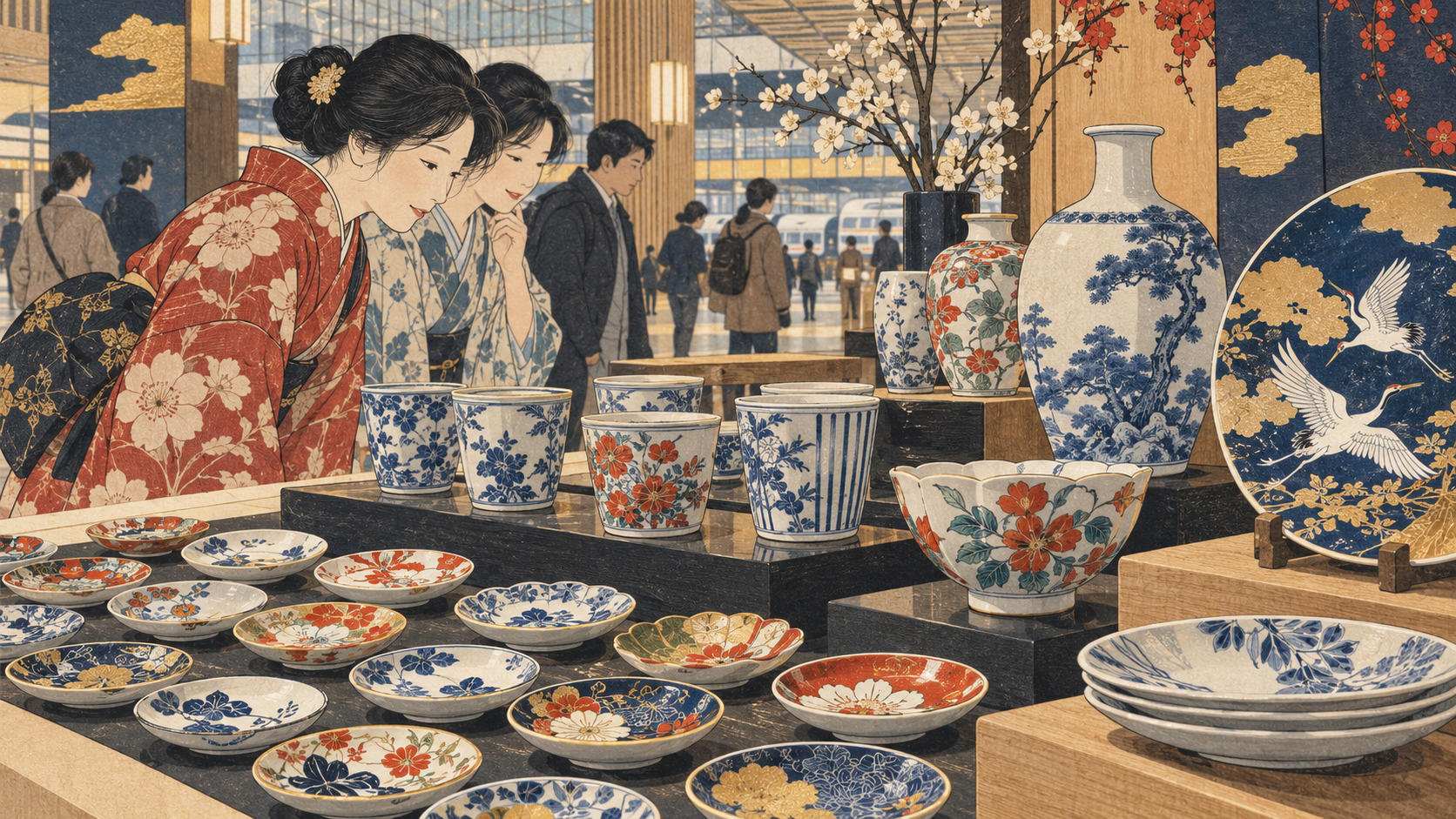
A tiny dish can carry an industrial history. In the colour of its white body, the pressure of a cobalt line, the thickness of its rim and the weight that settles in the hand are choices about labour, patrons, price and use.
From September 4 to 6, JR Kyushu Hall on the ninth floor of JR Hakata City became a temporary comparative cabinet. Misato Yakimonogatari Eki-ichi brought together Arita ware from Saga Prefecture, Mikawachi ware from Sasebo in Nagasaki Prefecture and Hasami ware from Hasami, also in Nagasaki. The free event advertised about 1,000 varieties, chiefly mamezara small dishes, soba-choko cups and guinomi sake cups.
“Misato,” literally “three villages,” is not an old province, a technical classification or a single historical school. It is the contemporary tourism frame used by organiser Kyushu Tourism Organization. That matters. The exhibition did not prove that the three centres are interchangeable; its value lay in making their differences visible at close range.
A station concourse becomes a gateway
The market was only one layer. A gallery called “Tradition and Now” placed works from the Imaemon, Kakiemon and Gen-emon kilns beside Koransha and Fukagawa Seiji for Arita. Mikawachi was represented through its okiage relief painting, Hirado chrysanthemum ornament, and karako children. Hasami’s historical line ran through the work of industrial-design pioneer Masahiro Mori for Hakusan Porcelain.
Three table coordinators interpreted the regions for present-day use: Mayumi Yamano for Arita, Shima Tanaka for Mikawachi and Maiko Araki for Hasami. Daily talks devoted September 4 to Mikawachi, September 5 to Hasami and September 6 to Arita; the final session included the 15th Sakaida Kakiemon.
The programme extended past the hall. A charter train called Misato Yakimonogatari-gō was promoted as a route from Hakata to the producing towns, with a departure ceremony scheduled for platform 5 on September 4. The station was made into both showroom and dispatch point: encounter an object in the city, then follow it back to the kiln, museum and landscape that made it.
- Arita: a broad history of blue-and-white, enamelled colour, export porcelain and modern company kilns.
- Mikawachi: techniques refined under the Hirado domain kiln, including karako, piercing and raised decoration.
- Hasami: large-scale production of good daily porcelain, renewed in modern functional design.
These distinctions are tendencies, not borders. Arita has always made useful wares; Mikawachi included private kilns; Hasami contains skilled handwork. A neat tourism slogan can orient the visitor, but it should never be mistaken for the complete economic and artistic life of a producing centre.
The shared beginning: Hizen and Korean potters
All three histories reach back to the ceramic economy of Hizen at the turn of the 17th century. They also reach into the violence of Toyotomi Hideyoshi’s invasions of Korea from 1592 to 1598. Japanese official histories commonly say local lords “brought back” Korean potters. That restrained verb should not hide the coercive setting in which people and knowledge were moved by war.
Arita’s tourism authority records that the Korean potter Kanagae Sanbee, commonly known as Ri Sanpei, and others identified porcelain stone at Izumiyama in the early 1600s, enabling porcelain production in Arita. Early wares left through the port of Imari and were accordingly called Imari ware. Applying today’s clear regional labels backwards can conceal the way making and distribution once produced different names.
Mikawachi’s official history follows two currents. Hirado lord Matsura Shigenobu returned in 1598 with about 100 Korean potters, and Koseki established a kiln at Nakano. Another group, led by Kōraibaba, moved from the Karatsu area into Mikawachi. The people in both lines had roots in Ungcheon in present-day South Korea.
Hasami similarly began under the Omura domain with knowledge carried by Korean potters. Production shifted from glazed earthenware to porcelain after suitable stone was found. None of these centres was a sealed site of solitary invention. Potters, clay and stone, cobalt, fuel, merchants and methods crossed local boundaries.
Arita: when “IMARI” travelled
Arita porcelain from roughly the 1610s to about 1650 is classed as Early Imari. Many pieces were comparatively thick and decorated in sometsuke—cobalt pigment applied beneath the glaze. Enamel decoration above the glaze expanded from the 1640s, adding reds, greens, yellows and other colours to a field that had been dominated by blue and white.
From the 1650s, the Dutch East India Company carried Arita porcelain to Southeast Asia and Europe. There it was known through its port as “IMARI.” Kakiemon-style porcelain—with milky white bodies, open space and controlled enamel painting—was collected at European courts and imitated by factories including Meissen and Chantilly.
Yet Arita cannot be reduced to a European success story. It contains early blue-and-white, Kakiemon and Kinrande enamel traditions, Nabeshima patronage, domestic markets, and modern businesses. By displaying Koransha and Fukagawa Seiji with hereditary and studio lineages, Eki-ichi acknowledged that the abolition of domain controls, Western chemistry, world fairs and company organisation also belong to the tradition.
Mikawachi: virtuosity and the economics of patronage
At Mikawachi, Imamura Sannojō found porcelain stone on Hario Island in 1633. The Hirado domain opened an official kiln in 1637 and consolidated leading potters at Mikawachiyama in 1650. A successful mixture using Amakusa stone in the 1660s helped full porcelain production take hold.
Domain patronage allowed official kilns to devote exceptional material and labour to presentation objects and elite wares. Karako—Chinese-dressed children playing beneath a pine—became the best-known motif. Pierced work removed parts of the body to form lace-like patterns. Okiage built smooth relief by repeatedly brushing liquid clay onto the surface. Chrysanthemum ornament lifted individual petals with a spatula.
“Superlative technique” is accurate as admiration but thin as explanation. A line becomes fine because a painter chooses and controls a brush; a wall becomes translucent because forming and firing risks have been mastered. Mikawachi’s virtuosity grew within a particular economy—one in which domain workshops could, for selected objects, subordinate immediate profit to prestige.
Hasami: taking porcelain to the everyday table
Hasami developed another formidable skill: producing consistent, serviceable porcelain at scale. Large multi-chamber climbing kilns and specialised labour lowered the cost of blue-and-white dishes. Japan’s Association for the Promotion of Traditional Craft Industries describes the centre as a major producer of everyday tableware by the late Edo period.
The emblematic kurawanka bowl was sturdy ware associated with food sellers serving passengers on boats along the Yodo River. Their call—roughly, “Won’t you eat rice? Won’t you drink sake?”—gave the vessel its familiar name. On the strength of that history, Hasami and Hirakata in Osaka issued a citizen-exchange declaration in 1999. Hasami’s “conpla” bottles carried soy sauce and sake from Dejima to overseas customers.
Modern Hasami ware’s functional, restrained design is therefore more than a change of fashion. It renews a long commitment to putting well-made vessels into ordinary use. Showing Masahiro Mori’s work for Hakusan Porcelain as part of the historical account, rather than as an escape from it, makes industrial design a legitimate chapter of craft tradition.
What “about 1,000 varieties” cannot tell us
A large number creates spectacle, but it needs discipline. The figure is the organiser’s approximate count of product varieties. It is not a count of participating kilns, physical objects sold or regional output. It cannot be used to rank the commercial strength of the three centres.
Nor does a finished cup reveal every participant in its production. A Japanese porcelain district may connect stone and clay processors, mould makers, body makers, painters, glaze specialists, firing operations, trading companies and retailers. The celebrated named kiln or the backstamp is only one visible point in a production ecology.
That is why the route from station market to producing town matters. A charter train or bus tour can return attention to kiln sites, workshops and museums. It can turn shopping into informed travel. Whether this three-day event generated durable visits, orders or apprenticeships, however, requires evidence not yet available.
Can collaboration preserve difference?
Regional cooperation gives small industries a louder voice. “Hizen porcelain” offers international visitors an intelligible doorway and gives organisers enough scale for a major urban event. But collaboration also creates pressure to assign each place a marketable personality: ornate Arita, intricate Mikawachi, modern Hasami.
The better function of comparison is not to decide a winner. It is to notice that whites differ, blues differ, and even two cups of the same nominal size propose different relations among hand, food and table. Price, weight, rim, decoration and blank space are records of historical choices.
For three days, Hakata Station became a very large cupboard. Inside it were not three timeless styles, but three changing industrial histories: shaped in different proportions by war and migration, feudal protection, maritime trade, common dining, modern companies and industrial design. A mamezara is small. It is still large enough to carry the question that matters—whose work, from which place, will the next purchase help continue?
- Misato Yakimonogatari Eki-ichi official site — dates, venue, approximately 1,000 varieties, displays, speakers and official romanisation.
- Kyushu Tourism Organization event release — organiser, charter train, ceremony and regional tours.
- Fukuoka City’s Yokanavi visitor site — event details and access.
- Arita Tourism Association, “What is Arita ware?” — terminology, techniques, Early Imari, VOC trade and modernisation.
- Arita Tourism Association, Izumiyama quarry — porcelain stone, production and historic-site status.
- Official Mikawachi ware history — Korean potters, Hirado domain kiln, stone and exports.
- Official Mikawachi technique guide — karako, piercing, okiage and chrysanthemum ornament.
- Traditional Crafts Aoyama Square, Hasami ware — origins, material, process and daily wares.
- Association for the Promotion of Traditional Craft Industries, Hasami feature — climbing kilns, scale and division of labour.
- Hasami Town, exchange with Hirakata — kurawanka ware and the 1999 declaration.