A world record measured in millimeters
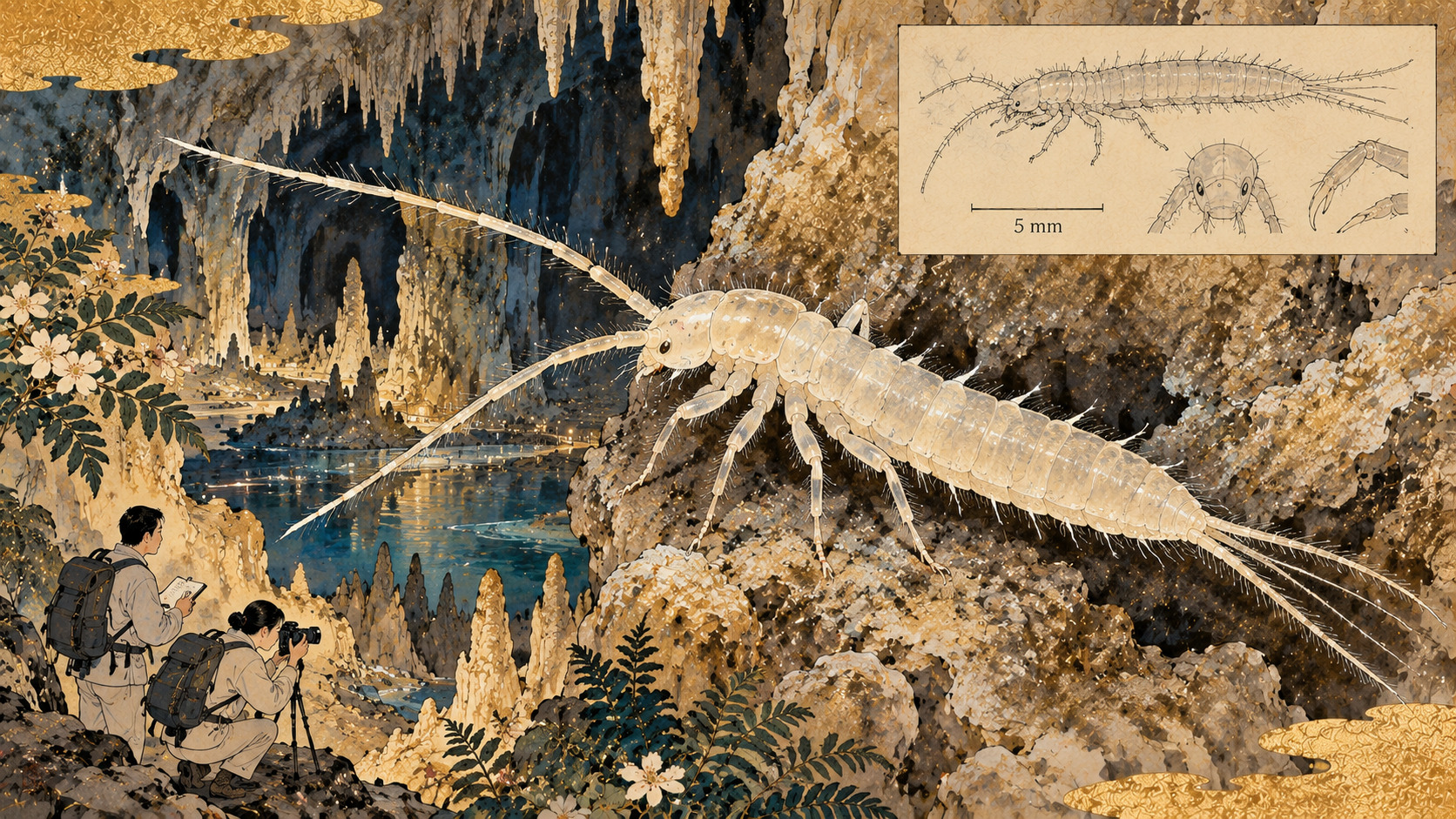
Beneath the limestone grasslands of Akiyoshidai in western Japan, researchers have identified an animal that is enormous by the standards of its own small, little-seen family. The newly named Pacificampa dodecas reaches 13 millimeters in body length, excluding its antennae and two tail appendages. Kyoto University and Mine City call it the world’s largest known member of the family Campodeidae. This is not the largest cave animal, or a creature the size of a person. The scientific superlative refers to a specific group of diminutive, six-legged soil and cave dwellers.
The discovery that waited more than seventy years
The most remarkable twist may be its timing. Scientists already knew by at least 1953 that these animals lived in Akiyoshidai caves, according to Kyoto University. Yet the population remained without a formal scientific description. Researchers have now assigned it the Japanese common name Akiyoshi-horaana-nagakomushi and the scientific name Pacificampa dodecas. The peer-reviewed article appeared online on October 9, 2026, and the university and city announced it on October 27. The news is the formal identification and naming—not a claim that the animal first appeared, or was first observed, this week.
A municipal specialist and university taxonomists
The work joins research in Kyoto University’s Laboratory of Systematic Zoology with field expertise in Mine City. The authors are Tomoyuki Yokogawa, Takashi Murakami and Takafumi Nakano. Murakami, an environmental conservation specialist in the city’s tourism policy department, collected animals from caves in the plateau. The scientists compared physical features and analyzed genes. This collaboration matters because biological discoveries often depend on people who know a landscape intimately, keep returning to it, and preserve the specimens that a distant laboratory needs to compare.
What a dipluran is—and what it is not
Diplurans are small, wingless, six-legged arthropods usually found in soil or underground environments. In the group studied here, the slender body ends in two long appendages known as cerci. The animal also carries conspicuous antennae. Those features help specialists distinguish relatives, but they also explain why size comparisons demand care. The 13-millimeter figure is measured without the antennae or cerci. Calling it a “giant insect” would be misleading for general readers; “largest known campodeid dipluran” is the defensible claim.
The clues in a body and a gene
According to the paper’s abstract, the team documented the species from four caves. The investigators examined the arrangement of prominent bristles on parts of the body and the relationship between antenna length and body length. Partial sequences of a mitochondrial gene, cytochrome c oxidase subunit I (COI), supported the conclusion that the samples from those caves belonged to one species and formed a distinct lineage from other Japanese Pacificampa. Its size surpassed that of Pacificampa daidarabotchi, previously regarded as the giant of this family in northern Kyushu. The claim rests on multiple kinds of evidence, not size alone.
A challenge to the family tree
There is a less photogenic but equally important result. Molecular analysis using the 18S ribosomal RNA gene suggested a close relationship between Pacificampa and the soil-dwelling genus Metriocampa. It also raised the possibility that the currently defined subfamily Campodeinae does not form a single evolutionary lineage. That does not mean the entire classification has been rewritten overnight. The researchers state that the precise evolutionary position of Pacificampa remains uncertain. Instead, the new species may help scientists test how this branch of underground life should be organized.
The ocean that became a mountain landscape
The caves themselves are the product of a far older story. Mine City describes Akiyoshidai’s limestone as the remains of reefs formed in the Carboniferous and Permian periods, when the rocks began as marine deposits. Geological forces later brought them into the Japanese archipelago. Over immense spans of time, water dissolved passages through limestone, creating intricate underground environments. Kyoto University describes a roughly 12-by-8-kilometer limestone region with more than 450 caves. An astonishingly old marine landscape has become a laboratory for animals that live without daylight.
A century of looking beneath the surface
Biological work in Akiyoshidai caves reaches back to the 1920s. A visitor sees grassy hills studded with white rock; a zoologist sees multiple, partly isolated habitats beneath. Scientific naming is not an administrative afterthought. It allows observations made decades apart to be connected to an identified species; it gives conservationists, museum curators and researchers a common vocabulary. The lengthy gap between awareness of this animal and its formal description illustrates why taxonomy—careful, often slow comparative study—remains indispensable even in an era of high-speed genetic sequencing.
A landmark year for the geopark
In April 2026, another milestone made Akiyoshidai more visible internationally. The Miné-Akiyoshidai Karst Plateau Geopark was formally designated a UNESCO Global Geopark, as confirmed by Japan’s Ministry of Education and UNESCO’s official listing. Recognition reflects its geological heritage and regional conservation and education efforts, not an award specifically for the new animal. The combination nevertheless invites a richer view of the destination: its caves are not empty scenery beneath a celebrated plateau, but environments with biological histories of their own.
The conservation question remains open
What comes next? Mapping the species’ distribution, learning how its populations are connected, studying its ecology and understanding how changes in water and cave conditions may affect it. Those are questions, not findings already established by this paper. No long-term population trend or formal threat assessment for this species was confirmed in the sources reviewed. Cave ecosystems can be sensitive to disturbance; the discovery should not be taken as an invitation to collect animals or enter restricted cave passages.
Why a tiny giant deserves a global audience
It is easy to imagine biodiversity discovery as a dramatic encounter in an unexplored rainforest. Akiyoshidai suggests another version. A creature may be present in a studied landscape for generations, noticed but not yet named, while its evolutionary relationships remain unresolved. A field specialist’s collecting, a university’s comparative work and several fragments of DNA eventually give it a place in the scientific record. The result is both modest and profound: a 13-millimeter animal whose story changes how we describe an entire branch of life beneath Japan.
Sources and verification
Checked against the October 27 university and municipal announcement, the October 9 paper, and primary geology and UNESCO records. No original interview was conducted.