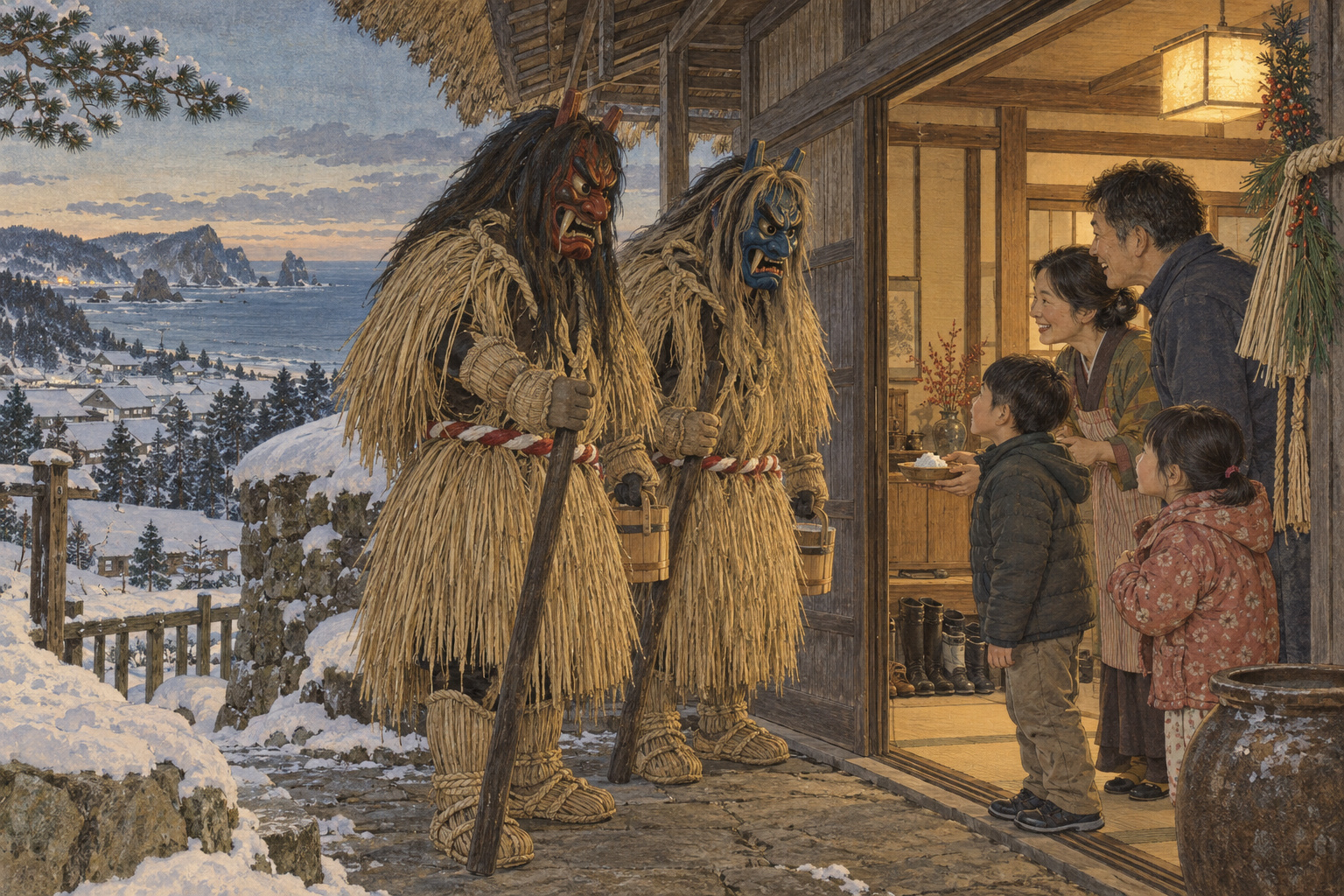
The mask catches the eye. The welcome explains more. In Oga’s Namahage tradition, a fierce visitor is received with hospitality because the encounter carries a promise of blessing as well as admonition. Oga City describes Namahage as visiting deities who rebuke idleness, dispel misfortune and bring health and abundance.[1] Understanding the tradition means looking at the household that receives them, not only at the figure at its door.
For this September feature, the distinction is especially useful. The community visits belong to New Year’s Eve. Museum interpretation and a winter tourism festival offer other ways to encounter Namahage. They share cultural material, but take place in different settings and serve different purposes.
A visitor with a place in the household
The Namahage Museum presents a belief that the figures are messengers of the deities associated with Oga’s mountains. Their role includes bringing good harvests and fishing catches.[2] Describing them merely as monsters that frighten children loses much of that meaning.
The name is commonly explained through namomi, marks caused by prolonged exposure to a hearth’s heat, and the idea of removing them to admonish idleness.[1] This is a traditional explanation of the word, rather than proof of a single historical origin. It connects the figure with the obligations of household life in winter.
The encounter is therefore more than an entrance and a shout. It involves people who know how to receive the visitor and respond. The household has a role in shaping the occasion. That reciprocal relationship helps explain why hospitality belongs within a ritual whose outward appearance can be so intimidating.
Shinzan’s carefully ordered encounter
The Oga Shinzan Folklore Museum describes a local form in which two Namahage wear masks without horns. An advance representative, the sakidachi, asks whether they may enter. The museum also explains a sequence of stamping: seven times upon entering, five before sitting at the meal and three when rising.[3]
These details reveal order within the apparent tumult. They also need to remain attached to their place. Shinzan’s sequence should not be presented as a universal script for every settlement on the peninsula. Local differences are part of what is being transmitted.
Why the masks should remain different
Oga’s municipal account notes variations in masks, clothing, objects and movement, including masks made from carved wood, bark and paper applied to baskets.[1] The city’s heritage project identifies the straw costume as kede, while recording other local names.[4]
The Namahage Museum displays more than 150 masks formerly used across the city.[5] This is a collection count, not a count of communities currently performing the ritual. Its value lies in making variation visible. Each face can prompt questions about where it was used, who made it and what its community chose to preserve.
A single, easily recognized image travels well in tourism publicity. A living regional tradition is harder to summarize. Preserving its differences requires attention to details that may be unfamiliar to visitors—and to the people who can explain why those details matter.
History has records as well as legends
The museum recounts a story in which supernatural figures undertake to build a thousand stone steps in one night, only to be deceived by a rooster’s call after completing 999.[2] It is a local legend, rather than a verified account of the custom’s foundation.
The city’s heritage project points to a different kind of evidence: the traveler Sugae Masumi’s written and illustrated account of a visit to Miyazawa on the fifteenth day of the first month in 1811, in 『牡鹿乃寒かぜ』.[4] A record establishes that a practice was observed; it does not establish the year in which it began.
The same heritage account explains that the observance formerly belonged to Little New Year and now takes place on December 31.[4] Historical calendar dates should not be mistaken for a current visitor timetable. The change also reminds us that transmission has included adjustments over time, rather than the exact repetition of an unchanging event.
Recognition and the work it cannot replace
Namahage received Japan’s designation as an Important Intangible Folk Cultural Property on May 22, 1978.[1] In 2018 it joined the UNESCO inscription “Raiho-shin, ritual visits of deities in masks and costumes,” grouping ten observances. Oga’s account of that process emphasizes community ties and exchange across generations.[6] This is intangible cultural heritage, distinct from inscription as a World Heritage site.
The distinction is substantive. A mask can be conserved as an object, but an annual household visit needs people to prepare it, wear it, understand the movements and receive the visitors. International recognition cannot perform those tasks on a community’s behalf.
An October 2025 report published by Akita Prefecture describes difficulties caused by declining numbers of bearers and receiving households.[8] That identifies two sides of transmission. Recruiting people to appear as Namahage addresses only part of the challenge if fewer households can sustain the encounter.
A current policy with a local face
Oga’s preservation-subsidy notice, updated September 10, 2026, offers support to city neighborhood associations and other groups conducting or planning to restart the ritual. It covers half of eligible repair or replacement costs for masks, costumes and carried objects. For repairing or recreating a locally distinctive mask using historical photographs or other records, the mask’s eligible subsidy rises to four-fifths. The published deadline is January 29, 2027; advance consultation is required and the scheme may close when its budget is exhausted.[9]
The higher rate gives practical expression to a cultural choice. Historical evidence can guide what a community uses next, rather than remaining only in an archive. Repair becomes a way to pass on a particular local identity.
Funding objects is only one part of continuity. People must still share the knowledge that makes those objects meaningful in use. The policy is best understood as support for that work, rather than evidence that the wider succession problem has been solved.
Learning to explain what visitors see
The Oga City Tourism Association’s Namahage Dendoshi program combines site visits, lectures and a written examination to build knowledge and support for transmission. Its published schedule lists sessions on December 6, 2026, and March 7, 2027.[10]
Such education can help people communicate the tradition beyond a striking photograph. Knowing a custom through study and bearing responsibility for it within a settlement are different experiences, but they can support one another. A well-informed interpreter can explain the setting, acknowledge local variation and direct attention to the community behind the performance.
Three settings worth distinguishing
The Namahage Museum introduces masks and related material through exhibitions. Beside it, the Oga Shinzan Folklore Museum offers learning sessions presenting Shinzan’s practices.[3][5] These provide an appropriate starting point for an autumn visitor who wants context for the year-end custom.
The Namahage Sedo Festival has its own history. According to its organizing committee, the winter tourism event began in 1964 at Hoshitsuji Shrine before moving to Shinzan Shrine. It brings Namahage together with elements of the shrine rite called Saitosai.[7] The festival’s February setting is distinct from December’s visits to community homes.
Visitors benefit from knowing which setting they are entering. A museum demonstration can teach; a public festival can introduce the culture to a wider audience; a household ritual depends on the relationships and permission of its hosts. None should be assumed to grant unrestricted access to the others.
Namahage’s future will depend on more than keeping its appearance recognizable. It will depend on whether another generation can make sense of the encounter and choose to sustain it. Behind the fierce face are people maintaining the possibility of a welcome next year.
Sources and references
- Oga City: Namahage cultural-property account
- Namahage Museum: ritual, etymology and legends
- Oga Shinzan Folklore Museum: Shinzan ritual practice
- Oga cultural-heritage project: records, costume and origins
- Namahage Museum: exhibitions
- Oga City: UNESCO inscription and its background
- Namahage Sedo Festival committee: festival history
- Akita Prefecture: October 15, 2025 report on transmission and cultural education
- Oga City: preservation subsidy, updated September 10, 2026
- Oga City Tourism Association: Namahage Dendoshi education and examination