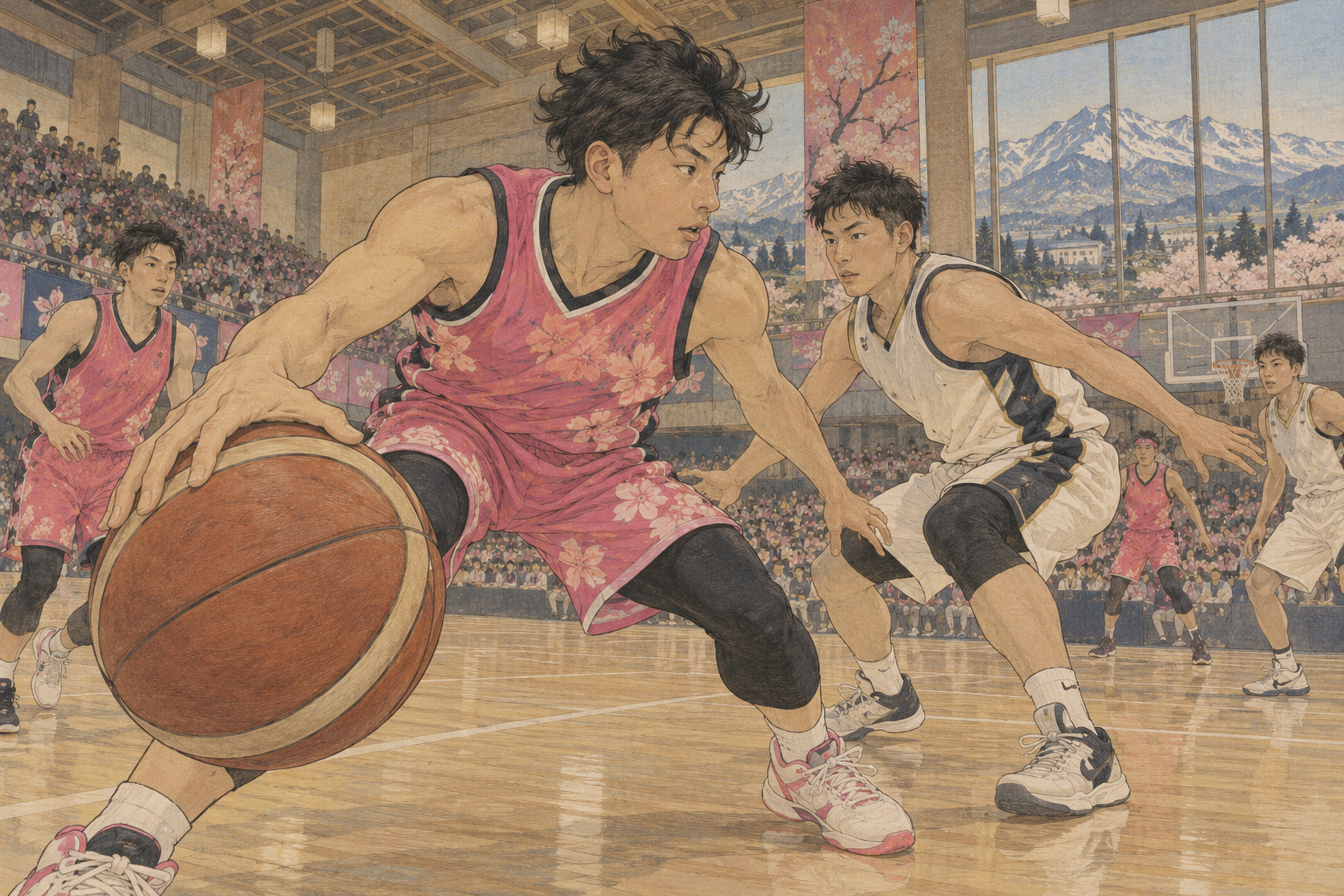
The Akita Northern Happinets left their Yokote preseason weekend with two defeats and clear work to do. Levanga Hokkaido won 90–76 on September 5 and 92–64 on September 6 at IRISO Arena Yokote.[1][2] For Akita, the basketball offered a demanding examination of a team still taking shape.
The location tells another part of the story. Yokote’s new municipal arena entered use this summer, with the city announcing July 1 as its opening date.[4] Bringing the prefecture’s professional club to this southern Akita venue gives practical meaning to a longstanding ambition: a team whose relationship with supporters extends across the prefecture.
What the two games showed
The club’s official reports record the following results. Halftime scores are calculated from the published quarter scores.[1][2]
| Date | Final | Halftime |
|---|---|---|
| September 5 | 76–90 | 32–45 |
| September 6 | 64–92 | 41–48 |
Akita trailed 14–26 after the first quarter of the opening game. On the second day, a seven-point halftime gap expanded as Hokkaido outscored the hosts 44–23 after the interval.[1][2] The figures point to different phases worth examining: the start of one game and the ability to sustain performance in the other.
In the club’s published account of the first postgame press conference, head coach Mick Downer identified problems defending the pick-and-roll and positioning away from the ball.[1] A pick-and-roll uses a screen to impede a defender before the screener moves toward the basket. Defending it requires coordinated decisions, rather than effort from only the player closest to the ball.
After the second game, Downer described a substantial gap between the current performance and the intended style. His explanation emphasized developing the team for the season rather than reshaping everything to secure one immediate result.[2] That is the useful tension in preseason basketball: results matter, but their value also lies in exposing what must improve.
These were preparation games, not regular-season standings results. Nor should two September scorelines be treated as a prediction of an entire season. They provide a specific record of where Akita encountered difficulty in Yokote.
A new arena with several responsibilities
IRISO Arena Yokote is the named municipal gymnasium at Akasaka, Tate-no-shita 48-2. The city’s announcement distinguished its June 14 opening ceremony from the July 1 opening.[4] The Happinets’ visit therefore came during the facility’s first summer of operation.
The operator identifies three purposes: everyday sport and health, tournaments and cultural exchange, and a disaster-response role.[5] Professional basketball is one use within that wider public responsibility. An arena has to work for ordinary users as well as for the audience of a prominent event.
That dual role can be productive. Seeing professionals compete in a local facility may change how a young player imagines the place where sport happens. A visitor attracted by the game may discover a venue they later use themselves. Those are possibilities, not documented outcomes from this weekend.
A successful sports event also cannot, by itself, settle questions about the value of a public building. The more durable test includes routine use, affordability, maintenance and how different groups share the space. A club visit brings attention; everyday activity gives that attention somewhere to lead.
The history behind a prefecture-wide club
The Happinets’ operating company lists January 30, 2009 as its incorporation date. The club separately dates its 県民球団宣言—its declaration of a commitment to the people of the prefecture—to October 15, 2011.[6][7] These milestones concern different tasks: establishing an organization and articulating the relationship it intends to maintain.
That declaration describes an ambition to contribute to pride, hope and vitality in Akita and to remain rooted there.[7] A prefectural name is only the beginning of such a commitment. Whether a club feels close depends partly on opportunities to see it, the journey involved and the ease of bringing someone who has never attended before.
Yokote supplies one answer to that geographic challenge. Supporters can travel to the club’s games in Akita City; the club can also bring games toward supporters elsewhere. Hosting preseason basketball in the south widens the set of places where that encounter can occur.
The distinction is especially useful when discussing regional reach. It is possible to admire a team from afar. Being able to enter an arena, follow the action and experience the event in person creates another kind of relationship. Neither form of support needs to displace the other.
How identity becomes a shared experience
The club explains its name through a wish to share happiness with those connected to it. It also links “Northern” to the Akita Northern Bullets rugby club and a shared aspiration to energize Akita through sport. Its logo draws on rice-growing imagery and basketball tradition.[8]
Those symbols connect the organization to recognizable features of the prefecture. Another connection is performed before games: the club says players and supporters sing the Akita prefectural song together at home games held in Akita.[9] The Yokote event program included the song alongside the starting-lineup introduction.[3]
Repeated rituals give a game a history beyond its result. They can help make a gathering recognizable from one visit to the next. But a welcoming club also leaves room for spectators who do not know the words or the routines yet. A shared identity becomes stronger when newcomers can enter it comfortably.
Beyond the professional roster
The club’s basketball-school information lists regional classes in Noshiro, Yurihonjo and Yokote as well as Akita City.[10] This provides another form of contact: learning and playing, alongside watching.
A child inspired by a game does not need to become a professional for that connection to have value. Practicing a skill, joining friends or understanding how difficult a movement is can deepen an interest in sport. Regional basketball is sustained by many such relationships, not solely by the athletes who reach the highest level.
The Yokote event announcement also included food vendors and a fan-club reception.[3] These give a basketball visit a social dimension outside the game itself. A meal, a purchase or a meeting with friends can be part of why someone returns.
They should not be confused with a measured economic impact. A vendor list establishes an opportunity to trade, not a verified increase in regional spending. Assessing that would require evidence about sales, visitor origins and what spending would otherwise have occurred.
The less visible work of welcoming supporters
For Yokote, the club published dedicated access and parking instructions, warned that spaces were limited and asked visitors not to park without permission at surrounding businesses. It directed wheelchair users and others needing that access to the first-floor main entrance.[11]
Such details influence whether a regional event feels accessible. A first visit is shaped by finding the entrance and understanding the arrangements as well as by what happens on court. Good relations with neighboring businesses also form part of the club’s relationship with its host community.
The weekend therefore deserves to be read on two levels. On court, Akita faced shortcomings that its own coach acknowledged. Across the prefecture, the games brought the team into a new municipal venue and created another point of contact with supporters. A club’s regional commitment becomes tangible through that repeated exchange: people make the journey to the team, and the team makes the journey to them.
Sources and references
- Akita Northern Happinets: September 5 game report and press-conference account
- Akita Northern Happinets: September 6 game report and press-conference account
- Akita Northern Happinets: Yokote preseason event program
- Yokote City: arena opening ceremony and July 1 opening announcement
- IRISO Arena Yokote: facility purposes and operations
- Akita Northern Happinets: operating company and incorporation date
- Akita Northern Happinets: principles and prefecture-wide club declaration
- Akita Northern Happinets: team name and logo
- Akita Northern Happinets: singing the prefectural song
- Akita Northern Happinets: basketball schools and regional classes
- Akita Northern Happinets: Yokote access and parking arrangements