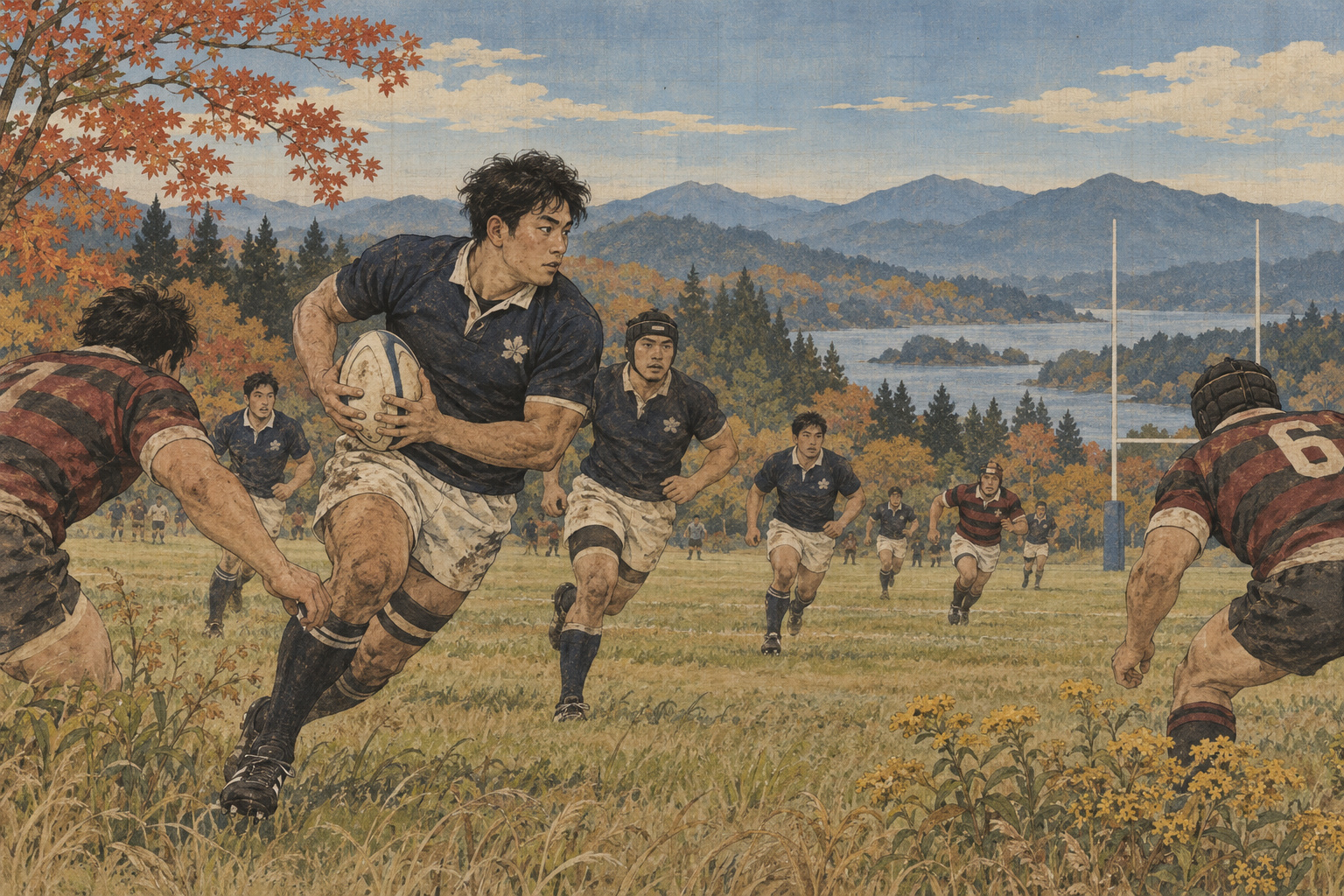
Akita’s opening defeat supplied two very different numbers: a 5–40 deficit at halftime and a 12–5 advantage over the second half. Together they produced a 17–45 loss to Tokyo Gas Blue Flames at ASP Stadium on September 13, a demanding start to the Northern Bullets’ promoted season in Top East Div.1.[1] The task now is to turn the response into something that arrives before a game has slipped away.
As of this report’s September 18 cutoff, the next test is scheduled for Sunday, September 20: an away match against Yokogawa Musashino Atlastars at Yokogawa Electric’s ground, kicking off at 1 p.m. Japan time.[1] For readers following Akita’s autumn, that fixture opens a larger question. What does progress look like for a club built to keep ambitious rugby connected to the place where its players live and work?
A recovery that needs its timing explained
The official Japan Rugby Football Union record puts the second half in perspective. Akita’s two tries in that period came in the 37th and 44th minutes, with a successful conversion after the last. Tokyo Gas had scored six first-half tries. The recorded attendance was 550.[2]
Those details matter because a half won on points can suggest a closer contest than the chronology supports. The late scores show Akita still finding a route to the line; they do not establish sustained control of the match. The useful question for the next outing is whether the Bullets can create effective possession and contain their opponents while the result remains open.
In comments published by the Kanto Rugby Football Union, head coach Shinichi Tsukida described a difficult first half in which Tokyo Gas prevented Akita from playing its intended rugby. He credited the players with regrouping after the interval and returning to their tasks, while looking toward improvement over the season. His assessment concerned the team’s first match after promotion to Div.1.[3][7] It provides a starting point for judging subsequent performances, rather than a reason to disregard the opening deficit.
The shape of the autumn
Top East Div.1 is the competition named in the current regional union schedule; it should not be confused with Japan Rugby League One’s Division 1. Akita’s listed opponents are Tokyo Gas, Yokogawa Musashino, Meiji Yasuda Hollies and Clean Fighters Yamanashi, with two meetings against each across an eight-match league program.[4]
| Date / kickoff | Opponent | Ground |
|---|---|---|
| Sept. 20 / 13:00 | Yokogawa Musashino | Yokogawa Electric |
| Oct. 4 / 13:00 | Meiji Yasuda | Meiji Yasuda Greenland |
| Oct. 24 / 12:00 | Yamanashi | ASP Stadium, Akita |
The schedule also places home games at ASP Stadium on November 8 and November 22.[4] That gives the season a rhythm: changes tested away, then performances available for local supporters to assess at home. Anyone planning a visit should check the organizer’s latest announcement for alterations.
Why Akita needed a different kind of team
The Bullets’ origins help explain why their league campaign carries significance beyond the table. A 2023 interview in Akita sports magazine TITLE traces the predecessor, Akita City Hall’s rugby team, to 1958 and the establishment of the Northern Bullets to 2004. The founding coach recalled recruitment difficulties and the effort to assemble support from businesses and former players for a club with broader participation.[5]
This was an organizational response to a sporting problem. If a team draws its players from one workplace, its competitive future is tied to that workplace’s ability to recruit. Opening the club changes the possibilities: a player can belong to the rugby team without every teammate belonging to the same employer. It also changes the work of running the organization, which must sustain relationships across a wider community.
The club’s own founding statement, written with the 2007 Akita national sports festival approaching, argued for support extending beyond a single company or workplace. It linked high-level rugby to opportunities for local talent and a team that children could aspire to join.[6] These were stated ambitions, but they identify the problem the club was created to address: how to preserve a place for serious rugby in Akita.
The history behind the working week
Another TITLE interview, with a former city-hall player, recalls finding available facilities and placing particular emphasis on the fundamentals of the game.[10] That testimony offers a useful corrective to histories told only through tournament finishes. The survival of a rugby tradition also depends on ordinary arrangements: somewhere to train, people available at the same time and enough continuity to improve together.
The present club roster lists players associated with city government, businesses and education.[7] A chairman’s message on the club website likewise describes employment alongside competitive rugby and the intention to give young people opportunities to pursue the sport in Akita.[11] This is a sporting institution connected to working life in several parts of its community.
That connection deserves practical scrutiny. A competitive squad needs more than goodwill: it needs time to train together and the ability to keep experienced players while bringing others through. The public match record cannot tell us whether every part of that support is secure. It can, however, remind supporters what the weekend performance rests upon. Continuity off the field makes sustained improvement on it possible.
A visible connection to school rugby
One concrete example of the club’s wider role predates this season. Its report on clinics held on March 9 and 16, 2025, at Akita Chuo High School’s rugby ground records about 150 participant appearances across the two days. Students came from five high schools, including Akita Technical and Akita Chuo; Tohoku Electric Power’s Akita branch supported the program.[8]
The distinction between participant appearances and unique students matters, but the activity still describes a tangible meeting point between school rugby and the senior game. A local player becomes someone a teenager can learn from directly. That can make a future involving both work and rugby easier to imagine.
Participation figures alone cannot establish how many students later continued playing, returned to Akita or joined the Bullets. Those are longer-term questions. For a community club, however, keeping the connection open is itself work: arranging another session, maintaining relationships with coaches and making the senior game accessible to the people who may eventually sustain it.
Akita Prefecture’s 2026 club profile also lists the Northern Bullets Pleiades women’s team and a junior team.[12] The senior men’s league campaign is therefore one part of the organization’s place in local rugby. Looking across those activities gives a fuller picture of who can participate and how the club’s founding ambitions might be carried forward.
What growth should mean this season
The team’s 2026 slogan is ogaru, an Akita expression the club explains as growing or becoming bigger.[9] It fits the autumn best when treated as a question to be answered through observable change. Can the Bullets compete effectively earlier in matches? Can their response to pressure become repeatable? Can their presence remain useful to rugby beyond the first team?
The answers will arrive on different timescales. A league fixture offers an immediate test; a durable relationship between schools, players and employers takes longer. Neither makes the other irrelevant. The September 20 trip brings the first opportunity to show what has changed since the opener. The broader campaign will test how much a club rooted in Akita can grow while continuing to give others a place in the game.
Sources and references
- Akita Rugby Football Union: September 13 result and upcoming games
- Japan Rugby Football Union: official Tokyo Gas match record
- Kanto Rugby Football Union: 2026 Top East Weekly Report, vol. 2
- Kanto Rugby Football Union: Top East Div.1 fixtures and results
- TITLE: interview with the founding head coach, May 30, 2023
- Northern Bullets: founding statement and club philosophy
- Northern Bullets: players and staff
- Northern Bullets: March 2025 high-school clinics
- Northern Bullets: team identity and 2026 slogan
- TITLE: interview with a former city-hall team player, May 30, 2023
- Northern Bullets: chairman’s message
- Akita Prefecture Sports Station: 2026 club profile