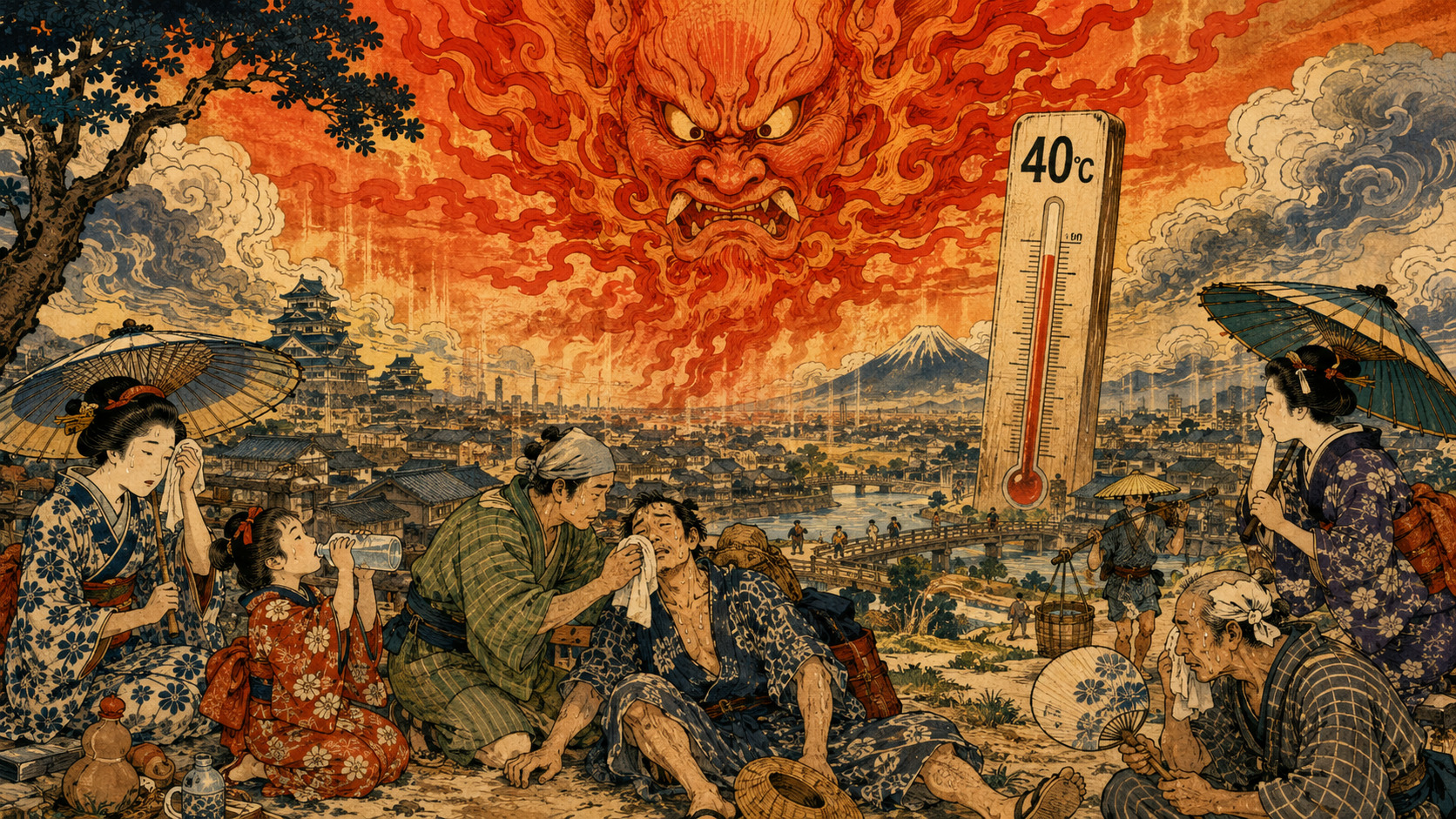
The first threshold fell in a mountain town known for water. Gujo Hachiman is threaded by canals, springs and the Yoshida River, a place where summer is usually pictured through dancing, clear streams and old stone lanes. At 1:56 on Tuesday afternoon, July 21, the automated station there registered 40.0°C. For the first time in 2026—and for the first time since Japan’s national weather service gave 40-degree heat an official name—the country recorded a kokushobi.
The heat did not stop at one instrument. Tajimi, an inland pottery city in Gifu Prefecture with a long history of punishing summer temperatures, reached 40.3°C. Toyota, the industrial city across the prefectural line in Aichi, reached 40.1°C. Hachiman and Toyota set all-time records for their respective stations; Tajimi remained below its own 40.9°C record from 2007.
Across Japan’s 914 reporting stations, 278 reached at least 35°C—the older category called mōshobi, or extremely hot day—and 734 reached at least 30°C. Heatstroke alerts covered 42 prefectures, the widest spread of the season to that point. The geography of the numbers was central Japanese, but the public-health emergency was almost national.
What kokushobi means—and what it does not
Kokushobi is written 酷暑日: koku, harsh or cruel; sho, heat; bi, day. The Japan Meteorological Agency defines it with a single observed quantity: a daily maximum air temperature of 40.0°C or above. Forty exactly counts. It is a description of a completed day’s maximum, and it may also be used in forecasts. It is not, by itself, an evacuation order, a heatstroke diagnosis or the government’s heat-alert system.
| Japanese term | Romanization | JMA definition by daily maximum | Working English sense |
|---|---|---|---|
| 夏日 | natsubi | 25.0°C or higher | Summer day |
| 真夏日 | manatsubi | 30.0°C or higher | Midsummer day |
| 猛暑日 | mōshobi | 35.0°C or higher | Extremely hot day |
| 酷暑日 | kokushobi | 40.0°C or higher | Severe / brutally hot day |
The reading is also more disciplined than the number glowing on a pharmacy sign or car dashboard. JMA’s standard is an electric thermometer inside a mechanically ventilated shield, protected from direct sun and mounted about 1.5 meters above short grass in an open, well-ventilated setting. In full sun, beside a wall, above black asphalt or inside a parked car, a person can face a far harsher thermal environment than the official air temperature suggests.
That distinction cuts both ways. An official 39.9°C day does not become safe because it missed the new word by one tenth of a degree. A humid 34°C can impose more strain on sweat evaporation than a dry 36°C. The category is memorable; the human body experiences a continuum.
A private coinage enters the national vocabulary
Japan did not invent the word in 2026. In August 2022, the Japan Weather Association surveyed 130 of its meteorologists about names for two increasingly visible extremes: days at 40°C or above and nights whose minimum stayed at 30°C or above. It chose kokushobi for the first and chō-nettaiya, “super tropical night,” for the second. At the time, both were private terms, not JMA definitions.
The association’s historical count explained the urgency. It found 67 observations of 40°C or more from the beginning of Japan’s instrumental record in 1875 through mid-2022; 59 had occurred after 2000. Improvements and expansion in observing technology contributed to the count, but the clustering was unmistakable. By March 2026, the association reported that at least one 40°C reading had occurred in every year from 2018 through 2025. In 2025 alone there were a record 30 station-days at or above 40°C.
JMA moved after three consecutive record-hot summers and the normalization of readings once treated as freak events. It opened a public naming poll from February 27 to March 29, 2026. Of 478,296 responses, 202,954 favored kokushobi, more than three times the total for the runner-up, chō-mōshobi. Suggestions outside the formal list included “scorching day,” “boiling day,” “sauna day” and even “stay-home day.” After consulting language and weather experts, JMA announced the winner on April 17.
The progression has a precedent. JMA added mōshobi for 35°C days to its forecast vocabulary in 2007, the very summer Tajimi and Kumagaya broke a national temperature record that had stood since 1933. A category can look bureaucratic on the day it is adopted and prophetic a decade later.
The weather machine over central Japan
No single switch produces 40°C. The broad-scale engine is a deep, persistent high-pressure system. In Japan’s most severe heat patterns, the lower- and middle-atmosphere Pacific high extends over the archipelago while the upper-atmosphere Tibetan high reaches east. Air descends through that tall column, compressing and warming as clouds are suppressed. Long sunshine then pours energy into the ground and built surfaces.
That “double high” was strengthening over Japan during the July 2026 spell. Light winds allowed heat to accumulate from one day to the next. Inland locations were especially exposed: they were distant from the moderating sea breeze, and basin or valley topography could limit ventilation. Where air crossed higher terrain and descended, foehn-like warming could add a local increment. The exact recipe differed among Hachiman, Tajimi and Toyota; a national pressure pattern set the stage, while land surface, wind and topography selected the hottest seats.
Tajimi illustrates why local explanations need care. The city lies at the northeastern edge of the Nōbi Plain in basin-like terrain. It can be affected by intense solar heating, weak winds, downslope warming and urban surfaces. But “the basin traps heat” is not a complete forecast: cloud, soil moisture, wind direction and the arrival of a sea breeze can change the day’s maximum by degrees. Station records describe what happened at a precise place, not a permanent title of “Japan’s hottest city.”
From Yamagata’s 74-year record to Isesaki’s 41.8°C
The history of Japan’s highest temperatures is a history of long stability followed by quick succession. Yamagata recorded 40.8°C on July 25, 1933. That remained the national record for 74 years. Then the ceiling began to lift repeatedly.
1933 — Yamagata, 40.8°C: A record that survives until the twenty-first century.
2007 — Kumagaya and Tajimi, 40.9°C: Both exceed Yamagata on August 16; JMA also brings mōshobi into official use that year.
2013 — Ekawasaki, Shimanto, 41.0°C: Japan records its first official 41-degree reading.
2018 — Kumagaya, 41.1°C: The deadly July heat wave raises the record again; Hamamatsu ties it in 2020.
2025 — Kaibara, 41.2°C; Isesaki, 41.8°C: The national record falls twice in one summer. Shizuoka and Hatoyama also reach 41.4°C.
2026 — Tajimi, Toyota and Hachiman: Not a national record, but the first 40°C event under the official word kokushobi.
A ranking table can conceal changes in the observing network, station surroundings and instrumentation. JMA flags moved stations and maintains rules about statistical continuity. Even with those cautions, the modern concentration is striking. The country once waited generations for a higher national maximum; between 2013 and 2025 it set or tied the national record in four summers.
The climate signal beneath a weather event
A pressure pattern, sunshine and local wind explain why a particular station reached 40°C on a particular afternoon. Climate change explains why the entire distribution from which such afternoons emerge is shifting warmer. The two explanations are not rivals. Weather supplies the shape of the event; global heating raises the floor beneath it.
JMA’s national annual mean temperature has risen at 1.44°C per century over 1898–2025. The summer trend is 1.38°C per century. The pace is visible in thresholds: across 13 long-running stations selected to minimize urban influence, the average number of 35°C days rose from about 0.8 a year in 1910–1939 to about 3.2 in 1996–2025—roughly 4.2 times as many.
Then came 2025. The national summer temperature anomaly was +2.36°C against the 1991–2020 average, the highest since national records began in 1898 and the third consecutive record-hot summer. Japan logged 9,385 station-days at 35°C or above and 30 station-days at 40°C or above, both records. A JMA-led event-attribution analysis concluded that the summer’s exceptional warmth would have been virtually impossible in a hypothetical climate without global warming; even in the warmed climate of 2025, it was estimated as roughly a once-in-60-years event.
That result should not be misread as proof that greenhouse gases alone “caused” the July 21, 2026 readings. Event attribution requires a defined region, period and model comparison; a same-day headline is not that analysis. The defensible inference is broader: human-caused warming makes the atmospheric starting point hotter, so the same high-pressure and local-wind pattern has a greater chance of crossing a fixed threshold.
Cities add another layer. Concrete and asphalt store solar energy, buildings reduce ventilation, and vehicles and air-conditioning systems release waste heat. JMA finds that major cities have warmed especially strongly at night, with global warming and urbanization working together. Yet urban heat is not an alternative explanation that cancels climate change; JMA’s rural-weighted national series and nearby sea-surface temperatures rise too.
What 40°C asks of the human body
The body must shed metabolic heat while the environment is trying to add more. It can send warm blood toward the skin and evaporate sweat. At high air temperatures, radiation and convection become less effective and may reverse direction. Evaporation becomes the principal escape route—but humidity slows it, protective clothing obstructs it, dehydration reduces sweat, and still air removes less vapor from the skin.
Heat illness begins when those defenses cannot hold core temperature and circulation within safe limits. Early signs can include dizziness, lightheadedness, muscle cramps, unusual sweating, headache, nausea and exhaustion. Confusion, collapse, seizure, an inability to walk normally, very high body temperature or an inability to drink are emergency signs. Heatstroke can damage the brain, kidneys, liver, muscles and clotting system; delay is dangerous.
Risk is not evenly distributed. Older adults may sense heat and thirst less strongly, sweat less effectively, live alone or hesitate to use air conditioning. Children warm faster relative to body size and stand closer to heat radiating from pavement. Pregnancy, heart or kidney disease, diabetes, disability, some medications, heavy labor, sports, sleep loss and recent illness can reduce reserve. Acclimatization helps but is not armor; a fit worker can still collapse.
Why the alert is based on WBGT, not the word of the day
Japan’s heatstroke alert system uses the wet-bulb globe temperature, or WBGT, an index designed to represent heat stress by combining air temperature with humidity, radiant heat and wind. In ordinary outdoor settings, the wet-bulb component gives humidity the largest weight. That makes WBGT closer to the body’s cooling problem than dry-bulb air temperature alone.
A heatstroke alert is issued for a forecast area when the next day’s maximum WBGT is expected to reach 33 at one or more designated sites. The system began nationwide in 2021. A heatstroke special alert, operating since 2024, is much more demanding: it is issued for a prefecture when the next day’s maximum WBGT is forecast to reach 35 at all applicable information sites. Municipalities can then open designated cooling shelters, and institutions are expected to consider canceling or changing activity that cannot be made safe.
- Kokushobi: Did one station’s daily maximum air temperature reach 40.0°C?
- Heatstroke alert: Is WBGT forecast to reach 33 at one or more sites in a forecast area?
- Heatstroke special alert: Is WBGT forecast to reach 35 at every applicable site in a prefecture?
- Practical rule: Check the local alert and WBGT, not only the day’s headline maximum.
On July 21, the ordinary alert was widespread; the temperature label was reached at three stations. Those facts describe different scales of the same danger. A prefecture can face severe heat illness risk without any 40°C observation, and one station can record a kokushobi without triggering the statutory special alert.
A public-health disaster that often happens at home
The latest Fire and Disaster Management Agency figures available before this edition counted 4,580 emergency transports for suspected heat illness in the week of July 6–12, 2026. Seven patients were classified as dead at initial medical assessment. The figures were provisional and preceded the July 21 peak.
The completed 2025 season shows the scale. From May through September, 100,510 people were transported—the highest total since the agency began the survey in 2008. People 65 or older accounted for 57.1%. More than 36% required admission for moderate or severe illness. Residences were the single largest location, at about 38%; roads accounted for about 20%, public outdoor spaces 12% and workplaces 11%.
The home figure matters because the cultural image of heatstroke is still a runner or construction worker under blazing sun. Many victims are older people indoors, sometimes with an air conditioner present but unused. Cost anxiety, aversion to cold air, a muted sense of heat or difficulty operating equipment can turn a closed room into the dangerous site.
What to do before—and during—heat illness
At 40°C, “be careful” is too vague. The Environment Ministry’s guidance begins with changing the environment: use air conditioning, stay in a cool place, avoid unnecessary outdoor exposure, pause exercise outside a genuinely cool setting, drink at regular intervals and replace salt appropriately when sweating heavily. Check on older neighbors and relatives. Never leave a child, dependent adult or animal in a parked vehicle, even briefly.
- Move: Take the person to an air-conditioned room or a shaded, well-ventilated place.
- Cool: Loosen clothing; wet and fan the skin; cool the neck, armpits and groin while arranging help.
- Hydrate only if safely able: Give cool water or oral rehydration solution in small amounts if the person is awake and can swallow. People with prescribed fluid or salt restrictions should follow their clinician’s plan.
- Call 119 immediately: If the person is confused, unconscious, having a seizure, unable to walk normally, rapidly worsening or unable to drink independently. Do not force fluids into someone with impaired consciousness.
- Do not leave them alone: Improvement can reverse; continue cooling and observation until help arrives or symptoms fully resolve.
For workplaces, Japan’s rules hardened in June 2025. When work is expected to continue for at least one hour—or more than four hours in a day—in an environment with WBGT 28 or air temperature 31°C, employers must establish and publicize a reporting system, an emergency response procedure and steps for rapid cooling, withdrawal from work and medical care. A 40°C day is far beyond the temperature trigger. The regulation recognizes a crucial fact: heat safety cannot rest only on an individual worker’s judgment after symptoms begin.
Japan’s adaptation timeline is accelerating
The country has long adapted summer life through shade screens, deep eaves, evening water sprinkling and seasonal clothing. Such practices make heat more bearable; they cannot substitute for mechanical cooling in a prolonged 40°C emergency. Modern policy has moved from etiquette and energy conservation toward health protection and legal duty.
2005: The Environment Ministry launches Cool Biz, loosening office clothing norms and discouraging excessive cooling.
2007: JMA formalizes mōshobi for days at 35°C or above.
2021: The WBGT-based heatstroke alert begins nationwide.
2024: The statutory special alert and designated cooling-shelter system begin.
2025: Revised occupational-safety rules require heat-illness reporting and response systems in qualifying hot work.
2026: JMA adopts kokushobi; the first official one arrives on July 21.
Names and alerts are adaptations too: they compress technical information into a phrase people can repeat. But a word works only if institutions can act behind it. Schools need authority to cancel practice. Outdoor workers need paid breaks, water and a buddy system. Households need affordable electricity and usable cooling. Municipalities need open shelters and transport. Hospitals and ambulance services need surge capacity. The vocabulary of danger must be matched by the infrastructure of safety.
The future contained in one new word
JMA and the Ministry of Education’s Climate Change in Japan 2025 report projects that the national average number of 35°C days late this century would rise from about 1.3 a year in the 1980–1999 baseline to 4.2 under a world roughly 2°C warmer than preindustrial conditions and 18.8 under a 4°C pathway. These are national averages across selected long-running stations, not a forecast for every city. The direction is the point: today’s extreme category moves toward tomorrow’s routine season.
Kokushobi therefore carries two meanings. Operationally, it is exact: 40.0°C or higher. Historically, it is evidence that Japan’s language has had to catch up with its climate. The country’s first “official” kokushobi was not the hottest day Japan has known, nor proof of an unprecedented national event. It was something subtler—a moment when an old physical threshold entered a new social era.
At Hachiman, the official number came from a shielded sensor above grass. Outside the fence, people moved through reflected sun, warm walls, humid air and the obligations of an ordinary Tuesday. That is where the category acquires its real meaning. Not at the instant an instrument writes 40.0, but in the decisions made before the body can no longer compensate: to stop work, open a door, turn on the cooling, carry water, call a relative, notice a stranger and call 119.
Sources and method
Temperatures, station records, category definitions and climate trends were checked against JMA data and releases. Emergency-transport figures use FDMA’s latest available weekly preliminary report and its completed 2025 seasonal report. Safety advice follows the Environment and Health ministries. “First official” means the first 40°C observation after JMA adopted the term in April 2026; Japan recorded 40°C many times before that date.
- TBS News Dig: three stations reach 40°C; nationwide station totals, July 21, 2026
- Japan Weather Association / tenki.jp: first 2026 kokushobi and updated readings
- JMA: decision and public-poll results for the name kokushobi, April 17, 2026
- JMA: Tajimi all-time station rankings
- JMA: Japan’s all-time national temperature rankings
- JMA: how official air temperature is measured
- Japan Weather Association: 2022 origin of kokushobi and early 40°C history
- Japan Weather Association: 40°C station-days and 2026 severe-heat report
- JMA: Japan’s summer-temperature trend, 1898–2025
- JMA: long-term change in the annual number of 35°C days
- JMA Climate Change Monitoring Report: records and attribution for summer 2025
- JMA and MEXT: Climate Change in Japan 2025, observed and projected heat
- Environment Ministry: heatstroke alerts and recommended action
- Environment Ministry: statutory heatstroke special-alert threshold and cooling shelters
- FDMA: preliminary emergency transports, July 6–12, 2026
- FDMA: completed 2025 heat-illness emergency-transport report
- Health Ministry: first aid when heat illness is suspected
- Health Ministry: revised workplace heat-illness rules effective June 2025
- Environment Ministry: the history of Cool Biz
Health note: This article provides general public-safety information, not individualized medical advice. People with heart or kidney disease, pregnancy, fluid restrictions or medicines affected by heat should follow a clinician’s specific plan. In Japan, call 119 for an emergency.