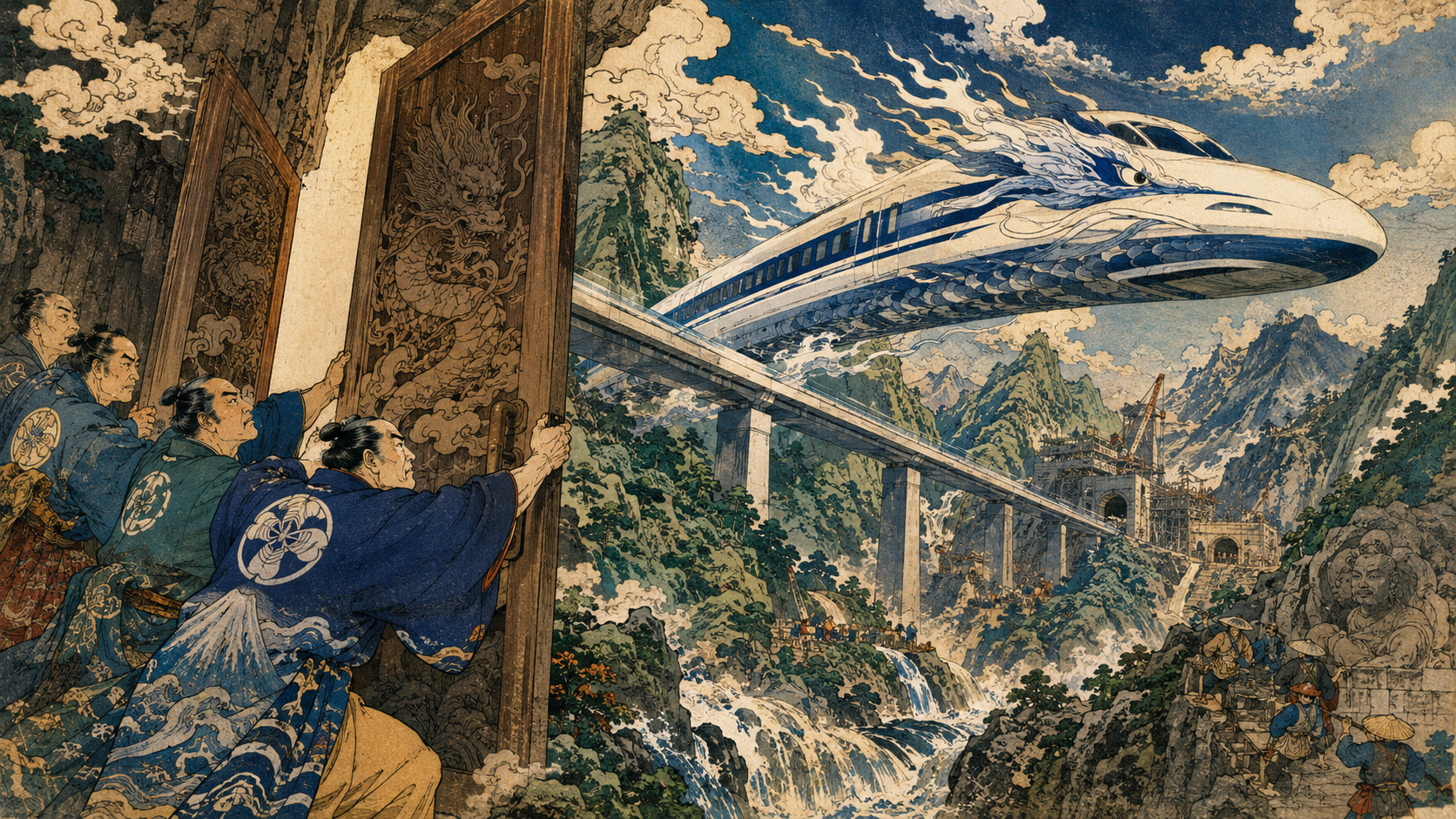
At 500 kilometres an hour, a maglev train would cross Shizuoka Prefecture’s 8.9-kilometre portion of the Southern Alps tunnel in roughly 64 seconds. There will be no station. The train will not emerge into daylight. Yet securing permission for that minute beneath the mountains took more than a decade—and helped destroy the original 2027 opening plan for the entire Shinagawa–Nagoya line.
On July 18, Shizuoka Governor Yasutomo Suzuki and JR Central President Shunsuke Niwa signed a natural-environment conservation agreement covering the tunnel’s main works. It commits the railway to an extensive package of water, biodiversity and spoil-disposal safeguards; monitoring before, during and after construction; disclosure to the prefecture and experts; and an immediate temporary halt if an unforeseen event affects the natural environment. Separate documents address compensation for water users, long-term oversight and regional development.
The signatures close the project’s most visible political impasse. They do not mean a boring machine instantly begins cutting 1,400 metres beneath the peaks, nor do they supply a new date for passengers. JR Central must pass from surveys and yard preparation to full construction, learn what the rock and water actually do, finish difficult tunnels and deep stations elsewhere, install railway systems, manufacture and test trains, commission the integrated route and finance a cost outlook that has risen to ¥11 trillion.
What the July agreement actually does
The compact is not a vague promise to “respect nature.” It is an agreement under Shizuoka’s Natural Environment Conservation Ordinance for the main works in Aoi Ward, Shizuoka City. The covered development area is about 628,700 square metres, of which about 215,500 square metres is designated for physical alteration. JR Central must perform the separately enumerated conservation measures and manage the site with due care.
Its strongest procedural clause concerns surprises. If an unforeseen event affects environmental conservation, JR Central is to suspend work immediately, investigate the cause and report to the prefecture. Unless the investigation clearly rules out a causal relationship with the project, the company is to hear expert views where needed, consult Shizuoka and take countermeasures. The prefecture can request reports and inspections; it can advise, recommend and, in serious cases, publicize violations. Proposed changes to the project require prior consultation.
| Document or institution | Function | What it does not guarantee |
|---|---|---|
| Natural-environment conservation agreement | Makes the negotiated measures part of the main-work framework; provides for a temporary halt, investigation, reporting and prefectural oversight | It cannot predict every geological event or prove in advance that no impact will occur |
| Water-use compensation confirmation | Sets a process for responding if construction affects actual water use; signed in January 2026 with MLIT present | Compensation after harm is not the same as preventing harm |
| Monitoring system | Tracks river flow, groundwater, water quality, temperature, ecology and spoil sites before, during and after work | Monitoring is useful only if thresholds trigger timely action |
| Prefectural Chuo Shinkansen review panel | Experts evaluate regular results and abnormal events and advise on requests to JR Central | The panel does not construct or operate the railway |
| Regional-development agreement | Commits Shizuoka and JR Central to discuss industry, tourism, station access and regional transport benefits | It specifies broad objectives; many benefits and details remain to be negotiated |
The Oi River basin’s eight cities and two towns also signed a confirmation with JR Central requiring the safeguards and monitoring to continue after work begins and after service starts, alongside continuing disclosure and dialogue. That last phrase matters: the new arrangement turns a dispute over whether digging may start into a continuing argument, governed by data, over how digging may proceed.
Why one river could hold an entire railway
The Oi rises in the Southern Alps and runs through a heavily engineered basin. Its water has long been captured and rerouted for hydropower, farming, drinking water and industry. Decades before maglev, residents mounted a “Give Us Back Our Water” campaign after dam and power development reduced flows. In the dry season, restrictions are not an abstraction. A new diversion imposed on a river with a long memory of scarcity was always going to be politically explosive.
JR Central’s 2013 draft environmental assessment projected that tunnel excavation could reduce flow in the upper Oi by as much as roughly two cubic metres a second at a modeled point. The exact meaning and downstream effect of that estimate became fiercely contested, but the number changed the negotiation. Shizuoka demanded that all tunnel water belonging to the basin be returned, not merely most of it or only when the company judged pumping necessary.
The physical problem is counterintuitive. A tunnel is a drain. When excavation encounters saturated fractures, groundwater enters the opening and follows the tunnel’s gradient. Near the Yamanashi border, water could escape through the new tunnel to the Fuji River side before a completed route exists to send it back into the Oi system. Deep rock compounds uncertainty: the Southern Alps are squeezed between major tectonic systems, still rising three to four millimetres a year in places, fractured by faults and subject to high water and rock pressure.
The final approach uses more than one tool. During normal operations, tunnel inflow is to be returned toward the Oi using gravity drainage and pumping. During the period when excavation from Yamanashi could carry water out of the basin, an equivalent quantity is to remain in the Oi by reducing hydropower intake at the Tashiro Dam. Tokyo Electric Power Renewable Power, which operates the dam, therefore became part of a solution to a railway problem.
This is an accounting system built on physical measurements: how much water enters the tunnel, how much would otherwise leave at the dam, what the river is carrying and what downstream users experience. It can be robust only if gauges work, assumptions remain conservative, results are published quickly and the parties agree on what counts as an abnormal change. Water returned at one place and one time is not always ecologically identical to groundwater lost from a particular tributary.
The mountain is also a living system
Water dominated the public conflict, but it was not the sole issue. The Southern Alps became a UNESCO Biosphere Reserve in 2014. Alpine plants, headwater insects, native fish and small tributaries can respond to changes invisible in a downstream total-flow number. Spoil from a 25-kilometre tunnel must be transported, stored and stabilized in a landscape of steep slopes, heavy rain, erosion and landslide risk.
The national expert process completed a water report in 2021 and a broader environmental report in 2023. Shizuoka and JR Central then worked through dozens of points involving biodiversity, groundwater, tributaries, spoil placement, potentially contaminated rock, drainage, access roads and emergency response. The 2026 pact incorporates that accumulated technical work rather than replacing it.
JR Central is to measure river flow, water quality and temperature; groundwater levels and quality; species and habitat conditions; and the stability and drainage of spoil sites. A new prefectural review panel spans geology, tunnel engineering, water treatment, biodiversity, geotechnical disaster prevention, public policy and risk psychology. The mix is revealing. This is not only a hydrology problem. It is also a problem of institutional trust: what data are believed, who can inspect them and how uncertainty is communicated.
Sixty-four years from laboratory to railway
Japan’s superconducting maglev story began in 1962, two years before the first Tokaido Shinkansen entered service. Japanese National Railways researchers sought a system freed from the adhesion limit between steel wheel and rail. Superconducting magnets mounted on the vehicle interact with coils in the guideway: one set produces propulsion; another lifts and laterally guides the train as speed rises. Small wheels support the vehicle at low speed and retract after levitation.
The Central Shinkansen entered the national basic plan in 1973. A test track opened in Miyazaki in 1977, followed by decades of vehicle, magnet, guideway and control development. Construction of the Yamanashi test line began in 1990, and running tests started in 1997. In 2009, a transport-ministry evaluation concluded that the technological basis for commercial use had been established.
In 2007, JR Central said it would build the line on the premise of self-financing. The government’s 2011 development plan selected the superconducting system and a direct route through the Southern Alps, designed for 505 km/h. Environmental assessment followed; in October 2014, the transport minister approved the first Shinagawa–Nagoya construction plan. In April 2015, a test train reached 603 km/h, a world railway speed record.
Those milestones created a paradox. The vehicle could demonstrate extraordinary speed on a controlled test line, while the commercial railway became slower to realize as it encountered landowners, rivers, cities, active geology and local politics. Technology readiness was necessary. It was never sufficient.
1962 — Research on a new levitated transport system begins.
1973 — Chuo Shinkansen enters the national basic plan.
1977 — Testing begins on the Miyazaki maglev track.
1997 — Running tests start on the Yamanashi line.
2009–11 — Technology judged established; development plan selects superconducting maglev and the Southern Alps route.
2014–15 — Main plan approved; Yamanashi test train reaches 603 km/h.
2017–24 — Shizuoka works remain blocked as water and environmental negotiations intensify; 2027 opening becomes impossible.
2024–26 — Borehole, water-return, compensation, monitoring and conservation arrangements accumulate.
July 18, 2026 — Main-work environmental compact is signed.
A dispute about consent—and about who receives the benefit
Former governor Heita Kawakatsu was often portrayed as the single obstacle. His confrontational rhetoric unquestionably personalized the fight, and relations moved faster after his 2024 resignation and Suzuki’s election. But a governor did not invent the projected water diversion, the fractured rock or the absence of a Shizuoka maglev station. Technical negotiations under national expert panels continued across the political change; many elements of the settlement were assembled over years.
Shizuoka’s bargaining position also reflected an uneven exchange. The line clips the remote northern tip of the prefecture, delivers no station and passes underground. The most obvious national gains—40 minutes between Tokyo and Nagoya, a second intercity spine, capacity released on the Tokaido Shinkansen—accrue elsewhere or indirectly. The environmental risk, however uncertain, sits inside Shizuoka’s watershed.
The July regional-development agreement attempts to rebalance that equation. It identifies industrial and tourism activation through better use of the Tokaido Shinkansen, creation of new recurring relationships with the region, improved convenience at stations and stronger connections with local transport. In January 2025, Niwa also said that when maglev reaches Nagoya, the number of Hikari services stopping at both Shizuoka and Hamamatsu would rise to two an hour. The new agreement leaves details for later negotiation, so these benefits should be judged when they become timetables and funded projects.
The broader lesson is not that every prefecture should have a veto over national infrastructure. It is that speed for distant users does not cancel water, construction traffic and opportunity-cost questions for the place crossed. Durable consent requires a credible exchange and enforceable rules, not simply a declaration that the project serves Japan.
What remains between an agreement and an opening
The approved Shinagawa–Nagoya phase is 285.6 kilometres long and includes six stations: Shinagawa, new stations in Kanagawa, Yamanashi, Nagano and Gifu, and Nagoya. Much of the alignment runs in tunnels—under metropolitan districts as well as mountains. Work is active at portals, shafts, bridges, station boxes and shield-tunnel sections, but construction contracts and visible works are not the same as a completed railway.
The Shizuoka section itself is among Japan’s hardest tunneling assignments. The wider Southern Alps tunnel is about 25 kilometres, with maximum overburden around 1,400 metres. Faulted and crushed rock can produce sudden high-pressure inflows or deformation. Every slower-than-expected advance at a critical-face tunnel can move the route’s completion because there is limited ability to work around it.
Elsewhere, urban shield tunnels must pass deep below Tokyo, Kanagawa and Nagoya; giant underground stations must be excavated beneath operating transport hubs; spoil must find safe destinations; property and access issues must close; power, control, guideway, ventilation, evacuation and emergency systems must be installed and integrated. A maglev train levitating at 500 km/h on the Yamanashi test line does not commission 286 kilometres of passenger railway.
JR Central’s current official construction-plan page still lists completion as “2027 or later,” a legal placeholder rather than an operating forecast. The company abandoned 2027 because the Shizuoka work could not begin, and it has not replaced it with a calendar year. Niwa has said a new opening outlook will be considered after the Shizuoka section starts and its difficulty becomes clearer. Any headline that translates the July agreement into “opening soon” therefore goes beyond the evidence.
- Consent clock: the central Shizuoka barrier is cleared, while detailed reporting and consultations continue.
- Geology clock: actual advance rates, inflows and rock pressure will determine the critical path.
- Environmental clock: monitoring must run before, during and after excavation, including after service begins.
- System clock: civil works must be followed by guideway, power, control, safety testing and integrated commissioning.
- Financial clock: JR Central must absorb cost escalation while sustaining the Tokaido Shinkansen and its balance sheet.
The cost is no longer the cost that was approved
The first-phase estimate was ¥5.52 trillion when the civil and electrical plans were developed. In 2021, JR Central raised the outlook to ¥7.04 trillion because of difficult works, stronger earthquake measures and spoil-placement costs; that figure became the approved budget in the 2023 plan revision. In October 2025, the company disclosed a new ¥11 trillion outlook, including rolling stock but excluding the already-built portion of the Yamanashi test line.
JR Central attributed about ¥2.3 trillion of the increase to price escalation, ¥1.2 trillion to difficult construction and ¥0.4 trillion to design and specification development, with rounding. It said operating cash flow plus roughly ¥2.4 trillion of additional bonds and borrowing could finance completion while preserving sound management and stable dividends. That is a corporate financing assessment, not insurance against further inflation, delay or geological surprise.
Japan also extended ¥3 trillion in long-term fiscal investment and loan funds to accelerate the eventual Nagoya–Osaka phase. But the second phase remains much less mature: route and environmental work west of Nagoya are not at the same stage, and a first-phase agreement cannot be treated as progress on every tunnel to Osaka. The strategic promise—Tokyo to Osaka in about 67 minutes and a second national trunk line—lies beyond another sequence of consents, engineering and capital.
Why build it at all?
The affirmative case is larger than shaving minutes from a business trip. The Tokaido Shinkansen opened in 1964 and is the core of JR Central’s business and Japan’s busiest intercity corridor. A geographically separate route offers redundancy against long closures from earthquakes, aging infrastructure or major maintenance. Moving the fastest Tokyo–Nagoya–Osaka demand to maglev could release paths on the existing line for more intermediate services—one source of the promised benefit to Shizuoka.
Time compression could also integrate the capital, Chukyo and Kansai labor and business markets. Intermediate stations in Sagamihara, Yamanashi, Nagano and Gifu could become new nodes if local transport and land use are designed well. Those gains are possibilities, not automatic outputs. A station can attract investment or merely channel spending toward larger cities; freed capacity creates value only if JR turns it into a useful timetable.
The environmental balance is similarly conditional. Rail can draw passengers from aviation, and JR Central has argued that per-seat carbon emissions are below aircraft on the Tokyo–Osaka market. But aerodynamic drag at 500 km/h makes maglev more energy-intensive than conventional high-speed rail. The climate case will increasingly depend on train occupancy, the electricity mix and whether the new capacity replaces higher-emission travel instead of inducing trips that would not otherwise occur.
The pact’s true test will come after the photographs
The July ceremony was a triumph of persistence. Shizuoka converted a broad demand—protect every drop—into a layered system of return measures, gauges, compensation, expert review, disclosure and stop-work rules. JR Central converted years of technical submissions and local meetings into permission to enter the last unstarted main-work section. The national government’s expert and monitoring processes created a forum when bilateral trust had collapsed.
But adaptive management is only as strong as its response to bad news. The first real test may be a gauge that moves unexpectedly, a tributary that dries more than modeled, turbid water after heavy rain or a fault zone that releases more water than forecast. At that moment, delay will be expensive. The agreement requires the parties to value evidence and prevention more than schedule pressure.
For the railway, July 18 is the day a locked gate opened. It is not the day the train arrived. The engineering challenge has moved from conference rooms toward rock; the environmental challenge has moved from promises toward measurements. Japan’s maglev is more possible than it was a week ago—and still many difficult years from carrying passengers.
Reader’s guide
| Question | Answer |
|---|---|
| What happened on July 18? | Shizuoka and JR Central signed the environmental agreement required for the Southern Alps tunnel’s main works in the prefecture. |
| Has excavation started? | The agreement clears the way. Surveys and yard preparation have occurred, but the transition to full main works and the critical tunnel advance still lie ahead. |
| Does the pact set an opening date? | No. JR Central has not announced a replacement for the abandoned 2027 target. |
| What happens to tunnel water? | Water is to be returned to the Oi system by drainage and pumping; during a temporary cross-basin phase, reduced intake at Tashiro Dam is to offset an equivalent volume. |
| Can work be stopped? | Yes. The agreement calls for an immediate temporary halt, investigation and reporting when an unforeseen environmental event occurs. |
| Is the whole Tokyo–Osaka line now unblocked? | No. The agreement concerns the Shizuoka first-phase section. Shinagawa–Nagoya still requires years of work, and Nagoya–Osaka is a later, less mature phase. |
Sources and method
This article distinguishes the legal effect of the July agreement from construction forecasts. Distances, costs and dates use official documents current to July 22, 2026; environmental claims are attributed to the prefecture, JR Central or national expert process as appropriate.
- Shizuoka Prefecture: environmental response and July 18 agreement
- Shizuoka Prefecture: complete signing materials, conservation and regional-development documents
- Shizuoka Prefecture: chronology of dialogue with JR Central
- Shizuoka Prefecture: Oi River water-conservation measures
- Shizuoka Prefecture: water monitoring and risk management
- MLIT expert panel: 2023 report on the Shizuoka section and Southern Alps environment
- JR Central: Oi River water measures, May 2026 edition
- JR Central: Chuo Shinkansen plan, route length, approved budget and construction status
- JR Central: ¥11tn cost outlook and financing assessment
- JR Central: superconducting-maglev technology and development chronology
- MLIT: Chuo Shinkansen specifications and national spatial rationale
- Transport Policy Council: 2011 deliberations and recommendations
- MLIT: railway chronology, 2014 authorization and 2015 speed record
- Mainichi: July 18 signing and immediate project context