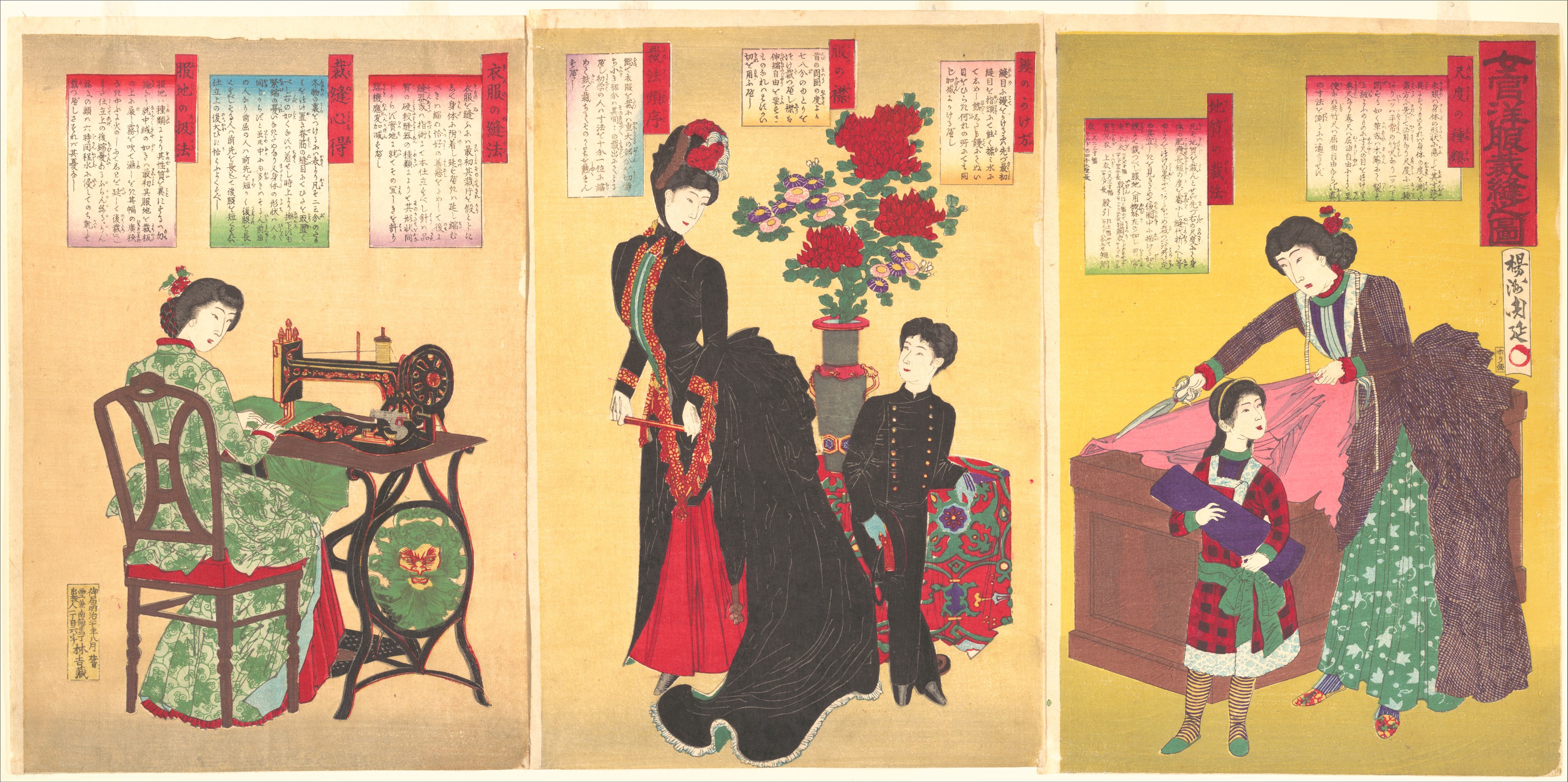
A sewing machine at the center of a revolution
It is tempting to look at an 1887 Japanese woodblock print of court ladies sewing Western clothes and see a charming novelty. The machine is small, the dresses elaborate, the room elegantly appointed. Yet this picture is also a compact argument about who could define modern Japan. A former fighter for the defeated Tokugawa order, Yōshū Chikanobu was now portraying an imperial household that presented European dress and technology as marks of national standing.
The work, Court Ladies Sewing Western Clothing (Jokan yōfuku saihō no zu; 女官洋服裁縫之図), is the October 23 Art Choice. The Metropolitan Museum of Art dates it precisely to August 23, 1887, and identifies it as a color woodblock triptych. At its center stands Empress Shōken in a fitted Western-style gown; a prince appears in school uniform; attendants cut and sew cloth with a machine. The museum interprets the scene in the context of the court’s effort to demonstrate Japan’s equal standing among foreign powers.
One caution changes how we read it: a commercially produced print is not a candid photograph of court life. It depicts what an artist and publisher thought the public would find instructive, prestigious or fascinating. It offers evidence of imagery and aspiration, not proof that every court lady actually worked at that machine in exactly that arrangement.
The painter had once fought the new government
Chikanobu was born Hashimoto Naoyoshi (橋本直義) in 1838, into a family attached to the Takada domain, now associated with Joetsu in Niigata Prefecture. Joetsu City’s museum identifies his father as Hashimoto Naohiro (橋本直恕). He studied within the Utagawa school, including under Utagawa Kuniyoshi and Toyohara Kunichika. His training equipped him to picture warriors, actors, celebrated women and the changing city.
When the Boshin War began in 1868, he did not watch from a studio. Museum records place him among Takada retainers who formed the Shinbokutai (神木隊), fought alongside the former shogunate’s forces, and continued the campaign associated with Hakodate. Accounts differ in compression and detail about his movements and wounds; the secure point is that he fought on the losing side and later resumed his career in Tokyo.
Art history sometimes tells a clean story: the samurai surrendered his sword and picked up a brush. Chikanobu’s life was less neat. He had already learned to draw before war, and the culture of printed images survived across the political rupture. What changed was the audience, subject matter and speed at which modern Japan demanded new pictures.
War pictures before court fashions
The Meiji government was established in 1868, but modernization did not make older visual habits vanish. Prints remained an accessible medium for picturing fresh controversies and unfamiliar objects. Chikanobu’s career gained momentum around the mid-1870s. The Seinan War of 1877 created a market for images of contemporary conflict, and he produced battle prints while competing with other prominent designers.
As photography, lithography and illustrated journalism expanded, woodblock artists had to offer more than documentation. Rich pigments, theatrical groupings, recognizable faces and a persuasive narrative mattered. Chikanobu’s range—warfare, historical heroes, domestic interiors, urban spectacles and fashionable women—was a commercial and artistic response to a changing image economy.
Why Western dress became political
The imperial court’s clothing was never just personal style. It could communicate Japan’s willingness to participate in international diplomacy on terms recognizable to European officials. Machida City’s International Museum of Graphic Arts notes that Empress Shōken began appearing publicly in Western dress in 1886; Chikanobu’s representations of Western-clothed women became one of his characteristic themes in the following years.
The context matters. Treaty revision, institutional reform and diplomatic ceremony placed unusually heavy symbolic demands on the imperial family. The use of imported fashion did not mean Japanese textile culture had been discarded. Nor did the adoption of Western dress proceed uniformly across classes, regions or households. The print captures a courtly model of modernization that could be admired, debated, copied or simply observed from afar.
Its sewing machine is a telling detail. Mechanization was not restricted to factories and railroads; it entered the imagination of home and court, too. A machine set among scissors, patterns and costly fabric makes technological change visible through work traditionally associated with women.
Look closely at what the triptych is doing
The picture’s three-sheet format creates a stage. The figures do not crowd around an engine in a factory; they gather in a carefully arranged interior. The machine belongs to a story about refinement and skill. European silhouettes, the texture of cloth and disciplined gesture suggest that learning new techniques can itself be a patriotic accomplishment.
Yet the arrangement contains contradictions. A court print celebrates agency while presenting women through expectations imposed from above. It foregrounds sewing as accomplishment but does not tell us whose labor produced the fabric, which artisans were displaced, or how women outside elite institutions understood the changes. Those questions belong to the historian looking beyond the frame.
We should also resist reading Chikanobu as either a secret opponent of modernization or an uncomplicated propagandist for it. Neither conclusion can be established from this one print. He drew what was new, what was old, and what audiences remembered or wanted to imagine.
The extraordinary double vision: modernization and nostalgia
In the late 1880s, Chikanobu developed paired interests that Machida’s 2023 retrospective aptly describes as “civilization and enlightenment” and remembrance of the past. His Chiyoda no Ōoku (千代田之大奥), published in the 1890s, reconstructed customs and scenes associated with women in the Tokugawa castle. The National Diet Library preserves a contemporaneous 1894–1896 edition.
This was no simple contradiction. In a society rapidly redesigning its public life, historical costume and courtly memory could become objects of heightened curiosity. The same artist who showed an empress in a bustle could invite viewers into an idealized world of the old inner palace. Both belonged to the Meiji era’s effort to decide what Japan had been and what it might become.
Another celebrated cycle, Shin Bijin (真美人), portrayed modern women and fashionable detail. Chikanobu’s subjects were not one anonymous feminine type: they encompassed actors, courtiers, mothers, historical figures and working lives. They also reflected the limitations of the print market’s perspective, particularly its preference for pleasing or legible ideals of womanhood.
The craft behind a mass image
A nishiki-e (錦絵) was a collaborative product. A designer drew the composition; an engraver cut the blocks; a printer managed color registration and impression; a publisher financed distribution. Those other hands matter in a work whose purpose was reproducibility. A three-panel print could circulate beyond the space its subject represented.
The Met describes this surviving impression as ink and color on paper, approximately 36.4 by 75.4 centimeters across the image. The horizontal spread made a single interior into an event. The sharp outlines, patterned surfaces and chromatic contrasts were achievements of artisanal coordination even as Japan was adopting industrial forms of production.
A remarkable return to Chikanobu in 2026
This October’s selection has a timely local resonance. The Joetsu City History Museum mounted a Chikanobu exhibition from July 18 through October 12, 2026, marking a donation of approximately 1,200 works and presenting around 150 selected pieces across two rotations. The exhibition has ended; this article is not advertising it as currently open.
Joetsu’s interest brings Chikanobu back to the domain-connected community from which he emerged. Machida’s earlier retrospective surveyed his substantial output and noted that he continued adapting even while photographic and lithographic media challenged the woodblock print. Museums are recovering the breadth of an artist too easily reduced to graceful portraits.
What the print can and cannot tell us
The Met’s record secures the date, title, medium, public-domain status and principal figures as interpreted by the museum. Japanese museum records secure the artist’s name and reading—Yōshū Chikanobu, 楊洲周延(ようしゅう・ちかのぶ)—and the larger chronology of his life. The Met lists the work as a gift of Lincoln Kirstein in 1959 and says it is not currently on view.
No document reviewed for this article establishes that Chikanobu personally watched this exact sewing lesson or recorded words spoken by the empress and attendants. The figures should not be treated as eyewitness portraits of a particular private event. Historical art reveals a world, but it does so through design choices, markets, institutions and the politics of looking.
A revolution measured in stitches
Japan’s transformation is often narrated through armies, constitutions, steel mills and railways. In this image, the great argument about the future plays out around cloth. Former retainers became commercial artists; imperial women adopted unfamiliar clothing; hand-carved blocks depicted a mechanical sewing machine.
Chikanobu’s genius was not that he could choose between old Japan and new Japan. It was that he kept showing how the two occupied the same room. More than a century later, the machine still looks unexpectedly modern—and the questions about whose vision of modernity prevailed remain very much alive.
Sources and image provenance
This is an art-historical feature based on published museum records. It is not based on an interview or an on-site inspection. The Joetsu exhibition ended October 12, 2026.