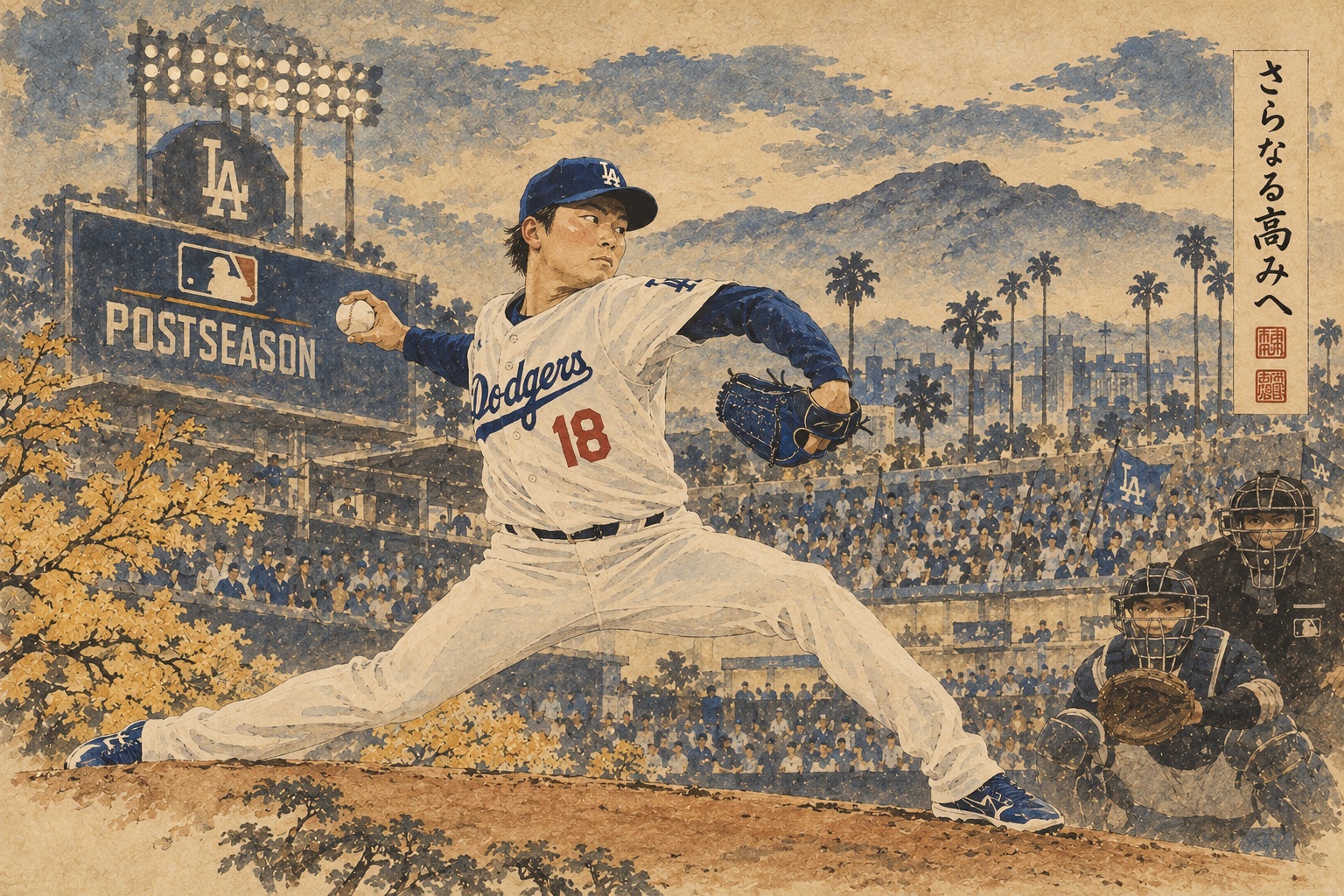
On October 6 at Truist Park in Atlanta, Yoshinobu Yamamoto delivered the kind of start that turns a postseason series. The Los Angeles Dodgers right-hander threw seven innings, allowed four hits and one run, struck out 10 and needed 98 pitches to carry Los Angeles to a 3–1 victory over the Braves. The Dodgers moved ahead 2–1 in the National League Division Series and to within one win of the NL Championship Series.[1]
The opposing starter was Chris Sale, which gave the game another layer. In late August, Sale had shut out the Dodgers 1–0 while Yamamoto pitched well enough to win on most nights. Yamamoto later said that memory made the first run especially important in the rematch.[2]
The game looked like an ace duel from the first inning
Yamamoto opened aggressively. He struck out Drake Baldwin on a curveball, froze Ronald Acuña Jr. with a fastball around 97 mph and retired Matt Olson on a ground ball.
The sequence captured the basic problem hitters face against him. The fastball is hard enough to demand early commitment, the splitter disappears below the zone, and the curveball changes eye level. The pitches come from remarkably similar release patterns.
His only real trouble came in the fifth
Atlanta loaded the bases with one out in the fifth and scored on a Baldwin groundout. Yamamoto avoided the inning that often destroys postseason starts: the crooked-number inning.
That distinction matters in October. Dominance is useful, but damage control is often more valuable. Yamamoto escaped with one run allowed and kept pitching through the seventh.
The rematch with Sale
The August meeting had ended badly for Los Angeles even though Yamamoto pitched effectively. Sale completed a 1–0 shutout, and Yamamoto took the loss because the Dodgers never scored.
In Game 3, Kiké Hernández and Freddie Freeman homered in the fourth inning to give Yamamoto a three-run cushion.[3]
He did the rest.
Dave Roberts chose trust over intervention
Before the game, Dodgers manager Dave Roberts said he trusted Yamamoto “undoubtedly” and intended to give him every opportunity to handle the game himself.[1]
That is meaningful in the modern postseason, where managers often remove starters quickly before a lineup sees them a third time. Roberts allowed Yamamoto to continue because the right-hander was not simply overpowering hitters; he was adjusting within innings.
His previous postseason appearance ended with a World Series trophy
Game 3 was Yamamoto’s first postseason appearance since the final night of the 2025 World Series.
That Series established his MLB postseason reputation. Yamamoto earned three wins across 17 2/3 innings, struck out 15 and, one day after starting Game 6, returned on zero days’ rest to pitch the final 2 2/3 scoreless innings of Game 7. Los Angeles won its second straight championship, and Yamamoto received the Willie Mays World Series Most Valuable Player Award.[4]
He became the first Japanese pitcher to win World Series MVP and the second Japanese player after Hideki Matsui in 2009.[5]
His big-game reputation did not begin in Los Angeles
Yamamoto arrived in MLB with an extraordinary résumé from the Orix Buffaloes.
From 2021 through 2023, he won Japan’s pitching Triple Crown-plus — leading the Pacific League in wins, ERA, strikeouts and winning percentage — for three consecutive seasons. He also won three straight Eiji Sawamura Awards and three straight Pacific League MVP awards.
That stretch established the attributes the Dodgers were buying: command, durability, a deep pitch mix and repeatable mechanics rather than raw velocity alone.
Why a relatively small right-hander creates elite stuff
Yamamoto is not physically imposing by modern MLB starter standards. His effectiveness comes from a delivery in which the body remains connected and the release is difficult to distinguish across pitch types.
The splitter is especially important. It can begin on a fastball plane before diving below the zone. The curveball changes vertical shape and hitter eye level, which in turn makes the fastball appear faster.
Hitters are not simply reacting to speed. They are trying to identify three or four trajectories that look similar until late.
The $325 million question
When Yamamoto came to MLB through the posting system after the 2023 season, the Dodgers signed him to a 12-year, $325 million contract. At the time, it was a record-setting commitment to a pitcher who had not yet thrown a major league pitch.[6]
The doubts were obvious. Could NPB dominance survive the shorter MLB rotation cycle? Would his body hold up? Would the fastball play against major-league power?
2024 was adaptation, not completion
Yamamoto’s first season included a significant shoulder injury and a long absence. He returned in time to contribute to the Dodgers’ 2024 championship run, but the year exposed the adjustment required by MLB travel, pitching schedules, baseballs, mounds and lineups.
His rookie season therefore mattered less as a final verdict than as an adaptation year.
In 2025, he became an ace
Yamamoto threw 173 2/3 innings with 201 strikeouts in 2025, made the All-Star team and finished third in National League Cy Young voting. He was also named to the All-MLB First Team.[6][7]
Then came the postseason and World Series MVP. His standing changed from an expensive international signing to a pitcher already embedded in Dodgers postseason history.
He backed it up in 2026
Reuters reported that Yamamoto finished the 2026 regular season 14–9 with a 2.53 ERA in 28 starts.[8]
MLB’s player data lists 179 innings and 178 strikeouts. Most importantly, he remained in the rotation for a full season and entered October healthy.[9]
Another Japanese star on Ohtani’s team
Shohei Ohtani naturally dominates discussion around the Dodgers, particularly in Japan. But baseball creates nights when one starting pitcher influences the entire game more than any individual hitter can.
Game 3 was one of those nights. Ohtani went hitless. Los Angeles still won because Yamamoto protected a three-run lead for seven innings.
A place in Japanese postseason history
MLB notes that Yamamoto is the third Japanese-born pitcher to strike out at least 10 in a postseason game, after Hiroki Kuroda and Shohei Ohtani.[1]
Kuroda struck out 11 for the Yankees in the 2012 ALCS. Ohtani later joined the group in the 2025 NLCS. Yamamoto’s Game 3 start extends a history in which Japanese pitchers are no longer merely succeeding in MLB rotations; they are deciding October games.
Why Game 3 mattered mathematically as well as emotionally
MLB’s historical data show that teams winning Game 3 after a best-of-five series is tied 1–1 have advanced 48 of 67 times, about 72%.[1]
History guarantees nothing, but Yamamoto changed the Dodgers’ position. Instead of facing elimination, Los Angeles entered Game 4 with two opportunities to finish the series.
“He knows how to finish when it matters”
After the game, Roberts praised Yamamoto’s ability to complete pitches and innings in the highest-leverage moments — what Japanese reporting paraphrased as knowing how to “pitch through the important spots.”[10]
That may be the most useful description of his postseason skill. Three runs of support. A hostile road park. A tied series. Sale on the other side. One swing could change everything.
Yamamoto kept the game in the shape the Dodgers needed.
The postseason version of Yamamoto has begun again
His 10-strikeout night is not the story of a new October hero appearing suddenly. It belongs to a continuous line: three years of domination in Japan, an enormous MLB contract, a difficult first-season adjustment, Cy Young contention, a World Series MVP and now another decisive postseason start.
The Dodgers have not yet won the Division Series. But Game 3 clarified Yamamoto’s place on the roster.
He is no longer best described as the decorated Japanese pitcher the Dodgers paid a record price to acquire. He is the pitcher they trust with the game when the series begins to turn.
Sources and references
- MLB, “Yamamoto (10 K's) dazzles in first postseason appearance since WS Game 7 heroics,” October 6, 2026.
- TV Tokyo Sports, Yamamoto comments on the rematch with Chris Sale, October 7, 2026.
- Reuters, “Yoshinobu Yamamoto, Dodgers take NLDS lead over Braves,” October 7, 2026.
- MLB, Yoshinobu Yamamoto wins 2025 World Series MVP.
- MLB Japan, Yamamoto becomes first Japanese pitcher to win World Series MVP.
- MLB Japan, 2025 NL Cy Young voting and contract background.
- Los Angeles Dodgers, award winners.
- Reuters, Dodgers NLDS rotation and Yamamoto’s 2026 regular-season line.
- MLB, Yoshinobu Yamamoto player statistics and awards.
- TV Tokyo Sports, Dave Roberts reaction to Yamamoto’s Game 3 start, October 7, 2026.
Reporting and verification cutoff: October 7, 2026. The Dodgers led the NLDS 2–1 at the cutoff; advancement to the NLCS was not yet confirmed. Game statistics refer to the October 6 game in Atlanta.