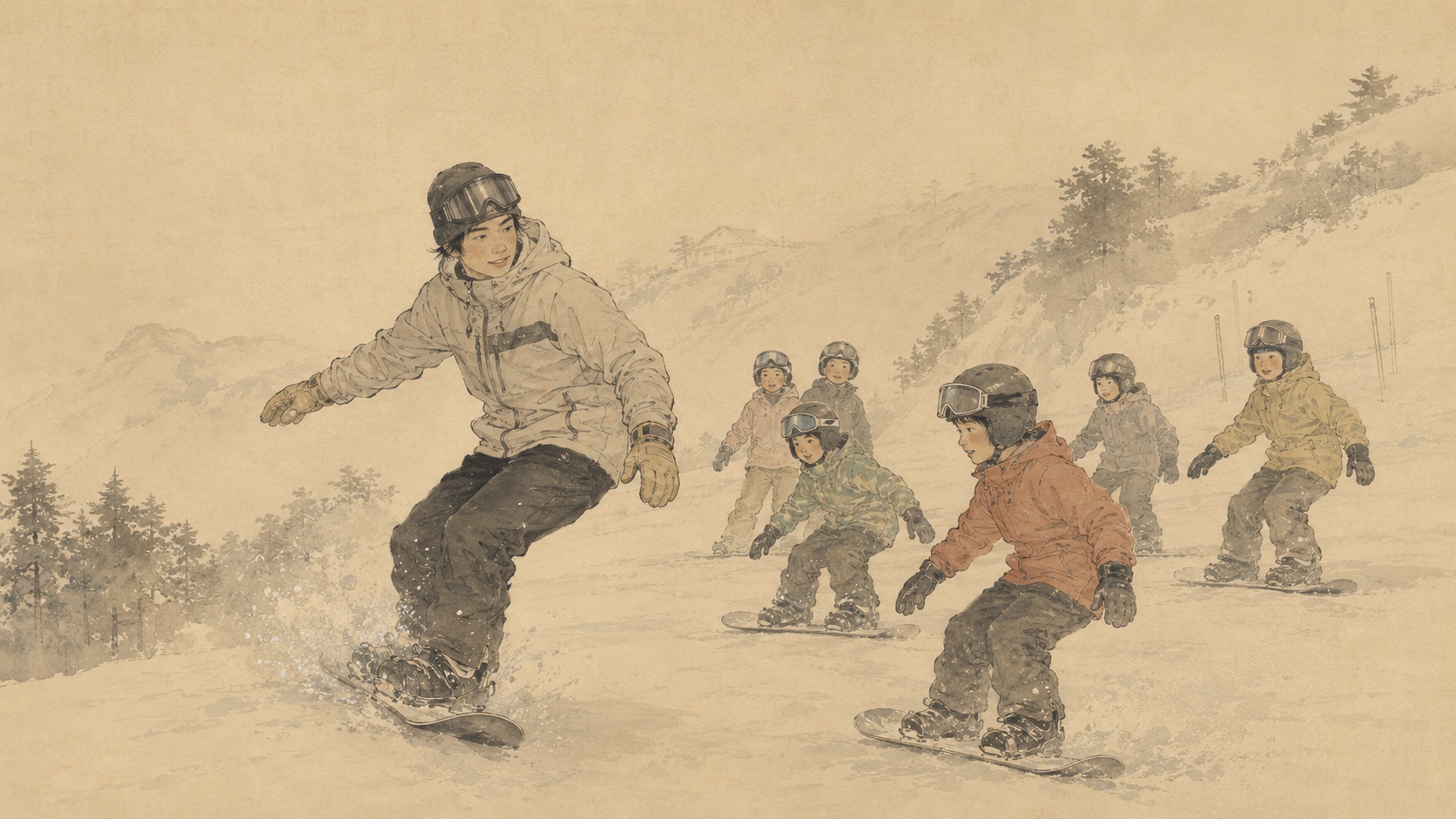
For most children growing up in Yokohama, snowboarding does not begin outside the front door. It begins with logistics: transportation to a mountain, unfamiliar equipment, rental costs, winter clothing, a lesson, and parents who may or may not know how any of it works. Yokohama's new November event is designed to shrink that first step.
On November 1, the city plans to bring roughly 24 local third- through sixth-graders to SNOVA Shin-Yokohama in Tsurumi Ward for a morning aimed at beginners and early-level snowboarders. The special guest is Yuto Totsuka, the Yokohama-raised rider who won men's halfpipe gold at the Milano Cortina 2026 Winter Olympics.
A free event does not make snowboarding a free sport
The city's terms are unusually specific. Applications opened at 10:00 AM on September 3 and close at 11:30 PM on September 23. Applicants must live in Yokohama and be in grades three through six. If applications exceed the roughly 24 available places, participants will be selected by lottery.
The event itself is free. Equipment and clothing rentals, when needed, are not; those costs are the participant's responsibility. Yokohama and the Yokohama Ski Association are the organizers, while Yonex — Totsuka's sponsor and employer affiliation in Olympic records — is listed as a cooperating company.
That cost structure gets at a larger question in winter-sport participation. Snowboarding has more front-end friction than many everyday youth sports. A family needs a board and boots or access to rentals, winter clothing, gloves and often protective equipment. A mountain day normally adds transportation and lift access. Before a child decides whether the sport is fun, a household may already have made a substantial commitment.
An indoor snow facility changes the equation. It cannot eliminate equipment costs, but it can detach a first session from a long trip to a mountain and from the uncertainty of natural snowfall. That is particularly relevant in a major coastal city whose children may watch Olympic snowboarding more easily than they can try it.
Yokohama's planned snowboard experience
| Item | Details |
|---|---|
| Date | Sunday, November 1, 2026, 8:30 AM–12:00 PM; check-in from 8:15 |
| Venue | SNOVA Shin-Yokohama, 1-2-43 Kajiyama, Tsurumi Ward, Yokohama |
| Eligible children | Yokohama residents in grades 3–6; beginners and early-level riders |
| Capacity | Approximately 24; lottery if oversubscribed |
| Cost | No participation fee; equipment/clothing rental at participant expense |
| Applications | September 3–23 through Yokohama's electronic application system |
| Organizers | City of Yokohama and Yokohama Ski Association |
| Cooperation | Yonex Co., Ltd. |
| Special guest | Yuto Totsuka |
The Olympic champion is returning to the city that raised him
Yokohama's description of Totsuka as a local athlete is not merely ceremonial. When Mayor Takeharu Yamanaka presented him with the Yokohama Sports Honor Award on April 27, the city explicitly described him as having been raised in Yokohama.
Ichisawa Elementary School went further in its February school bulletin: Totsuka is an alumnus. JOC Olympic materials list Yokohama Municipal Tanimoto Junior High School later in his education, followed by Komyo Gakuen Sagamihara High School and Nippon Sport Science University.
His childhood sports timeline makes the November event especially resonant. JOC says Totsuka began snowboarding at age two, discovered halfpipe in the lower elementary grades, and obtained Japan Snowboard Association professional status in fifth grade.
Yokohama's event is for grades three through six — almost exactly the age window in which Totsuka himself moved from simply riding to serious halfpipe competition.
His Olympic story starts with a crash, not a medal
Totsuka's career is more useful to children when the difficult parts are left in it. At PyeongChang 2018, the 16-year-old reached the men's halfpipe final but crashed on his second run and did not complete the competition. He finished 11th.
He continued upward. In the 2020-21 season he won Winter X Games SuperPipe for the first time. In 2021 he became world champion. At Beijing 2022, however, the Olympic result was again outside the medals: 10th place.
Milano Cortina 2026 was his third Games. In the February 13 final, Totsuka scored 90.00 on his first run and 95.00 on his second, beating Australia's Scotty James for gold. Ryusei Yamada took bronze at 92.00, with Ruka Hirano fourth and Ayumu Hirano seventh.
In a JOC interview published in July, Totsuka said winning Olympic gold fulfilled a goal he had carried since childhood. That makes him a particularly powerful guest for a beginner event — not because his path was inevitable, but because it took three Olympics to reach the result that now defines him publicly.
Snowboarding entered the Olympics in Japan — and Japan was nowhere near today's level
The sport's Olympic history is still young enough to fit inside a generation. Snowboarding made its Olympic debut at the Nagano 1998 Winter Games, with men's and women's giant slalom and halfpipe.
JOC's contemporary preview described snowboarding as a sport believed to have emerged in the United States in the 1960s and explained halfpipe to Japanese audiences as a freestyle event judged on height, difficulty and execution.
Japan entered four men and two women in the Nagano halfpipe events. Every one of them was eliminated in qualifying. The gap between domestic enthusiasm and the world's best was obvious.
Twenty-eight years later, the 2026 Olympic men's final looked almost inverted: Totsuka won gold, Yamada won bronze, Ruka Hirano finished fourth and Ayumu Hirano seventh. Japan had gone from no halfpipe finalist at its home Olympic debut to four men inside the top seven.
1998: Snowboarding debuts at the Nagano Winter Olympics; all Japanese halfpipe riders exit in qualifying.
2001: Yuto Totsuka is born in Kanagawa Prefecture.
Age 2: Begins snowboarding.
Lower elementary school: Encounters halfpipe.
Grade 5: Earns Japan Snowboard Association professional status.
2018: Olympic debut at PyeongChang; 11th in halfpipe after a final-round crash.
2021: World champion.
2022: 10th at the Beijing Olympics.
Feb. 2026: Wins Olympic halfpipe gold with 95.00.
Apr. 2026: Receives Yokohama Sports Honor Award.
Nov. 2026: Scheduled to join Yokohama's beginner snowboard event as special guest.
For urban children, access comes before talent
A child cannot discover an aptitude for snowboarding without first reaching snow. That sounds trivial, but it is the core participation problem for a winter sport in metropolitan Japan.
Families with no skiing or snowboarding background face a chain of unfamiliar decisions: where to go, what to rent, which boot size is correct, what clothing is needed, whether to book a lesson, how to fall safely, and what rules apply around other slope users. The first barrier can be organizational rather than athletic.
An indoor facility is one way to shorten that chain. It offers snow without requiring a resort trip and allows an event to be scheduled independently of an early-season snowfall pattern. For a city program, that makes a controlled beginner session possible months before many families would otherwise plan a mountain day.
The limited capacity — about 24 — can be read two ways. In a city of more than 3.7 million people, it is tiny. It cannot by itself change participation rates. But beginner snow sports also require close attention to equipment, balance, stopping, falling and spacing. A smaller group can be an advantage if the objective is a safe first experience rather than a mass festival.
Yokohama has not published the instructor-to-child ratio, detailed lesson plan, protective-equipment requirements or the exact portion of the session in which Totsuka will appear. Those details should not be invented.
Japan's governing body is also trying to make the first step smaller
The same participation logic is visible at the national level. The Ski and Snowboard Association of Japan has developed a child-oriented ski and snowboard challenge that begins literally with putting the board on and works toward basic sliding skills.
In 2026, SAJ also described its slopestyle and big-air clinics as part of a pathway from participation to athlete development, emphasizing safe training and cooperation with regional facilities and instructors.
The message is important: elite development does not begin with an elite trick. It begins with making the first encounter safe enough and enjoyable enough that a child chooses to come back.
Totsuka's presence in Yokohama can reinforce that message without turning the event into a talent identification camp. His biography provides the long view; the lesson on November 1 can remain small.
Yokohama is trying to turn an Olympic medal into participation
In April, the city honored Totsuka. In November, it plans to put him in the same space as children trying the sport. Those are two different uses of an Olympic medal.
An award looks backward, recognizing achievement. A participation event points forward. Yokohama has not officially labelled the snowboard session an “Olympic legacy” project, so it would be too strong to present that phrase as city policy. But as Japan.co.jp analysis, the structure resembles a small legacy program: convert the visibility of a local champion into a chance for residents to try the activity that produced the medal.
The city has used a similar participation model in other sports. Kohoku Ward's 2026 urban-sports program, for example, offers beginner skateboard sessions for elementary-school children starting with safety rules, standing on a stationary deck and basic movement before progressing.
That is the more meaningful comparison to the November snowboard morning than Olympic competition itself. The question is not how high a child can jump. It is whether the first 45 or 60 minutes make the sport feel possible.
Twenty-four places are not a participation strategy by themselves
Demand may exceed supply. If it does, Yokohama's response is a lottery. That protects fairness, but it also exposes the event's central limitation: only a very small number of children can attend.
If the city wants the effect to extend beyond one November morning, the next layer would matter: repeat sessions, links to local instructors, information for families about affordable follow-up opportunities, or other ways to reduce the second-visit barrier after the first experience.
None of those follow-up measures has been announced as part of this program, so they remain possibilities rather than commitments.
The event's success therefore should not be judged by whether it “creates an Olympian.” A more realistic measure would be whether children leave wanting another day on snow — and whether families have a practical way to give them one.
The best outcome is not “the next Totsuka”
Sports stories about children often reach too quickly for the phrase “the next champion.” That is not what Yokohama's application page says. The audience is beginners and early-level riders, not selected prospects. The stated purpose is to let children experience the fun and attraction of snowboarding.
Totsuka began at two. The children invited in November are older. Some may never compete. Some may decide immediately that snowboarding is not for them. That is normal. Participation is valuable even when it does not become a pipeline.
In 1998, Japan hosted snowboarding's Olympic debut and did not put a single halfpipe rider into the final. In 2026, a rider raised in Yokohama became Olympic champion. Now the same city is offering two dozen children a morning on snow with that champion in the room.
The most important moment will not be a trick. It may be much smaller: fastening the bindings, standing sideways, sliding a few metres, stopping without panic — and wanting to do it again.
Sources
- City of Yokohama, press release announcing the beginner snowboard experience — September 3, 2026; date, venue and Yuto Totsuka's role as special guest.
- City of Yokohama, event information page — grade levels, capacity, application dates, cost, organizers and Yonex cooperation.
- Japanese Olympic Committee, Yuto Totsuka athlete profile — birth date, affiliation and Olympic record.
- JOC, Milano Cortina 2026 Medalists' Voices: Yuto Totsuka and Ryusei Yamada — Totsuka began at age two, found halfpipe in elementary school, became a professional in fifth grade, and discusses his Olympic journey.
- JOC, February 13 Milano Cortina 2026 snowboard results — Totsuka's 95.00 gold-medal score and Japanese finalists.
- City of Yokohama, Yuto Totsuka receives the Yokohama Sports Honor Award — April 27, 2026; city describes Totsuka as raised in Yokohama.
- Yokohama Municipal Ichisawa Elementary School bulletin — identifies Totsuka as an alumnus and recounts his childhood snowboarding path.
- JOC, Milano Cortina 2026 Team Japan handbook — education history including Yokohama Municipal Tanimoto Junior High School.
- JOC, Nagano 1998 snowboard preview — snowboarding's Olympic debut and contemporary explanation of halfpipe.
- JOC, Nagano 1998 halfpipe results — all Japanese halfpipe riders eliminated in qualifying.
- Ski and Snowboard Association of Japan, child beginner ski/snowboard challenge — beginner pathway from putting equipment on to basic riding skills.
- Ski and Snowboard Association of Japan, 2026 slopestyle/big-air clinics — safe training and linkage from participation to development.
- Yokohama Kohoku Ward, 2026 urban-sports experience program — comparison with the city's beginner-oriented skateboard participation model.
This article was checked against public information available by 5:05 AM JST on September 4, 2026. Yokohama's Japanese primary materials are the controlling source for the official event title, date, eligibility, capacity, organizers and application terms. The city calls Yuto Totsuka a “special guest”; it does not publicly describe him as the instructor responsible for direct coaching of all participants. The event title uses “first snowboard experience,” but eligibility also includes early-level riders, so the article does not assume every selected child will be snowboarding for the first time. The public page did not provide a detailed lesson curriculum, Totsuka's appearance schedule, whether he will give individual instruction, rental prices or complete protective-equipment rules; those details are not inferred.
Image rights: © 2026 Japan.co.jp. AI-assisted editorial illustration. Unauthorized republication or reuse is prohibited. For licensing, use the contact page.