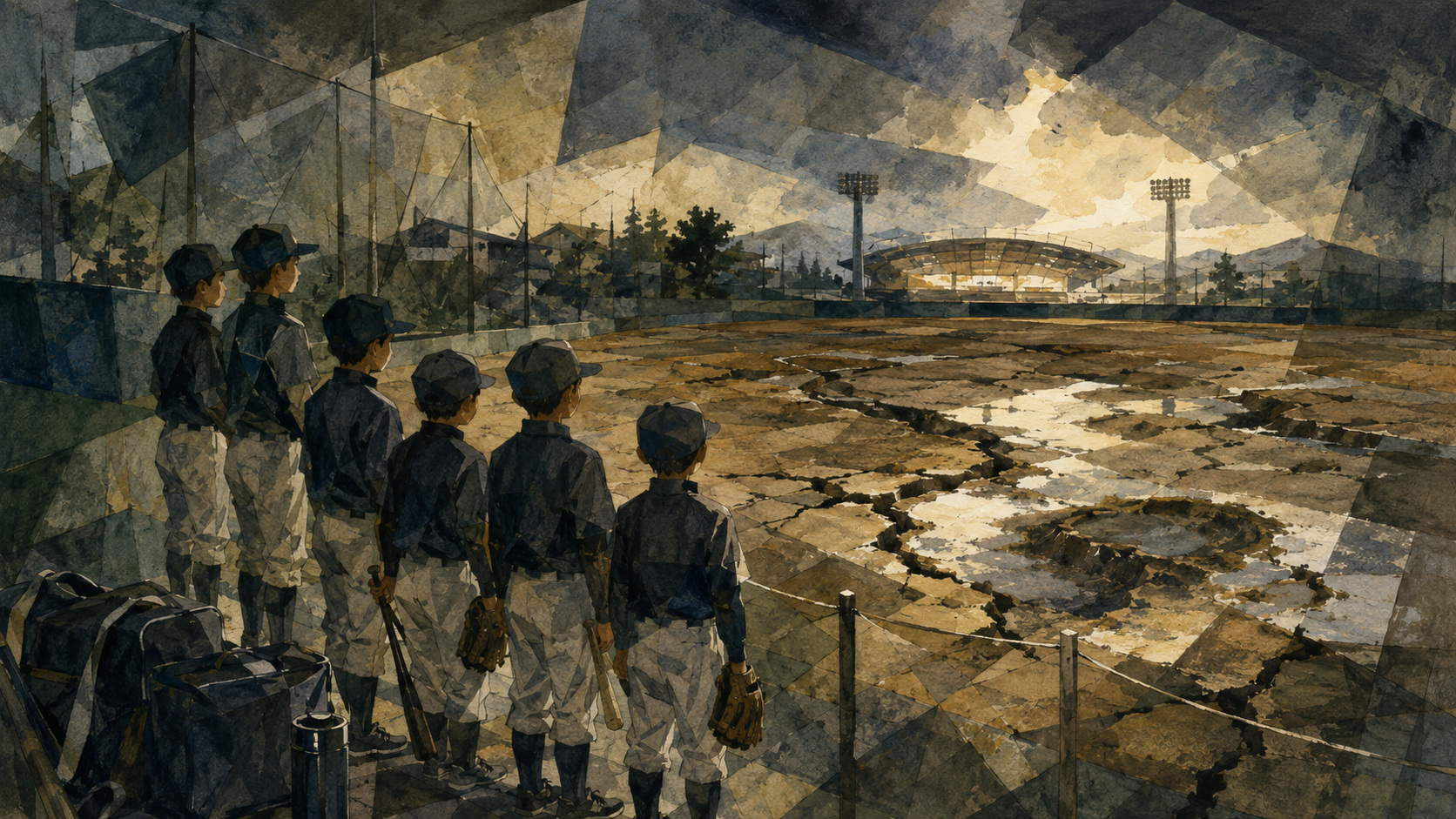
On August 10, the first victory was simply getting 17 children into the same place.
They could not step onto the field where they had trained. They gathered instead in an open area nearby. Some had been living through evacuation; some through water outages. For days, the 22 elementary-school players of the Guts Youth Baseball Club had been dispersed by the routines of disaster—where the family could sleep, where water could be found, what road could be used, which adult had time to drive.
Coach Keisuke Tajima gave them instructions that were ordinary on purpose. Practice properly whenever the group could assemble. Do what could be done at home. And do the summer homework. The message joined baseball to school and both to daily life: the field was closed, but the calendar had not disappeared.
The club had spent 12 years creating repetition—throw, catch, field, run, cover, encourage. The magnitude 7.1 earthquake of July 28 broke the place that held that repetition. The ground cracked. Some liquefied areas changed color. Uneven steps appeared. Practice and games stopped.
One player wanted to play anywhere, even if it had to be somewhere different. Another wanted baseball back as quickly as possible. Their impatience was not a demand that safety be ignored. It was a child’s precise description of what the disaster had taken: not the sport in the abstract, but the next time everyone would arrive together.
When Dirt Stops Behaving Like Ground
At 4:27 PM on July 28, the earthquake struck beneath the Kumamoto region at a provisional depth of 16 kilometers. Japan’s Meteorological Agency measured magnitude 7.1 and intensity 7—the top of the national seismic scale—in Uki City and Hikawa Town. Severe shaking spread across the region, and the effects continued after buildings stopped moving.
Liquefaction is one of those afterlives. In loose, water-saturated soil, grains ordinarily touch and support one another. Strong shaking raises the pressure of water between them and disrupts that contact. For a short time, the ground loses strength and behaves more like a liquid. Water and sand can erupt at the surface; soil can settle unevenly; buried pipes can rise; the ground can move sideways toward a lower edge.
On a baseball field, the visible evidence may look almost modest beside a collapsed house: a brown stain, a crack, a ridge. But a runner hits the edge of a base at speed. An infielder moves laterally while watching a ball. A child charging a grounder trusts the next footfall without looking down. An unpredictable step is not cosmetic. Nor is the surface necessarily restored because a crack has disappeared from view.
Yatsushiro City said it intended to fill the club ground’s cracked sections with soil. That is a concrete first action, not a published completion standard. As of the reporting cutoff, the city had not announced when the team could return. The public record did not say whether the site would require subsurface testing, regrading, drainage work or only localized repair. Those questions should be answered by qualified inspection, not inferred from television images.
The scarcity of alternatives is visible elsewhere. On July 29, the city initially suspended use of all 24 municipal sports facilities while staff and specialists inspected earthquake damage; facilities judged unsafe were to remain closed. Separately, the prefectural baseball stadium and surrounding Yatsushiro Sports Park sustained settlement, uplift and more than 20 identified liquefaction sites. That park lies on reclaimed coastal land and had also liquefied in places during the 2016 earthquake. With no reopening date, high-school officials were considering other venues for the autumn prefectural tournament.
“Find Another Field” Is Not a Complete Plan
Baseball appears portable. A glove, a ball and another person are enough for catch. A wall can return a throw. A towel can stand in for a pitching drill; footwork and swings can be rehearsed without a diamond. Tajima’s advice recognized that continuity can begin at home.
But a team cannot be reduced to 22 separate home workouts. Coordinated fielding, live batting, baserunning, situational judgment and the small communications between positions require shared space. A borrowed field also requires an available time, transport, adult supervision, equipment storage, toilets, shade, water and assurance that the route is safe. In a disaster, each requirement competes with household repair, disrupted work and evacuation.
August heat adds another constraint. The Japan Sport Association’s exercise guidance says activity should generally stop at a wet-bulb globe temperature of 31°C or higher, especially for children; at 28°C or higher, strenuous exercise should be avoided and frequent rest, water and salt replacement are required. A paved corner or an exposed vacant lot is not automatically a safe substitute merely because its ground is level.
A workable temporary program therefore needs more than permission. It needs a broker: the city, school, league or neighboring clubs coordinating space and times; transport help for displaced families; flexible attendance; heat monitoring; water and shade; and low-intensity ways for children to rejoin before they are ready for full practice.
| Recovery stage | What the players need | What adults must solve |
|---|---|---|
| While the field is closed | Safe reunions, catch, mobility and low-risk skill work | Accessible meeting space, transport, water, shade and communication |
| Temporary practice | Enough shared space for team drills and renewed routine | Borrowed-field scheduling, insurance, supervision and heat rules |
| Return to the home field | A level, predictable surface and safe facilities | Inspection, repair criteria, drainage checks and a public reopening decision |
| Return to games | Gradual conditioning, confidence and fair competition | Rescheduling that does not punish teams for disaster-related absence |
The club’s immediate goal was not to reproduce its old training load on improvised ground. It was to preserve connection until a safe field could hold the full game again.
The Ball Japan Invented for Children
There is a long history behind the assumption that a child in Japan should be able to find a place to play baseball. The game was introduced in 1872 by American teacher Horace Wilson. Schools and universities helped it spread, and in 1915 the first national middle-school championship—the ancestor of the summer Koshien tournament—brought 10 representative teams to Toyonaka.
The hard leather ball, however, was expensive and dangerous for children. In Kyoto, primary-school teachers and other members of a youth-baseball study group tried to design something cheaper, safer and durable. In 1918, stationery merchant Sakae Suzuka devised a rubber ball with raised surface patterns inspired, according to the Baseball Hall of Fame and Museum, by the tread of a shoe. The “children’s ball” entered mass production and spread nationwide.
That invention did more than replace leather with rubber. It lowered the threshold for entry. Children could play in smaller spaces, with less severe consequences from a misjudged catch. Nanshiki, or rubber-ball baseball, became a distinct Japanese sporting culture extending from school-age teams to adults. The public report on Guts does not specify its league affiliation or ball standard, so this article does not assign it one. The club nonetheless belongs to the wider youth-baseball world that the safer ball helped create.
Koshien Stadium opened in 1924 because the school tournament had outgrown its earlier grounds. It could hold more than 50,000 people from the beginning. By 1927 the summer games were carried live on radio. A local children’s game and a national ritual became connected by imitation: a stance copied from a broadcast, a batting order written like a high-school lineup, a dream placed years ahead.
1872 Horace Wilson introduces baseball in Japan.
1915 The first national middle-school championship is played.
1918 Sakae Suzuka invents a rubber ball for children.
1924 Koshien Stadium opens and hosts the national tournament.
1927 Live radio makes the summer tournament a shared national event.
Around 2014 The Guts Youth Baseball Club begins the 12-year history reported in 2026.
2026 A broken local diamond and Koshien’s illuminated one become part of the same story.
The Ninth Inning Reached Yatsushiro
Ariake High School entered this summer as a first-time representative from Kumamoto. Its baseball program was in its 30th year. On July 24, Ariake beat defending prefectural champion Tokai University Kumamoto Seisho 4–1 to win the Kumamoto tournament. Four days later, the earthquake struck.
At Koshien on August 7, Ariake faced Kyoto representative Ritsumeikan Uji. It trailed entering the late innings. In the ninth, two outs had already been recorded when an error and a walk helped load the bases. Leadoff hitter Haruki Nagata drove a two-run double to center to turn the game. Another run followed on an error; Ariake won 6–3. It was the school’s first victory at Koshien.
For the Guts players, the compelling part was not celebrity. One child told KAB that seeing everyone fight without giving up until the end was moving. That lesson traveled cleanly: the field could be unusable without the team itself being finished.
The connection ran deeper than the score. Ariake’s captain had been a second-grader in Nishihara Village during the 2016 Kumamoto earthquakes. His home was half destroyed, and he spent two to three years in temporary housing. His youth team’s practice ground became a debris storage site. He remembered playing catch with his father and finding brief chances to play with friends when ordinary baseball was impossible. The experience taught him that being able to play was not guaranteed.
Ten years later, he went to Koshien just after another Kumamoto earthquake, while elementary-school players in Yatsushiro were learning the same fact. The inspiration was therefore not a slogan projected downward from a distant stadium. It was recognition moving between two generations of children shaped by interrupted fields.
Ariake’s second-round game against Nagasaki Nihon University High School was scheduled for August 13 at 1:00 PM JST—more than three hours after this edition’s 9:52 AM information cutoff. This article records the anticipation, not a result that was not yet known at the stated reporting time.
Baseball Has Met Disaster Before
Japanese baseball history contains repeated arguments over whether play should continue after catastrophe. Each decision takes place amid mourning and scarce resources. Playing can appear insensitive; cancelling can remove one of the few shared structures left. There is no rule that resolves the tension. The history instead shows organizers changing the meaning and manner of play.
Two months after the 1995 Great Hanshin-Awaji Earthquake, the spring invitational was held at Koshien without brass-band instruments and with measures intended to reduce the burden on the damaged region. That summer, visible earthquake scars remained and teams and cheering sections traveled to the stadium by train.
In 2011, the spring tournament opened 12 days after the Great East Japan Earthquake. Organizers cancelled the opening parade, prohibited instrumental cheering and adopted “Ganbarō! Nippon” as the theme. The following spring, Ishinomaki Technical High School from a heavily damaged city was selected through the 21st-century slot. These events became symbols, but symbols did not rebuild the towns from which the players came.
In 2016, the same contradiction reached Kumamoto’s local grounds. Some became relief or debris sites precisely because a flat, accessible athletic space is valuable during an emergency. A field can serve a community by ceasing to be a field. The cost is borne partly by children whose routine disappears.
Now the 2026 earthquake has placed those histories inside living memory. Ariake’s captain is not an abstract link to 2016; he was the child without a ground. The Guts players are not merely the audience for a heroic story; they are its next witnesses.
Why Returning to Play Matters—and Why It Is Not Therapy
Disaster recovery for children is often described in the language of resilience. The word can be useful, but it can also ask children to perform strength for adults. A child may be eager to play and still frightened by aftershocks. Another may miss practice because the family is displaced. Neither response is failure.
Education and humanitarian guidance emphasizes safety, routine, play and time with peers as parts of psychosocial support. UNICEF describes child-friendly spaces as places where children can re-establish routines, play, study, express feelings and spend time with other children. Japan’s education guidance defines emergency support as protecting physical and psychological safety, securing a sense of reassurance and helping normal school systems return.
A baseball club can provide some of those conditions: known adults, familiar teammates, rules that make the next action understandable, movement after days in restricted spaces, and a role that is not “evacuee.” Tajima’s reminder about homework is important for the same reason as his reminder to practice. Both tell a child that disaster has not consumed every identity.
But a coach is not a clinician, and baseball is not a mental-health treatment. Persistent distress, sleep problems, withdrawal or other serious changes require attention from families, schools and qualified professionals. A team should make room for conversation without compelling children to recount the earthquake, and should welcome partial participation without using attendance as proof of commitment.
The most humane definition of return is therefore not “all 22 resume full practice immediately.” It is that all 22 remain invited: the child in a shelter, the child without a ride, the child whose glove is under debris, the child ready to sprint and the child who only wants to watch.
Repair the Network, Not Only the Crack
Yatsushiro’s announced soil repair may return the surface to use. Before reopening, the public deserves clarity about who inspected the site, what was repaired, what conditions were checked and what would trigger another closure after an aftershock or heavy rain. The children do not need a technical report in their hands; parents and coaches need a decision they can trust.
The larger recovery is a scheduling and access problem. When municipal facilities are inspected or closed and the prefectural stadium is unavailable, every displaced team looks toward the same smaller pool of diamonds. Priority rules, evening slots, transport distances and field maintenance become recovery policy. Without coordination, clubs with more money, vehicles or adult time recover first.
A fair plan would publish facility status in one place, broker temporary sharing among schools and clubs, support transport for displaced families, protect rest and heat limits, and preserve meaningful game opportunities after training resumes. It would also record where liquefaction occurred, so the next repair begins with knowledge rather than surprise.
Not every part of the old schedule can be saved. Nor should children be rushed into competition to create an uplifting image. Progress can be measured more quietly: a safe catch session, 17 players becoming 18, an infielder trusting the dirt, a family able to say yes when practice is announced.
| Question for recovery | Evidence available by the cutoff | What remains unanswered |
|---|---|---|
| What happened to the club field? | Cracks, discoloration in liquefied areas and surface steps made it unusable | Named site, full technical assessment and damage dimensions |
| What will the city do? | Fill cracked areas with soil and repair them | Completion date, inspection criteria and reopening date |
| Can the club practice elsewhere? | Players gathered in a nearby open area; home practice was encouraged | A regular temporary diamond, transport and game schedule |
| How wide is the facility problem? | 24 city sports facilities initially paused for inspection; serious separate damage at the prefectural stadium | Current capacity across the whole network as facilities reopen |
The Next True Bounce
A baseball diamond is measured space. The bases hold their places; the foul lines settle disputes; the mound and plate organize every pitch. For a child, that geometry offers a small promise: if you learn the rules and your teammates do the same, the next play can be understood.
Liquefaction broke that promise in physical form. The ground moved after everyone had treated it as fixed. The repair must therefore accomplish more than smoothing the dirt. It must restore confidence that the surface, the schedule and the adults responsible for both are dependable.
The Guts players already know what their distant models did with two outs. Ariake did not win because hope changed the score. It stayed in the game long enough for an error, a walk and Nagata’s double to change it. That distinction matters. Determination needs an opportunity in which to act.
For 22 children in Yatsushiro, that opportunity begins with somewhere safe to put down four bases. The next true bounce will be a small sound. After an earthquake, it will also be evidence: the field is ground again, and the team has a place to become a team.
Reporting Notes and Principal Sources
This article uses KAB’s August 12 club report as its central source and preserves the edition cutoff of August 13 at 9:52 AM JST. The Guts practice ground was not named in public reporting and is not identified here as the separately damaged prefectural stadium. The club’s league affiliation and ball type were also not specified. Technical discussion explains liquefaction generally and is not a substitute for a site assessment. Child-recovery guidance is contextual; no clinical claim is made about individual players.
- KAB: Guts Youth Baseball Club, 22 members, 17-player reunion, field damage, city repair plan and Ariake inspiration
- NCC/TV Asahi network report: evacuation, water outages, interrupted games and the August 10 gathering
- Japan Meteorological Agency: July 28 earthquake time, magnitude, depth and observed intensity
- Yatsushiro City: inspection and staged reopening policy for 24 municipal sports facilities
- Television Kumamoto/FNN: separate damage at Prefectural Yatsushiro Baseball Stadium and Sports Park
- Ministry of Land, Infrastructure, Transport and Tourism: how liquefaction occurs and why its effects can persist
- KAB: Ariake’s 6–3 first-round win, ninth-inning comeback and first Koshien victory
- KAB: Ariake’s first Kumamoto title, 4–1 final and first national-tournament qualification
- KAB: Ariake captain’s 2016 earthquake experience, temporary housing and lost youth practice ground
- Japan High School Baseball Federation: national championship history from 1915
- Japan High School Baseball Federation: tournament responses after the 1995 and 2011 earthquakes
- Nippon Professional Baseball: Japan baseball timeline, including the 1872 introduction and 1918 rubber ball
- Baseball Hall of Fame and Museum: Sakae Suzuka and the child-oriented rubber ball
- Japan Sport Association: exercise and heat-illness prevention guidance
- UNICEF: safe spaces, routine, play, study, expression and peer contact for children affected by crisis
- Ministry of Education: emergency support, children’s safety, reassurance and return of normal school systems