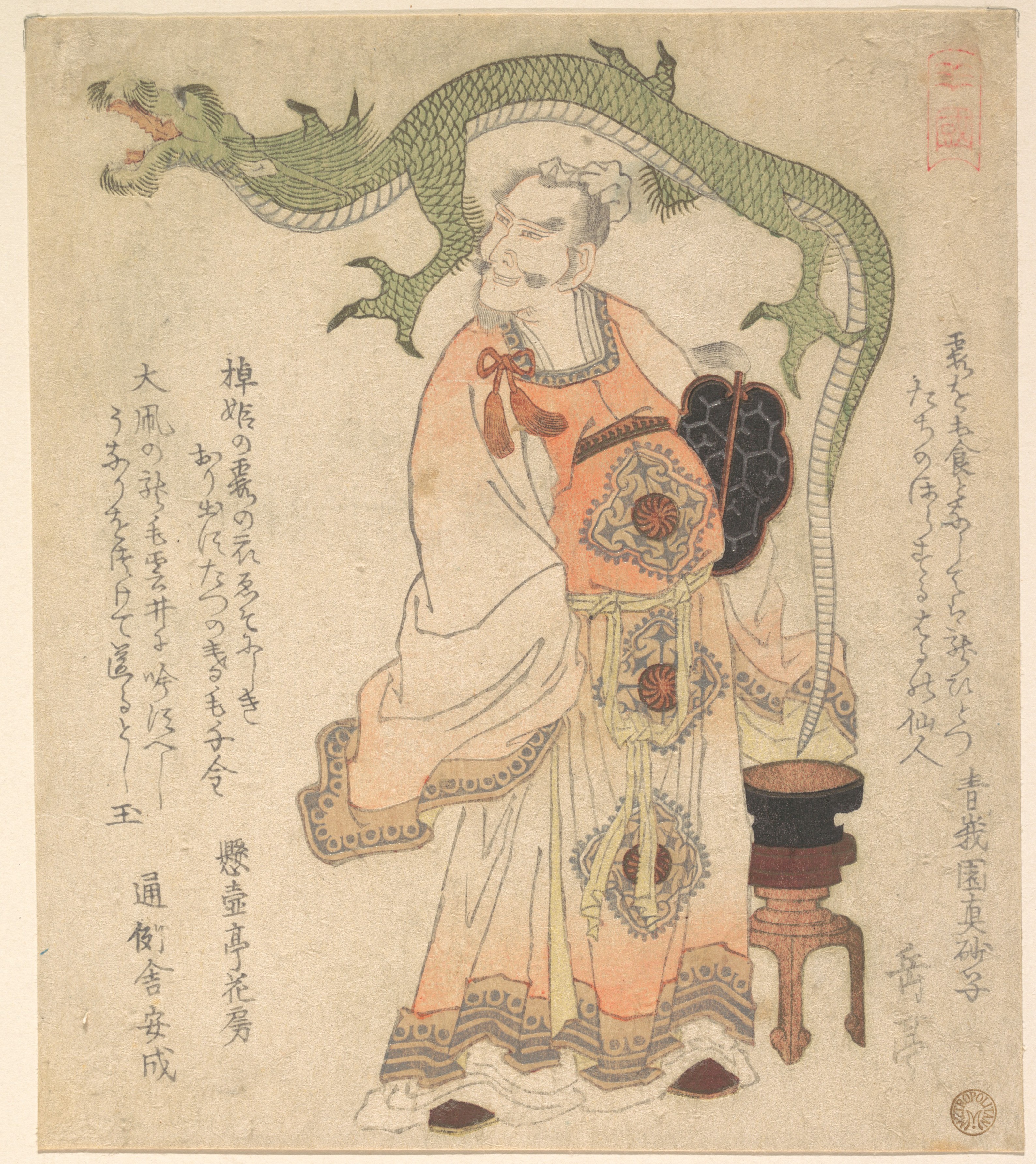
A sage summons a dragon across a sheet barely eight inches high. The image survives not as an imposing scroll but as a small, privately commissioned woodblock print. Around 1825, Yashima Gakutei produced a work now titled Chinese Sage Evoking a Dragon. Two centuries later, the Metropolitan Museum of Art in New York identifies it as public domain, gives it catalogue number JP1107, and makes the work accessible to readers far beyond the circle for whom prints like it were originally made.
The luxury hidden in plain sight
The great surprise of surimono is that scarcity, rather than mass distribution, could produce extravagance. Many were commissioned by poetry clubs or individual enthusiasts to celebrate the New Year, a gathering, or a successful poem. Unlike commercial prints that publishers hoped to sell to broad audiences, these objects often moved through networks of people who knew one another. That social economy helped make expensive papers, subtle pigment gradations, metallic effects and blind embossing possible. The print was simultaneously a picture, a literary encounter and a gift. It was designed to reward attention.
An object with a precise identity
The Met dates Chinese Sage Evoking a Dragon to approximately 1825, attributes it to Yashima Gakutei and records its medium as ink and color on paper, produced through woodblock printing. Its dimensions are 20.3 by 17.6 centimeters (8 by 6 15/16 inches). The work entered the museum through the Rogers Fund in 1919 and is not currently on view, according to the collection record. Its identification as an Edo-period surimono is secure; identifying every mythological reference inside the composition is another matter. The museum’s English title does not, by itself, establish the exact text, poem or narrative source of the scene.
The print that asked to be read
Surimono were not merely miniature ukiyo-e. Many included kyōka, a playful form of thirty-one-syllable Japanese verse whose wit might depend on allusion, homophones, season, local customs and the identity of its recipient. A poem could elaborate on an image or make its apparently straightforward imagery newly ambiguous. A dragon might call to mind auspicious power or Chinese narrative, but the exact significance of this dragon demands specific iconographic and inscriptional evidence. An international reader can appreciate the visual ambition while recognizing that part of its intended literary conversation remains hard to reconstruct.
Who was Yashima Gakutei?
Gakutei is generally dated to approximately 1786–1868. Bates College Museum of Art describes him as born in Osaka, a student of Totoya Hokkei and Hokusai, a prolific kyōka poet and an artist particularly skilled in embossed prints. Yet early Japanese biographical traditions also connect his origins to Edo locations including Kasumigaseki and Aoyama. Japanese reference material lists several names or artistic identities, including Gakutei Kyūzan, Harunobu and Sadaoka. These differences are not a reason to dismiss the evidence; they are a reminder that an artist’s modern biography is assembled from records written for different purposes and at different times.
Beyond Hokusai’s shadow
The famous name Hokusai can help international audiences find Gakutei, but it can also obscure him. His career brought together illustration, popular literature, poetry and fine printing, not merely imitation of another master’s designs. Studies connect him particularly with Totoya Hokkei, himself celebrated for surimono. The important historical point is not to build an imagined intimate apprenticeship scene: the chronology and nature of particular relationships vary across accounts. It is that Gakutei worked within an extraordinarily inventive print-and-poetry network and developed a voice visible in his surviving objects.
When blank paper became an image
Blind embossing, often called karazuri, creates raised patterns by pressing paper with carved blocks without relying on visible ink. The result may emerge only as light slides across the surface. Bates College describes the embossed folds and white textile patterns in Gakutei’s print of a courtesan representing the deity Benzaiten. An Amherst College exhibition checklist identifies metallic printing and delicate gradation in a Gakutei carp print. Such observations are evidence for his technical versatility. They should not be transferred uncritically to every individual object: the exact techniques of the dragon print require direct examination or object-specific documentation.
A wider geography of imagination
The motifs in Gakutei’s work could travel across literary and religious borders. His subjects ranged from celebrated poets to fish, legendary figures and the world of pleasure and performance. The Met holds his depiction of the ancient Japanese poet Kakinomoto no Hitomaro, while other collections preserve designs involving carp and elaborate allusive verse. These works belong to a culture in which Chinese narratives, Japanese classical poetry and present-day social exchange could appear on the same intimate sheet. That cosmopolitan intellectual play is part of their modern appeal.
An artist, a poet and a publishing system
The painstaking surface of a surimono should also draw attention away from the myth of the lone genius. Producing a multicolor woodblock print demanded drawing, carving, paper preparation, printing and often the coordination of the person or poetry group that commissioned it. Expertise passed through workshops, relationships and repeated adjustment. We should not pretend to know the exact individuals who carved or printed Chinese Sage Evoking a Dragon without documentation. But it is reasonable to situate the object within a collaborative Edo print culture. Luxury here meant the investment of time, skill and social attention in something small enough to hold in one hand.
From private exchange to an open-access collection
The migration of Gakutei’s print from an intimate Edo literary world into a New York museum creates a remarkable reversal. Once a specialist keepsake, the object is now catalogued for a global public. The Met explicitly marks JP1107 public domain and states that its open-access public-domain images can be used commercially and noncommercially without permission. That does not make every online reproduction equally trustworthy or make an enlarged digital view equivalent to seeing embossed paper in person. It does make the verified original preferable to a synthetic recreation for a serious art-history article.
What remains unknown
The Met’s circa 1825 date is an attribution, not a dated receipt. Gakutei’s approximate birth date and reported birthplace deserve qualification. And while the artwork title describes a sage and dragon, its complete literary source and inscriptions have not been independently translated for this report. Rather than manufacture a legend, readers deserve a boundary between what the museum establishes, what scholarship reasonably supports and what future study might clarify.
Why this small dragon matters now
A contemporary image is often judged by how fast it travels. Surimono invites a different standard: how much thought can a tiny surface hold? Gakutei’s precise lines and literary ambitions arose from an art of deliberate exchange. The dragon may be the element that stops a reader. The discovery is the culture behind it—an Edo world in which visual surprise, poetry and extraordinary craftsmanship were made for attentive human beings. Small in size, expansive in imagination: that is the luxury worth preserving.
Sources and documentation
Based on museum and research records. No independent translation of the featured print’s inscriptions or firsthand object examination was conducted.