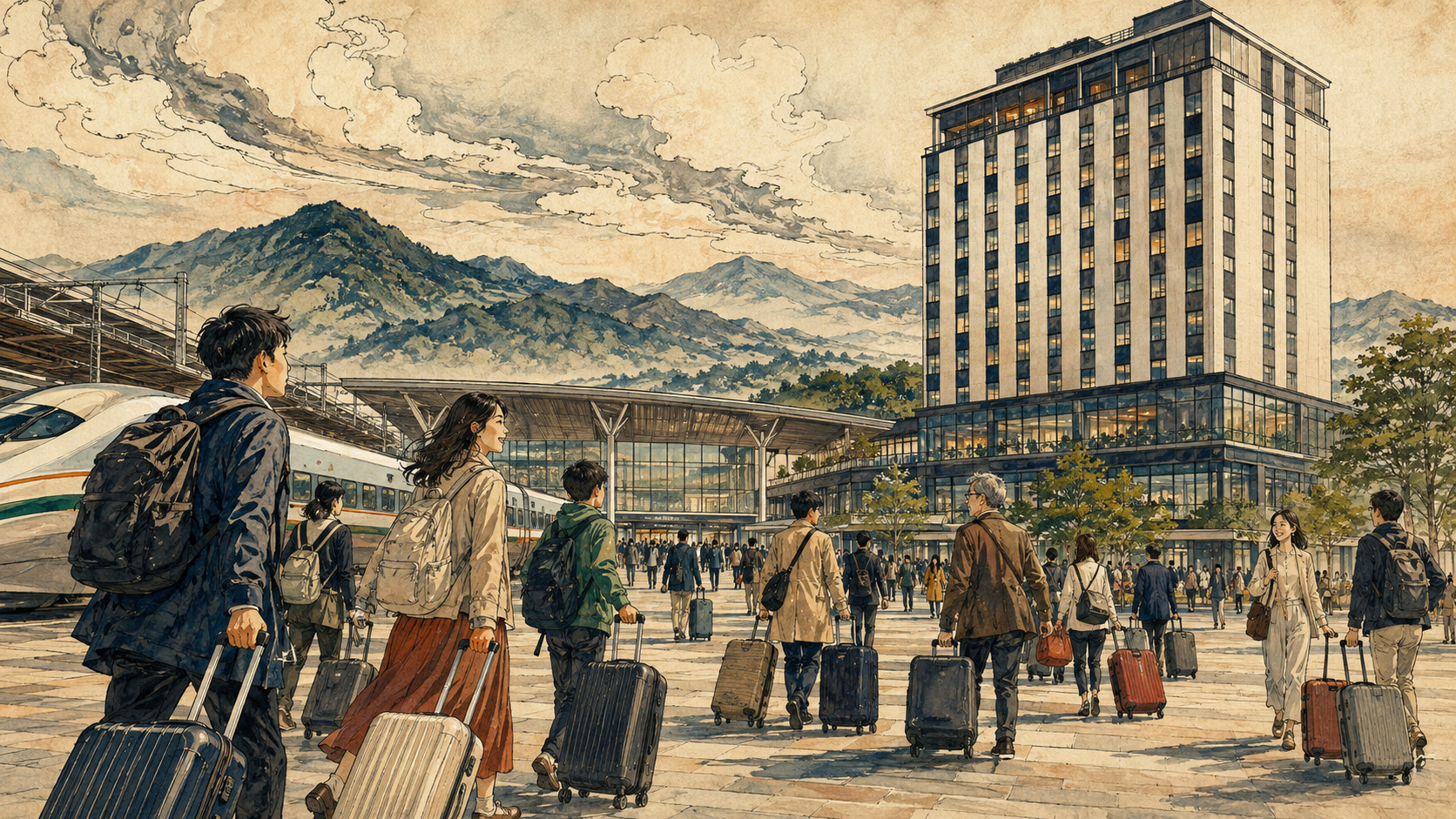
Four minutes on foot southeast of Yamagata Station, a new 12-story hotel is planned for Saiwai-chō in the spring of 2028. It would have 198 rooms. Once operating for a full year, that inventory represents 72,270 available room-nights by simple arithmetic—enough to alter not only the station skyline but the competitive logic of a regional lodging market.
TKP Corporation announced the tentative APA Hotel Yamagata Ekimae on August 18. It will be TKP’s first hotel in Yamagata Prefecture. That “first” refers to TKP’s portfolio, not the APA brand’s first presence in the prefecture. Construction is scheduled to begin in October 2026, with completion in February 2028 and opening one month later. The name, timing and specifications remain plans rather than finished facts.
The easy story is a station hotel built to catch expanding inbound tourism and corporate travel. The data tells a more interesting—and more difficult—story. Foreign guest-nights in Yamagata are rising quickly, yet the overall lodging market has not returned to its 2019 volume. The 198 rooms are not simply being added to satisfy proven shortage. They are a wager that the composition and behavior of Yamagata’s 2028 visitor will be different.
Three roles behind one hotel
The structure differs from a fully owned and operated hotel in which one company controls the real estate, management and brand. TKP has signed a building lease with NOB Holdings of Higashine, Yamagata, and a franchise agreement with APA Hotel. In practical terms, the project combines a local real-estate counterparty, TKP’s operation and APA’s brand, reservation reach and operating system.
The site covers 1,149.81 square meters, with 4,481.05 square meters of total floor area in a 12-story steel building. Its 198 rooms will be weighted toward twins, and some will connect. A restaurant and large bath are planned, including an open-air natural hot-spring bath, an indoor bath and a sauna. If the business case were limited to solo travelers on short corporate trips, the group-room mix and bathing experience would be less central. The physical plan reveals the commercial hypothesis: families, friends and international groups must matter too.
TKP was founded in 2005 and grew from rental meeting rooms and flexible offices. It opened APA Hotel TKP Sapporo Ekimae in 2014 and has since made hotels and residential training a growth business. The company describes itself as APA Hotel’s largest franchisee. If the Yamagata project opens, TKP’s APA franchise portfolio is expected to reach 23 hotels and 4,091 rooms; all accommodation facilities operated by TKP would reach 35 properties and 4,922 rooms.
TKP’s meeting-room customers already buy corporate events, recruitment sessions and training. Accommodation can be sold around those uses through a related corporate network. The company points to food, semiconductor and precision-machinery clusters as sources of steady business travel in Yamagata. The operational question is whether weekday corporate demand can be layered with weekend and holiday tourism strongly enough to move 198 rooms through all seasons.
1901: the station put Yamagata on national time
Yamagata Station opened on April 11, 1901, when the Ōu South Line was extended from Kaminoyama to the prefectural capital. Before the railway, Yamagata was connected through a castle-town economy, safflower trade, mountain pilgrimage, agriculture and craft. The station imposed the shared clock of a national railway and concentrated the movement of people, products, mail, government and the military in one place.
The next decisive change arrived on July 1, 1992. The Yamagata Shinkansen created a one-seat journey between Tokyo and Yamagata. It was Japan’s first “mini-Shinkansen,” using converted standard-gauge track so Shinkansen trains could continue over a conventional railway corridor. The service was extended to Shinjō in 1999, and the new E8 series entered service in 2024.
1901 Yamagata Station opens with the extension of the Ōu South Line.
1992 The Yamagata Shinkansen opens between Tokyo and Yamagata.
1999 Shinkansen service extends north to Shinjō.
2001 Kajo Central opens as the centerpiece of west-side redevelopment.
2024 The E8 series begins Yamagata Shinkansen service.
2028 The tentative APA Hotel Yamagata Ekimae is scheduled to open.
The Shinkansen altered more than travel time. Yamagata City’s central-area plan says its arrival triggered redevelopment of the station and the west side, making the station the starting point of an urban axis with concentrated public and commercial functions. Kajo Central, built within a 29.9-hectare redevelopment of former railway yards and industrial land, opened on January 1, 2001, linked to the station by underground and second-floor passages.
Yet the same city plan records the hollowing of the center as suburban development, car dependence and large outlying stores drew activity away. A convenient station does not automatically produce lively sidewalks. Rail can deliver a traveler, but local sales do not rise if that traveler simply transfers to the next destination.
Yamagata Station is already an effective entrance. The next task is to turn that entrance into a reason to stay—and then a reason to add another night.
Foreign growth inside an incomplete recovery
Japan Tourism Agency final data show 4,739,560 guest-nights in Yamagata Prefecture in 2025, down 2.8% from the previous year and 14.9% below 2019. Japanese guest-nights totaled 4,427,000, 17.1% below 2019. Foreign guest-nights moved in the opposite direction: 312,560, up 22.0% year on year and 33.5% above 2019.
| Yamagata Prefecture, 2025 | Guest-nights / rate | Year on year | Versus 2019 |
|---|---|---|---|
| Total guest-nights | 4,739,560 | −2.8% | −14.9% |
| Japanese guest-nights | 4,427,000 | −4.2% | −17.1% |
| Foreign guest-nights | 312,560 | +22.0% | +33.5% |
| All-property room occupancy | 50.3% | +1.0 point | −0.9 point |
| Business-hotel occupancy | 69.0% | — | — |
The foreign segment is growing rapidly, but it represented only about 6.6% of Yamagata’s guest-nights in 2025. Nationally, foreign travelers accounted for 27.2%. A straight-line claim that inbound growth alone requires 198 new rooms is therefore incomplete. The project needs foreign growth to continue, domestic erosion to stabilize, and business and leisure seasons to complement one another.
There is room to build that market. Yamagata Prefecture’s third tourism plan, covering fiscal 2025 through 2029, seeks demand from Taiwan, China and South Korea while expanding promotion in Hong Kong, Southeast Asia, Europe, the United States and Australia. It emphasizes higher-value tourism, longer stays and digital modernization. Yamagata City separated an Inbound Promotion Office from its tourism strategy division in April 2024. For fiscal 2027, the city is targeting 3.523 million visitor arrivals and an estimated ¥33 billion in tourism spending, with routes designed to increase both time in the region and overnight stays.
Zao, Yamadera and Ginzan: the strength and weakness of a gateway
Yamagata Station serves more than the city bearing its name. The Senzan Line runs toward Yamadera and its hillside temple complex. Buses leave for Zao Onsen and the snow monsters. A Shinkansen journey north to Ōishida connects with the route to Ginzan Onsen. Cherry blossoms, the Hanagasa Festival, autumn food and foliage, and winter snow provide different reasons to travel across the year.
But “gateway” can be a dangerous compliment. Gateways are easy to pass through. A visitor sleeping in Zao or Ginzan, taking a day trip to Yamadera from Sendai, or collecting a rental car for a circuit around the prefecture does not necessarily need a room beside Yamagata Station. For the hotel to broaden the local economy, the station district must sell more than onward transportation: dinner, sake, shopping, museums, a morning walk and an intelligible plan for the next day.
- Walkability: clear multilingual routes from the station and hotel to restaurants, Kajo Park and Nanokamachi.
- Evening and morning: local offers that can be used after arrival and before departure.
- Secondary transport: integrated train, bus and luggage information for Zao, Yamadera and the Ginzan corridor.
- Local procurement: food, drink, cleaning, repairs and experiences purchased from nearby businesses.
- Low seasons: corporate training, sports and cultural events that fill weekday and seasonal gaps.
The large bath fits this strategy in two ways. An open-air bath, indoor bath and sauna create a shared experience beyond the room and can make a station property more attractive to groups and longer-stay guests. But a hotel that captures meals and leisure entirely inside the building can also reduce spending in the surrounding streets. Hotel success and neighborhood success are not automatically the same outcome.
Competition and the labor constraint
Adding 198 rooms will affect rates, recruitment and purchasing for existing hotels. A recognized brand can create new demand and enlarge the market. If demand fails to grow, it can merely redistribute guests from existing properties. Yamagata’s 50.3% all-property occupancy rate in 2025 does not describe a market that is full every night. The 69.0% rate for business hotels is stronger, however, and more relevant to station and corporate demand.
The harder supply constraint may be people. The prefecture’s tourism plan calls labor shortages severe and treats workforce development and digital efficiency as urgent. A hotel needs front-desk staff, cleaners, breakfast crews, maintenance and overnight response every day. TKP has not announced hiring numbers or employment terms. If the new property raises wages and creates durable work, that becomes part of its regional impact. If it intensifies competition for workers already needed by inns and restaurants, the effect will be more complicated.
Environmental performance also extends beyond a brand promise of efficient design. Construction materials, energy for baths, water, linen, food waste and guests’ onward transport all shape the operating footprint. A 2028 hotel should be measured not only by rooms sold but by the resources required per occupied room and the value that remains locally.
The numbers to watch in 2028
After opening, the useful evidence will go beyond a launch-day crowd or online review score: average daily rate, occupancy, the weekday-weekend gap, foreign share, length of stay, local procurement, local jobs, referrals to surrounding restaurants and performance in low seasons. Only then will it become clear whether the 198 rooms expanded Yamagata’s market or divided demand that was already there.
Yamagata Station joined the city to a national railway network 127 years before the proposed hotel opening. Thirty-six years before it, the Shinkansen shortened the distance to Tokyo. The 2001 west-side redevelopment stacked new urban functions around the tracks. The next challenge is not speed or height. It is converting a visitor’s arriving time into time lived in Yamagata.
If the plan holds, 198 sets of windows will light up in March 2028. Those lights will indicate more than the performance of one hotel. They will offer a running measure of whether Yamagata can become not simply a place people come to see, but a place they stay long enough to know.
Project summary
| Name | APA Hotel Yamagata Ekimae (tentative) |
|---|---|
| Address | 6-6 Saiwai-chō, Yamagata City, Yamagata Prefecture |
| Access | Four minutes on foot from Yamagata Station on the Yamagata Shinkansen and Ōu Main Line |
| Scale | 12-story steel structure; 1,149.81 m² site; 4,481.05 m² total floor area |
| Rooms | 198, weighted toward twins, with some connecting rooms |
| Facilities | Restaurant and large bath planned with a natural hot-spring open-air bath, indoor bath and sauna |
| Schedule | Construction planned for October 2026; completion February 2028; opening March 2028 |
| Structure | TKP plans to operate under a building lease with NOB Holdings and an APA Hotel franchise agreement |
- TKP announcement: first Yamagata hotel planned for March 2028 (Japanese)
- Japan Tourism Agency, 2025 Accommodation Survey final results (PDF, Japanese)
- Yamagata railway portal: chronology of the Ōu Main Line (Japanese)
- Yamagata City central-area revitalization plan (PDF, Japanese)
- Kajo Central: history and station connection (Japanese)
- Yamagata Prefecture, Third Tourism Plan (Japanese)
- Yamagata City Inbound Promotion Office (Japanese)
- Yamagata City tourism targets and fiscal 2025 measures (PDF, Japanese)
- Yamagata Prefecture guide to manufacturing clusters (PDF, Japanese)
- Yamagata Prefecture: the Japan Heritage story of Yamadera and safflower culture (Japanese)
Editor’s note: Occupancy figures are prefecture-wide statistics by property type; they are not forecasts for the station district or this hotel. The foreign-guest share was calculated from published totals. The exchange rate shown above was supplied by the publisher.