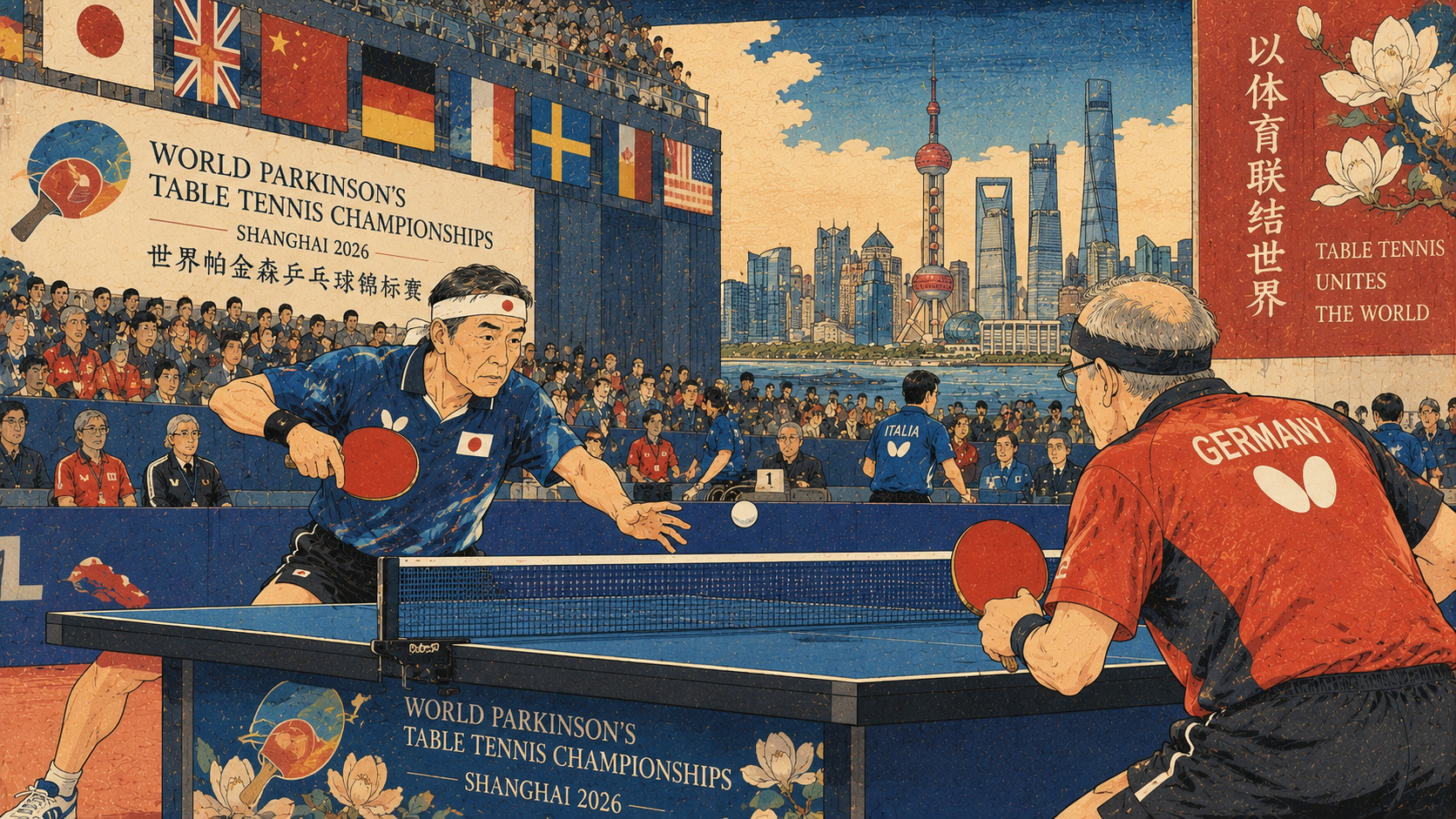
At the table, they are competitors first. Japan’s players are on the official score sheets.
A world championship with more than one kind of victory
At Shanghai Jiao Tong University this week, competitors living with Parkinson’s disease have been playing for points, games and places in a world championship. The event is neither a demonstration match nor an invitation to pity. The ITTF Foundation’s World Parkinson’s Table Tennis Championships forms part of a larger festival involving an Alzheimer’s championship and a public-facing health congress. The sporting contest runs October 21–25, after an October 20 opening ceremony. Crucially for readers in Japan, official match records establish that Japanese players are taking part.
The Japanese competitors are not hypothetical
The ITTF results database identifies Yasuhiko Fuke in men’s singles Class 1, Mayumi Kanie in women’s singles Class 1, and Hiroko Tobita in women’s singles Class 3, each marked JPN. Their names appear here as rendered in the international sporting records; the available Japanese association listing does not establish official kanji spellings or personal biographies. That distinction matters. Coverage should not manufacture careers, diagnoses or quotations merely because the competitors make an appealing human-interest narrative.
Two wins on the official score sheet
On October 21, Fuke defeated American Ljubomir Medenica by three games to none in his Class 1 group. He also beat China’s Zhao Liping 3–0. A third result against Sweden’s Torbjörn Lidström is recorded as a walkover, not a played match; it must not be characterized as a third on-court sweep. These are modest details only in appearance. They show exactly what an independent sports report should do: give the players their competitive due, while refusing to use results as evidence of any change in medical condition.
227 registrations, and an important distinction about countries
The foundation’s September 15 registration update counted 227 players living with Parkinson’s or Alzheimer’s, from 24 countries and territories, with 119 registered from China and 108 from elsewhere. The opening ceremony release referred to people from 33 countries and territories, a broader attendance population that included guests beyond registered athletes. Treating these two totals as directly comparable would mislead readers. The player roster included 103 women and 124 men. There is a story about inclusion in these numbers, but also an opportunity to ask who has the resources and support to travel internationally.
From a New York idea to an Asian championship
The first world Parkinson’s championship took place in Pleasantville, New York, in 2019. The ITTF Foundation says 62 participants from 12 countries attended that pioneering edition, developed with Ping Pong Parkinson and the efforts of Croatian-born musician Nenad Bach. Japan has been part of the movement for years: an ITTF announcement ahead of that inaugural tournament reported seven intended Japanese entrants, four men and three women. Shanghai is therefore the latest chapter of a longer international connection rather than the beginning of Japan’s involvement.
Why Shanghai matters
For its 2026 edition the broader World Table Tennis for Health Festival has crossed into Asia for the first time. It arrives in China, a country with an immense table-tennis culture, during the ITTF’s centenary year. The opening festivities included community activities and a plan to donate tables after the event to local health and recreation organizations. That legacy is potentially more consequential than the ceremony itself: equipment and qualified coaches can make participation possible on ordinary weekdays long after visiting competitors have returned home.
Sporting classifications are not labels for a person
Competitors play in functional classes intended to improve fairness. The inaugural tournament described Class 1 as involving greater Parkinson’s-related impairment and Class 3 as less. The existence of classes must not be confused with a complete clinical portrait of any individual. Two people in the same competitive class need not share the same everyday capabilities, health history or care requirements. The tournament offers singles and doubles formats, including mixed doubles, and athletes must adapt tactically to opponents within the relevant event structure.
The medical evidence: promising participation, not a cure
Table tennis challenges timing, gaze shifts, hand-eye coordination, posture and decision-making. Participants frequently describe its social appeal. There is credible evidence for physical activity and rehabilitation in Parkinson’s care: the World Health Organization points to physiotherapy and training that can support functioning and quality of life, and a clinical practice guideline supports aerobic, resistance and balance exercise. But a world tournament is not a randomized clinical trial. It does not prove that table tennis stops neurodegeneration, replaces medication or works equally well for everyone. Medical claims need a different level of evidence from sporting claims.
Competition, without the sentimental shortcut
Too often coverage of disability or chronic illness asks athletes to serve as symbols of inspiration before acknowledging them as competitors. The Shanghai results instead show opponents with names, tactics, close matches, decisive serves and forfeits. The preparation required to travel across borders can be substantial, and the foundation has explicitly discussed the planning involved in managing journeys and medication schedules. That context is real; personal details about any particular Japanese entrant would still require direct interviews.
Building something after the medals
A pre-festival camp on October 17–18 brought 46 players together, according to organizers. The accompanying October 23–24 congress connects scientists, clinicians, organizers and players around the wider questions of health and inclusion. For Japan, there is a practical policy question: can local clubs, municipal recreation centers and support organizations create accessible opportunities for ordinary people with Parkinson’s, not only for those who can enter an international championship? It involves trained instructors, transport, cost and accessible scheduling as much as sporting ambition.
A reporting cutoff, not a manufactured finale
The Japan Table Tennis Association distinguishes the competition dates, October 21–25, from October 26, listed as departure day. The present feature uses the verified match records available during reporting on October 24; it does not supply invented champions or claim a final Japanese medal total. An edition published on October 26 should update its results from the official ITTF bracket once every final has been certified.
A small ball, a bigger public conversation
The most enduring contribution of this championship may be its insistence that people with Parkinson’s belong in competitive sport as participants with goals of their own. For Fuke, Kanie, Tobita and the other athletes named in the official records, the story begins with the same fundamental questions asked of any player: who did they face, how did they play, and what happens next? Accuracy is a form of respect.
Sources and reporting notes
Reporting checked through October 24, 2026. Some women’s match rows show incomplete score fields; no results are inferred. Official Japanese-script spellings have not been independently established.
- ITTF Foundation — official Shanghai tournament
- ITTF — official 2026 match records
- 日本卓球協会 — 2026世界パーキンソン卓球選手権大会
- ITTF Foundation — 227 registered athletes, Sept. 15
- ITTF Foundation — opening ceremony, Oct. 20
- ITTF — Japan at the first championship, 2019
- ITTF Foundation — inaugural championship history
- World Health Organization — Parkinson disease
- American Physical Therapy Association — clinical guideline
- ITTF Foundation — training camp Oct. 17