- A ship under an unfamiliar flag
- The Kuniyoshi pupil who crossed artistic boundaries
- The American ship: an old highway sees a new ocean
- London in three sheets
- One subject, more than one museum record
- Why Japanese people wanted pictures of foreign places
- A print was a collaboration—and a business
- How to read the pair without mistaking art for evidence
- The legacy of depicting change
A ship under an unfamiliar flag
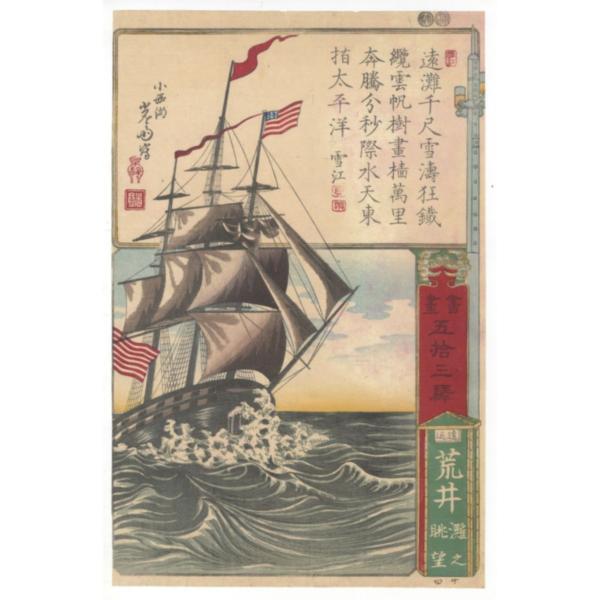
A three-masted vessel shoulders into a choppy sea. Above its sails a flag moves in the wind; below, the surf breaks into sharply cut waves. The object looks like a straightforward picture of maritime travel, until one notices how the print makes the ship seem to advance from the world beyond Japan and into the viewer’s own space. The sea becomes both a physical barrier and a means of contact.
This is Utagawa Yoshimori’s An American Sailing Ship off Arai, dated October 1872 in the collection of New York’s Metropolitan Museum of Art. Just one month earlier, the artist produced an expansive, three-sheet vision of London: a river crossed by a crowded bridge, a dense urban skyline and a sky alive with color. Both prints belong to the opening years of the Meiji era, when the foreign world was no longer an abstract rumor but a question of national consequence.
For JAPAN.co.jp’s November 23 Art Choice, the two works provide a rare pairing. The vessel at Arai tells a story of the world arriving at Japan’s edge. The view of London imagines what lay at the other end of those routes. Neither print is best understood as a neutral photograph of its subject. They are commercial images made to help nineteenth-century Japanese viewers give shape to profound change.
The Kuniyoshi pupil who crossed artistic boundaries
Yoshimori, written 歌川芳盛 and read Utagawa Yoshimori, was born in 1830. Japan’s National Diet Library lists his death in 1884, as does the Metropolitan Museum. Other Japanese museum records use 1885. The disagreement deserves acknowledgment: dates attached to artists of this period are not always consistent across collection catalogs.
He trained under Utagawa Kuniyoshi, one of Edo’s most inventive print designers. Kuniyoshi’s reputation rested on dramatic warrior pictures, caricature, playful visual distortions and an ability to set figures in motion. His artistic circle produced designers whose skills could serve changing fashions in popular print. Yoshimori’s work ranged from warrior imagery and pictures of nature to illustrated books and prints concerned with foreigners.
The last category became especially consequential in the years surrounding the opening of Yokohama. Prints of foreign ships, visitors and buildings were a way for a popular visual culture to respond almost immediately to shifts in trade and diplomacy. An artist did not have to abandon the woodblock medium to portray a radically new subject. The old printing system was flexible enough to carry news about a newly connected world.
The American ship: an old highway sees a new ocean
The Met catalogs the American vessel as an October 1872 color woodblock print on paper, measuring 36.2 by 24.1 centimeters in the image area. Its accession number is 2007.49.243, part of the William S. Lieberman bequest. The ship is square-rigged and three-masted, with American flags clearly visible. Yoshimori gives the rigging particular attention, creating a convincing vocabulary of lines and angles.
The Japanese title associated with this subject refers to Arai, a station on the historic Tōkaidō road in what is now Shizuoka Prefecture. A 2026 exhibition checklist from the Tokyo Fuji Art Museum lists Yoshimori’s 1872 design as 書画五拾三駅 遠江 荒井 潮之眺望, linking it to a wider series that revisited the celebrated stations of the old route. This matters: a conventional subject from Edo travel culture becomes a stage for an American ocean-going vessel.
The print does not document a named ship’s confirmed passage on a particular day. It offers no independently established vessel identity, coordinates or sailing log. That should not diminish its historical usefulness. It tells us how an artist and publisher chose to represent foreign mobility to Japanese readers. A familiar place name carried an unfamiliar symbol of maritime commerce.
London in three sheets
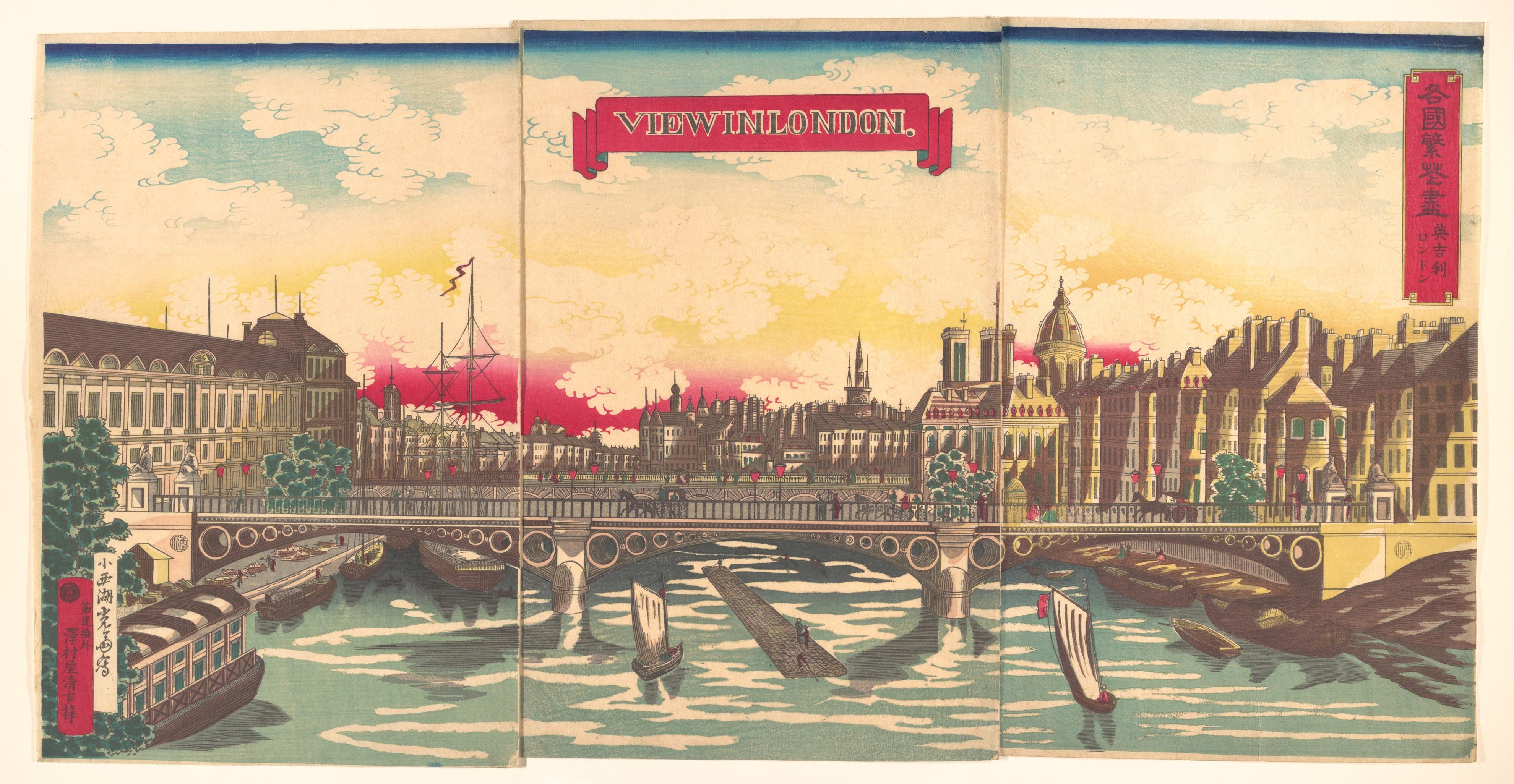
The second work is cataloged by the Met as “View in London,” the Prosperity of Countries: London, England, made in September 1872. It is a triptych, three separate sheets designed to be viewed as one panorama. The museum identifies it as accession number 2007.49.242a–c, also from the Lieberman bequest, and marks it public domain.
Where the ship print concentrates force within a narrow vertical format, London opens outward. The bridge stretches across the three sheets, dividing the waterfront from a city of towers, long facades and crowded rooftops. Small craft interrupt the broad surface of the river. The sky, notably, is no passive background: warm color moves toward a vivid red band on the horizon, turning a distant capital into an almost theatrical landscape.
The Roman-letter headline “VIEW IN LONDON” coexists with the Japanese written title and conventional publisher’s cartouches. It is a telling visual hybrid. The print is a Japanese publishing product presenting the imagined prosperity of a British city. It should not be treated as a precise topographical record, and no surviving evidence reviewed here establishes that Yoshimori personally visited London. The original European image or images he may have consulted have not been conclusively identified for this feature.
One subject, more than one museum record
An important curatorial complication deserves space beside the London image. The Metropolitan Museum dates its triptych to September 1872 and attributes it to Yoshimori. Japan’s Cultural Heritage Online, drawing on the Kobe City Museum collection, has a related record titled 各国繁花尽 英吉利ロンドン that gives the year as 1873. Its attribution is qualified as probably by Yoshimori, with the alternate name Konishi Kōsai.
The records should not be flattened into a single supposedly certain date. Without an impression-by-impression study, we cannot establish whether the holdings reflect differences in printed states, publication dating, cataloging practice or another feature of their provenance. The two JPG files selected for JAPAN.co.jp correspond to the compositions cataloged by the Met, so our captions follow its September 1872 and October 1872 dates.
Such uncertainty is part of responsible art history, not a flaw to edit away. A later impression can differ from an earlier one in coloration or line quality. A publisher’s mark, censorship seal, title variant or collector’s documentation can change how scholars describe a sheet. Digital reproductions make global comparison easier but do not substitute for inspecting the actual objects.
Why Japanese people wanted pictures of foreign places
In 1853 Commodore Matthew Perry’s ships arrived in Japan; the commercial treaties of the late 1850s and the opening of Yokohama in 1859 placed foreign people and goods directly within Japanese visual experience. The Meiji Restoration of 1868 accelerated a period of institutional and social transformation. By the time Yoshimori made these prints in 1872, the foreign ship had become more than a curiosity. It represented a challenge in technology, commerce and national identity.
Yokohama-e, the popular woodblock images of the port and its foreign inhabitants, answered a public appetite for seeing what had previously been remote or inaccessible. Costumes, animals, streets and vessels filled sheets intended for a broad audience. But visual confidence should not be mistaken for eyewitness accuracy. Artists combined observation, imported pictures, published descriptions and imaginative reconstruction in varying degrees.
London prints were especially potent. They offered scenes of urban concentration, bridges and built infrastructure that viewers could understand within the familiar language of Japanese color woodblocks. Another Kuniyoshi pupil, Utagawa Yoshitora, made a different London triptych in 1866, held by the Met. That is a separate artwork by a separate artist—not the Yoshimori triptych shown here—and its existence places Yoshimori in a much broader market for pictures of overseas cities.
A print was a collaboration—and a business
The term ukiyo-e can suggest the signature of a single famous artist, but color woodblock printing relied on a network of labor. The designer established the composition. A carver translated its outlines into a key block and prepared additional blocks. Printers registered colors on paper; publishers commissioned, financed and marketed the edition. In a fast-changing society, their collective commercial judgment determined what visual stories would reach the street.
The London triptych demonstrates the complexity of that work. An architectural bridge must run continuously across three sheets, while the river surface and the atmospheric changes in the sky must create the sense of one scene. Each sheet was printed separately. The design’s unity could be disrupted by misregistration, fading or variation in later printings.
The Arai print asks for a different type of control. In a single vertical sheet, ropes, masts and sails become a sharp network of diagonals. Yoshimori does not need an actual mechanical diagram to persuade a viewer that a large ship moves under wind power. The image balances a recognizable technological object with the expressive economy of woodblock art.
How to read the pair without mistaking art for evidence
Start with the ship’s flags and motion. It is a vessel being displayed as foreign and active, rather than a static object in harbor. Wave crests break rhythmically against the hull. The upper poem and the vertical title panels frame the ship as a subject worthy of both description and visual excitement.
Now look at London’s bridge. It performs the compositional work that the rigging does in the ship print: a set of prominent lines organizing attention. The bridge leads across a busy river and into a city represented as dense and prosperous. The skyline and watercraft convey the scale of a global metropolis even as the image departs from modern standards of geographic exactitude.
The pairing suggests two routes by which the outside world entered the imagination of early Meiji Japan. One was physical, through foreign vessels arriving at Japanese waters. Another was representational, through printed and spoken accounts of distant places. Yoshimori’s art sits in the productive space between what could be witnessed and what had to be pictured.
The legacy of depicting change
Why choose this artist for a November 2026 news edition about robotics, science, public transportation, heritage and a Japanese sailor preparing to cross the Pacific? Because the problem facing today’s illustrators is not altogether new. When technology changes quickly, audiences need visual forms that make the unfamiliar legible without turning speculation into fact.
Yoshimori did not design robots or satellite instruments. The contemporary illustrations appearing elsewhere in this JAPAN.co.jp edition are newly made editorial images inspired by his bold contours and dynamic compositions, and must be labeled as such. The ship and London pictures in this feature are historical Yoshimori works reproduced from public-domain museum images. The distinction between original artwork and modern interpretation is essential.
The American ship and London river scene were made more than 150 years ago, but their central question remains familiar: how do people understand a changing world through the images available to them? The prints are not perfectly transparent windows on 1872. They reveal something more intriguing—the decisions made by a Japanese artist and publishing culture about how the unknown should look.
Sources, collections and research limitations
Captions follow the Metropolitan Museum’s catalog records for the two illustrated objects. Biographical and Japanese-title checks use the National Diet Library, Cultural Heritage Online, Tokyo Fuji Art Museum and print scholarship. We did not physically inspect impressions, authenticate seals independently or identify the precise European source image for the London composition.
- The Metropolitan Museum of Art: An American Sailing Ship off Arai (1872)
- The Metropolitan Museum of Art: View in London (1872)
- 文化遺産オンライン・神戸市立博物館:「各国繁花尽 英吉利ロンドン」
- 国立国会図書館典拠:歌川芳盛(初世)
- 文化遺産オンライン:「書画五拾三駅 武蔵神奈川横浜眺望」
- 東京富士美術館:明治の浮世絵関連出品目録
- University of Oregon, Lavenberg Collection: Utagawa Yoshimori
- 文化遺産オンライン:歌川芳盛の作品一覧
- The Metropolitan Museum of Art: Yoshitora’s separate London image (1866)